

Short answer: This article explains the key facts, eligibility issues, settlement factors, deadlines, and source-backed updates related to this legal topic. Results vary by case facts, evidence, jurisdiction, and representation.
How to Find a Disability Lawyer Before Deadlines Run Out
📋 Table of Contents
- Why You Need to Find a Disability Lawyer Before It’s Too Late
- Understanding Disability Claim Types and Eligibility
- How to Find Disability Lawyer Experts for Your Case
- Legal Fees, Costs, and the Contingency Model
- The Role of a Lawyer in the Appeals Process
- Frequently Asked Questions about Finding a Disability Lawyer
- Conclusion
Wondering how to find a disability lawyer? These are the best places to begin:
- Your state or provincial bar association – Many run free referral programs that match you with licensed attorneys in this field
- Personal referrals – Ask your doctor, a lawyer you already know, or people who have been through a disability claim
- Legal aid offices – If your income qualifies, you may get help for free or at reduced cost
- Free case reviews – Most disability attorneys will meet with you at no charge and collect a fee only if you win
Disability claims are difficult to manage alone. The forms are complicated, the deadlines are unforgiving and a lot rides on the result — possibly your income and long-term financial stability. The hard truth is that first-time disability applications are usually denied. Insurers run for profit, and they expect many people to quit after a rejection; without a lawyer, plenty of claimants do. The encouraging part: disability attorneys generally work on contingency, so there are no upfront fees. For Social Security claims, the fee is limited to 25% of past-due benefits or a dollar cap set by the SSA, whichever is smaller (the cap was $6,000 for many years and, as of this update, is $9,200 for favorable decisions made on or after November 30, 2024). If you do not win, you do not pay. Claimants with representation tend to fare better in winning benefits — a pattern repeatedly observed across large numbers of cases rather than a marketing line. Whether this is your first application or you are challenging a denial, the right disability lawyer can mean the difference between approval and years of money trouble. My name is Mason Arnao. Through my work in internet marketing, SEO and lead generation in the legal space, I have helped many thousands of people research attorneys and get connected with qualified ones — including people trying to find a disability lawyer who suits their circumstances. Below, I explain step by step how to locate, screen and hire the right disability attorney for your claim.
Key terms when you find a disability lawyer:
Types of Disability Claims and Who Qualifies
Before you start searching for a disability lawyer, get clear on which kind of claim you are bringing. “Disability” covers a lot of ground, and the legal route depends on who would be paying your benefits.

Social Security Disability Insurance (SSDI)
SSDI is the most widely used federal disability program in the U.S. It works like insurance funded by the FICA taxes taken from your paychecks. To qualify, you need enough recent work history to have built up adequate “work credits” — essentially coverage you have been paying for throughout your career. Our Social Security Disability Insurance Complete Guide covers it in depth.
Supplemental Security Income (SSI)
SSI works differently from SSDI because it is based on financial need. Work history is irrelevant; you qualify by having little income and few assets. The program serves people who are older, blind or disabled and have almost no financial safety net.
Long-Term Disability (LTD)
LTD coverage typically comes through an employer or a policy you bought yourself. These claims fall under contract law and, in many cases, the federal ERISA statute. One of the biggest obstacles is the switch from an “own occupation” standard to an “any occupation” standard.
- Own Occupation: You count as disabled when you cannot perform your particular job.
- Any Occupation: Typically after two years, the test gets tougher — you are considered disabled only if you cannot perform any job your education or experience reasonably fits you for.
The Numbers Behind Disability
The Canadian Survey on Disability, useful both for readers in Canada and as a broad benchmark, reports that 1 in 7 people have a disability — about 3.8 million people — and that 49% of disabled people aged 25–64 hold jobs. In other words, many people keep working through their conditions until they physically cannot. Whether your claim involves disability for PTSD or ongoing physical pain, the SSDI benefits qualifications are still demanding.
How to Find a Disability Lawyer Who Fits Your Case
Choosing a lawyer should involve more than calling the name on the nearest billboard. You want someone who knows the details of your condition and the local administrative law judges (ALJs) likely to hear your claim. As you look for the right disability lawyer, focus on three things:
- Familiarity with your condition: An attorney who handles many SSDI for cancer claims may approach a case differently than one who concentrates on SSDI for anxiety.
- Track Record: No honest lawyer promises a win (walk away from anyone who does), but they should be willing to talk about how their hearings tend to go.
- What Clients Say: Pay attention to comments about communication. Are calls returned? Are the SSDI application tips explained in plain terms?
Where to Look for a Qualified Disability Attorney
- State and Local Bar Associations: These groups keep lists of licensed lawyers and frequently offer referral programs to match you with a qualified attorney where you live.
- Legal Aid Clinics: For lower-income claimants, resources such as the Legal Aid Ontario legal clinic directory or comparable U.S. legal aid offices can be invaluable.
- Referrals From Professionals: Physicians and other lawyers often know which disability attorneys are respected for handling particular medical conditions.
How to Vet a Disability Lawyer Before You Hire
Feel free to run the first meeting like a job interview — you are the one doing the hiring.
- Who You Will Talk To: Will most of your contact be with the lawyer, or will a paralegal handle nearly every call?
- Workload: Is this a high-volume practice where you could become just a file number, or a smaller office offering hands-on disability claim assistance?
- Hearing Experience: Many disability claims are decided at the hearing. Look for an attorney comfortable standing before a judge and arguing your residual functional capacity.
Disability Lawyer Fees, Case Costs and Contingency Pay
Worry about large legal bills keeps many people from getting help, yet in disability law “no win, no fee” is the norm.
The Federal Limit on Fees
In Social Security cases (SSDI and SSI), federal rules tightly control what a lawyer may charge. The usual fee is 25% of your past-due benefits (backpay), up to the SSA’s dollar cap, whichever is lower. That cap was $6,000 for years; as of this update it is $9,200 for favorable decisions on or after November 30, 2024.
- Example: Win $20,000 in backpay and the fee is $5,000.
- Example: Win $40,000 in backpay and the fee stops at the cap rather than the full 25% ($10,000).
To get a rough idea of what your backpay could be, try our SSDI benefit calculator.
Administrative Expenses
Even with a contingency fee, you may owe certain out-of-pocket expenses, such as:
- Charges for copies of medical records.
- Mailing and photocopying.
- The lawyer’s travel to a hearing. Many offices pay these costs upfront and recover them from your award at the end, so ask for a clear explanation of how expenses are handled at your first meeting.
How a Disability Lawyer Helps With Appeals
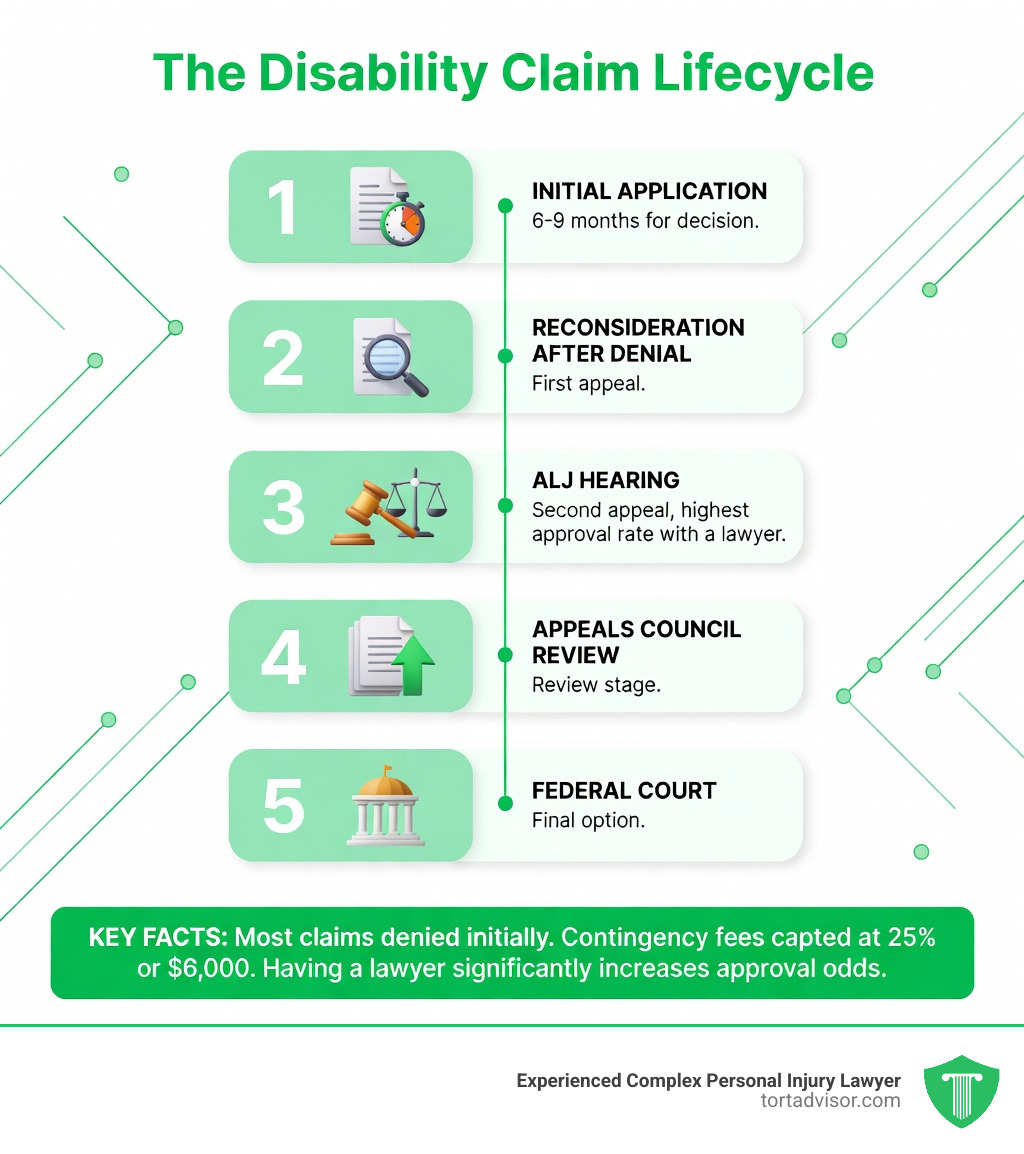
A denied first application is common, so try not to panic — most people are in the same position. This is the stage where a lawyer adds the most value, because the disability appeal process has several levels.
- Reconsideration: Someone who was not involved in the original decision reviews your whole file. Your lawyer can add evidence that was left out. See our SSDI reconsideration appeal guide for details.
- ALJ Hearing: Often your strongest opportunity. You go before an Administrative Law Judge, and your lawyer questions the vocational expert and makes sure the judge sees how your symptoms keep you from working.
- Appeals Council: After an unfavorable hearing decision, the Council can be asked to check the ruling for legal mistakes.
- Federal Court: The last option is filing a disability lawsuit in U.S. District Court.
A key part of the lawyer’s work is obtaining “Medical Source Statements” from your treating doctors. These detailed forms go well beyond a brief note — they convert a diagnosis into concrete functional limits, which is the language the SSA relies on.
FAQs: How to Find and Choose a Disability Lawyer
When should I start looking for a disability lawyer?
As early as possible. You can submit the first application on your own, but having a lawyer from the start helps make sure your disability claim forms are completed correctly and avoids small errors that can cause long delays. After a denial, you generally have just 60 days to appeal, so do not wait until the deadline is nearly up to find a disability lawyer.
How is a disability lawyer different from a disability advocate?
A lawyer has a law degree, has passed the bar exam and can take your claim all the way to Federal Court. An “advocate” or non-attorney representative may know the SSA process well but is not a licensed attorney. Some advocates do excellent work, yet they cannot file SSDI lawsuits once a case moves past the administrative stage.
Can a lawyer still help if my condition is not listed in the SSA “Blue Book”?
Absolutely. The “Blue Book” lists impairments severe enough to qualify on their own, but many people are approved based on their Residual Functional Capacity (RFC) instead — meaning the combined effect of symptoms, age and education rules out work even without a listed condition. Building an RFC-based claim is a core skill for disability attorneys. Review the SSDI eligibility rules to gauge where you stand.
Conclusion
Getting disability benefits can be a long, draining process tangled in red tape. Whether you are facing a denied disability claim or just beginning your disability benefits application, you do not need to handle it alone. Legal Lawsuit knows your health comes first. As a legal-information site, we help you understand the process and connect with experienced attorneys in our network who regularly take on the SSA and private insurers. A screened, knowledgeable advocate can push for the benefits and peace of mind you are owed. Don’t let a complicated system keep you from what you have earned — start with a free, confidential case review. Start your SSDI Lawsuit today
Related Posts
Quick Answer: The Boy Scouts of America (BSA) filed for Chapter 11 bankruptcy in 2020 after facing tens of thousands [...]
Quick Answer: Survivors of sexual abuse by Catholic priests, nuns, or other Church personnel may be able to file a [...]
Quick Answer: Clergy abuse settlements vary enormously based on the severity of the abuse, the strength of evidence that the [...]

