
Short answer: This article explains the key facts, eligibility issues, settlement factors, deadlines, and source-backed updates related to this legal topic. Results vary by case facts, evidence, jurisdiction, and representation.
📋 Table of Contents
- Understanding Your Work Abilities After a Disabling Injury
- What is Residual Functional Capacity (RFC)?
- The Comprehensive RFC Assessment Process
- How RFC Determines Your Disability Claim
- Strengthening Your Case: The Role of Your Doctor and Legal Counsel
- Frequently Asked Questions about Residual Functional Capacity
- Conclusion: Navigating Your Disability Claim with a Clear RFC
What Residual Functional Capacity Means for Your Ability to Work
Residual functional capacity (RFC) is how the Social Security Administration (SSA) measures what you are still able to do on the job despite physical or mental limitations. Rather than a medical diagnosis, it is an administrative judgment of the most work-related activity you can keep up on a regular, full-time basis (8 hours a day, 5 days a week), and the SSA, not your physician, has the final say.
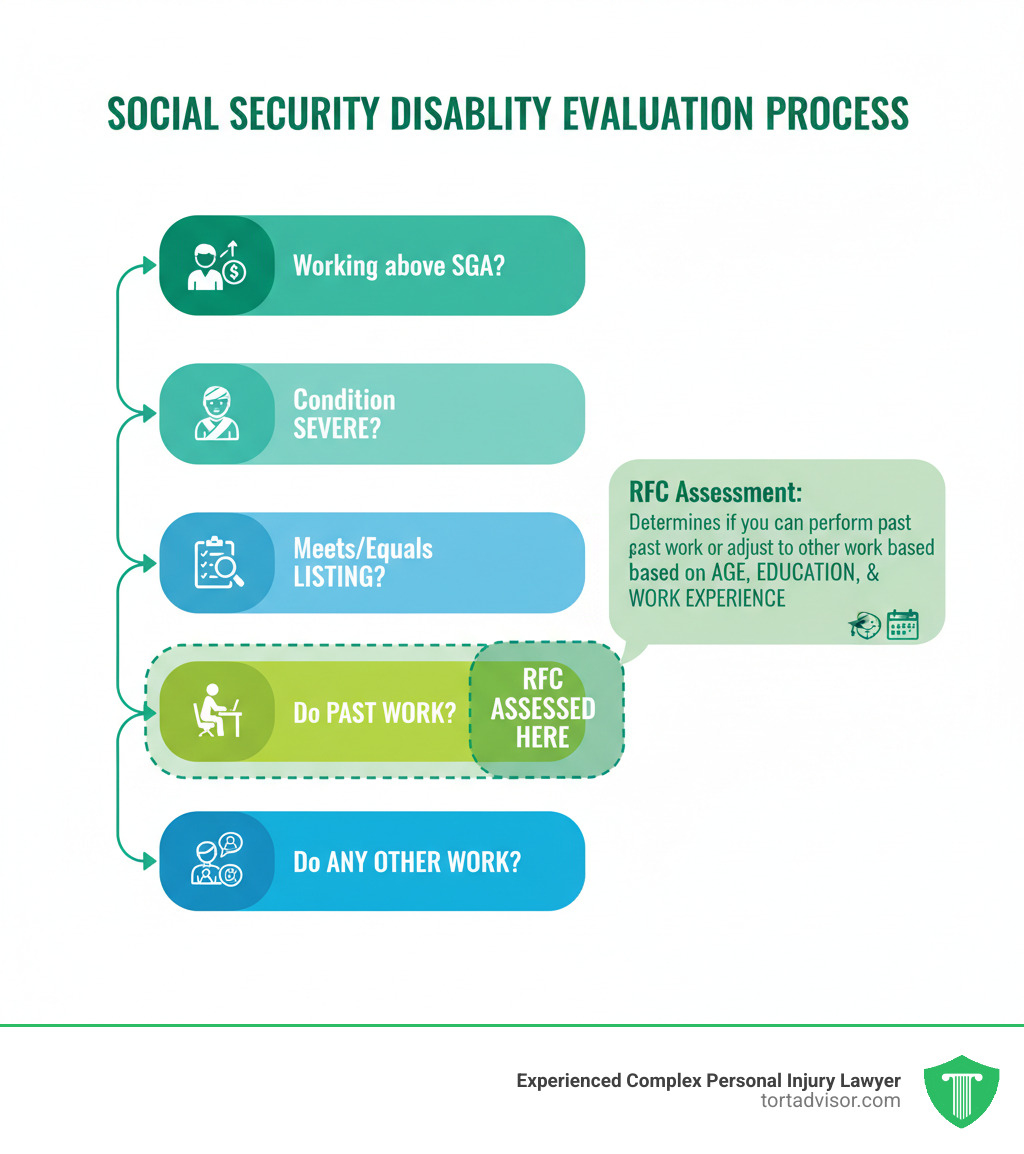
The RFC weighs every impairment and symptom you have, pain included, to gauge your physical and mental abilities. It matters so much because the SSA relies on it at steps 4 and 5 of the disability evaluation, where it often decides whether a claim is approved or denied.
When an injury keeps you from working, knowing how your RFC works is essential. The SSA looks at what you can still manage, from how much you can lift to how well you can focus and what environments you must avoid (such as dust or fumes).
SSA rules even point out that two people with the identical back condition may end up with different RFCs: one able to do medium work, the other limited by pain to light work.
I’m Mason Arnao. Years of working with complex data systems and regulatory frameworks give me a useful lens on how the SSA handles residual functional capacity assessments. This guide breaks the RFC process down so you know what the SSA evaluates and how to build a stronger claim.
Residual functional capacity terms explained:
- Denied Disability Claim
- Disability Claim Assistance
- How to Claim Social Security Disability Insurance Arkansas
Residual Functional Capacity (RFC) Defined
Residual functional capacity is the SSA’s detailed measure of your work abilities given your health conditions. Instead of a yes-or-no disability label, it looks at concrete capacities, such as whether you can lift 20 pounds or stay on your feet for six hours.
Central to the RFC is whether you can work on a sustained basis. The SSA asks whether you can keep up a full-time schedule of 8 hours a day, 5 days a week, not just manage on a good day. Its formal definition describes RFC as what a person “can still do despite their limitations,” with the focus on how impairments restrict work activity.

Importantly, the RFC is an administrative finding, not a diagnosis. Your doctor identifies your condition; the SSA decides how that condition affects your capacity to work. Your doctor’s opinion carries weight, but the SSA makes the final RFC call.
The SSA must account for the combined effect of every impairment, including ones that would not count as “severe” by themselves. Back pain plus migraines plus anxiety, for example, may rule out steady work even though none of them would alone. The agency has to consider how all of your health problems, minor ones included, add up to limit your ability to keep a job.
To read the official rule, see Your residual functional capacity in the SSA’s Code of Federal Regulations.
How the SSA Conducts an RFC Assessment
To determine your residual functional capacity, the SSA builds a full picture of what you can do at work, drawing on many sources: medical records such as diagnoses, treatment notes and test results, and, crucially, your doctors’ opinions.
The SSA also considers “lay evidence,” meaning statements from you, relatives and past employers that describe your limits in everyday terms. Your own account of your symptoms and daily routine is especially important because you live with the impairments every day.

With the evidence assembled, a claims examiner, often working with a medical consultant, reviews it to pin down your functional limits. They write a “narrative discussion” analyzing the evidence, addressing any inconsistencies and explaining how symptoms like pain or fatigue affect your ability to work over time. The assessment has to go function by function, stating exactly what you can do, such as how much weight you can lift, how long you can stand and whether you can concentrate.
Exertional Levels Explained
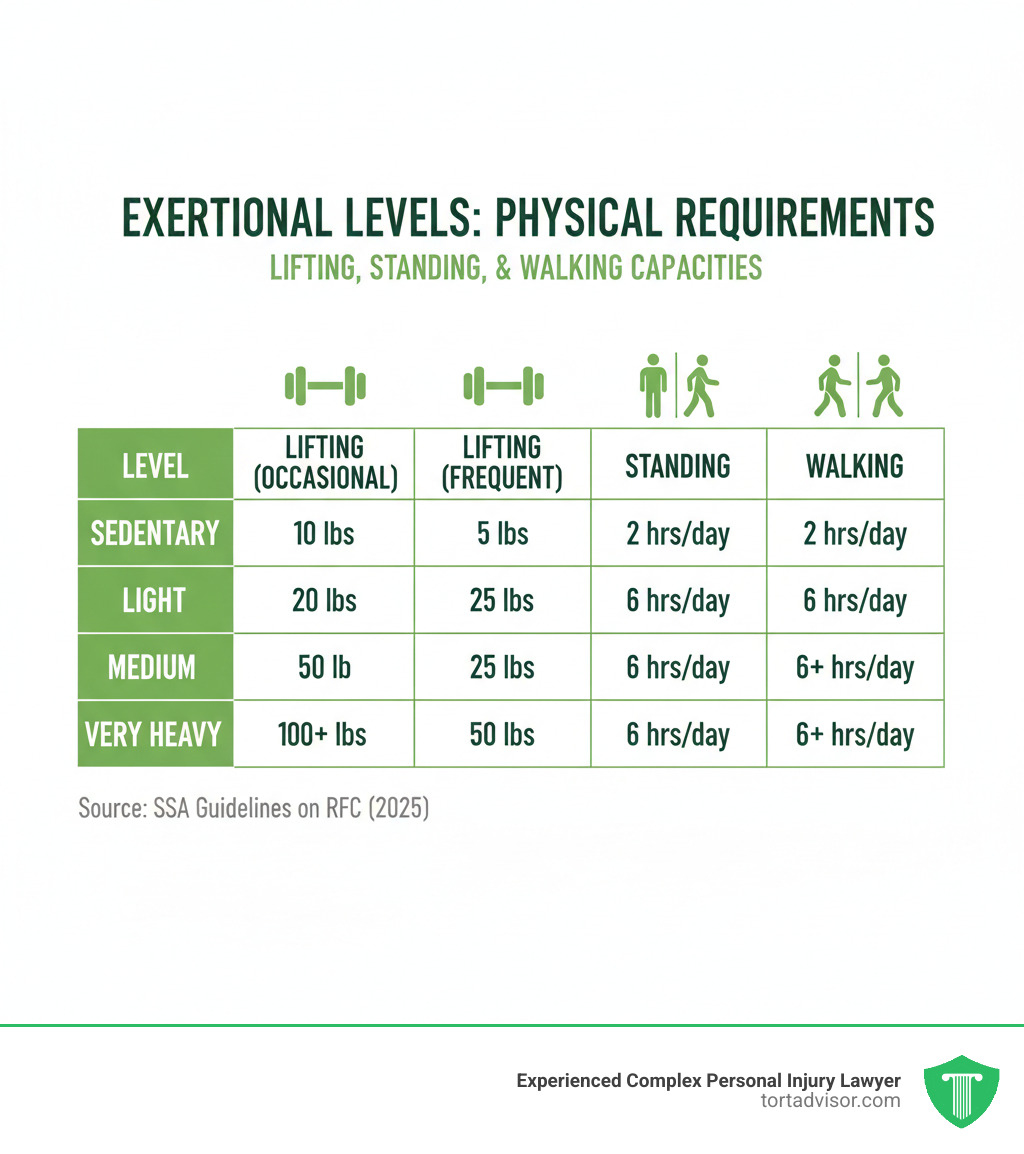
The SSA sorts physical ability into “exertional levels” based on how much strength jobs demand, and your RFC will be placed in one of them.
- Sedentary work: Lifting no more than 10 pounds, mostly seated, with standing or walking totaling no more than about 2 hours in an 8-hour day.
- Light work: Lifting up to 20 pounds now and then and 10 pounds often, with a good deal of standing or walking (up to around 6 hours a day).
- Medium work: Lifting up to 50 pounds now and then and 25 pounds often, with up to 6 hours of standing or walking.
- Heavy work: Lifting up to 100 pounds now and then and 50 pounds often.
- Very heavy work: Lifting more than 100 pounds now and then and more than 50 pounds often.
Your exertional level is key to deciding whether you can return to past jobs or switch to different work.
Non-Exertional and Environmental Limits
Strength is only part of the picture. The SSA also evaluates non-exertional limitations:
- Postural limits: Trouble bending, stooping, crouching, kneeling or climbing.
- Manipulative limits: Difficulty reaching, gripping objects or making fine finger movements, for example because of arthritis or carpal tunnel syndrome.
- Visual and communication limits: Problems seeing, hearing or speaking that affect job performance.
- Environmental limits: A need to stay away from certain conditions, like dust or fumes for people with asthma, loud noise for people with migraines, or hazardous machinery for people with epilepsy.
Each of these abilities factors into your residual functional capacity, and every limitation narrows the range of jobs you could perform.
How the SSA Assesses Mental Residual Functional Capacity
Mental and emotional functioning matters just as much. A mental residual functional capacity assessment looks at how mental health conditions affect your ability to function in a job.
The SSA focuses on four areas:
- Understanding and memory: Can you remember and carry out simple or detailed instructions?
- Concentration and persistence: Can you stay focused for long stretches, such as two hours at a time, and get through a normal workday?
- Social interaction: Can you deal appropriately with bosses, coworkers and the public?
- Adaptation: Can you cope with workplace stress and adjust to changes in a routine job?
Serious limits in these areas can greatly improve your odds of approval. If you could only work in complete isolation, or would miss more than one day a month, for example, you may be found disabled. If a Denied Disability Claim involved a mental health condition, a thorough mental RFC is often the key to winning on appeal.
How Pain and Other Symptoms Factor In
Judging subjective symptoms such as pain, fatigue and dizziness is one of the hardest yet most important parts of an RFC assessment, because these symptoms can be disabling even when tests don’t show them.
The SSA has to consider how the symptoms you report limit sustained work activity, and consistency is what counts. The agency looks for a coherent picture across your medical records, your doctor’s reports, the treatment you’ve been prescribed and your own description of daily life.
The better your reported symptoms line up with the objective evidence, the more they will count in your RFC. Don’t minimize your pain or other symptoms, since those details can decide your claim. For more background, see resources like Information on chronic pain from MedlinePlus.
How Your RFC Decides Your Disability Claim
Your residual functional capacity is the hinge of your claim, used at two critical points, Steps 4 and 5 of the SSA’s evaluation. Once the SSA finds a severe impairment that does not meet a listing, it turns to your RFC to decide whether you can still work.
Step 4: Can You Still Do Your Past Work?
At Step 4, the SSA measures your residual functional capacity against the demands of your “past relevant work.” Under a 2024 rule change the agency now generally looks back five years (it used to be 15). It considers both how you did the job and how it is usually done across the country. If your RFC shows you can still handle past work either way, the claim is denied; if your limits rule out your former jobs, the claim moves to Step 5.
If you are curious about possible benefit amounts, the SSDI Benefit Calculator can help with planning.
Step 5: Can You Do Any Other Job?
At Step 5, the SSA asks whether you could do any other work that exists in the national economy, combining your RFC with your age, education and work history and applying the Medical-Vocational Grid Rules, known as “the Grids.”
The Grids recognize that older people with less education and skills that don’t transfer have a harder time moving into new kinds of work. A 55-year-old construction worker with a high school diploma whose RFC now limits them to sedentary work would likely be found disabled, since shifting to desk work is considered unrealistic. A younger college graduate with the same RFC might be denied because they are presumed more adaptable with more transferable skills.
A thorough RFC that captures every limitation is essential to winning at this step. For help, Disability Claim Assistance can connect you with professionals who know this process.
Building a Stronger Claim: Your Doctor and Your Lawyer
A carefully documented residual functional capacity is the backbone of a winning claim. The SSA makes the final decision, but it must carefully evaluate the opinions of your treating doctors, often provided in a Medical Source Statement (MSS).
How much weight that opinion gets depends partly on when you filed. For claims filed before March 27, 2017, a well-supported treating doctor’s opinion consistent with the record could receive “controlling weight.” For newer claims, the SSA judges every medical opinion mainly on how well it is supported and how consistent it is with the rest of the evidence. Either way, a detailed, well-supported opinion from your doctor remains among the strongest evidence you can submit.

Getting Your Doctor to Document Your Residual Functional Capacity
Your own doctor has seen how your condition affects you over time, something a one-time SSA examiner cannot know. Still, doctors rarely write detailed functional assessments unless asked, so take the initiative.
Book a visit specifically to talk about your work limitations, and bring a physical or mental RFC form for your doctor to fill out. These forms prompt the function-by-function detail the SSA wants. A vague note like “patient is disabled” does little; specifics such as “can lift no more than 10 pounds” or “can concentrate only in 15-minute stretches” are far harder for the SSA to dismiss.
Why a Disability Lawyer Helps
Social Security disability rules are famously complicated. A seasoned disability attorney knows the regulations and what the SSA looks for in an RFC.
An attorney can:
- Comb through your medical records for gaps.
- Work with your doctors to secure strong Medical Source Statements.
- Make sure your RFC captures every limitation, pain and fatigue included.
- Contest an inaccurate SSA RFC on appeal.
Represented claimants succeed noticeably more often, particularly on appeal, and most disability attorneys work on contingency, so you owe nothing unless you win. Given how complex RFC assessments are, professional guidance is often what tips a claim toward approval. For support, request Disability Claim Assistance and a free, confidential case review.
Residual Functional Capacity: Common Questions
Can my RFC change?
Yes. The SSA recognizes that conditions improve or get worse. If your health declines, an updated RFC can strengthen your claim; if it improves, your ongoing eligibility could be affected. The SSA runs Continuing Disability Reviews (CDRs) to check, with frequency depending on whether improvement is expected. Keep seeing your doctors and keep your records complete.
What if the SSA gets my RFC wrong?
If you think the SSA’s residual functional capacity finding is inaccurate, you can appeal, and many people do. An appeal lets you add new evidence and have an Administrative Law Judge (ALJ) review the case, and many claims are won at the hearing, where you can describe your limits in person. An attorney can spot errors in the original assessment and build a stronger record. A first denial is not the end.
Does a sedentary RFC guarantee approval?
No, but it substantially improves your odds. The SSA still weighs your age, education and work experience. Younger people with transferable skills may be expected to adjust to sedentary work, while people over 50 with a background in physical labor and limited education are often approved under the Grid Rules, which acknowledge that older workers have a harder time moving into entirely new kinds of jobs.
Putting It Together: A Clear RFC Strengthens Your Claim
Your residual functional capacity is often the single most important factor in a disability claim. It is the SSA’s answer to “What can you still do despite your limitations?” Winning usually depends on a carefully documented RFC that captures every physical and mental limit, symptoms like pain and fatigue included.
The process is complicated, requiring detailed medical evidence and knowledge of SSA rules, so be proactive: ask your treating doctor for a detailed opinion on your functional limits and gather thorough evidence to back up your claim.
The disability system is complex, and Legal Lawsuit understands how much rides on it. Your claim is about your income, your future and your family’s security, not just forms. That is why we connect people with experienced attorneys in our network who handle SSDI cases, understand residual functional capacity assessments and know how to present a claim as strongly as possible.
You don’t have to manage this on your own. With solid documentation and skilled representation, you can put forward the strongest possible claim for disability benefits.
Get experienced legal help with your SSDI claim.
Related Posts
Quick Answer: The Boy Scouts of America (BSA) filed for Chapter 11 bankruptcy in 2020 after facing tens of thousands [...]
Quick Answer: Survivors of sexual abuse by Catholic priests, nuns, or other Church personnel may be able to file a [...]
Quick Answer: Clergy abuse settlements vary enormously based on the severity of the abuse, the strength of evidence that the [...]