
Short answer: This article explains the key facts, eligibility issues, settlement factors, deadlines, and source-backed updates related to this legal topic. Results vary by case facts, evidence, jurisdiction, and representation.
In This Guide
- Why Applying for Social Security Disability Insurance Online Can Speed Up Your Claim
- Before You Apply: Use Online Tools to Check Your Eligibility
- Step-by-Step: How to Apply for Social Security Disability Insurance Online
- Understanding the Timeline, Benefits, and Next Steps
- What to Do If Your Application Is Denied
- Frequently Asked Questions about the SSDI Process
- Conclusion
Why It Pays to Apply for SSDI Online
If you plan to apply for SSDI online, start here. Social Security Disability Insurance (SSDI) pays monthly cash benefits to workers whose serious, long-lasting medical condition keeps them from working. If you paid into Social Security and can no longer hold a job, SSDI may provide the income you need. Short Answer: The Fastest Way to Apply for SSDI
- Confirm you may qualify using the SSA’s online questionnaire.
- Collect your paperwork, including medical records and job history.
- File online at www.ssa.gov/benefits/disability.
- Send a complete application backed by all supporting evidence.
- Plan on 3–6 months for a first decision.
Applying online beats mailing paper forms, and you can save your work as you go. The average disabled-worker benefit was $1,483 in early 2023, yet close to 70% of first applications are denied, so a complete, well-supported claim matters from day one. To qualify, a medical impairment must keep you from substantial gainful activity (earnings above $1,470 a month in 2023) and be expected to last at least 12 months or end in death. Partial and short-term disabilities are not covered. Below, we walk through the quickest way to file using the SSA’s online tools.
More on Social Security Disability Insurance:
Before You File: Check Your Eligibility With Online Tools
Make sure you are likely to qualify for Social Security Disability Insurance before you start. SSDI is an insurance benefit you earn through work and the Social Security (FICA) taxes deducted from your pay. The SSA tracks this with “work credits” tied to annual earnings; in 2024, each $1,730 of income earned one credit, with a maximum of four per year. Most adults need 40 credits, 20 of them earned in the 10 years before the disability began, though younger workers may need fewer. The SSA applies a recent work test and a duration of work test to your record. You must also meet the SSA’s strict disability definition: your condition must stop you from Substantial Gainful Activity (SGA), meaning earnings above $1,470 a month in 2023, must be “medically determinable,” and must be expected to last at least 12 months or result in death. Partial or short-term disabilities do not qualify. For a quick read on your chances, the SSA’s free online benefits questionnaire takes only a few minutes and gives a preliminary answer — the Social Security benefits questionnaire is a good place to begin.
How the SSA Decides Whether You Qualify for SSDI
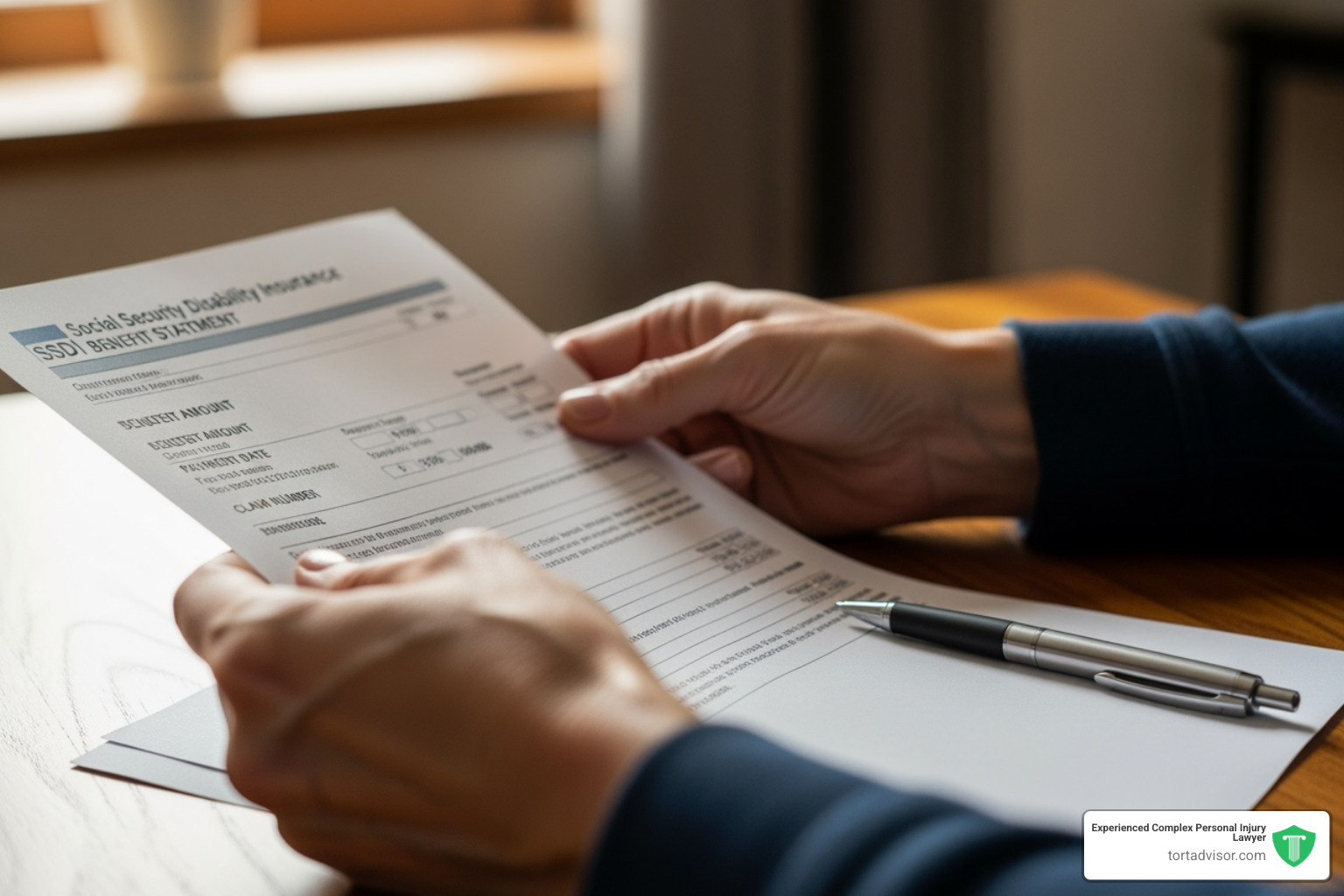
The SSA applies a five-step sequential evaluation to decide whether you are disabled. Step 1: Are you working? Earnings above the SGA limit ($1,470 a month in 2023) will usually lead to a denial. Step 2: Is your condition severe? It must significantly limit basic work tasks like walking, sitting, or remembering, and be expected to last 12 months or result in death. Step 3: Does it meet or equal a listing? The SSA’s “Listing of Impairments,” or “Blue Book,” covers conditions severe enough to qualify on their own; matching one generally leads to approval. Step 4: Can you still do your past work? If no listing fits, the SSA looks at whether your limitations allow you to perform any job you held in the last 15 years. Step 5: Can you switch to other work? The SSA weighs your Residual Functional Capacity (RFC), age, education, and experience to decide whether other jobs in the national economy are realistic, and the older you are, the harder it is for the SSA to say you can retrain. The takeaway: a diagnosis alone won’t qualify you; what counts is whether you can work.
SSDI and SSI: How They Differ
People often mix up Social Security Disability Insurance (SSDI) and Supplemental Security Income (SSI). SSDI is earned through work and FICA taxes. SSI is based on need, serving people with little income or savings, and it is paid from general tax revenue. A quick comparison:
| Feature | Social Security Disability Insurance (SSDI) | Supplemental Security Income (SSI) |
|---|---|---|
| Funding Source | Payroll (FICA) taxes | General tax revenue |
| Eligibility Criteria | A qualifying disability plus enough work history; no income or asset limits. | A qualifying disability (or age 65+/blindness) plus limited income and assets; no work history required. |
| Benefit Calculation | Tied to your average lifetime earnings. | The federal benefit rate minus countable income. |
| Health Coverage | Medicare once a 24-month wait ends. | Medicaid, usually right away. |
| Means-Tested | No | Yes |
The SSA’s website lets you compare SSDI and SSI in more depth. Because SSDI is earned, there is no cap on your assets, while SSI limits countable resources (generally to $2,000 for one person). You can receive concurrent benefits from both if your SSDI amount is low and you meet SSI’s financial rules.
How to Apply for SSDI Online, Step by Step
Filing for Social Security Disability Insurance takes effort, but applying online is usually the quickest, most efficient route. You can also apply by phone (1-800-772-1213) or in person at a local office, but the online portal lets you move at your own pace, save your work, and submit electronically. To begin, visit the SSA’s page explaining how to apply for SSDI.
Collect Your Documents First
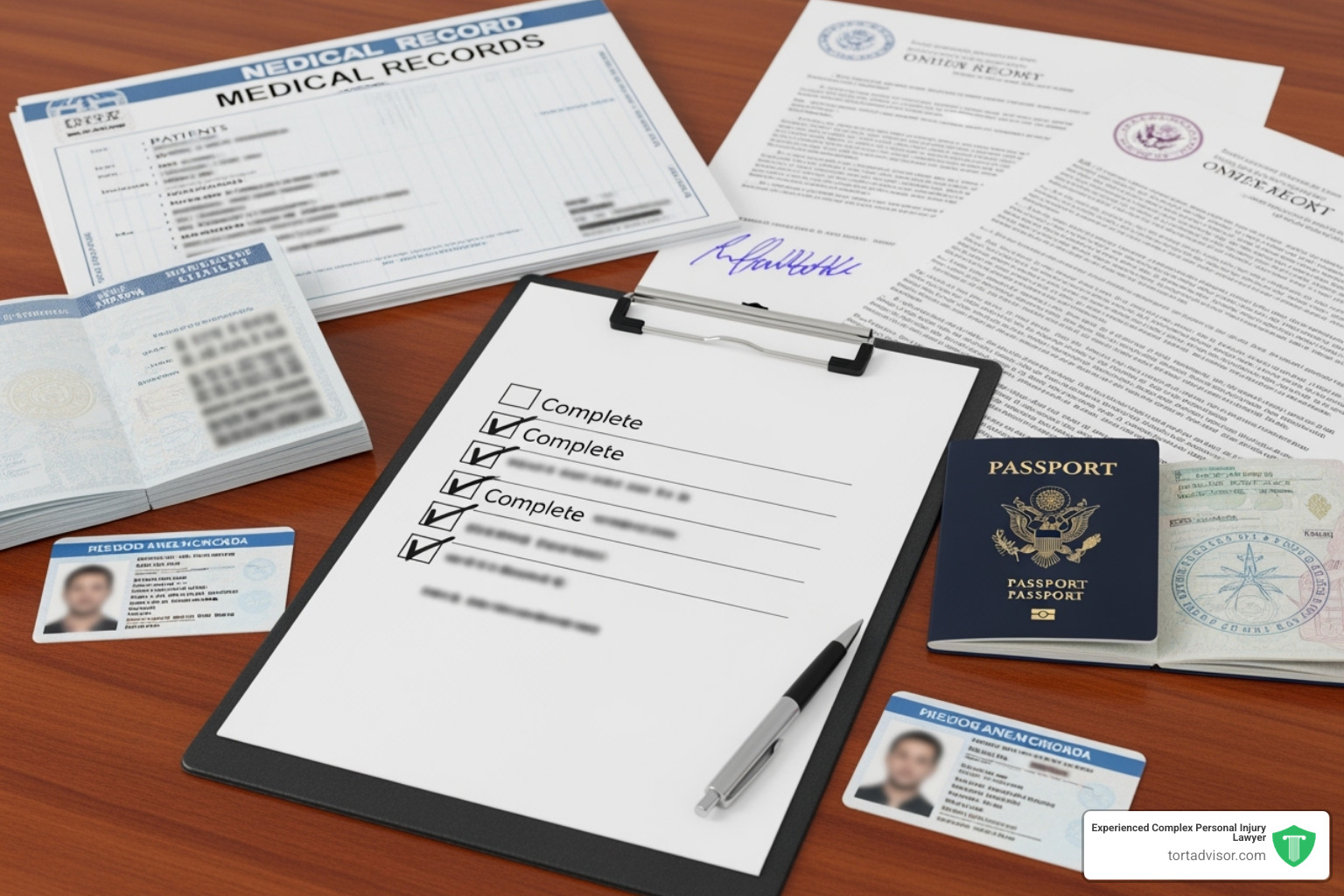
Getting organized up front pays off, because complete applications move faster and missing details trigger delays while the SSA follows up. You will need:
- Personal Details: Your Social Security number and birth certificate, birth dates and SSNs for your spouse and minor children, and marriage or divorce dates.
- Military Records: Your DD Form 214, if you served.
- Employment Information: Employer names and addresses for the past 15 years, dates worked, and earnings, plus W-2s or self-employment tax returns for the last two years.
- Medical Records: The most important piece. List every doctor, hospital, and clinic that treated you with addresses and phone numbers, along with patient ID numbers, treatment dates, your medications, and dates of tests like X-rays and MRIs.
- Job Duties: A detailed account of what your jobs involved over the last 15 years, so the SSA understands their physical and mental demands.
Filling Out the Online Application
Start by setting up a “my Social Security” account at www.ssa.gov/myaccount. You will use it to apply and later to manage benefits, track your claim, and update your details. The online application has several components:
- Adult Disability Report: The heart of the application, where you describe your condition, how it limits your work, your treatment, and your job history. Be complete and truthful.
- Work History Report: Asks for specifics about past jobs, such as how much you lifted, how long you stood, and whether you supervised others.
- Medical Records Release: Lets the SSA request records straight from your providers. Keep all contact information up to date to prevent delays.
Check everything carefully for errors or gaps before you submit. Because you can save and come back later, you don’t have to finish this detailed, sometimes tiring process in one sitting.
SSDI Timeline, Benefits, and What Comes Next
Once your Social Security Disability Insurance application is in, the wait starts. It is not fast, but knowing the timeline helps. A first decision typically takes three to six months, longer if the SSA needs more information. If approved, there is a required five-month waiting period before cash benefits begin; for example, if your disability started January 15, your first payment would cover July and arrive in August. People with ALS are exempt from this wait. Medicare has its own delay: most SSDI recipients qualify 24 months after cash benefits begin, usually about 29 months after the disability started, with exceptions for ALS and end-stage renal disease (ESRD). If these timelines feel overwhelming, attorneys in our network who handle Disability Claim Assistance can help guide you.

How Your SSDI Payment Is Calculated
Your Social Security Disability Insurance benefit is not a flat amount; it depends on your earnings over your lifetime. The SSA uses your Average Indexed Monthly Earnings (AIME) to calculate your Primary Insurance Amount (PIA), which is your monthly benefit, so higher lifetime earnings and contributions mean a higher check. In early 2023, disabled workers received $1,483 a month on average, though your figure will reflect your own record. Our free SSDI Benefit Calculator can give you a personal estimate.
Additional SSDI Benefits
SSDI provides more than a monthly payment.
- Medicare: You become eligible automatically after 24 months of SSDI benefits.
- Benefits for Family: A spouse who is over 62 or caring for your child under 16, and unmarried children under 18 (or disabled before 22), may qualify on your record, subject to a family maximum. The SSA’s website explains family benefits.
- Cost-of-Living Adjustments (COLAs): Benefits usually rise each year to help keep up with inflation.
- Switch to Retirement Benefits: At full retirement age, disability benefits convert automatically to retirement benefits, typically at the same amount.
If Your SSDI Application Is Denied
About 70% of first-time Social Security Disability Insurance applications are denied. A denial letter is discouraging, but it does not end your claim, and many people win on appeal. Frequent reasons for denial include:
- Not enough medical evidence showing how severe and long-lasting the disability is.
- Earnings over the Substantial Gainful Activity (SGA) limit ($1,470 a month in 2023).
- Not following prescribed treatment without a valid reason.
- Missing or inaccurate information on the application.
You generally have 60 days from the date on the denial letter to appeal; miss it and you may have to start over with a new application. Approval odds often improve at later appeal stages, especially with professional help. Read more about a Denied Disability Claim and the Disability Appeal Process.
The Four Stages of an SSDI Appeal
Appeals of a Social Security Disability Insurance denial move through four stages:
- Reconsideration: A different examiner reviews your file, and you may add new evidence. Most reconsiderations are denied too, but this step is required before moving on.
- Administrative Law Judge (ALJ) Hearing: Often your strongest chance at approval. You can testify, present your case, and have an attorney question expert witnesses. Having a representative at this stage is widely seen as a major advantage.
- Appeals Council Review: If the judge denies you, you can ask the Appeals Council to look for legal errors. It may approve, deny, or send the case back for a new hearing.
- Federal Court: The last option is a lawsuit in federal district court, a complex step that calls for an experienced disability attorney to argue the SSA’s decision lacked legal or evidentiary support.
The appeals process is demanding. An experienced attorney can collect evidence, prepare you to testify, and make legal arguments for you, so professional help is strongly recommended. The SSA’s website also explains how to appeal.
SSDI Process Questions, Answered
The Social Security Disability Insurance process prompts a lot of questions. Here are answers to several common ones.
How long does it usually take to get an SSDI decision?
Expect to wait. A first decision on an initial application usually takes three to six months, though the SSA’s “Compassionate Allowances” program can resolve claims for certain severe conditions within weeks. A denial adds considerable time through the appeals process: reconsideration can take another three to six months, and waiting for an ALJ hearing can stretch beyond a year. The overall timeline depends on how complex your case is, how complete your records are, and local backlogs.
Am I allowed to work while collecting SSDI?
Yes. SSA “work incentives” let you try working again without losing benefits right away. The Trial Work Period (TWP) allows up to nine months of work (they need not be consecutive) at any earnings level while you keep your full SSDI check. Next comes a 36-month Extended Period of Eligibility (EPE), during which no benefit is paid for months your earnings exceed the SGA limit ($1,470 in 2023), but benefits can restart without a new application if earnings drop back below SGA. Be sure to report all work and earnings to the SSA promptly to avoid overpayments. These rules are detailed, so learn them before going back to work; the SSA offers guidance on how working may affect your benefits.
What is the average SSDI payment per month?
As of February 2023, disabled workers received an average Social Security Disability Insurance benefit of $1,483 a month. That is only an average; your benefit is calculated from your own lifetime earnings, so the more you earned and paid in, the higher it will be. The maximum SSDI benefit in 2023 was $3,627 a month, though few people receive that much. For an estimate based on your work history, try our SSDI Benefit Calculator.
Conclusion
Choosing to apply for SSDI online is the most efficient way to pursue Social Security Disability Insurance. This guide has covered everything from checking eligibility to appealing a denial. Still, the process is complicated, the SSA’s rules are strict, and close to 70% of initial applications are denied, so the right help can matter. An experienced disability attorney knows what the SSA needs and how to present your case persuasively, and representation is widely considered a significant advantage at hearings. Legal Lawsuit is a legal-information site that helps people understand their options and connect with experienced disability attorneys in our network through a free, confidential case review. Whether you are filing for the first time or appealing a denial, you don’t have to go it alone. To see how attorneys can help, explore SSDI Lawsuits.
Additional Resources
Related Posts
Quick Answer: The Boy Scouts of America (BSA) filed for Chapter 11 bankruptcy in 2020 after facing tens of thousands [...]
Quick Answer: Survivors of sexual abuse by Catholic priests, nuns, or other Church personnel may be able to file a [...]
Quick Answer: Clergy abuse settlements vary enormously based on the severity of the abuse, the strength of evidence that the [...]