
Short answer: This article explains the key facts, eligibility issues, settlement factors, deadlines, and source-backed updates related to this legal topic. Results vary by case facts, evidence, jurisdiction, and representation.
In This Guide
SSDI Benefits Qualifications in Brief
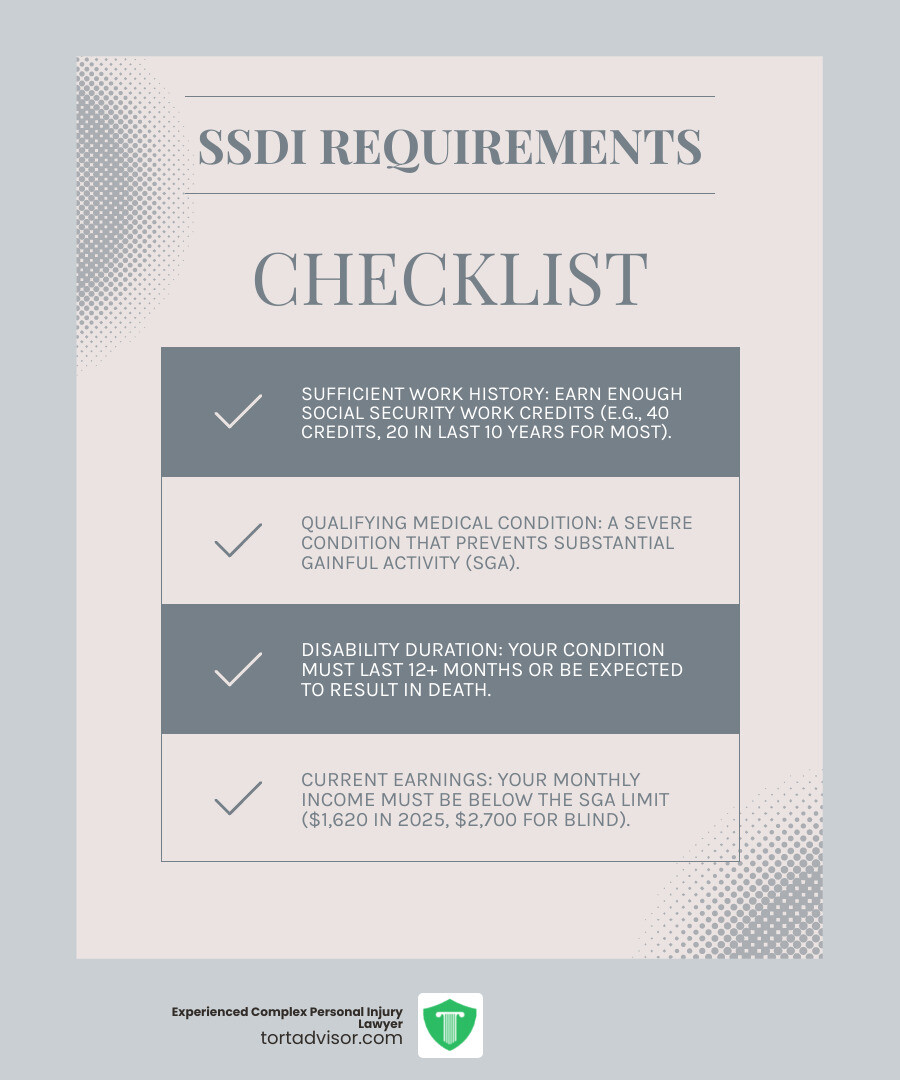
SSDI benefits qualifications rest on two pillars: an adequate work record and a qualifying medical condition. You need enough work credits from paying Social Security taxes, and your disability must stop you from substantial gainful activity for at least 12 months or be expected to end in death. Fast Eligibility Checklist:
- Work Credits: Usually 40 credits, with 20 earned in the past 10 years
- Current Earnings: Under $1,620 a month ($2,700 if blind) in 2025; limits adjust yearly
- Medical Condition: Must keep you from substantial gainful activity
- Duration: Expected to last at least 12 months or to result in death
- Age: Younger workers may qualify with fewer credits
The numbers are striking: a 20-year-old worker faces roughly a 1-in-4 chance of becoming disabled before retirement age, yet close to 70% of first-time disability claims are turned down. Knowing the rules protects your financial future. The Social Security Administration (SSA) applies a rigid five-step test and does not pay for partial or short-term disability; your condition must fully prevent substantial gainful activity. If you qualify, SSDI delivers monthly income, Medicare after a waiting period and possible benefits for family members. The hard part is the application itself, which demands detailed medical and employment records. This guide walks through each requirement.
More on SSDI benefits qualifications:
- Denied disability claim
- Disability claim assistance
- how to claim social security disability insurance arkansas
Work Credits and Medical Requirements
The Social Security Administration (SSA) looks at two separate things: your employment history and your health. Meeting SSDI benefits qualifications requires passing both.
How Your Work Record Affects SSDI Benefits Qualifications
SSDI is insurance you earn through Social Security payroll taxes, measured in work credits. In 2025, each $1,810 of earnings equals one credit, with a cap of four credits a year (reached at $7,240). The threshold usually rises every year. Most applicants need 40 credits, and recency matters: under the “20/40 rule,” 20 of those credits must come from the 10 years right before your disability started. That recent-work test targets benefits to people who were contributing shortly before becoming disabled. Younger applicants need fewer credits because they have had less time in the workforce:
- Younger than 24: 6 credits earned during the three years before the disability began.
- Age 24 to 31: Credits for working half the time between age 21 and the onset of disability.
- Age 31 and up: The usual 20/40 rule applies.
These exceptions reflect that disability can happen at any stage of life. You can check your exact credit count through your online Social Security account, then use our SSDI Benefit Calculator to estimate a possible monthly payment.
The Medical Side of SSDI Benefits Qualifications
The SSA’s disability standard is demanding and a frequent cause of denials. Only total disability counts: the condition must block substantial work for 12 months in a row or be expected to cause death. The question is not whether you can return to your old job but whether you can perform any job in the national economy. The impairment must seriously restrict basic work functions such as lifting, standing, walking, sitting or remembering. The SSA keeps a list of impairments called the Blue Book, but a condition that is not listed can still qualify if it is equally severe. Approved claims most often involve musculoskeletal problems (such as severe arthritis or spine disorders), mental health conditions (such as major depression or bipolar disorder) and heart conditions (such as heart failure), along with cancers, neurological diseases and lung disorders. Above all, the SSA focuses on functional limitations, so your records must spell out what you can and cannot do. Thorough evidence from your doctors, including test results and written opinions on your limits, is essential to meeting the medical SSDI benefits qualifications.
The SSA’s Five-Step Review of SSDI Benefits Qualifications

To decide whether you meet SSDI benefits qualifications, the SSA follows a five-step sequential evaluation carried out by your state’s Disability Determination Services (DDS). Think of each step as a gate; fail any one and the claim is denied.
Steps 1 and 2: Current Work and Severity
The opening steps screen out claims that miss the basics. Step 1: Are you working? If you earn more than the Substantial Gainful Activity (SGA) limit, the SSA treats you as not disabled. In 2025 that limit is $1,620 a month, or $2,700 for blind applicants, and going over it means denial no matter how serious your condition. Step 2: Is the condition severe? If you are under the SGA limit, the SSA asks whether your impairment significantly restricts basic work activities like lifting, standing, sitting or remembering for at least 12 months. If not, the claim ends here.
Steps 3, 4 and 5: Listings and Your Capacity to Work
Claims that clear the first two steps get a closer look. Step 3: Does the condition match a listing? The SSA compares your impairment with the Blue Book. A condition that meets or equals a listing is considered disabling on its own, and approval here skips the remaining steps. Step 4: Can you do your past work? If no listing fits, the SSA sets your Residual Functional Capacity (RFC), meaning what you can still do despite your limits. If that RFC allows any relevant job from the past 15 years, you are denied. Step 5: Can you do other work? If past work is ruled out, the SSA weighs your age, education and transferable skills to see whether you could do other jobs in the national economy. If so, the claim is denied; if not, it is approved. For the most serious conditions, such as ALS or acute leukemia, Compassionate Allowances and Quick Disability Determinations flag and speed up claims so approval can come in weeks or even days.
Applying for SSDI and Appealing a Denial

Knowing your SSDI benefits qualifications is step one; getting through the application is step two. Knowing what lies ahead makes it less stressful.
Ways to Apply for SSDI
There are three ways to file: apply online, call the SSA’s national toll-free number (listed on SSA.gov), or go to a local office, ideally with an appointment. Collect your paperwork first. The SSA’s application checklist covers items such as:
- Medical Information: Names and contact details for every doctor and hospital, dates of treatment and your medication list.
- Employment History: Your employers and job duties over the last 15 years.
- Personal Details: Your Social Security number, birth certificate and bank information for direct deposit.
Keep the five-month waiting period in mind: even once approved, benefits start with the sixth full month after your disability began.
If Your SSDI Claim Is Denied
Most first applications are turned down, but that is not the end. You can appeal through four levels, and the odds of approval often improve as you go.
- Reconsideration: A different DDS examiner reviews your file plus any new evidence. Many claims are denied again, but this step is required.
- Administrative Law Judge (ALJ) Hearing: You present your case in person, often your strongest chance at approval, and having a representative helps a great deal.
- Appeals Council: If the judge rules against you, the Council can decline review, send the case back to a judge or decide it itself.
- Federal Court: The last option is a lawsuit in federal district court.
Appeals take time but meaningfully improve your odds. If you have been denied, review the SSA’s instructions for appealing and consider getting help with your denied disability claim.
SSDI Compared With SSI
Anyone researching disability benefits runs into both SSDI and SSI. They are easy to confuse, but they serve different groups and have different eligibility rules than the SSDI benefits qualifications covered above.
Key Differences Between SSDI and SSI
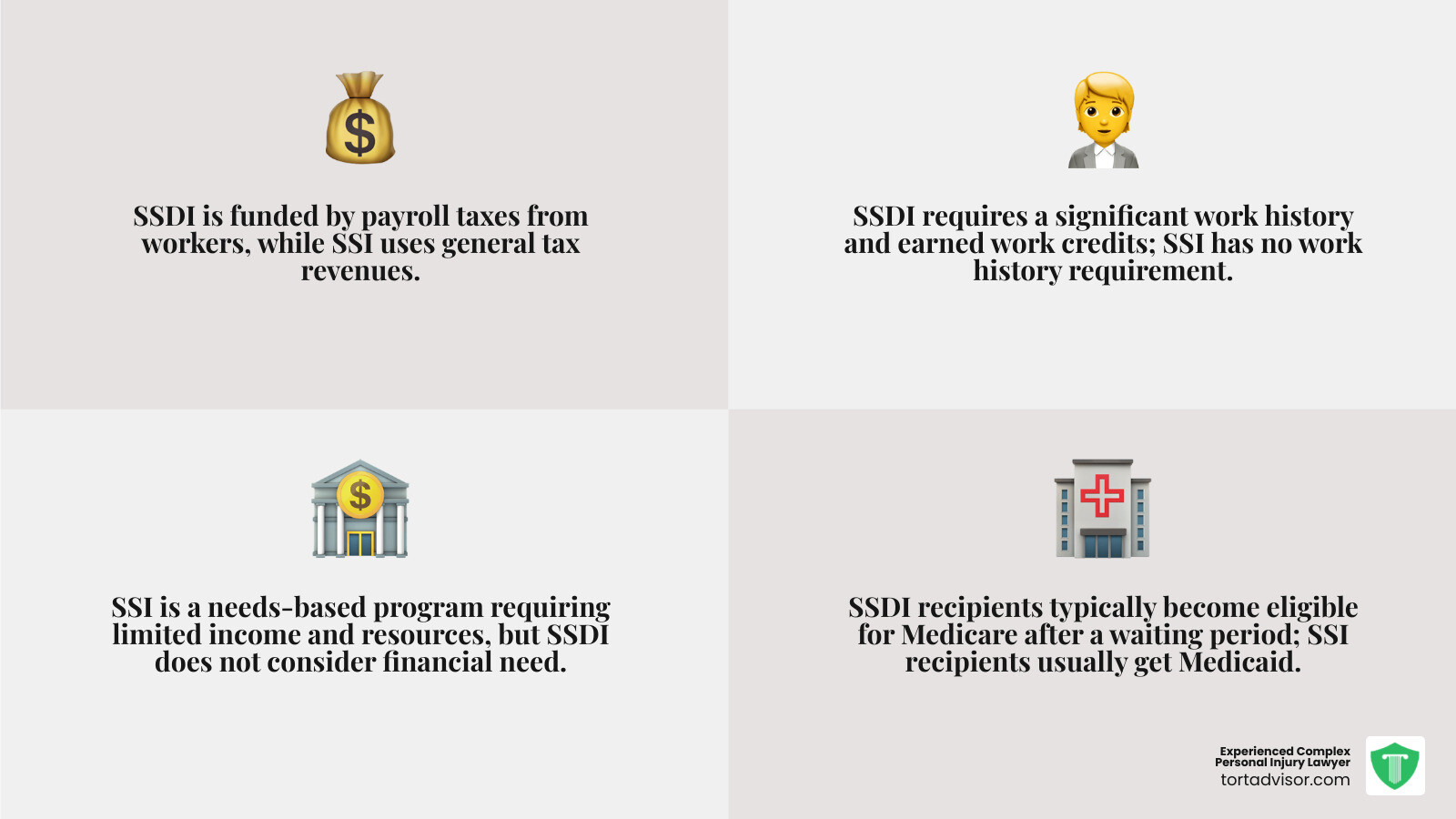
The biggest distinction is how you qualify. SSDI is earned through your work record and Social Security taxes, and your assets and unearned income do not matter. SSI is need-based, serving people with little income and few resources whether or not they have worked. The table summarizes the contrasts.
| Feature | SSDI (Social Security Disability Insurance) | SSI (Supplemental Security Income) |
|---|---|---|
| Funding Source | Paid for by FICA payroll taxes from workers, employers and the self-employed, deposited in Social Security trust funds. | Paid for by general tax revenue rather than Social Security taxes. |
| Work History | Requires a substantial work record and enough credits from paying Social Security taxes. | Requires no work record or credits. |
| Financial Need | Not need-based; income and assets other than earnings have no effect on eligibility or payment amount. | Need-based; tight income and asset limits determine eligibility. |
| Benefit Calc. | Calculated from your average lifetime earnings covered by Social Security. | Starts at a federal benefit rate and is reduced by countable income; some states add a supplement. |
| Health Coverage | Medicare begins after a 24-month wait from the date you become entitled to benefits. | Medicaid usually starts right after approval. |
| Taxability | May be taxable, depending on your other income. | Generally not taxable. |
You may collect both at once if your SSDI check is small and you fall within SSI’s financial limits. The SSA’s website has a side-by-side comparison of the two programs.
Family Benefits, Going Back to Work and Medicare
SSDI also offers protections for your family and several other key features.
- Family Benefits: Some relatives can receive monthly payments on your record, including a spouse who is 62 or older or caring for your child under 16, a former spouse in certain cases, and unmarried children under 18 (or 19 if still in school). Adult children disabled before 22 may also qualify. The SSA website explains family benefits in detail.
- Going Back to Work: The SSA supports return-to-work efforts through Work Incentives such as the Ticket to Work program, which let you try working without instantly losing benefits or health coverage. Learn how working could affect your eligibility before you start.
- Medicare: Coverage begins automatically 24 months after your entitlement date, except for people with ALS or End-Stage Renal Disease (ESRD), who skip the wait.
- Switch to Retirement: At full retirement age, SSDI automatically becomes retirement benefits, usually in the same amount.
SSDI Qualification FAQs
By now you may still have practical questions about SSDI benefits qualifications. These are the ones people ask most, with direct answers.
How long does an SSDI decision take?
Expect to wait. A first decision usually takes about 6 to 8 months, while fast-tracked claims such as Compassionate Allowances can be approved in weeks. An appeal adds considerable time, and a hearing before a judge can stretch the whole process past a year.
Is it possible to work while my SSDI application is pending?
Yes, but tread carefully. Your monthly earnings must remain under the Substantial Gainful Activity (SGA) limit ($1,620 in 2025, or $2,700 if blind). Earn more and the SSA will deny the claim at step one regardless of your health. Report all work accurately.
How much will I receive from SSDI?
There is no flat amount; your payment depends on your average lifetime earnings that were subject to Social Security tax, so higher earnings mean a larger benefit. For the best estimate, open a “my Social Security” account and use the SSA’s online calculator, which draws on your actual earnings record.
Getting Help With Your SSDI Claim
The truth is that SSDI benefits qualifications are complicated. Between the detailed rules and the high first-round denial rate, feeling overwhelmed is normal. A denial does not mean you are undeserving; often it means you need an experienced advocate. SSDI claims are legal matters with strict evidence and documentation standards, and one oversight can sink a valid claim. An experienced disability attorney knows what the SSA wants to see, how to build the record and how to argue persuasively at a hearing. Legal Lawsuit helps people connect with attorneys in our network who focus on disability law. Most work on contingency, so their fee comes from past-due benefits only if you win, with nothing up front. Whether you are just applying or appealing a denial, the right attorney can manage the paperwork, gather evidence and represent you. You do not have to go through this alone; request a free, confidential case review for your SSDI claim. Your disability has already upended your life, and securing the benefits you earned should not make it harder.
Related Posts
Quick Answer: The Boy Scouts of America (BSA) filed for Chapter 11 bankruptcy in 2020 after facing tens of thousands [...]
Quick Answer: Survivors of sexual abuse by Catholic priests, nuns, or other Church personnel may be able to file a [...]
Quick Answer: Clergy abuse settlements vary enormously based on the severity of the abuse, the strength of evidence that the [...]