Short answer: This article explains the key facts, eligibility issues, settlement factors, deadlines, and source-backed updates related to this legal topic. Results vary by case facts, evidence, jurisdiction, and representation.
📋 Table of Contents
- Why Your Disability Hearing is a Critical Opportunity
- Essential Disability Hearing Tips: A Step-by-Step Preparation Guide
- During the Hearing: Navigating the Process and Your Testimony
- After the Hearing: Understanding the Decision and Your Next Steps
- Frequently Asked Questions about Disability Hearings
- Conclusion: Secure Your Benefits with Expert Guidance
Why the Disability Hearing Is Your Best Chance at Approval
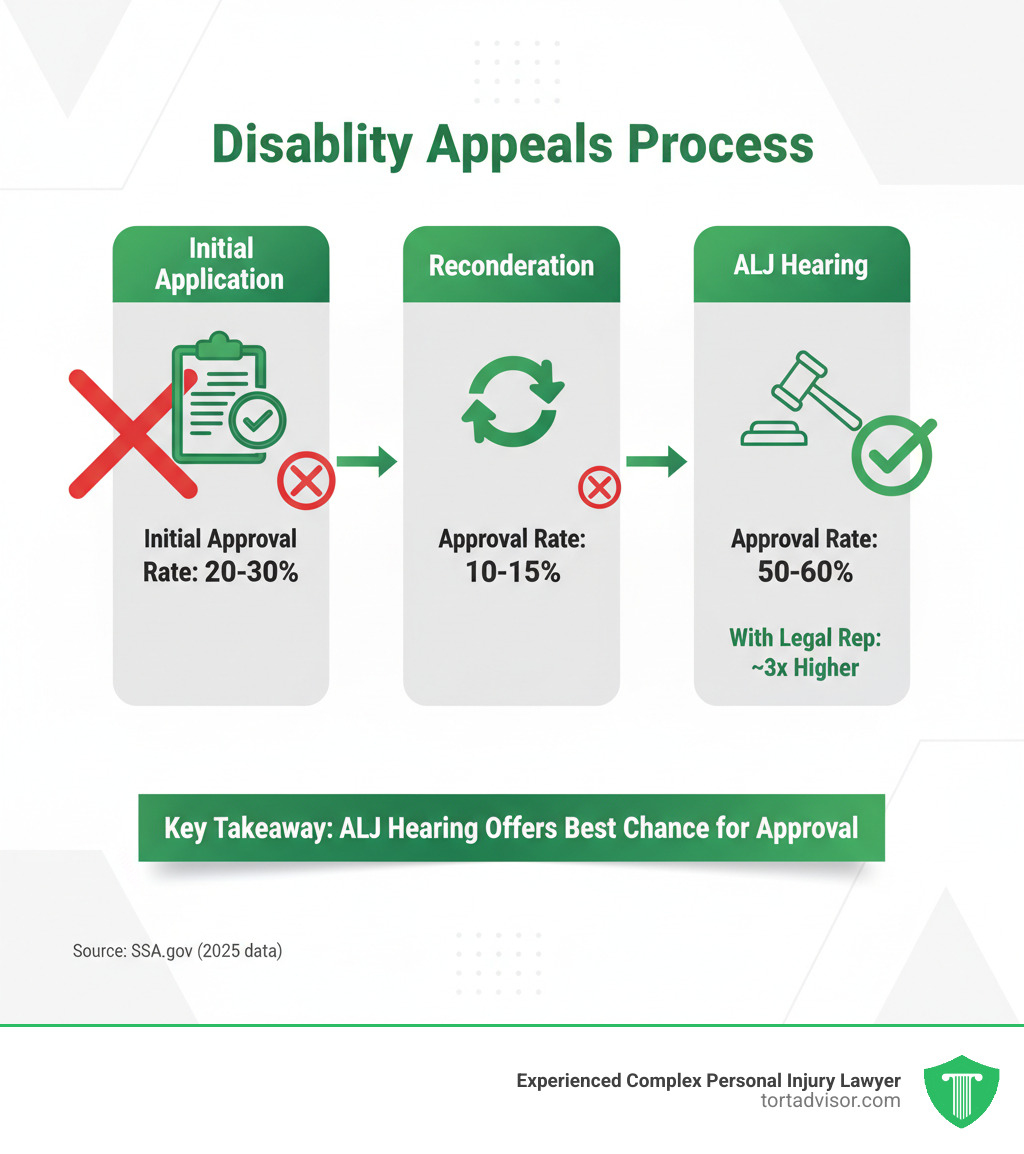
Good disability hearing tips can decide whether you finally get approved or receive yet another denial. Close to 80 percent of first-time disability applications are rejected, but the hearing stage gives you the strongest odds: roughly half of claimants win at hearing, and represented claimants do even better. The hearing is a formal session with an Administrative Law Judge (ALJ) who looks at your claim fresh. Unlike the earlier reviewers, the judge can question you directly and listen to how your condition really limits your ability to work. Disability Hearing Tips in Brief:
- Get all evidence in no later than 5 business days before the hearing.
- Add current medical records and statements from your doctors describing your limits.
- Plan truthful, detailed answers about your work history and daily routine.
- Speak clearly, stay courteous, and call the judge “Your Honor.”
- Neither overstate nor downplay your symptoms.
- Think about getting a representative, since claimants with lawyers are three times as likely to win.
Most hearings last around an hour, and you will be asked about your health conditions, past jobs and everyday activities. It can feel intimidating, but solid preparation greatly improves your odds of a favorable ruling, and this is your chance to explain in your own words why you can’t work. I’m Mason Arnao. My main background is technology and digital marketing, and I put these disability hearing tips together from extensive research into legal resources to help you through this crucial stage.
Key disability hearing terms explained:
- Denied disability claim
- Disability claim assistance
Disability Hearing Tips: How to Prepare, Step by Step
Your Social Security Disability hearing is the best chance you will get to secure benefits. Prepare well and you can walk in calm and confident. These disability hearing tips show you how.
Step 1: Collect and Submit Strong Evidence

The judge decides almost entirely on what is in your file, so collecting and submitting evidence correctly is one of the most valuable disability hearing tips there is. Start by requesting a copy of your SSA file so you see exactly what the judge will see, and check it for mistakes and gaps, such as an important MRI that never made it in. Those problems will not correct themselves. Then obtain current medical records from every doctor, specialist and therapist who has treated you, including office notes, test results and hospital records; providers may not charge you for records requested to support an SSI or SSDI claim. Records by themselves may not be enough, so ask your doctors for detailed statements or completed Residual Functional Capacity (RFC) forms that spell out your diagnosis, prognosis and concrete limits (for example, “can lift no more than 5 pounds” or “needs to lie down after 30 minutes seated”). Letters from witnesses such as relatives, friends or past employers can be persuasive too, describing how your condition affects daily life in ways records cannot; a former supervisor’s account of your slipping job performance is especially useful. The Work Activity Questionnaire can help you organize these details. Timing Matters: Everything must be submitted at least five business days before the hearing, and sending it a month or more ahead is better. You can mail or fax documents to the hearing office handling your claim; always keep copies and proof, such as a certified mail receipt.
Step 2: Know What a Lawyer Brings to the Table
Claimants who have a lawyer are three times as likely to be awarded benefits. A seasoned disability attorney knows what the judge looks for and how to present your claim as persuasively as possible: reviewing the file, filling evidence gaps, working with your doctors on strong statements and preparing you for the judge’s questions. At the hearing, they can cross-examine experts and make legal arguments for you, and they handle the paperwork so you can concentrate on your health. Cost worries are common, but disability attorneys work on contingency and are paid only if you win. Fees are capped at 25% of your past-due benefits, subject to a dollar maximum the SSA sets and adjusts periodically ($7,200 for much of 2024), with nothing due upfront, which puts experienced help within reach for nearly everyone. For Disability Claim Assistance, Legal Lawsuit can connect you with experienced attorneys in our network through a free, confidential case review.
Step 3: Get Ready for Your Hearing Format
Hearings take place in person, by video or by phone. Most are held remotely now, but if your condition makes remote participation hard, you can ask your local Social Security hearing office for an in-person hearing.
- In-person or video hearings at an SSA office: Get there roughly 30 minutes early to locate the room and calm your nerves.
- Phone or video hearings from home: Pick a quiet, private spot with no interruptions, line up childcare or pet care, and test your camera, microphone and internet beforehand. Make sure your phone is charged and has a strong signal.
- What to wear: Go for smart-casual. Tidy, comfortable clothing shows respect for the process, even if it’s only a phone hearing.
At the Hearing: The Process and Your Testimony
This is when you speak directly to the person deciding your claim. These disability hearing tips will help you handle it with confidence.
Who Will Be in the Room and What Happens
A disability hearing feels more like a serious conversation than a courtroom trial. It is fairly informal and usually lasts around an hour.
- The Administrative Law Judge (ALJ): The neutral decision-maker, who asks most of the questions.
- You (the claimant): Your testimony is the most important evidence.
- Your Attorney: Your advocate, who guides you, makes arguments and questions the experts.
- A Hearing Assistant: Makes the audio recording, so answer out loud with “Yes” or “No” instead of nodding.
- Vocational Expert (VE): A neutral specialist who testifies about what jobs require and which jobs exist.
- Medical Expert (ME): Not always present, but sometimes asked for an opinion on your condition.
After introductions you will take an oath, and the judge will ask about your health, work history and daily life. Your attorney can then ask follow-up questions and give a closing statement.
Testifying Well: Disability Hearing Tips for Your Answers
What you say matters enormously. The judge needs to hear from you directly how your disability shapes your life.
- Tell the Truth: Credibility is everything. Don’t inflate or play down symptoms, and be candid about both good and bad days.
- Describe an Average Day: When asked about your routine, skip your best and worst days and give a realistic middle picture.
- Get Specific: Rather than “I’m in a lot of pain,” say something like “My back pain feels sharp and burning, and after about 15 minutes on my feet I have to sit.”
- Cover Your Work History: Describe what your jobs involved and why your condition made it impossible to keep working.
- Explain Symptoms and Side Effects: Go past the diagnosis. Describe what the pain is like, how often it happens and how long it lasts, plus medication side effects such as drowsiness or trouble concentrating.
- Walk Through Daily Activities (ADLs): Explain how your condition affects grooming, housework, errands and hobbies, and whether you need help with them.
- Give Real Estimates: For physical limits, say concretely how long you can sit, stand, walk or lift in a work setting.
- Cover Mental Limitations: If you have a mental health condition, explain how it affects your focus, memory, ability to follow directions and handling of stress.
Mistakes to Avoid at Your Disability Hearing
Knowing what to avoid matters as much as knowing what to do.
- Don’t cut off the judge or your lawyer; let them finish the question.
- Speak up clearly so the recording picks you up.
- Stay courteous. Call the ALJ “Your Honor.”
- “I don’t remember” is fine, as is “I don’t know.” Both beat guessing.
- Ask the judge to rephrase any question you don’t understand.
- Ask for a break if you are overwhelmed or hurting.
- Skip absolutes like “always” and “never”; say “usually” or “rarely” instead.
- Leave money troubles out of it. The decision turns on medical disability, not financial need.
- Answer just what is asked. Don’t add unrequested detail.
- Leave the arguing to your lawyer. Your job is to give facts; legal arguments belong to your attorney.
For more help, see our page on handling a Denied Disability Claim.
After the Hearing: The Decision and What Comes Next
Once the hearing ends, the wait begins. These last disability hearing tips explain what to expect.

How Long Until a Decision? Judges don’t rule from the bench. A written decision arrives by mail, usually in 60 to 90 days, sometimes longer, so stay patient and keep up with your medical care in the meantime. Reading the Decision You will get one of three results:
- Fully Favorable: The judge finds you disabled from the onset date you claimed, and you receive full benefits.
- Partially Favorable: The judge finds you disabled but sets a different onset date, so monthly benefits continue but back pay may be smaller.
- Unfavorable: The judge denies the claim. It’s a setback, but not the final word.
What About Back Pay? An approval brings “back pay” for the months benefits were owed while your claim was pending; the amount depends on your onset date and how long the case took. Our SSDI Benefit Calculator can give you an estimate. Denied at Hearing? Your Options A hearing denial isn’t final. You can:
- Ask the Appeals Council for Review: You have 60 days to file. The Council checks the judge’s decision for legal mistakes and can order a new hearing.
- Sue in Federal Court: If the Appeals Council turns you down, you can bring your case to federal court.
- Start a New Application: Sometimes, especially if your health has declined, a fresh application is the better move. Talk it over with an attorney first.
The post-hearing stage is complicated, and an attorney can recommend the best path based on your particular facts.
Disability Hearing FAQs
Here are answers to frequent questions, with a few more disability hearing tips to put your mind at ease.
Is an SSI hearing different from an SSDI hearing?
Hardly at all, as far as the hearing goes. Social Security Disability Insurance (SSDI) depends on your work record, and Supplemental Security Income (SSI) is need-based for people with limited income and assets, but both use the identical medical standard. The judge concentrates on whether your condition keeps you from working. In an SSI case, the judge may quickly confirm your finances, but nearly the entire hearing focuses on your medical evidence and testimony, so everything here applies to both.
What if I miss my hearing?
Missing a hearing is serious and can get your case dismissed. If you know you’ll miss it, or the moment you realize you did, call the hearing office right away; the number is on your Notice of Hearing or available through the hearing office locator. You will need to show “good cause,” a serious, unavoidable reason such as a medical emergency, a family death or a car crash, explained in writing with proof like a doctor’s note. If the judge accepts it, the hearing is rescheduled; if not, the case may be dismissed.
How do I make sure the judge sees my medical records?
The judge can only weigh what is in your file. To make sure your records get there:
- Send evidence early. The cutoff is five business days before the hearing, but aim for at least a month ahead.
- Use the right office. Send everything directly to the hearing office handling your claim; its address and fax number are on your hearing notice.
- Keep proof. Use certified mail for a receipt or save the fax confirmation.
- Confirm it arrived. A few days later, call the hearing office to check that the documents are in your file.
An experienced disability attorney can handle every part of this for you so nothing slips through.
Wrapping Up: Get Expert Help Securing Your Benefits
These disability hearing tips give you a strong foundation for this pivotal step. Getting ready for a Social Security Disability hearing takes effort and organization, but it is your best chance to win the benefits you need. Strong evidence, honest answers and a professional presentation are the building blocks of a winning claim, and preparation lets you tell your story in a way the judge can truly grasp. Most first applications are denied, yet about half of claimants win at hearing, and represented claimants are three times as likely to succeed. Experienced disability attorneys know what evidence a judge needs and how to present it most effectively. Legal Lawsuit connects people in your position with experienced attorneys in our network who handle disability cases and know how to work through the Social Security Administration’s complexities, from Alabama to Wyoming and Chicago to Miami. Whether your hearing is coming up or you just received an unfavorable decision, you don’t have to sort it out alone. Request a free, confidential case review and take the next step toward securing your future.
Additional Resources
Related Posts
Quick Answer: The Boy Scouts of America (BSA) filed for Chapter 11 bankruptcy in 2020 after facing tens of thousands [...]
Quick Answer: Survivors of sexual abuse by Catholic priests, nuns, or other Church personnel may be able to file a [...]
Quick Answer: Clergy abuse settlements vary enormously based on the severity of the abuse, the strength of evidence that the [...]