
Short answer: This article explains the key facts, eligibility issues, settlement factors, deadlines, and source-backed updates related to this legal topic. Results vary by case facts, evidence, jurisdiction, and representation.
📋 Table of Contents
- Why Your Denied Disability Claim Doesn’t Have to Be the End
- Understanding Why Your Disability Claim Was Denied
- The Social Security Disability Appeal Process: A Step-by-Step Guide
- How to Improve Your Chances of Success When Appealing a Denied Disability Claim
- Frequently Asked Questions About Denied Disability Claims
- Conclusion: Don’t Give Up on the Benefits You Deserve
A Denied Disability Claim Is Not the End of the Road
Every year, thousands of Americans receive a denied disability claim notice — yet that letter doesn’t settle whether you’ll get benefits. Start with these priorities: What to Do Right Away After a Denial:
- File an appeal inside 60 days – rather than submitting a fresh application
- Pin down the reason for denial – read your notice line by line
- Build up your medical proof – ask doctors for detailed written statements
- Think about getting representation – claimants with representatives tend to fare better
Initial denials are the norm, not the exception: about 67% of first-time applications are turned down. Thin medical evidence is the top reason, though technical problems — like earning more than the $1,620 monthly limit or leaving paperwork incomplete — also sink claims. Fortunately, there are four levels of appeal, and the hearing before an Administrative Law Judge is usually where claimants stand the best chance. Appealing also keeps your original filing date intact, which can translate into significantly more back pay than reapplying. The appeals process can feel crushing when you’re already coping with illness. In our experience organizing information for readers, denied disability claim appeals tend to go better when the right evidence is gathered, organized and presented clearly — which is exactly what this guide helps you do.
Why Was My Disability Claim Denied?
Opening a denial letter can be crushing, particularly when a serious health condition is already wearing you down. Still, pinpointing the exact reason for the denial gives you a blueprint for a successful appeal. The letter is more than bad news — it tells you what the Social Security Administration (SSA) still needs to see. Read it as “this is what was missing,” not “you will never qualify.” Most denials fit into a handful of categories, and once you identify yours, you can address it directly.

Not Enough Medical Evidence
This is the leading cause of a denied disability claim. Having a diagnosis isn’t sufficient for the SSA; it wants proof that your condition is severe enough to stop you from doing any work for at least 12 months. That’s where many applicants stumble. A doctor may have diagnosed something serious, but if your records don’t clearly show how the condition limits your daily activities and ability to work, the claim will be denied. The SSA looks for detailed clinical findings, lab work, imaging and — above all — physician notes describing your specific functional limits. A chart that reads “patient has back pain” won’t do. The SSA wants something like “patient can sit no longer than 15 minutes, cannot lift over 5 pounds, and has severe pain that disrupts concentration.” Without that detail, even a genuine disability can be overlooked.
Technical Denials Based on Income or Work History
Some claims are denied before anyone reviews the medical file. These technical denials happen when basic eligibility rules aren’t met. Earning too much is the most frequent cause. The SSA sets an income ceiling called Substantial Gainful Activity (SGA) — $1,620 a month for non-blind individuals in 2025, adjusted periodically. Earn above it and the claim is denied automatically, no matter how serious your condition. Lacking enough work credits for Social Security Disability Insurance (SSDI) is another common problem. As a general rule, you need to have worked five of the past ten years and earned enough credits. At age 50, for example, you usually need roughly seven years of work history. If you haven’t worked long enough or recently enough, the claim fails on those technical grounds alone.
Not Following the Treatment Your Doctor Prescribed
This reason can sting because it feels like the SSA is questioning your private medical choices. From the agency’s viewpoint, though, skipping your doctor’s treatment plan suggests that following it might restore your ability to work. The operative word is “prescribed.” If a doctor recommends medication, therapy or a specialist visit and you don’t follow through, the SSA may decide your condition isn’t as disabling as you say — producing a denied disability claim even when the condition is truly severe. There can be legitimate reasons to skip treatment: you can’t pay for it, side effects are intolerable, or your doctor recommended against it. What matters is that those reasons are clearly written into your medical records. Otherwise the SSA may read non-compliance as a failure to try to get better.
Paperwork Mistakes and Missed Deadlines
A disability application involves a mountain of forms, and small errors can sink the whole claim — incomplete answers, details that conflict with your medical records, or late responses to SSA requests. Consistency is essential. If you tell the SSA you can’t stand longer than 15 minutes but your doctor’s notes say you reported standing for an hour, the mismatch can wreck your credibility and lead to denial. The SSA also has to be able to reach you. If your phone number or address changed and they can’t get hold of you, or you ignore requests for more information, they’ll deny the claim. It sounds unforgiving, but with the volume they handle, they won’t track down every applicant. Missed deadlines cause trouble too: the agency runs on fixed timelines, and late forms or documents can trigger an automatic denial no matter how strong your medical evidence is.
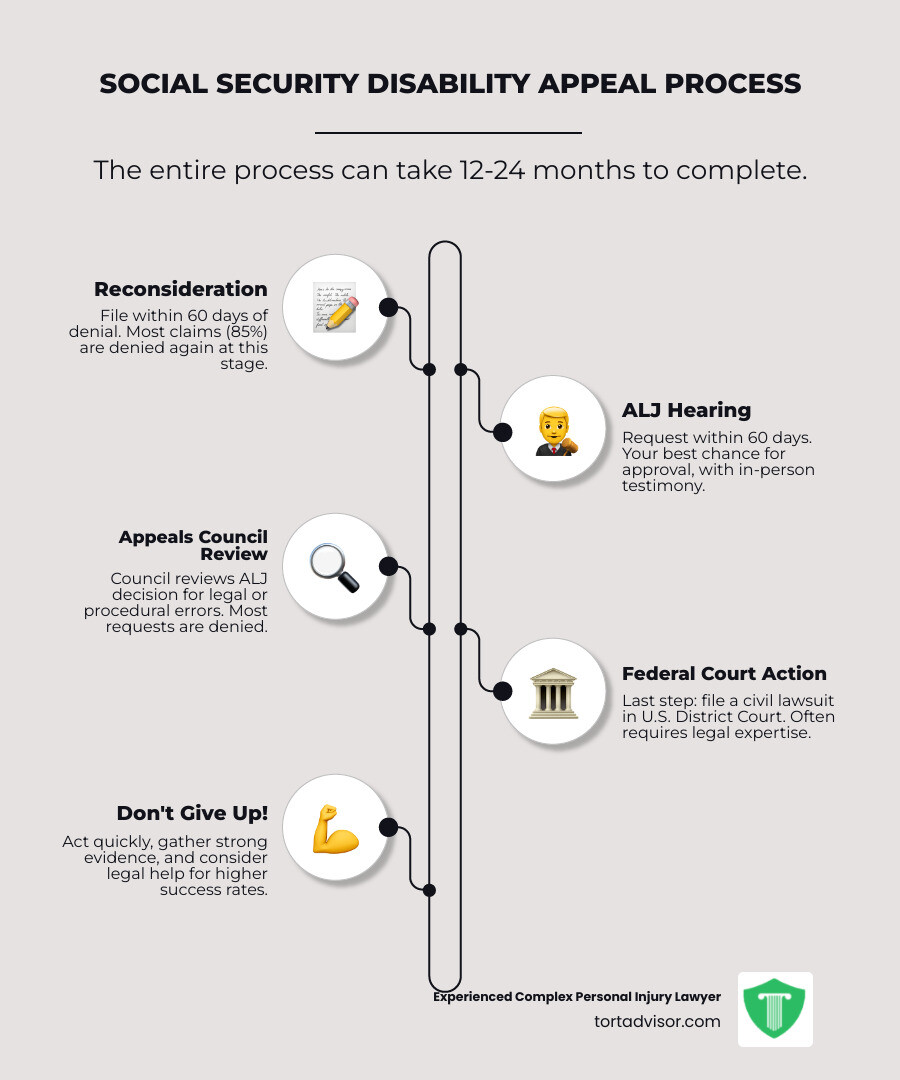
How to Appeal a Denied Disability Claim: The Four Levels, Step by Step
A denied disability claim letter puts a choice in front of you: appeal, or start over with a new application. In nearly every case, appealing is the smarter move. It keeps your original filing date, which can add up to thousands in extra back pay if you ultimately win. Reapplying wipes that date out, and unless your condition has changed a lot, the same evidence will likely produce the same denial. The SSA’s appeal process has four clearly defined levels. Each one is a fresh chance to prove your case, and success rates actually rise as you move up.

Level 1: Reconsideration
The first step is to submit a “Request for Reconsideration” within 60 days of getting your denial. The SSA presumes the letter reached you five days after its printed date, so don’t delay. At reconsideration, a different claims examiner at the Disability Determination Services (DDS) office — someone who had no part in the first decision — reviews the whole file anew, along with any new medical evidence you add. This is where you can move the needle: send in all new medical evidence collected since you first applied, including recent test results, updated physician notes and specialist reports. Be realistic, though — roughly 85% of reconsiderations still end in denial. That’s normal and shouldn’t discourage you. The request can be filed online through the SSA’s website.
Level 2: Administrative Law Judge (ALJ) Hearing
When reconsideration is denied — as it usually is — you have another 60 days to ask for a hearing before an Administrative Law Judge. Here your prospects improve markedly. The hearing is your best opportunity. Instead of a paper review, you appear in person or by video and explain your situation directly to the decision-maker. The ALJ is independent and reviews the full case with fresh eyes. You can describe precisely how your condition limits daily life, while your attorney makes arguments, submits evidence and questions any medical or vocational experts who testify. The judge sees a person, not just a file number. Data consistently shows that claimants’ odds of approval peak at the ALJ hearing, so preparation and presentation count most here.
Level 3: Appeals Council Review
If the ALJ rules against you, you can ask the Social Security Appeals Council to review the decision. Think of the Council as the agency’s quality check — it looks for legal or procedural errors in how the ALJ handled your case. It can deny review, decide the case itself, or send it back to an ALJ for a new hearing. The catch: the Council doesn’t have to take every case, and most review requests are denied. This level centers on legal issues rather than reweighing your medical evidence; the question is “Did the judge apply the rules properly?” rather than “Is this claimant disabled?”
Level 4: Filing in Federal Court
The last level moves outside the SSA entirely: you file a civil suit against the Social Security Administration in U.S. District Court. New medical evidence isn’t the focus — the argument is that the SSA’s decision was legally flawed or unsupported by the evidence already in the record. Federal court cases are technical and demanding. You’re effectively claiming every SSA level got it wrong, which takes sophisticated legal argument and deep knowledge of disability law. That’s why an attorney experienced with SSDI Lawsuits is essential at this point. Federal court can sound intimidating, but every level of appeal is another opportunity to secure the benefits you’re owed — provided you understand the process and prepare carefully.
Ways to Strengthen Your Denied Disability Claim Appeal
The appeals process can feel overwhelming, but specific steps can bolster your case and noticeably improve your chances. Being proactive and thorough pays off.

Build a Complete, Persuasive Evidence File
Your appeal lives or dies on evidence. Aim to tell the whole story of how your condition affects every part of your life; basic medical records alone rarely do it, so your file should leave no question about your limitations. Your main treating doctor is your most valuable supporter. Ask for a detailed letter or a completed Residual Functional Capacity (RFC) form that goes beyond naming your diagnosis. It should describe your prognosis and list concrete work-related limits: how long you can sit, stand or walk; how much you can lift; how well you can concentrate or deal with people. Crucially, it should tie your condition directly to your inability to work. Objective test results supply the hard proof the SSA expects. Include relevant MRIs, CT scans, X-rays, bloodwork and other diagnostics that measure your condition. For conditions driven by subjective symptoms — chronic pain or fibromyalgia, for instance — objective evidence matters even more, and functional capacity evaluations or neuropsychological testing can connect what you experience to what the SSA can measure. Don’t underestimate statements from people who know you. Letters from former bosses, coworkers, relatives and friends describing changes they’ve seen in you add powerful outside perspective on how your disability affects daily life and work in ways medical records can’t fully show.
Keep Thorough Records and Stay Consistent
One of the biggest lessons in denied disability claim appeals: consistency builds credibility. The SSA will compare everything you submit — appeal forms, medical records and testimony — looking for contradictions, and even small ones can raise doubts and justify a denial. Begin a detailed symptom journal today. Record pain levels, medication side effects and daily difficulties, what you can and can’t do, and how your condition shifts from day to day. That record does double duty: it helps you fill out forms accurately and helps you remember specifics at your ALJ hearing. Be candid about how your symptoms vary. Many people fear that mentioning “good days” will hurt them, but honesty helps. Emphasize how the condition affects you on bad days while being truthful about the ups and downs. The SSA knows most conditions fluctuate; it wants an honest, consistent account of those fluctuations.
Do You Need a Lawyer for a Disability Appeal?
The data is clear: represented claimants are approved at noticeably higher rates. Plenty of people try the appeals process alone to save money or because their case seems simple, and that often backfires. A capable disability attorney knows what the SSA is actually looking for, understands the fine points of disability law, knows which evidence persuades, and can describe your limitations in the most convincing terms. Just as important, they can catch weaknesses in your case before those become fatal. An attorney will prepare you carefully for the ALJ hearing, often the turning point of the appeal — anticipating the judge’s questions, presenting medical evidence effectively and handling the vocational experts who testify about your work capacity. If your claim involves disability insurance through an employer, things get even more complicated: many such claims fall under the Employee Retirement Income Security Act (ERISA), which has its own detailed appeal rules, and an attorney familiar with ERISA can navigate them and improve your odds. Getting help isn’t only about better odds; it’s about having an advocate who knows the system while you deal with the strain of illness. If you’re unsure whether representation suits your situation, it’s worth reading about whether you need a personal injury lawyer to help with this difficult process.
Denied Disability Claim FAQs
A denied disability claim tends to raise a flood of questions, and feeling confused or overwhelmed is completely normal. Below are clear answers to the questions people in your position ask most, so you can take the next step with confidence.
Should I appeal or reapply after a denial — what’s the difference?
This may be the single most important question, and the right answer can be worth thousands of dollars. An appeal keeps your current claim alive, protecting your original filing date and with it your potential back pay. That original date works like a timestamp that may carry real value if you win. A new application restarts everything with a new filing date. And unless your condition has meaningfully worsened, you’d be resubmitting essentially the same evidence that was already rejected — so there’s little reason to expect a different result. Appealing keeps alive the chance of benefits reaching back to your first application, which can mean substantial past-due payments that help your finances recover. Appealing almost always beats reapplying, particularly when you lack significant new evidence for a fresh claim.
What is the deadline to appeal a denied Social Security Disability claim?
The clock is tight, so here are the specifics. You get 60 days from receiving your denial notice to file an appeal. The SSA treats the letter as received five days after its printed date, whether or not it actually arrived then — so in practice you have about 55 days from the date on the letter, and moving quickly is essential. Miss the deadline and you may forfeit the right to appeal. The only escape hatch is proving “good cause” for the delay, a hard standard you shouldn’t count on. The same 60-day limit applies at every level — reconsideration, ALJ hearing and Appeals Council review — restarting with each new denial. Keep these dates on your calendar.
What comes next if reconsideration is denied?
To be frank, reconsideration usually ends in another denial; only about 15% of claims are approved at that stage. The outlook brightens from here. After a reconsideration denial, the next move is to request an Administrative Law Judge (ALJ) hearing, again within 60 days, and the dynamics change considerably. The hearing is your strongest opportunity to win. Rather than another paper review, you meet with a judge and explain your situation yourself, testifying under oath about how your disability affects everyday life. Your attorney can argue your case, submit evidence and question experts. The ALJ decides independently after reviewing the entire file. Approval rates here are markedly higher than at the initial and reconsideration stages, and many claimants finally win after months of frustration. Treat the hearing seriously and prepare well — it’s your day in court, and how you handle it can change the outcome.
Final Thoughts: Keep Fighting for the Disability Benefits You’re Owed
Getting a denied disability claim can feel devastating when health problems already make each day hard. Remember this: a denial is not a final loss. It’s often just the opening chapter of a claim that ultimately succeeds. Most applicants run into the same wall — with 67% of initial applications rejected, you have plenty of company. What sets successful claimants apart from those who quit is recognizing that the appeals process exists for a reason and often works. Right now, time matters most. You have 60 days from receiving the denial to appeal. Don’t let that window close while you absorb the disappointment or weigh your options; each passing day brings you closer to losing your appeal rights and possibly thousands in back pay. Moving forward takes three steps. First, learn precisely why you were denied by reading the letter closely — medical evidence, a technical rule or paperwork — because the reason maps out your appeal. Second, start collecting stronger evidence now: detailed statements from your doctors about your limitations, objective test results and documentation of how the condition affects daily life. Third, consider professional help, since represented claimants consistently do better. Your strongest chance usually comes at the Administrative Law Judge hearing, where an independent judge hears your story firsthand and sees how your condition really affects you — and where many people denied more than once finally win. You don’t need to tackle this system by yourself. Appeals are hard when pain, fatigue or other symptoms make simple tasks a struggle. That’s why Legal Lawsuit helps you connect with disability attorneys in our network who know the system well, handle SSDI Lawsuits and guide clients through each stage of the appeal. They understand what evidence persuades judges, how to prep you for a hearing and how to present your case at its strongest. Your denied disability claim doesn’t decide your future — what you do next does. The benefits you need are still within reach. File your appeal today and consider requesting a free, confidential case review to get guidance that can make a real difference.
Additional Resources
Related Posts
Quick Answer: The Boy Scouts of America (BSA) filed for Chapter 11 bankruptcy in 2020 after facing tens of thousands [...]
Quick Answer: Survivors of sexual abuse by Catholic priests, nuns, or other Church personnel may be able to file a [...]
Quick Answer: Clergy abuse settlements vary enormously based on the severity of the abuse, the strength of evidence that the [...]