
Short answer: This article explains the key facts, eligibility issues, settlement factors, deadlines, and source-backed updates related to this legal topic. Results vary by case facts, evidence, jurisdiction, and representation.
📋 Table of Contents
Why Disability for PTSD Matters for Your Future
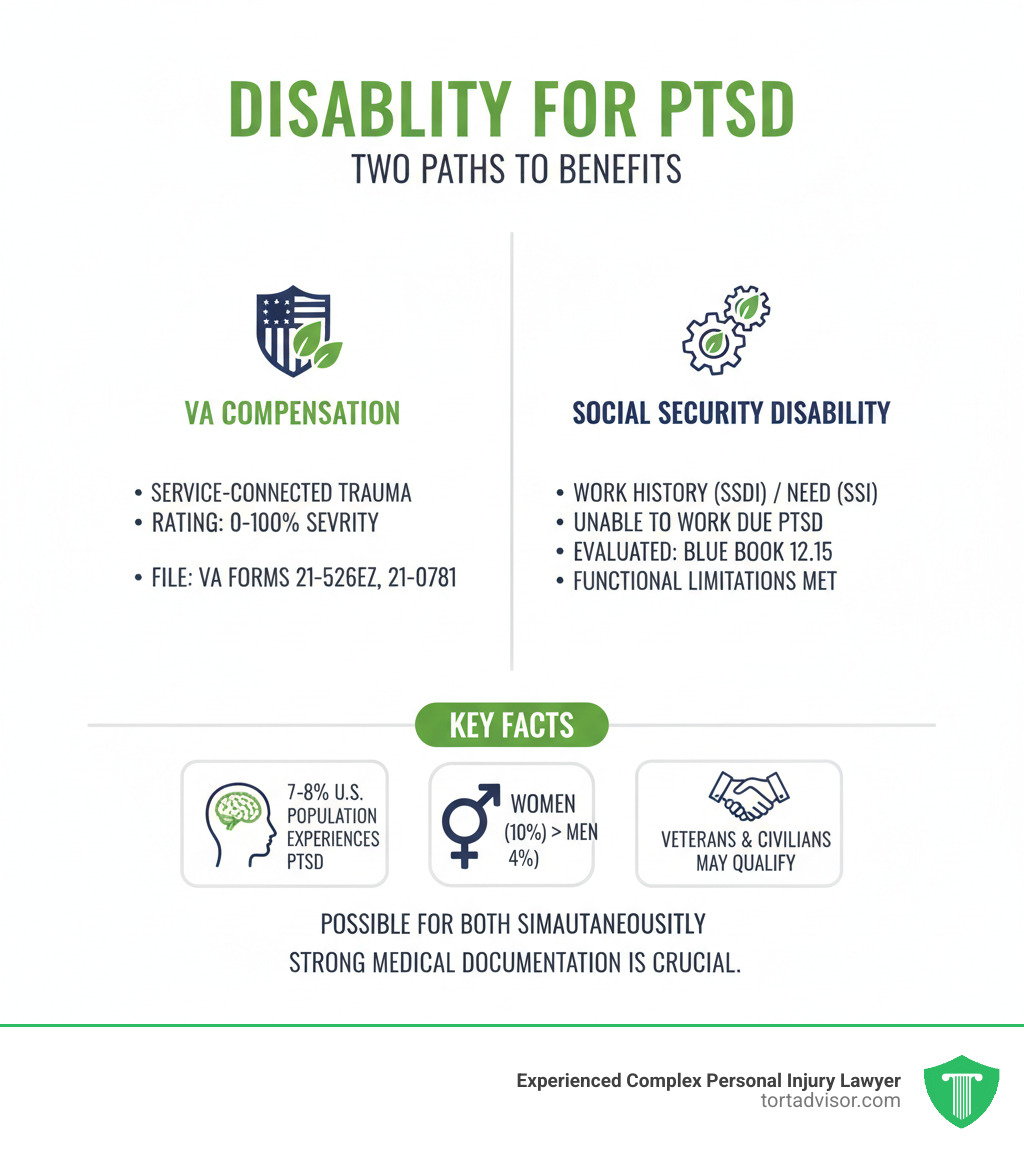
Disability for PTSD can be an essential safety net when trauma symptoms make it impossible to work. If PTSD has left you needing financial help, there are two main routes: At a Glance: Two Ways to Get Disability Benefits for PTSD
- VA Disability Compensation (veterans)
- Monthly payments that are tax-free
- Requires trauma connected to military service
- Rated from 0% to 100% depending on severity
- Filed with VA Form 21-526EZ and Form 21-0781
- Social Security Disability (SSDI/SSI) (anyone who qualifies)
- Monthly benefits based on work record (SSDI) or financial need (SSI)
- You must show PTSD keeps you from working
- Reviewed under Blue Book Listing 12.15
- Specific functional limits must be met
Key Facts:
- About 7-8% of people in the U.S. will have PTSD during their lifetime
- Women develop PTSD more often (10%) than men (4%)
- Civilians as well as veterans can qualify for benefits
- You may be able to collect VA and Social Security benefits at once
Millions of Americans live with post-traumatic stress disorder, and symptoms like flashbacks, intense anxiety, and intrusive thoughts can make steady work impossible. Whether your PTSD came from military service, a crash, or some other trauma, you deserve help. Disability programs exist for exactly this, though working through them can feel overwhelming. The VA and the Social Security Administration both treat PTSD as a potentially disabling condition, but each applies its own rules and application steps, and knowing the difference is where a successful claim begins. Medical evidence is everything, because approval hinges on what you can document. I’m Mason Arnao, and my work has helped many people pursuing disability for PTSD find the resources and experienced guidance they need. This guide explains how to qualify, walking through both the VA and Social Security processes and the steps that give you the best chance of approval.
Disability for PTSD key terms:
- Denied disability claim
- Disability appeal process
- Disability claim assistance
Your Options for Disability for PTSD
Financial support matters when PTSD disrupts your life. Two federal systems provide disability for PTSD: the Department of Veterans Affairs (VA) and the Social Security Administration (SSA). They operate independently, with different eligibility standards, applications, and definitions of “disability.”
- The VA program serves veterans whose PTSD is tied to their military service. It pays tax-free monthly compensation scaled to a severity rating between 0% and 100%, and it also opens the door to VA health care.
- Social Security covers veterans and civilians alike, replacing income through Social Security Disability Insurance (SSDI) or Supplemental Security Income (SSI) when PTSD is severe enough to stop you from working. SSDI depends on your work record; SSI depends on financial need.
You can collect from both programs at once. Separately, the Americans with Disabilities Act (ADA) is a civil rights law that guards against job discrimination and lets you ask for reasonable accommodations, though it pays no monthly benefit.
What PTSD Is and How Doctors Diagnose It
PTSD is a serious mental health condition that can follow living through or witnessing trauma such as actual or threatened death, serious injury, or sexual violence. Diagnosis requires certain symptoms that last longer than a month and substantially interfere with work, relationships, or everyday life. Clinicians rely on DSM-5 criteria, which sort symptoms into four groups:
- Reliving the event: intrusive memories, flashbacks, nightmares, and strong physical reactions to reminders.
- Avoidance: steering clear of people, places, or conversations tied to the trauma.
- Negative shifts in thinking and mood: lasting negative beliefs, emotional numbness, lost interest in activities, and feeling cut off from others.
- Hyperarousal: irritability, angry outbursts, reckless behavior, a heightened startle response, and trouble sleeping or focusing.
PTSD must be diagnosed by a qualified mental health professional such as a psychologist or psychiatrist after a full review of your symptoms and trauma history. That formal diagnosis is the cornerstone of any disability for PTSD claim. The VA offers extensive resources if you want to learn more about PTSD.
Why Medical Records Matter So Much
Your medical evidence can decide your claim. The VA and SSA both want hard proof that severe PTSD keeps you from functioning normally; your own description isn’t sufficient. Important records include:
- Treatment records: notes from every doctor, therapist, and psychiatrist you’ve seen covering diagnosis, symptoms, and treatment.
- Psychiatric evaluations: formal assessments by a psychiatrist or psychologist that objectively measure your mental state.
- Therapy notes: session records that show how you cope and what limitations the clinician observes.
- Medication history: every prescription, dose, and how well it worked, showing ongoing treatment.
- Nexus letter (VA claims): a medical professional’s statement directly tying your PTSD to a traumatic event during service.
- Lay statements: letters from family, friends, or coworkers describing how PTSD affects you day to day.
- Employment records: performance reviews or termination letters showing how symptoms affected your ability to keep a job.

Your records should tell the full story of your condition and how it affects you. The more complete and consistent they are, the stronger the claim.
Getting VA Disability Compensation for PTSD
VA disability compensation can be a lifeline for veterans living with PTSD, offering tax-free monthly payments and VA health care in recognition that service-related wounds aren’t always visible. When military trauma makes daily life hard, these benefits can provide the stability to focus on recovery. The VA publishes detailed guidance on PTSD disability compensation, and here are the essentials.
What You Need for VA Disability for PTSD
VA approval for PTSD requires meeting several conditions:
- A current diagnosis of PTSD from a qualified mental health provider.
- An in-service stressor, meaning the traumatic event happened while you were serving.
- A medical nexus linking your PTSD today to that stressor, ideally through a doctor’s nexus letter.
- Functional impairment, showing PTSD seriously affects your work, relationships, or daily life.
- An honorable or general discharge, though the VA may make exceptions when a less-than-honorable discharge was tied to untreated conditions like PTSD.
What Counts as a Traumatic Event for the VA?
The VA takes a broad view of trauma, and it isn’t restricted to combat. Qualifying stressors include:
- Combat: coming under fire, seeing casualties, or facing enemy action.
- Military Sexual Trauma (MST): sexual assault or repeated, threatening sexual harassment while serving.
- Personal assault: physical attack, stalking, or domestic abuse during service.
- Fear of hostile activity: serving where there was an ongoing, credible threat of attack.
- Non-combat events: serious accidents, natural disasters, or seeing death or grave injuries, for example as medical personnel.
What matters is that it happened during service. The VA must verify the event, though how much proof it needs depends on the kind of stressor.

Filing a VA PTSD Claim and Getting Rated
A VA claim for disability for PTSD can get complicated, so help from a Veterans Service Officer (VSO) or an accredited attorney is strongly recommended.
- Submit an “Intent to File.” It secures your effective date for back pay if you’re approved.
- File the claim. Use VA Form 21-526EZ for the application and VA Form 21-0781 to describe the stressor; you can also file online.
- Send supporting evidence. Include medical records, therapy notes, and nexus letters.
- Go to your C&P exam. The VA will arrange a Compensation & Pension (C&P) exam with a mental health examiner. Be fully candid about your symptoms and how they affect you; the examiner’s report carries great weight.
- Get your rating. The VA assigns PTSD a rating from 0% to 100% based on symptom severity and their effect on social and work functioning, using the General Rating Formula for Mental Disorders in 38 CFR Part 4. A 100% rating means total impairment.
A denial isn’t final. You can appeal, and many veterans with a denied disability claim win later with more evidence and legal help.
Qualifying for Social Security Disability (SSDI/SSI) With PTSD
The VA serves veterans, but the Social Security Administration (SSA) provides disability for PTSD to any American whose symptoms keep them from working, through two programs:
- Social Security Disability Insurance (SSDI) covers people with enough work history who paid payroll taxes, with benefits tied to lifetime earnings.
- Supplemental Security Income (SSI) is need-based, for people with limited income and assets, whatever their work history.
Under either program, PTSD must be severe enough to stop you from engaging in Substantial Gainful Activity (SGA), meaning earnings above a monthly limit, which was $1,550 in 2024 for non-blind individuals. Check the current figure when you apply.
How the SSA Reviews Disability for PTSD Claims
Social Security applies a five-step sequential evaluation to every claim:
- Are you working? Earnings above the SGA limit mean denial.
- Is the condition severe? PTSD must substantially restrict basic work tasks for 12 months or more.
- Does it match a listing? If your PTSD satisfies Blue Book Listing 12.15, you’re approved.
- Can you still do past work? If no listing is met, the SSA asks whether you could return to any previous job.
- Can you do other work? Considering your age, education, and skills, the SSA looks for other jobs in the national economy. If none fit, you qualify.
This structure explains why so many first applications fail and why detailed records are essential. Our article How to Claim Social Security Disability Insurance has more detail.
Meeting Blue Book Listing 12.15
The Blue Book sets out criteria for disabling conditions, and disability for PTSD falls under Listing 12.15, Trauma- and stressor-related disorders. Meeting it means automatic approval, which requires satisfying Paragraph A plus either Paragraph B or Paragraph C.
- Paragraph A calls for medical documentation of every core PTSD feature: trauma exposure, reliving it, avoidance, mood disturbance, and hyperarousal.
- Paragraph B requires showing that symptoms cause an extreme limitation in one, or marked limitations in two, of four areas: understanding information, interacting with others, concentrating and keeping pace, and adapting or managing oneself.
- Paragraph C covers serious and persistent cases: at least two years of documented PTSD with ongoing treatment that yields only “marginal adjustment,” meaning very little ability to adapt to daily demands.
If You Don’t Meet the Listing
Falling short of Listing 12.15 doesn’t end a claim for disability for PTSD. You may still win through a medical-vocational allowance, in which the SSA measures your Residual Functional Capacity (RFC), what you can still do despite your limits, with attention to how PTSD blocks employment. For instance:
- Focus and persistence often break down because of flashbacks and hypervigilance, making it hard to stay on task.
- Getting along with others may be hard because of irritability, paranoia, or emotional distance, ruling out team-based or customer-facing jobs.
- Showing up reliably suffers when nightmares, panic attacks, and severe anxiety make leaving home impossible.
- Handling stress is a major obstacle, since ordinary workplace pressure can set off overwhelming symptoms.
Your treatment records and therapy notes need to spell out these limits so the SSA can see your condition rules out any meaningful job.

Wondering what your monthly benefit might be? Our SSDI Benefit Calculator offers an estimate based on your work record.
VA vs. SSDI, and Where to Get Help
The systems for disability for PTSD can feel overwhelming, and the VA and Social Security have different goals and rules.
- The VA pays veterans for service-connected conditions. Payments are tax-free and depend on your rating (0-100%) and number of dependents, and you can usually work while receiving them unless you are rated unemployable.
- Social Security (SSDI/SSI) replaces income when you can’t work at all. SSDI reflects lifetime earnings and SSI pays a flat need-based amount, and you generally can’t earn above the Substantial Gainful Activity (SGA) limit ($1,550/month in 2024).
The processes differ too: the VA rates you after a C&P exam, while Social Security uses its five-step test of whether you can do any job in the national economy. The VA’s question is whether service caused your PTSD; Social Security’s is whether PTSD keeps you from working. Different questions call for different evidence and strategy.
Can You Get VA and Social Security Benefits Together?
Yes. VA disability and Social Security disability are separate federal programs, and qualifying for one doesn’t bar you from the other. A VA rating doesn’t guarantee SSDI approval, since each agency decides independently, but a high VA rating (70% or above) or a Total Disability Individual Unemployability (TDIU) finding can be strong evidence for Social Security because another federal agency has recognized serious limits. One important wrinkle: VA payments can count as income and lower your benefit if you’re applying for need-based SSI, though they don’t affect SSDI. For many veterans whose PTSD rules out civilian work, pursuing both is vital to financial stability.
How Legal Help Strengthens Your Claim
Disability claims are complicated, and first-round denials are common, all while you’re coping with PTSD. Experienced legal help can be invaluable here. Legal Lawsuit connects people pursuing disability for PTSD with experienced disability attorneys in our network. A capable disability lawyer offers key advantages:
- They know the legal standards and the evidence the VA and SSA expect.
- They help build persuasive evidence, like VA nexus letters and detailed functional reports for SSA claims.
- They file your claim correctly to prevent avoidable delays and denials.
- They handle appeals skillfully if you’re denied, representing you at hearings and tracking every deadline.
Representation at a hearing can sharply improve your odds. Attorneys know how to present a case, cross-examine vocational experts, and argue persuasively for you, and people who get professional disability claim help early tend to fare much better. You’ve already endured enough; you don’t have to fight this alone.
Disability for PTSD: Frequently Asked Questions
Answers to the questions people ask most about disability for PTSD.
How much disability can you receive for PTSD?
It depends on the program:
- VA disability: monthly pay depends on your rating (0% to 100%) and how many dependents you have; higher ratings and more dependents mean larger tax-free payments.
- SSDI: your benefit reflects your average lifetime earnings before disability, not how severe your PTSD is.
- SSI: a set federal maximum, reduced by other income, including VA disability payments.
Is disability for PTSD hard to get?
It can be. Many first claims are denied, usually because the medical evidence is thin or doesn’t link symptoms to functional limits. Approval depends on a strong, well-documented application showing how PTSD stops you from working. With careful preparation and persistence, many people with PTSD do win benefits, and good guidance helps a great deal.
What if my PTSD claim is denied?
A denial isn’t the end. The VA and SSA both offer several levels of appeal, and many claimants succeed on appeal.
- VA appeals: file a Supplemental Claim with new evidence, ask for a Higher-Level Review, or appeal to the Board of Veterans’ Appeals.
- SSA appeals: usually Reconsideration, then an Administrative Law Judge (ALJ) hearing, Appeals Council review, and possibly federal court.
Every appeal has strict deadlines, so act fast. Legal representation is strongly advised during appeals to protect your rights and present your case well. Our resources on SSDI Lawsuits cover denials in more depth.
Conclusion
If you’re pursuing disability for PTSD, you’re not alone, and help exists. PTSD is a serious, recognized disability that can deeply affect your ability to work. To give your claim its best chance:
- Obtain a formal diagnosis from a qualified mental health provider.
- Collect thorough medical records describing your symptoms and treatment.
- Learn each system’s rules: service connection for the VA, inability to work for Social Security.
- Document your functional limits clearly, showing how symptoms keep you from working.
The process is tough and early denials are common. The forms pile up and the waiting can be agonizing, but you don’t have to handle it alone. Legal Lawsuit connects people with experienced disability attorneys in our network who understand both VA and Social Security law and know how to advocate for you. The right lawyer can mean the difference between years of frustration and finally getting the benefits you deserve, and our network reaches all 50 states. Don’t let a complicated system stop you; whether this is your first application or an appeal, a free, confidential case review is a smart next step. Find experienced legal help for your SSDI lawsuit
Additional Resources
Related Posts
Quick Answer: The Boy Scouts of America (BSA) filed for Chapter 11 bankruptcy in 2020 after facing tens of thousands [...]
Quick Answer: Survivors of sexual abuse by Catholic priests, nuns, or other Church personnel may be able to file a [...]
Quick Answer: Clergy abuse settlements vary enormously based on the severity of the abuse, the strength of evidence that the [...]