
Short answer: This article explains the key facts, eligibility issues, settlement factors, deadlines, and source-backed updates related to this legal topic. Results vary by case facts, evidence, jurisdiction, and representation.
In This Guide
Why the Disability Appeal Process Matters
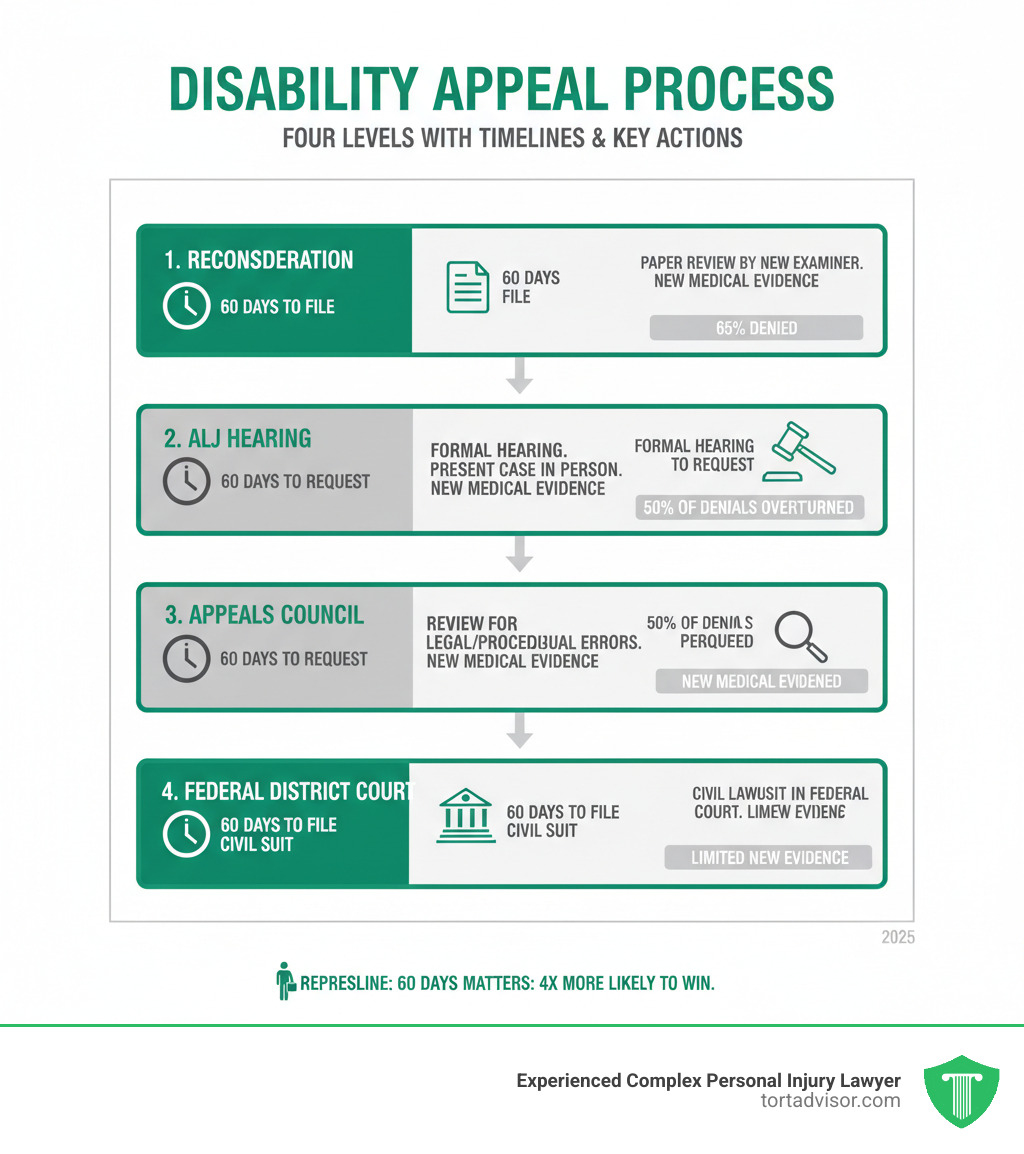
A denial letter from the Social Security Administration (SSA) is crushing, but it is rarely the final word. The SSA turns down roughly 65% of first-time disability applications, and the disability appeal process exists precisely because of that. It is a four-stage system that gives you another chance to prove your claim:
- Reconsideration: A fresh paper review by another examiner.
- Administrative Law Judge (ALJ) Hearing: A formal hearing where you present your claim.
- Appeals Council Review: A check of the judge’s decision for legal mistakes.
- Federal District Court: A civil lawsuit filed in federal court.
The SSA recognizes that first decisions are sometimes wrong; administrative law judges reverse close to half of the denials they review. Frequent reasons for denial, such as thin medical evidence or not following prescribed treatment, can often be corrected on appeal. Deadlines are short. You have 60 days from the date on your denial notice to file the first appeal, and missing it can force you to start over and lose months of back pay. Data also shows that represented claimants tend to fare considerably better. This guide explains each level so you know your rights and can improve your odds.
More on the disability appeal process:
- Denied disability claim
- Disability claim assistance
- how to claim social security disability insurance arkansas
The Four Levels of the Disability Appeal Process
The disability appeal process gives you four separate opportunities to win. At each level you generally have 60 days after receiving a decision to appeal, and missing a deadline usually means beginning again, so staying on schedule is essential.
Level 1: Reconsideration
Following a denial, you have 60 days to ask for reconsideration, a paper review handled by an examiner who has never seen your file. They look at everything originally submitted plus any new medical evidence, which makes this the moment to add updated opinions from your doctors, recent test results or records showing your condition has worsened. Form SSA-561 can be filed online. Most claims are denied again here, which leads to the more promising next stage.
Level 2: The Administrative Law Judge (ALJ) Hearing
Your odds improve substantially at this stage. An ALJ hearing is a de novo review, so the judge evaluates the case from scratch without deferring to earlier denials. For the first time, you can testify in person or by video, describe your daily challenges and have your representative present arguments and question witnesses. The judge may call a vocational expert to address which jobs you could perform or a medical expert to comment on your condition, and your attorney can cross-examine them to keep their testimony accurate. The decision may be ‘fully favorable’ (complete approval) or ‘partially favorable’ (approval with a later onset date or for a limited period). Approval rates peak here, particularly for represented claimants.
Level 3: Appeals Council Review
If the judge rules against you, you have 60 days to request Appeals Council review. There is no new hearing; the Council checks the decision for legal or procedural errors, such as misapplied SSA rules or overlooked evidence, and you may file a written brief explaining the flaws. New evidence counts only if it is “new, material, and chronologically relevant” to the period up to the judge’s decision. The Council may deny review, remand the case to a judge for a new hearing or, occasionally, decide the case itself.
Level 4: Federal District Court
If the Appeals Council declines review, your last option is a civil suit in Federal District Court, filed within 60 days. The federal judge does not take new testimony but reviews the whole administrative record to decide whether the SSA’s final decision rests on “substantial evidence” and applied the law properly. The argument is about legal error rather than re-proving your medical case. The court may affirm the denial, reverse and award benefits (uncommon) or remand for another hearing. This stage demands real legal skill, making an experienced attorney essential.
What Makes a Disability Appeal Succeed
Your disability appeal process is a construction project: it needs good materials, careful timing and a clear plan. Success usually depends on three things: strong medical evidence, meeting every deadline and understanding the rules of your program (SSDI or SSI).

The Evidence a Strong Appeal Needs
Medical proof is the core of any appeal, and a diagnosis alone is not enough; you must document your functional limitations.
- Medical Source Statements: Detailed reports from your treating doctors describing your prognosis and, above all, how your condition restricts work activities such as sitting, lifting and concentrating.
- Residual Functional Capacity (RFC) Forms: Completed by your doctor, these spell out what you can still do despite your impairments.
- Objective Test Results: MRIs, X-rays, lab work and psychological testing offer concrete, measurable support.
- Treatment Records: A full history of appointments, therapy, medications and hospital stays shows you are actively treating your condition.
- Third-Party Statements: Friends or relatives can back up your account by describing how your disability affects everyday life.
How the Disability Appeal Process Differs for SSDI and SSI
Both programs use the same four appeal levels, but their underlying requirements are not the same.
- Social Security Disability Insurance (SSDI) depends on your work record, so appeals focus almost entirely on showing your condition keeps you from working.
- Supplemental Security Income (SSI) is need-based. Beyond the medical question, you must satisfy strict income and asset limits, and an SSI appeal may call for updated financial records.
These differences also change how back pay is figured. For medical denials, however, proving disability works the same way in both programs. The SSA publishes guidance specifically on the SSI appeals process.
Key Deadlines and How to Track Your Appeal
The most important rule is the 60-day filing deadline at every level. The SSA adds a 5-day mailing grace period, but act right away; a missed deadline usually means a new application and lost back pay, and showing “good cause” for lateness is hard. You can track your appeal through your online ‘my Social Security’ account, by calling the SSA’s national toll-free line listed on SSA.gov or by visiting a local office. If you have a representative, they will manage communication and keep you informed.
Why Representation Helps in a Disability Appeal
The disability appeal process is full of legal traps, and a qualified disability attorney or representative can greatly improve your outcome. Most work on contingency and are paid only if you win. Fees are capped by law at 25% of past-due benefits, subject to a maximum set by the SSA (raised to $9,200 in late 2024), so no money is needed up front. Legal Lawsuit helps people connect with attorneys in our network because everyone deserves skilled advocacy. Learn more at Disability Claim Assistance.
When to Bring in a Lawyer
Sooner is better. Right after the first denial is a good time, since an attorney can analyze the decision, find gaps in your file and strengthen the reconsideration request. Representation becomes critical before an ALJ hearing, a formal legal proceeding where your attorney prepares you to testify, cross-examines SSA experts and submits legal arguments. A lawyer is also worth considering if your medical situation is complex or you are uneasy speaking in formal settings, and they make sure no deadline slips by and costs you your appeal rights.
What the Numbers Say About Representation
The data consistently favors having help.
- Some analyses have found represented claimants roughly four times as likely to win at the hearing level.
- Reported figures show about 56% of represented claimants approved, compared with roughly 33% of those without help.
Those trends make sense: an experienced attorney knows how to gather the right medical evidence, prepare you for testimony and challenge expert opinions that hurt your claim. The SSA has trained professionals on its side, and you should too.
Disability Appeal FAQs
Answers to frequent questions about the disability appeal process.
My benefits were stopped. How do I appeal a medical cessation?
If a Continuing Disability Review (CDR) leads the SSA to decide you are no longer disabled, it will move to end your benefits, and you can appeal.
- You have 60 days from the notice date to appeal using Form SSA-789.
- Importantly, you have just 10 days after receiving the notice to ask for “benefit continuation,” which keeps payments going while the appeal is pending.
Miss that 10-day window and payments stop during the appeal, which then follows the usual four-level path. Because the deadlines are tight and the rules, described in the SSA’s guidance on what to do if benefits stop, are complicated, getting legal help quickly is strongly advised.
Can I add new evidence at each appeal stage?
Yes, and you should. Keeping your file current with new medical evidence makes your claim stronger.
- Reconsideration: Send new test results, specialist reports or doctor’s notes that fill gaps in your original application.
- ALJ Hearing: A prime chance to show how your condition has changed over time; submit evidence at least five business days before the hearing.
- Appeals Council: Stricter rules apply, and new evidence is usually considered only if it is “new, material, and chronologically relevant” to the period up to the judge’s decision.
How does reconsideration differ from an ALJ hearing?
The first two stages of the disability appeal process work very differently.
- Reconsideration is a paper-only review. A new examiner reads your file and any added documents, with no face-to-face contact, and decides based on the written record. Most claims are denied here.
- An ALJ Hearing is a live proceeding. You testify before a judge in person or by video, describe your limitations in your own words and have your attorney argue and question witnesses. The judge decides anew, and this stage offers the best chance of approval.
Securing the Benefits You Earned
The disability appeal process involves four review levels, firm 60-day deadlines and demanding evidence standards, but a denial is not the end. The system offers several chances to prove your claim, and persistence pays: many people denied early win at an ALJ hearing or later. The data indicates that representation substantially improves your odds, because an experienced disability attorney helps you build the strongest record, meet every deadline and prepare for your hearing. Legal Lawsuit’s goal is to help you connect with an experienced attorney in our network who will advocate for you. Your disability shapes every day of your life, and you deserve skilled help. You do not have to face this process alone. Get help with your disability claim through a free, confidential case review.
Additional Resources
Related Posts
Quick Answer: The Boy Scouts of America (BSA) filed for Chapter 11 bankruptcy in 2020 after facing tens of thousands [...]
Quick Answer: Survivors of sexual abuse by Catholic priests, nuns, or other Church personnel may be able to file a [...]
Quick Answer: Clergy abuse settlements vary enormously based on the severity of the abuse, the strength of evidence that the [...]