Short answer: This article explains the key facts, eligibility issues, settlement factors, deadlines, and source-backed updates related to this legal topic. Results vary by case facts, evidence, jurisdiction, and representation.
In This Guide
Why SSDI Application Tips Can Make or Break Your Claim
Following proven SSDI application tips can decide whether you are approved or turned down. The Social Security Administration (SSA) denies a large majority of SSDI claims at the first stage, a figure often cited at around 70%, frequently because of fixable mistakes in a complicated process rather than because the person is not disabled. Key steps that improve your odds:
- Learn how the SSA defines disability: Your condition must stop you from substantial work and last at least 12 months.
- Collect all medical evidence: Doctor’s notes, test results and treatment records.
- Track daily life: Keep a journal of symptoms, pain and everyday struggles.
- Confirm your work credits: Make sure your work history is long enough.
- Stay honest and consistent: Contradictions can sink a claim.
- Prevent common mistakes: Fill out every form correctly and hit every deadline.
- Get your doctors involved: Their opinions and RFC assessments carry great weight.
- Think about getting help: Representation is widely reported to improve approval odds.
Applying for SSDI can feel daunting, with rigid rules and stacks of paperwork that trip up even people who truly qualify, and a claim that goes through appeals can take more than two years. Use this guide as your roadmap to a strong application: what the SSA looks for, which documents carry the most weight and how to sidestep the most common mistakes, whether this is your first filing or an appeal.
Related SSDI application topics:
- Denied disability claim
- Disability claim assistance
SSDI vs. SSI and the Eligibility Rules

Before applying any SSDI application tips, get familiar with the rules. The SSA’s definition of disability is narrow and demanding, and understanding it can spare you months of frustration.
How the SSA Defines Disability
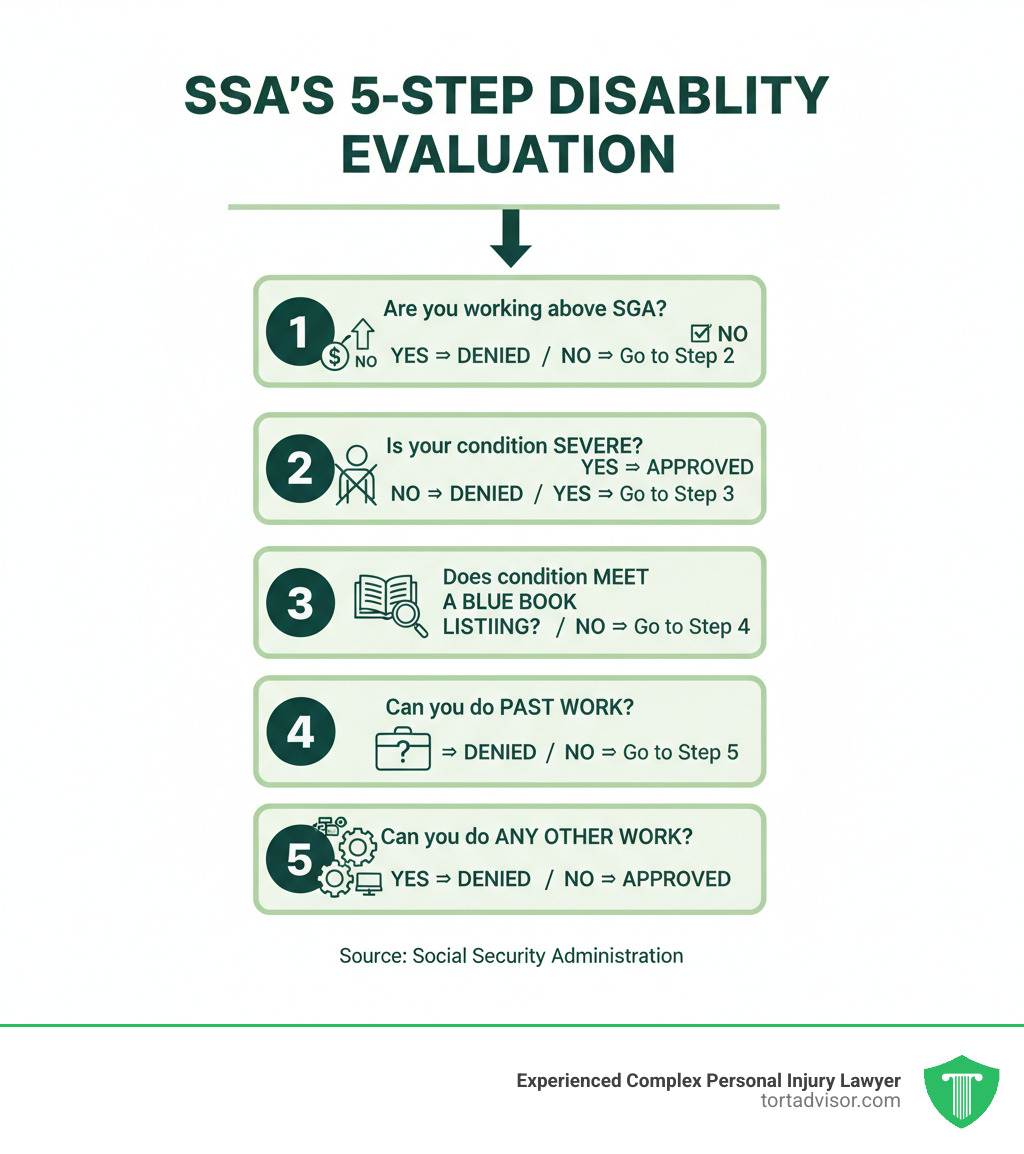
The SSA requires three things. First, a medically determinable physical or mental impairment supported by objective proof such as scans or lab work; your own description is not enough. Second, the condition must have lasted, or be expected to last, at least 12 months in a row, or be expected to result in death; if your doctor predicts recovery within a year, you will not qualify. Third, the impairment must keep you from Substantial Gainful Activity (SGA), meaning work that pays above a set income level. The SSA applies this tight definition through a five-step evaluation, which is a big reason so many first applications fail.
How SSDI and SSI Differ
Social Security runs two separate disability programs: Social Security Disability Insurance (SSDI) and Supplemental Security Income (SSI). SSDI is insurance funded by the payroll taxes you paid, so eligibility depends on having enough work credits, and your benefit reflects your lifetime average earnings. SSI is a need-based program for disabled people with little income and few assets, with no work history required. Its financial limits are strict: an individual may have no more than $2,000 in countable resources ($3,000 for a couple).
| Feature | SSDI (Social Security Disability Insurance) | SSI (Supplemental Security Income) |
|---|---|---|
| Program Type | Insurance for workers and their families | Need-based help for people with limited income and assets |
| Eligibility | Depends on work history and FICA taxes paid (work credits) | Depends on financial need (low income, few assets) |
| Work Credits | Needed; usually 40 credits, 20 of them earned in the past 10 years | Not needed; no work history required |
| Benefit Amount | Based on lifetime average earnings | Set federal amount, which some states add to |
| Medical Criteria | Must satisfy the SSA disability definition | Must satisfy the SSA disability definition |
| Spouse/Children | Family members may collect on your record | Usually no added benefits for family |
Some people qualify for both. Learn more about the differences between SSDI and SSI to see which program fits your situation.
Non-Medical Rules: Work Credits and SGA
Having a qualifying condition is not enough; you must also clear the non-medical hurdles. Work credits are the foundation of SSDI and come from working and paying Social Security taxes. In 2024, each $1,730 in earnings counted as one credit, with a maximum of four a year. Most applicants need 40 credits, 20 of them earned in the 10 years before becoming disabled, though younger workers can qualify with fewer. Substantial Gainful Activity (SGA) also matters a great deal: if the SSA decides you are performing SGA, it denies the claim without even reviewing your medical records. For 2024, earnings over $1,550 a month ($2,590 for blind applicants) generally counted as SGA. These limits change every year, so check the current thresholds, and if you work part-time while applying, watch your earnings closely.
Age, Education and Compassionate Allowances
For applicants 50 and older, the SSA uses “Grid Rules” that recognize how much harder it is to retrain later in life, weighing age, education and work background. An older worker with a physical labor history often has better odds than a younger, college-educated applicant with similar health problems. The Compassionate Allowances (CAL) program speeds up claims for very serious conditions such as aggressive cancers, ALS and early-onset Alzheimer’s, so approval can come in weeks rather than months. Review the Compassionate Allowances list and clearly flag your condition on the application if it appears there.
The Records and Medical Evidence You Need
Strong claims rest on strong proof, and careful preparation is among the most effective SSDI application tips.
Why Complete Medical Records Matter
Medical records are the core of any claim. The SSA leans on objective medical proof to judge how severe your condition is, so your claim is only as good as its documentation. Collect everything connected to your condition, such as:
- Physician notes and reports describing diagnoses, symptoms, treatment and functional limits.
- Lab work and imaging such as X-rays, MRIs and CT scans.
- Hospital records, including emergency visits and discharge summaries.
- Notes from physical and occupational therapy.
- A full list of medications, including doses and side effects.
- Surgical reports.
You are responsible for giving the SSA correct contact details for every provider; missing records can slow things down considerably.
Your Doctor’s Role and Staying in Treatment
Your treating doctors can be your strongest supporters. Tell them about your claim and talk through how your condition limits your work. Input from specialists can carry extra weight, particularly for conditions such as fibromyalgia or chronic fatigue. One essential SSDI application tip is to keep up regular care and follow your doctor’s treatment plan, because gaps can suggest your condition is not serious; if you are uninsured, look into Medicaid so care stays consistent. Also ask your doctor to fill out a Residual Functional Capacity (RFC) assessment, which spells out what work-related tasks you can do (sitting, standing, lifting and so on) and is among the most valuable evidence you can submit.
SSDI Application Tips for Documenting Your Condition
Your own account is key to showing how disability shapes daily life. Keep a disability journal recording daily challenges, pain levels, how often symptoms hit and medication side effects. Be precise: rather than “my back hurts,” write “Back pain hit 8/10 today; after standing 10 minutes I had to lie down for three hours.” Details like these show the SSA the real impact. On forms, explain how symptoms restrict specific activities with concrete examples, and review the SSA’s Blue Book of impairments that can qualify automatically; knowing whether your condition meets or equals a listing helps you frame your application.
Getting Organized With the SSA Starter Kit

The SSA’s Adult Disability Starter Kit is a valuable tool. Before you start, set up a ‘my Social Security’ account so you can review your earnings record and follow your claim. Have this information ready:
- Personal information: Date of birth, Social Security number and citizenship status.
- Family details: Dates of marriage or divorce and information about your spouse and children.
- Employment history: Jobs held over the last 15 years, with duties, dates and pay.
- Provider contacts: Names, addresses and phone numbers for every doctor, hospital and clinic.
- Tests and prescriptions: A full list of medical tests and current medications.
The Adult Disability Starter Kit is available on the SSA website, and pulling this information together in advance makes applying much easier.
Completing the Forms: Key SSDI Application Tips

With your records in hand, it is time to fill out the application itself, where accuracy counts.
The Function Report and Work History Report
Two forms matter most: the Function Report (SSA-3373-BK) and the Work History Report (SSA-3369-BK). The Function Report lets you show what daily life is really like, so be specific: instead of “I can’t clean,” explain why, such as “After 10 minutes on my feet the back pain is unbearable, so I can’t vacuum.” The Work History Report covers your jobs from the past 15 years and helps the SSA decide whether you could return to past work. Describe the physical and mental demands in detail; a former retail manager, for example, should mention the standing, lifting (such as 40-pound boxes) and stress, then explain why those tasks are no longer possible. As a rule, longer, detailed answers beat short ones, and you should write “N/A” rather than leave a question blank.
Advanced SSDI Application Tips: Why the SSA Asks What It Asks
Honesty and consistency come first. Do not overstate anything; conflicts between your forms, medical records and interviews can wreck your credibility. Describe both good and bad days, for example: “My pain runs from 5/10 to 8/10, and about four days a week it reaches 8/10, when I can’t do anything productive.” The SSA cares about medical evidence and functional limits, not financial hardship, lack of transportation or the local job market, so keep to facts about why you cannot work. For your SSA interview, bring organized documents and give direct answers that match what you wrote.
Mistakes to Avoid on Your Application
A large share of first-round denials come from avoidable errors. Watch out for these:
- Blank or incomplete forms: Respond to every question, even if the answer is “none” or “not applicable.”
- Missed deadlines: You get 60 days to appeal a denial; miss it and you usually start from scratch.
- Thin medical evidence: Submit detailed records and explain any breaks in treatment.
- Conflicting details: Keep your statements consistent across forms and with your medical records.
- Earning over SGA: Making too much while your claim is pending can trigger an automatic denial, so monitor your income.
- Leaving out conditions: The SSA looks at the combined effect of all impairments, so list everything that limits you.
- Misplacing your re-entry number: When applying online, save the number that lets you return to an unfinished application.
- Not cooperating: Go to every scheduled exam, including any Consultative Examination, and answer SSA requests quickly.
SSDI Timeline, Appeals and When to Get Help
Once you submit, the waiting starts. Knowing what comes next helps you plan.
How Long an SSDI Decision Takes
SSDI moves slowly. A first decision usually takes three to five months, and with appeals the whole process can stretch past two years. Your file goes to a state agency, Disability Determination Services (DDS), for medical review; its staff examine your records, may contact your doctors and may send you to a Consultative Examination (CE) with one of their physicians if they need more information. Attend that exam and be candid about your limits. Long waits are normal, so plan accordingly.
Appealing a Denied SSDI Claim
Most first-time SSDI applications are denied, often cited at around 70%, but a denial is frequently not the end, and many people win on appeal. You have 60 days from a denial to file an appeal, and missing that window usually means starting over. Appeals move through four stages:
- Reconsideration: A different DDS reviewer looks at the claim; denials are common here as well.
- Administrative Law Judge (ALJ) Hearing: Often the best opportunity for approval. You can make your case in person with an attorney, though waits can run a year or more.
- Appeals Council: If the judge denies the claim, you can ask the Appeals Council to review it.
- Federal District Court: The last step, which means filing a lawsuit.
The 60-day limit applies at every level, so knowing what to do after a denial is essential.
Why Hiring a Disability Attorney Can Help

Because the process is complicated and denial rates are high, an experienced disability attorney is worth considering, and representation is widely reported to improve the odds of approval. Disability attorneys work on contingency, so they are paid only if you win, and federal law caps the fee at 25% of your back pay, up to a maximum set by the SSA. If you lose, you owe no attorney fee. Attorneys are particularly helpful at the ALJ hearing, where they know what evidence judges look for, how to present the case and how to manage the paperwork, freeing you to focus on your health. Legal Lawsuit offers disability claim assistance by connecting people with experienced disability attorneys in our network through a free, confidential case review.
Extra Resources and Special Circumstances
The SSA has help for special situations. Vocational Rehabilitation (VR) services can help you try returning to work, and an unsuccessful attempt can actually support your claim. The SSA also offers free interpreters and special procedures for people experiencing homelessness, and the Privacy Act of 1974 protects your personal information.
SSDI Application FAQs
Answers to the questions people ask most about applying for SSDI.
How can I get approved for disability faster?
There is no shortcut, but you can speed things up. Approval comes fastest when a condition meets a Blue Book listing or qualifies under Compassionate Allowances (CAL) for severe illnesses. For everyone else, the most useful SSDI application tip for a quicker decision is to file a complete, well-documented application the first time. When the SSA has every record it needs at the outset, there are fewer delays from follow-up requests.
Can I apply for SSDI while working part-time?
Yes, but your earnings must stay under the Substantial Gainful Activity (SGA) limit. In 2023 that limit was $1,470 a month for most people ($2,460 for blind applicants), and it changes each year, so check the current figure. Earn above it and the SSA will probably deny the claim; earn below it and the SSA will still look at the kind of work you do to judge whether you could sustain a job. Be ready to explain your reduced hours or any special accommodations.
What does a disability lawyer cost?
Many people worry about this, but disability lawyers work on contingency, so you pay no attorney fee unless you win. If you do, federal law limits the fee to 25% of past-due benefits (back pay), up to a set cap (about $9,200 in recent years, subject to change). For example, on $20,000 in back pay the fee would be $5,000. This “no win, no fee” approach makes skilled help affordable, and getting disability claim assistance is a low-risk way to strengthen your claim.
Taking Charge of Your SSDI Claim
Living with a disabling condition while dealing with the SSA is hard, but approval is achievable. The SSDI application tips in this guide are practical ways to pursue the benefits you have earned. Preparation is what matters most. Approval often hinges on how well you document your condition and explain your limits, and meeting the SSA’s specific requirements is the key. The process can take months or years, which is where professional guidance pays off: an experienced disability attorney knows what the SSA needs, handles appeals and works on contingency, so you pay only if you win. Legal Lawsuit connects people with experienced disability attorneys in our network through a free, confidential case review, because everyone deserves strong representation when their financial security is on the line. Do not let the system wear you down; by learning how it works, you have already taken the first step toward securing your benefits. Disclaimer: This article offers general information, not legal advice. The SSDI process is complex and every situation is different, so consider speaking with a qualified disability attorney about your circumstances.
Additional Resources
Related Posts
Quick Answer: The Boy Scouts of America (BSA) filed for Chapter 11 bankruptcy in 2020 after facing tens of thousands [...]
Quick Answer: Survivors of sexual abuse by Catholic priests, nuns, or other Church personnel may be able to file a [...]
Quick Answer: Clergy abuse settlements vary enormously based on the severity of the abuse, the strength of evidence that the [...]