

Short answer: This article explains the key facts, eligibility issues, settlement factors, deadlines, and source-backed updates related to this legal topic. Results vary by case facts, evidence, jurisdiction, and representation.
📋 Table of Contents
- Understanding Your Path to Financial Support During Cancer Treatment
- Understanding Your Disability Options: SSDI vs. SSI
- How a Cancer Diagnosis Qualifies for Social Security Disability
- The Step-by-Step Guide to Applying for SSDI
- What to Do If Your SSDI Claim for Cancer Is Denied
- Frequently Asked Questions about SSDI and Cancer
- Conclusion
Cancer Disability Benefits: Getting Financial Support During Treatment
Cancer disability benefits through SSDI pay a monthly check to people whose cancer keeps them from working. The main ways to qualify:
- Fast-track approval under Compassionate Allowances for aggressive cancers (metastatic, inoperable or recurrent).
- Matching a Blue Book listing by meeting the medical criteria in Section 13.00.
- Medical-vocational allowance when treatment side effects rule out any kind of job.
- Baseline rule: The cancer must keep you out of work for at least 12 months or be terminal.
SSDI eligibility requires enough work history with Social Security taxes paid. SSI eligibility depends on limited income and assets, whatever your work record. A cancer diagnosis quickly raises the question of how the bills will get paid if you can’t work, and many people face the same worry. Treatment side effects such as chemotherapy fatigue, post-surgical pain and radiation-related cognitive problems frequently make full-time work impossible. Social Security Disability Insurance (SSDI) is the federal program built to replace part of your income when a serious health condition stops you from working. Getting approved is hard, though: the Social Security Administration (SSA) turns down roughly 70% of first-time disability applications, and many cancer patients who should qualify are denied simply because they don’t know what evidence the SSA wants. This guide from Legal Lawsuit clears that up. It explains how cancer qualifies, which medical records matter and how to make your claim stronger, whether your diagnosis is on the Compassionate Allowances list or you need to show how treatment has affected your ability to work. Knowing your SSDI rights can mean the difference between financial strain and stability while you are in treatment, and you don’t have to go through the process alone.
Related resources:
SSDI vs. SSI: Which Cancer Disability Program Fits You?
Before you file, figure out which Social Security program matches your circumstances. The SSA runs two separate programs, Social Security Disability Insurance (SSDI) and Supplemental Security Income (SSI). Each pays monthly benefits when cancer keeps you from working, but they follow different rules. Put simply, SSDI is insurance paid for by the FICA taxes you contributed while working, whereas SSI is need-based and serves people with limited income and assets regardless of work history. Some people qualify for both.
How SSDI Works
SSDI is a benefit you earn. The FICA taxes taken from your paychecks build “work credits,” and most people need 40 credits, 20 of them earned in the 10 years before the disability started (younger workers need fewer). The amount you receive reflects your average lifetime earnings, not your current finances, so savings, property or a spouse’s income do not affect eligibility. An approved SSDI claim for cancer also leads to Medicare after a 24-month waiting period, which is a crucial resource for continuing treatment.
How SSI Works
SSI gives financial help to disabled adults and children who have low income and few assets, no matter their work history, acting as a safety net for people who have not worked enough to get SSDI. Its financial limits are strict, and the SSA counts your income and resources, such as cash, bank balances and property, to decide eligibility. A big advantage of SSI is Medicaid eligibility, usually right away, which can be worth more than the monthly payment when treatment is expensive. For details straight from the Social Security Administration, see: More info about SSDI and SSI (https://www.ssa.gov/benefits/disability/) and Supplemental Security Income (SSI) information (https://www.ssa.gov/ssi).
| Feature | SSDI | SSI |
|---|---|---|
| Eligibility | A work record with FICA taxes paid | Low income and few assets |
| Funding Source | Paid from Social Security trust funds | Paid from general tax revenue |
| Benefit Basis | Tied to average lifetime earnings | Tied to financial need |
| Work History | Required | Not required |
| Health Insurance | Medicare (after 24 months on benefits) | Medicaid (typically right away) |
In short: cancer patients with a solid work record usually apply for SSDI, while those with little work history or very limited means should look at SSI. If a thin earnings record makes your SSDI check small, you may be eligible to receive both programs at once.
How Cancer Qualifies for Social Security Disability Benefits
The SSA wants to know how your cancer affects your capacity to work; a diagnosis alone does not qualify you. Your condition has to stop you from performing “substantial gainful activity” (SGA) and be expected to last at least 12 months or end in death. The agency needs hard evidence that the cancer, its treatment and the side effects make work impossible. There are three main routes to cancer disability benefits, each reflecting a different way the disease can limit you.

Fast-Track Approval: Compassionate Allowances (CAL)
Compassionate Allowances (CAL) is the SSA’s express lane for claims involving aggressive, severe cancers, letting qualifying cases be approved in weeks rather than months. CAL covers more than 50 cancer types, mostly those that are metastatic, inoperable or have come back after treatment, such as acute leukemia, pancreatic cancer and inflammatory breast cancer. Because the SSA has already decided these conditions meet its standards, claims move quickly. Check the full List of Compassionate Allowances Conditions to see whether your diagnosis is included, and name the CAL condition in your application to help speed things along.
Qualifying for Cancer Disability Benefits Under the Blue Book
If your cancer is not on the CAL list, you may still qualify by meeting the SSA’s “Blue Book,” formally the Listing of Impairments. The cancer listings in Section 13.00 spell out the medical evidence required, and meeting a listing means the SSA treats you as disabled without looking at your job skills. Frequently used criteria include:
- Distant metastases, meaning cancer that has spread well beyond where it started
- Recurrence following treatment
- A tumor that is inoperable or unresectable
Some listings also look at tumor features such as size, location and cell type, or at how the cancer responded to treatment. Pathology, imaging and surgical reports are essential, and your oncologist’s notes need to describe the extent of the disease and its response to therapy clearly enough to match these exact criteria.
Qualifying Without a Listing: Medical-Vocational Allowance
Plenty of cancer patients do not meet a Blue Book listing yet still cannot work. For them, the SSA evaluates Residual Functional Capacity (RFC), meaning what you are still able to do despite your illness. Cancer treatment is punishing: overwhelming fatigue, nausea, neuropathy (nerve damage) and cognitive problems often called “chemo brain” can make working impossible, and radiation, immunotherapy and targeted drugs bring disabling side effects of their own.

An RFC assessment records all of these limits, for example that fatigue keeps you from sitting longer than an hour or that neuropathy prevents you from using your hands. The SSA weighs your RFC together with your age, education and work history to decide whether any job remains that you could do. If no job fits that combination, you can be approved through a medical-vocational allowance, a route that is essential for showing how cancer and its treatment actually affect your daily functioning.
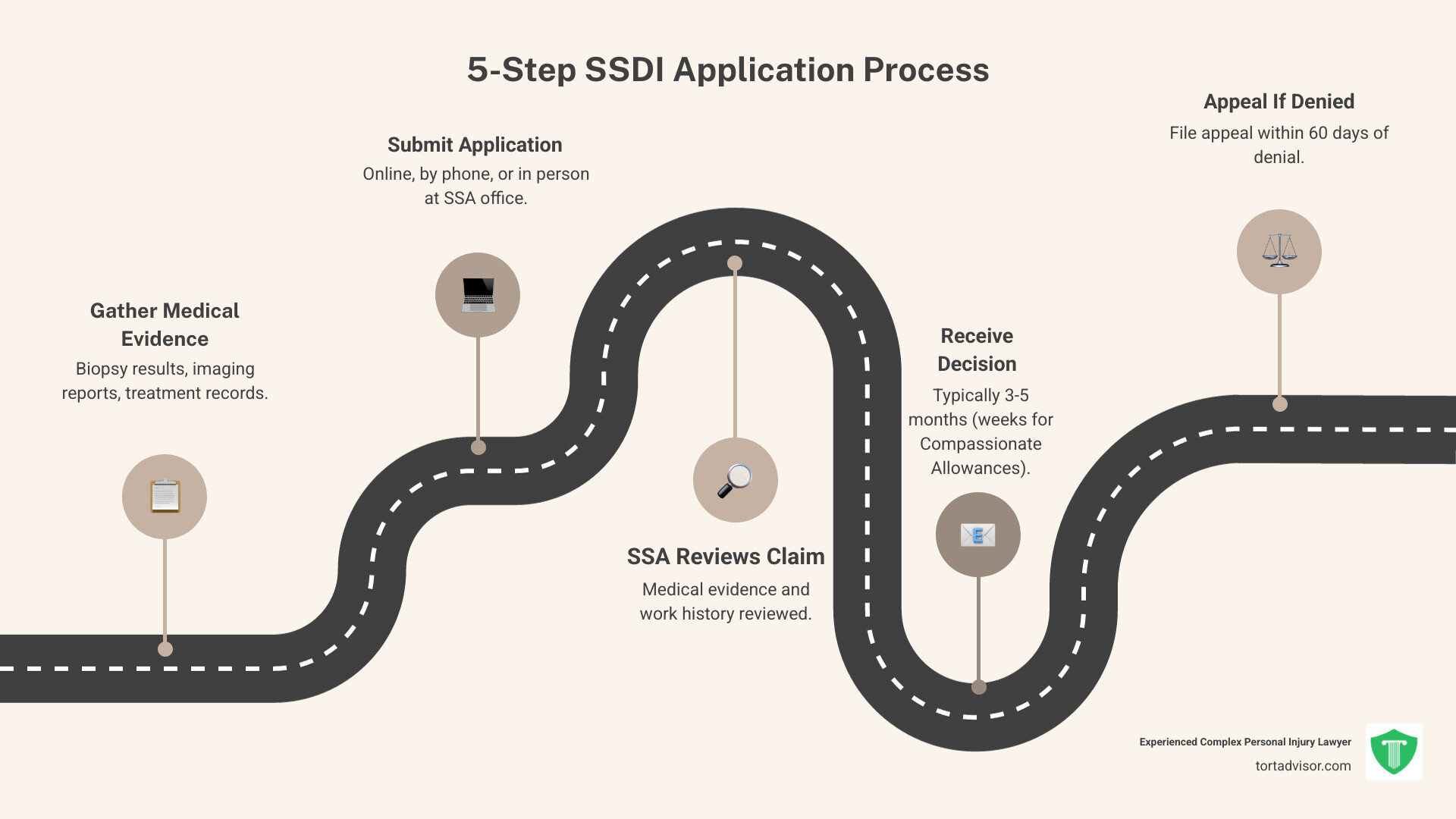
How to Apply for Cancer Disability Benefits, Step by Step
A successful SSDI for cancer application takes planning and organization. Many denials happen not because the person isn’t eligible but because key evidence was missing, and the SSA needs a full, detailed medical picture to say yes. Try our SSDI benefit estimate calculator

Collecting the Medical Evidence You Need
Your medical records are what prove your cancer is disabling, so thorough documentation is essential. The most important records:
- Biopsy and pathology reports: Confirm the diagnosis, the type of cancer and its stage.
- Imaging reports: Every CT, MRI, PET scan and X-ray showing where the tumor is, how big it is and whether it has spread.
- Oncologist’s notes: Should describe your symptoms, the effects of treatment and the functional limits, such as fatigue or neuropathy, that keep you from working. A detailed statement from your doctor can carry a lot of weight.
- Treatment records: Each round of chemotherapy, radiation, surgery and immunotherapy, with dates, doses and how you responded.
- Medication list: Every prescription and over-the-counter drug you take, plus side effects such as drowsiness, confusion or “chemo brain.”
Gaps in your records weaken your claim, so ask your oncology team to help you collect documents from other providers.
Filing Your Application
With your evidence ready, you can file. The SSA accepts claims three ways:
- Online: Use secure.ssa.gov/iClaim/dib to apply at your own pace and upload documents directly.
- By Phone: Call the SSA’s national toll-free number, listed on SSA.gov (TTY service is available), to get help from a representative.
- In-Person: Go to your local Social Security office (https://secure.ssa.gov/ICON/main.jsp), ideally with an appointment to avoid a long wait.
Once you file, your state’s Disability Determination Services (DDS) reviews the medical evidence and decides your claim. Compassionate Allowances cases may take a few weeks, while others commonly take three to five months. Answer any requests for more information promptly to prevent delays. Our guide to the disability benefits application (https://legallawsuit.com/disability-benefits-application/) offers more help with the process.
If Your Cancer Disability Claim Is Denied
A denial letter is discouraging, but it does not end your claim. Around 70% of first disability applications are denied, often over missing medical records or technical mistakes, so if your cancer disability benefits claim is turned down, keep going. You have just 60 days from the date on the notice to appeal, and missing that deadline can sink your claim. Many people do win on appeal, particularly at the hearing stage. For a full explanation of what comes next, read our guide to the Disability Appeal Process.
Appeal Stages: From Reconsideration to a Hearing
Appeals move through several levels, each one another chance to prove your claim.
- Reconsideration: A different examiner reviews your file, and you can add new medical evidence, such as records showing your condition has gotten worse.
- Administrative Law Judge (ALJ) Hearing: Often the most important stage. You can explain in person how cancer affects your everyday life, and an attorney can submit new evidence, question experts and argue your case. Many claims are approved here.
- Further Appeals: If the judge denies you, you can ask the Appeals Council to review the decision and, as a last resort, sue in federal court.
Handling an appeal on your own is hard. The rules are intricate, and the SSA has precise evidence requirements. A disability attorney knows exactly what the SSA is looking for. They can identify why you were denied, collect the missing evidence and represent you at the hearing, which can substantially improve your odds of getting the benefits you are owed. Visit Help with a Denied Disability Claim to request a free, confidential case review with an experienced attorney in our network.
Cancer Disability Benefits: Frequently Asked Questions
Answers to the questions people ask most about SSDI for cancer.
How much does a cancer disability check pay?
Cancer has no set payment amount. Your monthly SSDI benefit comes from your average lifetime earnings in jobs where you paid Social Security taxes, not from how severe your illness is. In 2024 the maximum SSDI benefit was $3,822 a month and the average was about $1,400; your own check depends on your work record. For a personal estimate, use the SSDI Benefit Calculator (https://legallawsuit.com/calculator/ssdi-benefit-calculator/). Payments begin only after a required five-month waiting period from your disability onset date.
Is there temporary Social Security disability for cancer?
No. Social Security does not pay temporary disability benefits. SSDI requires a condition expected to keep you out of work for at least 12 months in a row or that is terminal, because the program is meant for long-term disability. For shorter absences, ask your employer about short-term disability coverage or paid sick leave, and check whether your state runs a temporary disability program.
Where else can I find financial help and support?
SSDI may not cover everything. These organizations offer extra financial and practical help for people with cancer:
- American Cancer Society: Helps with lodging and rides to treatment and connects patients with financial resources.
- Triage Cancer: Provides free legal and practical information on money, insurance and employment issues. See their Triage Cancer resources.
- Patient Advocate Foundation: Offers direct financial assistance, co-pay relief and case management.
- Hospital Social Workers: Social workers and patient navigators at your hospital can link you to local support groups and financial aid.
Conclusion
Cancer brings enough hardship without money panic on top of it. Understanding cancer disability benefits is an important step toward financial stability when you can no longer work. You can qualify through Compassionate Allowances, by meeting a Blue Book listing, or through a medical-vocational allowance based on treatment side effects, and in every case the deciding factor is thorough medical evidence of your limitations. First-round denials are common, but appeals offer a real path forward, especially at a hearing before a judge. Facing this system alone is daunting. A disability attorney knows how to build a strong claim, present your medical evidence effectively and represent you at a hearing, taking much of the weight off your shoulders and improving your chances of approval. Legal Lawsuit connects cancer patients with experienced attorneys in our network who focus on disability law. When cancer keeps you from working, these benefits are yours by right, and you don’t have to pursue them alone.
Related Posts
Quick Answer: The Boy Scouts of America (BSA) filed for Chapter 11 bankruptcy in 2020 after facing tens of thousands [...]
Quick Answer: Survivors of sexual abuse by Catholic priests, nuns, or other Church personnel may be able to file a [...]
Quick Answer: Clergy abuse settlements vary enormously based on the severity of the abuse, the strength of evidence that the [...]

