
Short answer: This article explains the key facts, eligibility issues, settlement factors, deadlines, and source-backed updates related to this legal topic. Results vary by case facts, evidence, jurisdiction, and representation.
In This Guide
Disability Claim Forms Explained
Disability claim forms are the paperwork you file to request income support when an illness or injury keeps you from working. Whether you are applying for Social Security Disability Insurance (SSDI), Canada Pension Plan (CPP) disability or benefits through a private insurer, filing the correct forms is how you get your claim in front of a decision-maker. Forms you are most likely to need:
- SSA-16 – the federal application for Social Security disability benefits
- ISP-1151 – the application for CPP disability benefits in Canada
- Claimant’s Statement – your own account of the disability
- Attending Physician’s Statement – your doctor’s medical assessment
- Employer’s Statement – confirmation of your job duties and work history
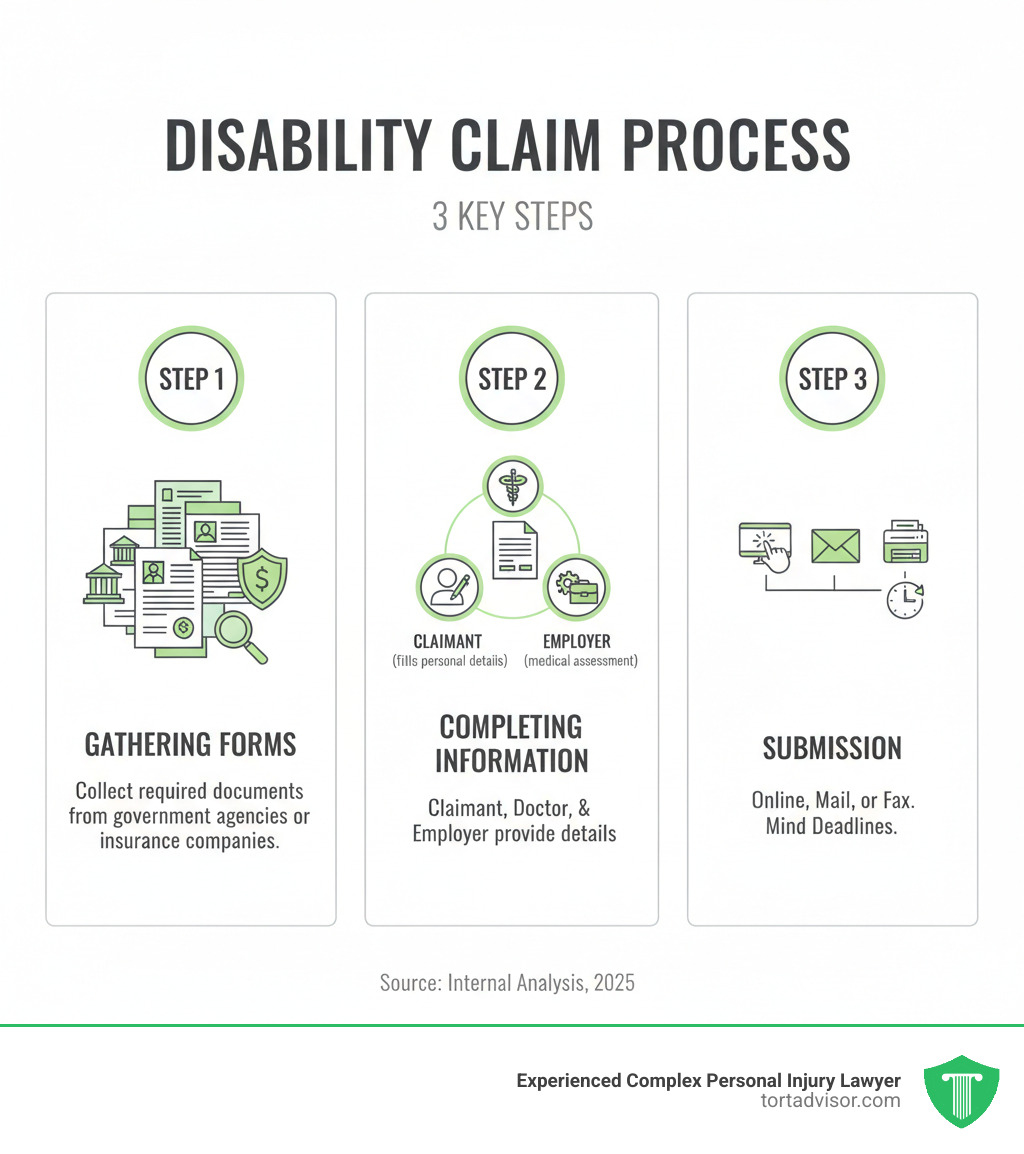
Three parties usually contribute: you, your doctor and your employer. Decision times differ widely, from a target of about 120 days for standard CPP claims to roughly five business days for terminal illness cases. Claims are most often slowed by incomplete forms, thin medical evidence and missing records such as treatment notes or job descriptions. Private insurers commonly expect forms within about 90 days of the disability starting, while government programs follow their own rules. I’m Mason Arnao, and my background in data management and process automation has shown me how much careful, complete paperwork matters to the outcome of a disability claim.
Government vs. Private Disability Claim Forms
When you can no longer work, sorting out which forms apply can feel daunting. Once you understand the basic categories, disability claim forms become much easier to manage.

Different programs use different disability claim forms. The biggest divide is between public benefits, such as SSDI or the Canada Pension Plan, and private coverage, meaning short-term or long-term disability insurance. Here is how they compare:
| Feature | Public Benefits (SSDI/CPP) | Private Coverage (STD/LTD) |
|---|---|---|
| Eligibility | Requires a work history of paying in through payroll taxes or contributions, plus strict medical rules | Depends on your policy, often beginning with an inability to perform your own job |
| Funding Source | Paid for by payroll taxes or contributions over your career | Paid for by premiums from you or your employer |
| How Disability Is Defined | Unable to do any substantial work because of a serious, long-term condition | Often “can’t do your own job” at first, later “can’t do any job” |
| Benefit Duration | May continue until retirement age for those who qualify | Short-term (weeks to months) or long-term (years, depending on the policy) |
The main takeaway: public programs apply a strict test from day one, while private policies often begin with a looser definition that tightens over time.
Main Government Disability Claim Forms
Public disability programs are an important safety net, but the paperwork is substantial. Social Security Disability Insurance (SSDI) covers U.S. workers who paid Social Security taxes. The core form is the Application for Disability Insurance Benefits, Form SSA-16-BK, though most people find it easier to apply through the Social Security Administration’s online system, which guides you step by step. That guidance helps because SSDI’s standard is demanding: you must show you cannot perform any substantial work because of a condition expected to last at least 12 months or end in death. Many first-time applications are denied, and appeals or even federal court review are sometimes needed to win benefits you earned. Canada Pension Plan (CPP) Disability follows a similar model. Contributors with a severe and prolonged disability apply using the Application for CPP Disability Benefits (ISP-1151), and Canada offers a fast-track process for terminal illness that can produce a decision in days rather than months.
Typical Private Insurance Disability Claim Forms
Private disability claim forms usually come in three parts. The Claimant’s Statement covers your condition, how it affects you and your treatment. The Attending Physician’s Statement supplies medical evidence from your doctor. The Employer’s Statement confirms your duties and pay. Group plans and individual policies generally follow this structure, although each insurer uses its own versions. When coverage comes through work, HR staff familiar with the forms can make things easier, and many insurers, including Unum and New York Life, publish online tools or guides for finding the right forms. Always confirm requirements with your own insurer.
What Each Disability Claim Form Asks You to Provide
Think of your disability claim forms as the way you explain your situation to the people deciding your claim. You are building a record that shows how your condition has changed your life and your ability to work.
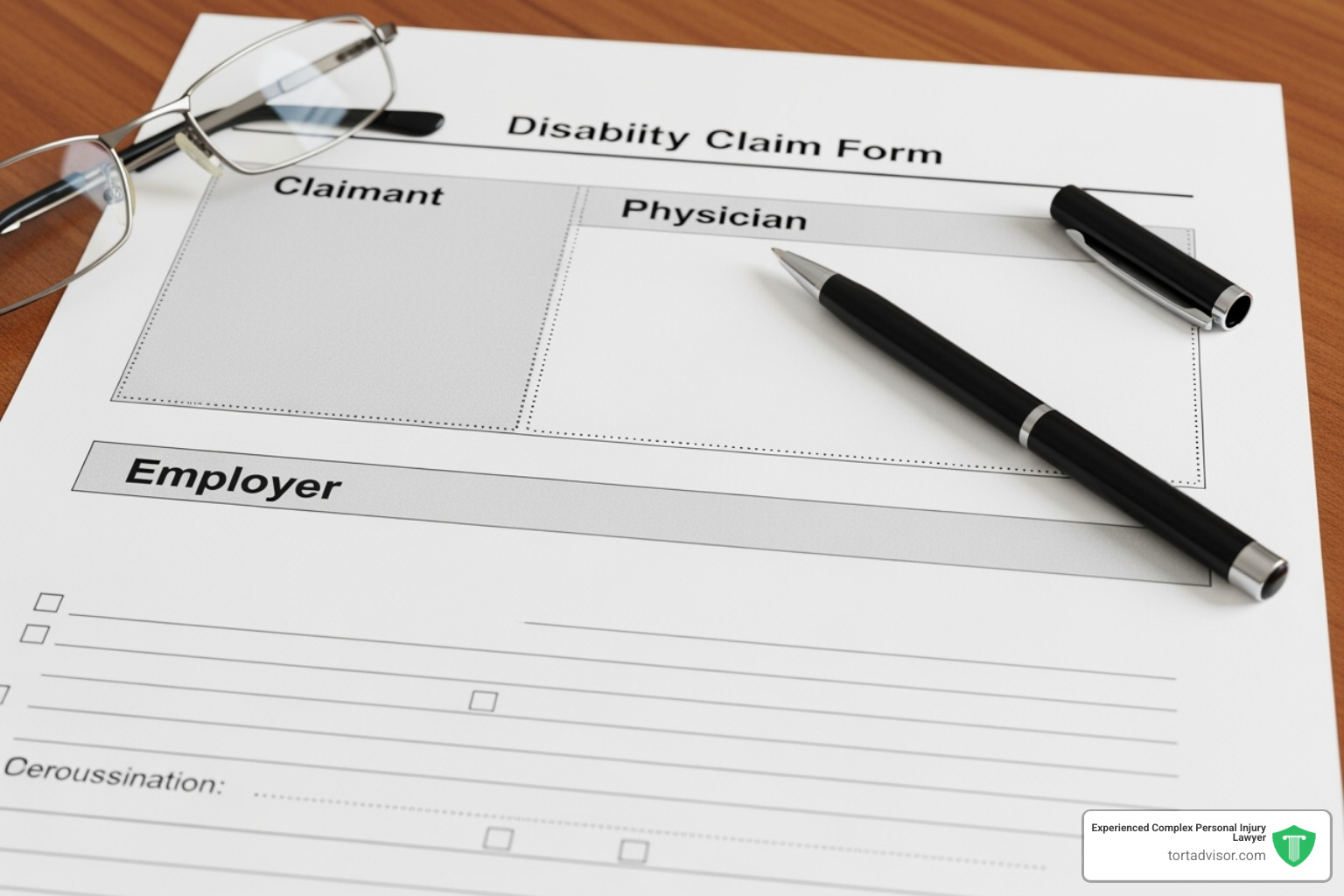
Three people normally contribute: you, your physician and your employer, each supplying a different piece of the picture. Self-employed claimants fill both the claimant and employer roles.
What You, the Claimant, Must Provide
Your section of the disability claim forms is where you describe daily life with your condition. Basic identifying details such as name, address and Social Security or Social Insurance Number are simple; the sections that follow matter more. For work history, describe what you actually did, not just your title, including the physical and mental demands, such as hours at a screen, lifting or time on your feet. When describing your condition, pair the medical term with its real effect: instead of only “herniated disc,” explain that pain stops you from sitting longer than 20 minutes. Symptoms and limitations should connect directly to why you cannot work; “severe fatigue” becomes “I can’t focus for more than 30 minutes, so I can’t finish the reports my job requires.” List every provider, clinic, date, medication and therapy in your treatment history to show you are actively pursuing care, and disclose other income such as workers’ compensation or other insurance. Honesty is essential. If presenting your claim feels overwhelming, an attorney can help you frame it clearly.
The Attending Physician’s Statement (APS)
Your doctor’s statement carries the most weight. Without strong medical support, your own account will not be enough, because this is where objective findings back up what you experience. The diagnosis section asks for the official diagnosis and prognosis, meaning how the condition is expected to progress. Objective evidence such as X-rays, MRIs and lab work distinguishes strong claims from weak ones, and mental health claims may rely on psychological testing. In the restrictions and limitations section, your doctor should spell out exactly what you cannot do and why; “no lifting over 10 pounds” is far stronger than “back issues.” The doctor should also describe your treatment plan, which shows how serious the condition is and that you are working to improve. In Canada, physicians commonly complete the Medical Report (ISP-2519) for CPP claims. Talk openly with your doctor about your job so their statement reflects your real limitations.
Supporting Documents to Gather
Alongside the main disability claim forms, you will need records that back up what you and your doctor reported. Treatment records, including clinical notes and specialist reports, establish the medical timeline, and test results and imaging supply the objective proof reviewers want. Include proof of age, job descriptions and pay stubs or T4 slips to show earnings and financial impact. Add accident reports if an accident caused the disability, and include WSIB/WCB correspondence and letters about other insurance benefits for workplace injuries. Self-employed claimants should provide tax returns, business records and detailed descriptions of their work. Keep copies of everything you send.
Filing, Timelines and Getting Approved
Once your disability claim forms and records are ready, you submit them and wait for a decision, which is often the hardest part.

Knowing what to expect, and what causes delays, can reduce stress and help you avoid avoidable setbacks.
Filing Online or on Paper
Most disability claim forms can be filed online or on paper, and the best choice depends on your situation and comfort with technology. Online filing, such as the SSA’s online disability application, provides instant confirmation, step-by-step prompts and document uploads, though it requires dependable internet. If you use fillable PDFs, save them to your computer and open them in Adobe Reader XI or newer rather than completing them in a browser. Paper filing remains widely accepted, and Service Canada explains how to mail or drop off forms. It needs no technology, but send important documents by registered mail and keep copies.
How Long Decisions Take and Why Claims Get Delayed
Wait times depend on the program. Service Canada aims to decide CPP disability claims within 120 calendar days, terminal illness claims within 5 business days and other grave conditions within 30 calendar days. Initial SSDI decisions often take several months, and appeals can push the timeline past a year. Private insurers frequently set a 90-day window from the start of the disability to file disability claim forms, with review time depending on complexity. Incomplete forms are a leading cause of delay or denial, since missing signatures or blank sections flag an application. Weak medical evidence is another, because records must show the condition keeps you from working. Claims can also be denied for earnings above the SSDI substantial gainful activity limit or not cooperating with requests or recommended treatment, and government programs require a “severe and prolonged” disability, which is a high bar. If you are denied, strict deadlines apply, so check how long you have to act right away.
Getting Help and Appealing a Denial
You do not have to handle this process by yourself. Family, community groups and professional advocates can help at every stage. For CPP, you can name someone to speak for you using the Consent to Communicate Information to an Authorized Person form (ISP-1603). A denial is not the end; denials are common and many claims succeed on appeal. For SSDI, the steps are usually reconsideration, a hearing before an Administrative Law Judge, Appeals Council review and finally a federal court case. An attorney experienced in disability law can gather the right evidence and guide you through appeals, which can meaningfully improve your odds.
Disability Claim Form FAQs
These are the questions people ask most often about disability claim forms.
How does a “severe and prolonged” CPP disability differ from a “terminal” one?
The difference can mean months versus days. A “severe and prolonged” disability is CPP’s standard test: a long-term condition that regularly prevents any substantially gainful work, such as advanced arthritis or major depression. These claims target about 120 calendar days. A “terminal illness” is one a clinician expects to cause death within about six months, and these claims are fast-tracked with a goal of 5 business days using the Terminal Illness Application (ISP-2530A). “Grave conditions” that progress quickly are expedited too, with a target of 30 calendar days.
Can I qualify if my condition isn’t in the SSA’s “Blue Book”?
Yes. A condition missing from the Blue Book (the Listing of Impairments) does not rule you out. The Blue Book lists conditions presumed disabling, but it is only one route. Otherwise, the SSA assesses your Residual Functional Capacity (RFC), meaning what you can still do despite your limits, and weighs it with your age, education and work history to decide whether you could do other work. Your doctor’s detailed description of your limitations is critical, so thorough medical records are key. You can review the SSA’s listings, but an unlisted condition can still qualify.
How is a claim different for self-employed people?
Self-employed claimants must supply the information an employer would normally provide, which makes disability claim forms more involved. You must document your own job duties, including physical and mental demands, hours and how the disability stops you from working. Income is harder to prove, so use tax returns, business records, invoices and financial statements, and show any drop in income with bank records or client messages. Evidence of impact might include client letters, lost contracts or proof you had to decline work. The upside is that you control your documentation and can present detailed, specific evidence, as long as it is complete and accurate.
Conclusion
Completing disability claim forms can feel like a maze when you are already coping with a serious illness or injury, with acronyms to decode, records to collect and every field to complete. Accuracy is everything. One missing signature, an incomplete medical form or a missed deadline can set a claim back by months. The process is demanding, but it is not impossible, and with preparation and support many people secure the benefits they earned. If you are overwhelmed or have been denied, that is common. Appeals exist precisely because first decisions often go against claimants, and a denial does not mean your case lacks merit. Legal Lawsuit can connect you with independent attorneys who handle disability claims, understand which evidence matters most and know how to present your case through each level of review. Do not let paperwork stand between you and the support you need. Request a free, confidential review of your SSDI claim to take the next step.
Additional Resources
Related Posts
Quick Answer: The Boy Scouts of America (BSA) filed for Chapter 11 bankruptcy in 2020 after facing tens of thousands [...]
Quick Answer: Survivors of sexual abuse by Catholic priests, nuns, or other Church personnel may be able to file a [...]
Quick Answer: Clergy abuse settlements vary enormously based on the severity of the abuse, the strength of evidence that the [...]