
Short answer: This article explains the key facts, eligibility issues, settlement factors, deadlines, and source-backed updates related to this legal topic. Results vary by case facts, evidence, jurisdiction, and representation.
In This Guide
How Disability Claim Assistance Changes Outcomes
When an illness or injury keeps you from working, disability claim assistance can guide you through a benefits system that is notoriously hard to navigate. Whether you are pursuing Social Security Disability Insurance (SSDI), Supplemental Security Income (SSI) or VA disability compensation, knowledgeable help can meaningfully raise your odds of approval. At a Glance: Where to Get Help With a Disability Claim:
- Veterans Service Organizations (VSOs): No-cost help from groups such as DAV, VFW and Wounded Warrior Project
- Accredited Attorneys: Legal skill for difficult claims and appeals, usually on contingency
- Educational Platforms: Training to advocate for yourself, plus peer communities
- Claims Consultants: Guidance from professionals as you apply
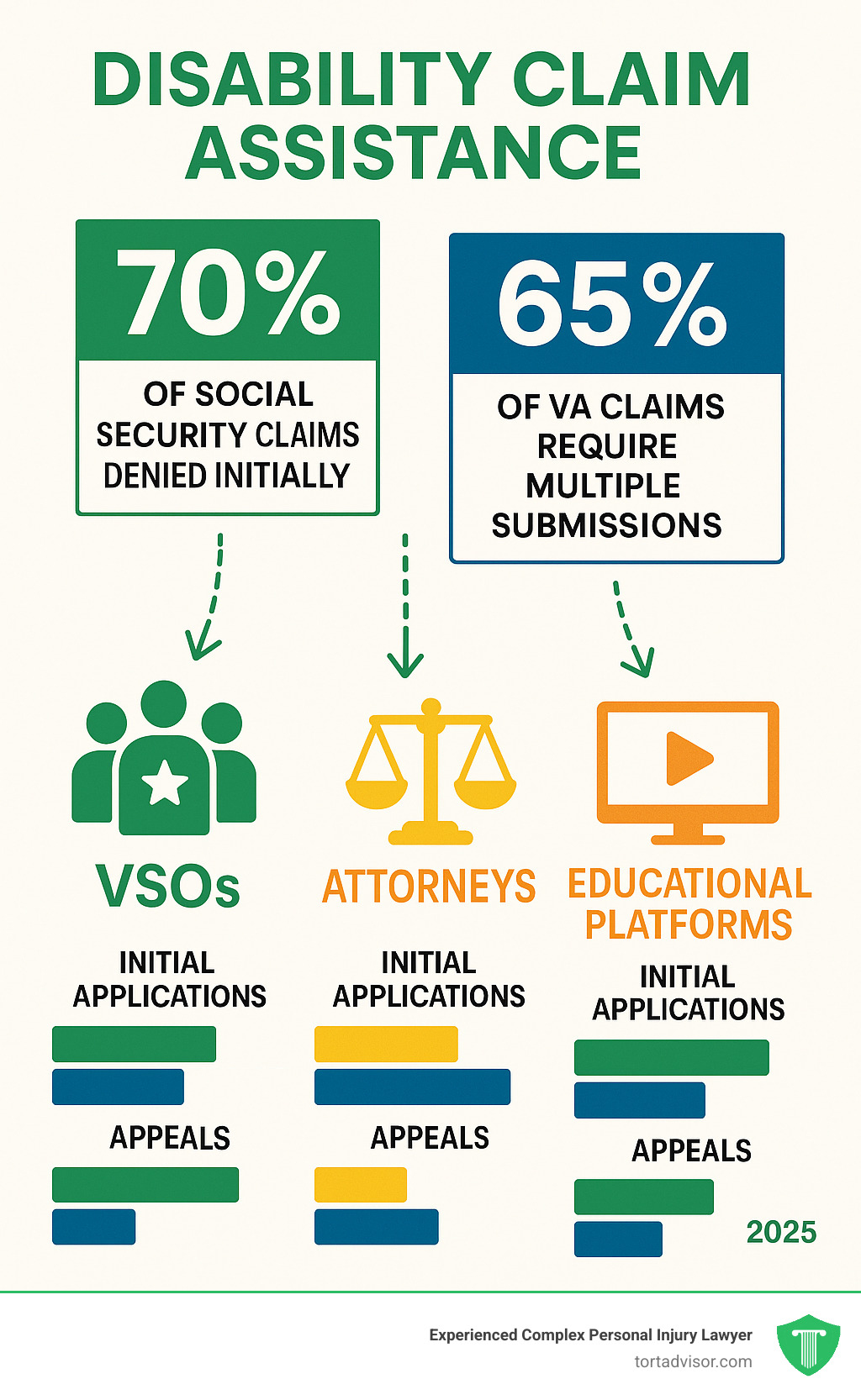
The numbers are hard to ignore. Commonly cited figures put about 70% of first-time disability applications in the denied pile at the Social Security Administration, and many veterans find the VA system just as difficult. The encouraging part is that you do not have to tackle it by yourself. The core problem is that most applicants are unfamiliar with the detailed rules, medical evidence standards and filing deadlines that decide whether a claim succeeds. Applying without guidance can mean avoidable denials or benefits left unclaimed. What many people overlook: each kind of help has its own strengths. VSOs are strong on first applications, attorneys are most valuable on appeal, and educational resources prepare you to speak up for yourself. I’m Mason Arnao. My career building technology systems that handle millions of database transactions a day has shown me how easily complex administrative processes can overwhelm people looking for disability claim assistance, and my work in systems administration and data management has taught me how to move through bureaucratic procedures efficiently.
SSDI, SSI and VA Benefits Explained
Disability benefits can seem like their own language, but in the United States there are only two main systems to learn. The Social Security Administration covers civilian disability, and the Department of Veterans Affairs serves veterans. What separates them? Social Security looks at whether you can work and, for SSI, your financial need; the VA looks at whether your condition is tied to military service. Put simply, Social Security asks “Are you able to work?” while the VA asks “Did your service cause or worsen this?” Knowing which system fits you is the first step toward the right disability claim assistance and fewer months lost to delays.
Social Security Disability Insurance (SSDI)
SSDI functions like insurance you have funded through payroll taxes on every paycheck. To qualify, you need enough “work credits,” which show you worked and paid Social Security taxes for long enough and recently enough. Younger workers need fewer credits. Someone who is 31 may need only six, while a person over 62 may need as many as 40. After approval, a five-month waiting period applies before benefits begin, with one exception: people with ALS (Lou Gehrig’s disease) approved after July 23, 2020 skip the wait. A detail many miss: your family may also be eligible. A spouse, children or even a former spouse may receive benefits once your SSDI starts, which can noticeably increase household support. The SSA publishes its own side-by-side comparison of SSDI and SSI on its website if you want more detail. And if your claim turns into a legal dispute, learn about SSDI Lawsuits and your choices.
Supplemental Security Income (SSI)
SSI works very differently from SSDI, which is welcome news for many applicants: it requires no work record at all. This need-based program supports people who are 65 or older, blind or disabled and who have very little income and few assets. The financial limits are tight, but SSI can be a vital source of support even for someone who has never held a job. Is it possible to receive SSDI and SSI together? Yes. These “concurrent benefits” apply when your SSDI check is small enough that you still fall under SSI’s income limits. And unlike SSDI, SSI begins with the first full month after you apply or become eligible, whichever is later. To check whether you might qualify, try the free benefits eligibility screener on the Social Security Administration’s website.
VA Disability Compensation
Veterans can receive VA disability compensation as a tax-free monthly payment, and not owing tax on it makes a real difference in what you keep. The requirement: the condition must be “service-connected,” meaning it began during service or was made worse by it. The VA gives a rating from 0% to 100% based on how much the condition affects daily functioning. Multiple conditions get complicated: the VA does not simply add ratings together but uses a “combined ratings table.” A veteran rated 50% for a brain injury and 50% for a back injury might land at 80% combined rather than 100%. The formula seems odd, but it has logic: each rating is applied to the “efficiency” left over after the previous one. New laws have expanded eligibility. The PACT Act broadened benefits for veterans exposed to toxic substances, opening the door to claims that may once have been rejected. Because the process can be daunting, disability claim assistance is especially valuable for veterans. Wounded Warrior Project’s article on Filing for a VA Disability Claim is a helpful place to begin.
Your Options for Disability Claim Assistance
Picking the right help for a disability claim can be confusing. It is a bit like opening a toolbox: every tool has a purpose, but which one fits the job in front of you? Disability claim assistance takes several forms, and what suits one person may not suit another. Some options are free and some charge fees, and they differ in expertise and how hands-on they are. Understanding those differences early can spare you time, money and frustration later.

The goal is to match the help to your situation. Is this your first application, and you just need someone to explain the basics? Have you been turned down repeatedly and need strong legal backup? Or do you prefer to learn every detail and run your own case?
Veterans Service Organizations (VSOs)
For veterans seeking disability claim assistance, a Veterans Service Organization is often the best first stop. Groups such as Disabled American Veterans (DAV), Veterans of Foreign Wars (VFW) and Wounded Warrior Project provide free help from accredited representatives who know the VA system thoroughly. They can help you file an initial claim, collect the right medical evidence and interpret VA decision letters that often read like code, all at no cost. There are trade-offs. VSOs serve huge numbers of veterans, so your file may receive a one-size-fits-all approach. They are good at getting standard claims filed properly but can overlook the details that might lift a rating from 70% to 100%, and in busy areas appointments can take weeks or months. Be careful, too, because not everyone advertising “free” help is legitimate. Wounded Warrior Project cautions that predatory companies target veterans with promises that are too good to be true. Anyone guaranteeing a 100% rating or demanding payment up front is a warning sign. Read more about these red flags: WWP Warns Veterans of Predatory Claims Assistance Practices.
Accredited Attorneys and Claims Agents
When a case becomes complicated, as many do, accredited attorneys and claims agents add real legal skill. They focus on disability law and know how to frame a claim for the strongest result. On fees, attorneys usually work on contingency and are paid only if you win. In Social Security cases, the fee is generally 25% of past-due benefits, subject to a cap set by the SSA (raised to $9,200 in late 2024). In VA cases, attorneys may charge only for appeals, not for first applications. Because their payment depends on your result, the incentives line up. Attorneys add the most value in difficult cases and appeals: repeated denials, several medical conditions or tricky legal questions. They know which medical evidence carries the most weight and how to present it persuasively, which can be the difference between an award and another denial. If you are deciding whether a lawyer makes sense, our article Do I need a Personal Injury Lawyer? walks through many of the same questions that apply to disability claims.
Educational Platforms and Peer Support
Self-advocacy is gaining ground among people filing disability claims, and it can be empowering. Educational platforms and peer communities help you become knowledgeable yourself instead of relying entirely on others. They provide courses, templates and step-by-step instructions to help you understand the rules, build strong evidence and present your claim clearly, so you learn to “speak VA” or “speak SSA” on your own. Peer support adds a lot. Online groups link you with people who have been through the same process, offering encouragement after a frustrating denial and practical tips from real experience. A veteran whose PTSD claim was approved may notice things even a strong VSO representative misses. The biggest payoff is lasting confidence: once you understand the system, you can handle future claims, help others and stop feeling lost in the paperwork.
How the Options Compare
Here is a side-by-side look at the main disability claim assistance choices:
| Feature | VSOs | Attorneys | Educational Platforms |
|---|---|---|---|
| Cost | Free | Contingency (25% only if you win) | Varies (subscription or one-time payment) |
| Your Involvement | Low, since they do the work | Moderate: you supply information, they handle the legal side | High: you learn the process and do it yourself |
| Strongest for First Applications | Excellent: free and effective for simple claims | Good, though costly for simple claims | Excellent: teaches you to file correctly |
| Strongest for Appeals | Good: can file appeals but may lack deep expertise | Excellent: legal skill is key on appeal | Good: explains appeal strategy |
| Success Rates | Reliable for routine claims | Stronger for complex claims | Depends on how well you use what you learn |
The best fit depends on your circumstances, how comfortable you are speaking up for yourself and how complicated your claim is. Plenty of people mix approaches, learning the basics first, using a VSO to file and adding an attorney if an appeal becomes necessary.
Where Help Matters Most in the Claims Process
Filing a disability claim is like building a house: you need a firm foundation, the right tools and someone who knows the code. Without good guidance, even a strong claim can fall apart, which is why solid disability claim assistance serves as your blueprint. Getting from application to decision can take months or years, and processing times differ widely by location and complexity. Having an informed ally can decide whether you are approved or denied.

Building the Evidence Your Claim Needs
Evidence is the core of any disability claim. Without thorough documentation, even very serious conditions get denied. Social Security claims require complete medical records that show the full picture: diagnostic reports, treatment notes, lab work and imaging. Many applicants also forget something crucial: detailed statements from treating doctors describing exactly how the condition restricts your ability to work. VA claims have different but equally important requirements. Your DD214 and service medical records are essential, and a “nexus letter,” in which a medical professional links your current condition to your service, is often the deciding document. Buddy letters also matter: statements from relatives, friends or fellow service members can powerfully describe how your disability affects daily life, because they see your struggles firsthand. Organizing early pays off, and good disability claim assistance can pinpoint which evidence you need and how to present it. You only get one first impression with an examiner. Reading What’s the first step to filing a claim? can start you off on the right foot.
Getting Ready for a C&P or Consultative Exam
Veterans will probably attend a Compensation & Pension (C&P) exam, and Social Security applicants may be sent to a consultative examination. These are not routine checkups; they are evaluations that can decide your claim. The examiner’s job is to measure your disability, not to treat you, so speak about your condition differently than you would with your own doctor. Describe your worst days honestly, not just your good ones. If a walk to the mailbox leaves you drained and hurting, say that. If you sometimes need help dressing, mention it without embarrassment. Be consistent with your medical records and what you have told your treating providers, since contradictions can damage a claim quickly. Bring a medication list and be ready to explain specifically how your condition limits work and daily tasks. Many veterans find the C&P exam stressful, but preparing helps. Wounded Warrior Project’s guide to Preparing for a C&P Exam can help you walk in with more confidence.
If Your Claim Is Denied: How Appeals Work
A denial letter hurts, but it does not have to be the final word. With first-round denials as common as they are, you are in large company. Appeals are where professional disability claim assistance often proves its worth, because choosing the right route can save months or years. On the Social Security side, reconsideration sends your file to a new reviewer and succeeds only some of the time. The bigger opportunity is usually the hearing, where you appear before an Administrative Law Judge and make your case in person; many claims are finally approved there. On the VA side, there are three main routes. A Supplemental Claim lets you add new evidence. A Higher-Level Review has a senior reviewer re-examine the existing record. A Board Appeal sends the case to a Veterans Law Judge. Picking the right lane is key: file new evidence when you have it, but skip a Supplemental Claim if the record is already strong. Experienced guidance helps with this decision, and the SSA’s website explains how to start a Social Security appeal. If your claim involves more serious legal issues, see More info about SSDI Lawsuits. Persistence often pays off on appeal, so do not let a first denial stop you from pursuing benefits you have earned.
Disability Claim Help FAQs
You likely have plenty of questions about getting help with a disability claim, and that is completely understandable. The process is overwhelming and you want to choose wisely. Here are answers to the concerns people raise most often about disability claim assistance.
What does disability claim assistance cost?
There are options for every budget, and some cost nothing up front. VSOs are free. DAV, VFW and Wounded Warrior Project charge veterans nothing, relying on donations and grants to fund their help. Attorney fees depend on the claim type. In Social Security Disability cases, attorneys work on contingency: no win, no fee. When they win, the fee is typically 25% of past-due benefits, capped by the SSA (the cap rose to $9,200 in late 2024), and you pay nothing out of pocket to begin. VA claims differ: by law, attorneys cannot charge for help with an initial application and may charge only for appeals, usually on contingency. For a general look at legal fees, see How much does a Personal Injury Lawyer cost? Educational platforms range widely. Some provide free material and community forums; others charge once for full courses or ongoing access to templates. Think of it as an investment in your own ability to advocate. Whatever you choose, get clear answers about cost before you sign up.
How can I check whether a representative is accredited?
This is an important question, because some people target those seeking disability claim assistance, and they are often called “claim sharks.” VA accreditation is easy to verify. The VA keeps a searchable database of accredited attorneys, claims agents and VSO representatives. Ask for an accreditation number and confirm it yourself in the official database rather than taking anyone’s word. Social Security is less centralized. There is no single VA-style database, but attorneys must be licensed by a state bar, and non-attorney representatives need SSA approval. Look for strong reviews, clear explanations of how they work and real experience. Be wary of anyone who wants large payments up front, makes unrealistic promises or is vague about credentials. Let transparency and reputation guide you. A legitimate representative will gladly share credentials and explain the process.
Can anyone guarantee my claim will be approved?
No, and anyone who says otherwise is a red flag. Promises of guaranteed approval are among the clearest warning signs in disability claim assistance; the person is either misleading you or does not understand the system. Approval depends on factors no representative controls: how strong your medical evidence is, the nature of your condition, your work history and how closely your case fits the strict standards of the Social Security Administration or the Department of Veterans Affairs. What good help can do is improve your odds. It can help you collect the right evidence, present the claim well, avoid common errors and handle appeals if needed, but the government agency always makes the final call. If a service sounds too good to be true, it probably is. Trustworthy representatives are candid about challenges and realistic about outcomes while still working hard for you. In short, quality disability claim assistance raises your chances; guaranteed results are a reason to walk away.
Moving Forward With Your Disability Claim
Pursuing disability benefits does not have to feel like an impossible climb. It is demanding, and the paperwork can be a lot. But keep this in mind: you do not have to do it alone.

This guide has covered the main disability claim assistance options. VSOs provide valuable free help that is ideal for getting started. Accredited attorneys bring legal strength when a case becomes complex or an appeal is needed. Educational platforms equip you to advocate for yourself. There is no single right answer: one person may do well with a VSO, another may need an attorney for a difficult appeal, and someone else may thrive through self-advocacy training. What counts is finding the approach that fits you. The high first-round denial rate we discussed at the start does not have to define your claim. With good guidance, you can work through this system successfully, as people do every day. Your next step might be calling a VSO in the morning, booking a free, confidential case review with an attorney or signing up for a course on how disability claims work. At Legal Lawsuit, we have seen how the right legal help can change someone’s circumstances. We help readers connect with attorneys in our network who understand both the law and what you are living through, and who advocate for people at difficult moments. Your claim is more than forms; it is your financial stability, your peace of mind and your ability to focus on your health and family. You have already taken the first step by learning about your options. Now take the next one. Get connected with trusted help for your SSDI claim.
Related Posts
Quick Answer: The Boy Scouts of America (BSA) filed for Chapter 11 bankruptcy in 2020 after facing tens of thousands [...]
Quick Answer: Survivors of sexual abuse by Catholic priests, nuns, or other Church personnel may be able to file a [...]
Quick Answer: Clergy abuse settlements vary enormously based on the severity of the abuse, the strength of evidence that the [...]

