Short answer: This article explains the key facts, eligibility issues, settlement factors, deadlines, and source-backed updates related to this legal topic. Results vary by case facts, evidence, jurisdiction, and representation.
📋 Table of Contents
How an SSDI Reconsideration Appeal Works
An SSDI reconsideration appeal is the first opportunity to fight a denied Social Security Disability Insurance claim. A denial letter puts you in large company: the Social Security Administration (SSA) turns down roughly 70% of first applications. It’s a routine stage of the process, not a dead end. SSDI Reconsideration at a Glance:
- Deadline: 60 days from when you receive the denial notice.
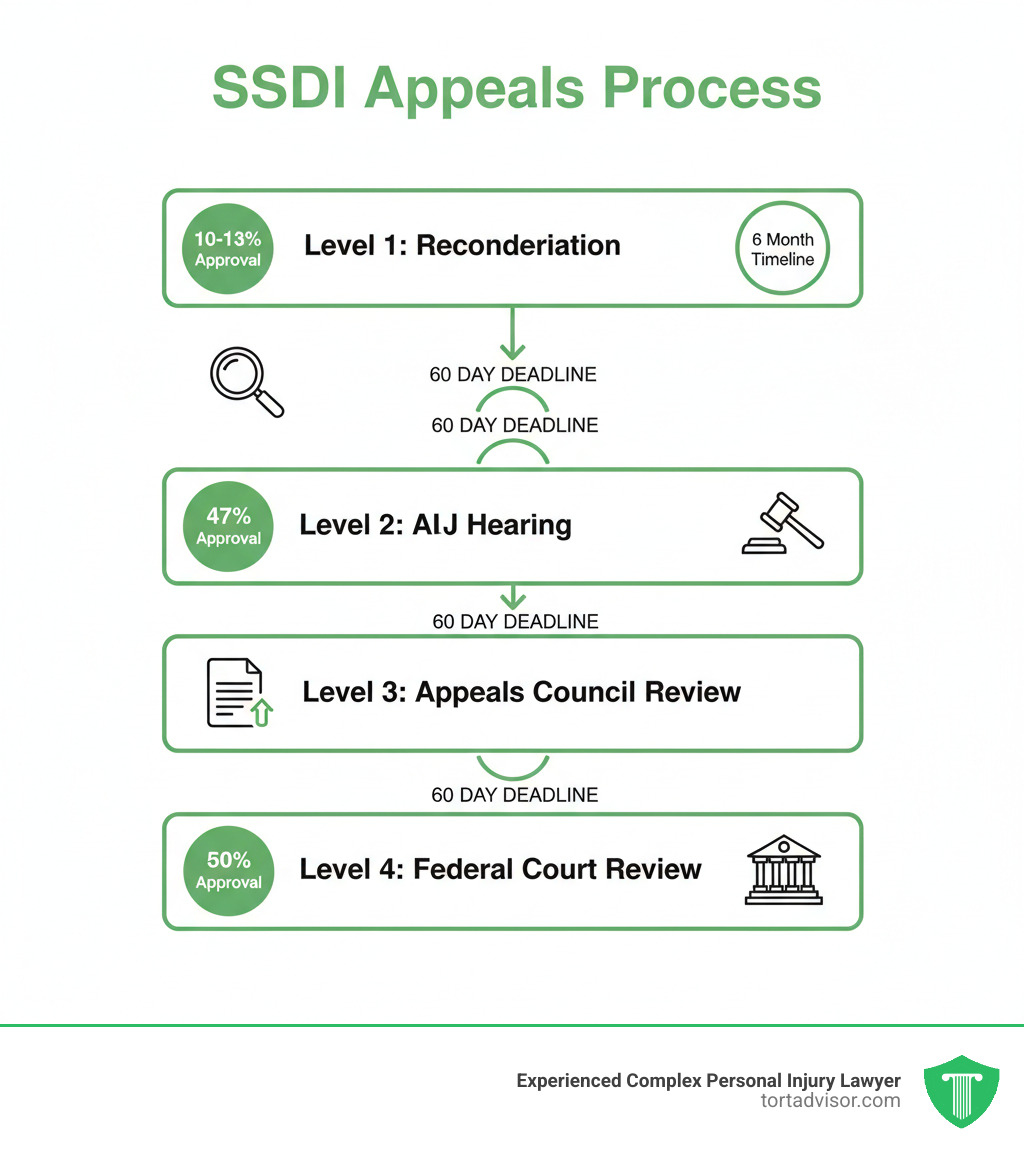
- Approval odds: just 10-13% of reconsiderations succeed.
- Wait time: about 6 months (183 days) on average.
- Forms: SSA-561 (Request for Reconsideration), SSA-3441 (Disability Report – Appeal), and SSA-827 (Authorization to Disclose Information).
- Cost: no filing fee, though you can choose to hire a lawyer.
Reconsideration is level one of four in the appeals system. Approvals are rare here, but the step is required and it preserves your original filing date and possible back pay. If reconsideration is denied too, you can ask for an Administrative Law Judge (ALJ) hearing, where roughly 47% of claims are approved, with better odds for people who have representation. Knowing how to strengthen your file makes the difference, and this guide covers each filing step and how to build the strongest case for the benefits you deserve.
Why You Were Denied: Where the Appeal Begins
Only around 30% of SSDI claims win approval at the first level, so most applicants get a denial. That isn’t a verdict on whether your disability is real; it’s how a complicated system typically works, and for many people it’s simply where the appeal starts. An SSDI reconsideration appeal triggers a fresh look at your case by a new claims examiner who had no part in the first decision. That examiner reviews your original evidence along with anything new you submit, which gives you the chance to close gaps and respond directly to the reasons for denial. The SSA’s “Understanding Supplemental Security Income (SSI)—Appeals Process” page offers related guidance that largely mirrors SSDI appeals.
Medical Denials vs. Technical Denials
A strong appeal starts with knowing why the SSA said no. There are two kinds of denials. Medical denials are the most frequent and happen when the SSA concludes your condition doesn’t satisfy its strict disability definition, perhaps because it thinks your evidence doesn’t prove you can’t work, your condition isn’t severe enough, or it won’t last 12 months. To appeal one, focus on bolstering the medical record with updated treatment notes and detailed statements from your doctors. Technical denials have nothing to do with your health. They stem from administrative problems such as too few work credits for SSDI, income or assets over SSI limits, or earnings above the “substantial gainful activity” (SGA) threshold. Some can be fixed by correcting records or supplying missing paperwork, but if you truly lack enough work credits, an SSDI appeal won’t work and SSI may be the better path.
| Denial Type | Key Characteristics | What the Appeal Should Focus On |
|---|---|---|
| Medical | Weak medical evidence, condition judged not severe, ability to do other work | Fresh medical records, physician statements, RFC assessments |
| Technical | Too few work credits, income or assets over limits, SGA-level work, administrative mistake | Fixing work history, explaining income and assets, proving SGA work ended |
Why an Appeal Beats Starting Over
Filing a brand-new application can seem easier, but appealing is nearly always the smarter move. For one, an appeal keeps your original application date, which sets your back pay if you’re eventually approved; reapplying resets it and can cost months or years of benefits, a meaningful amount of money. For another, an appeal makes you confront the exact weaknesses in the first claim, while a new application risks repeating the same errors. And although only about 13% of reconsiderations succeed, you must go through this stage to reach an Administrative Law Judge, where close to 47% of claims are approved. The system gives you several chances to prove your case, and persistence often pays off.
How to File an SSDI Reconsideration Appeal, Step by Step
An SSDI reconsideration appeal is very doable if you follow the steps and, above all, file on time.
You get 60 days from receipt of your denial to request reconsideration. The SSA presumes the letter reached you five days after its printed date, and the 60-day count starts then. Missing it can sink the claim, forcing a new application and the loss of your original filing date and back pay. If time is short, file right away; extra evidence can follow. You can begin online through the SSA’s “Request reconsideration” portal.
Forms You Need for an SSDI Reconsideration Appeal
Three forms make up the appeal:
- Form SSA-561 (Request for Reconsideration): your official request. Say plainly that you disagree and why, pointing to any evidence you think was missed or misread.
- Form SSA-3441 (Disability Report – Appeal): updates the SSA on changes since you first applied, including new diagnoses, appointments, hospital stays, or medications, which helps show how your condition has progressed.
- Form SSA-827 (Authorization to Disclose Information): lets the SSA request records straight from your providers. List every doctor, clinic, and hospital so nothing relevant is left out.
Along with the forms, collect any new medical records created since your first application, particularly from the past 90 days. Detailed statements from your doctors describing your work limitations can be extremely persuasive.
Ways to Submit: Online, by Mail or Fax, or in Person
You can send your appeal three ways:
- Online: the quickest and most recommended option. The SSA site confirms your submission immediately and gives you a re-entry number so you can save your work.
- Mail or fax: fill out Form SSA-561-U2 and send it to your local Social Security office. If mailing, use certified mail with a return receipt as proof of delivery.
- In person: file at your local office and ask for a stamped receipt as instant proof.
Whatever method you use, keep a copy of everything. A full paper trail with dates and confirmation receipts protects you if documents go missing or procedural questions come up later.
How to Strengthen Your Reconsideration
After filing your SSDI reconsideration appeal, the goal is to supply the new evidence that will overturn the denial. A new examiner reviews the case independently, so you get a clean slate.

Focus on “new and material” evidence: relevant information that wasn’t part of the first review, such as proof your condition has worsened, new diagnoses, or recent treatment. Keep following your doctor’s treatment plan, because the SSA wants to see you actively managing your health; if cost or access kept you from treatment, explain that in the appeal. One of the strongest items you can add is a Residual Functional Capacity (RFC) form filled out by your doctor, which turns your diagnosis into concrete work limits, like how long you can sit or how much you can lift, the exact questions the examiner must answer. Collect every new record, including recent tests, specialist reports, therapy notes, and hospital files; newer evidence carries more weight. If organizing it all feels like too much, disability claim assistance services can help.
What a Disability Lawyer Adds
Studies show claimants with representation are three times as likely to win. A disability lawyer knows what evidence convinces the SSA and can work with your doctors to get detailed reports and RFC forms. They handle communication with the SSA, keep deadlines on track, and shape a strategy around the specific reason you were denied. Reconsideration has no hearing, but having a lawyer shows the SSA you’re serious, and if reconsideration fails, you’ll already have representation for the ALJ hearing, where the odds improve considerably.
Realistic Odds for an SSDI Reconsideration Appeal
Go in with clear expectations: only about 13% of SSDI reconsideration appeals are approved, making this the hardest stage. Still, it’s the required gateway to an Administrative Law Judge (ALJ) hearing, where approvals climb to roughly 47%. At the hearing you can testify in person and your lawyer can present your case and question vocational and medical experts. Those numbers show why sticking with it matters; plenty of people denied at reconsideration go on to win at a hearing. Treat reconsideration as one necessary step on the road to approval, not a final answer.
After You File: How Long Reconsideration Takes and What’s Next
Once your SSDI reconsideration appeal is in, the wait begins; nationally, decisions take about six months (183 days) on average.
Your file goes to your state’s Disability Determination Services (DDS), where a new examiner and a medical consultant re-review the original record and all new evidence, sometimes contacting your doctors for more detail. DDS may also send you to a consultative examination (CE), an SSA-paid visit with an independent doctor to get current medical information. Go to any CE that’s scheduled, because missing it can mean an automatic denial. Keep up with treatment, track your appointments and symptoms, and send the SSA any new records as soon as you get them.
If Reconsideration Is Approved
A successful appeal brings a notice of approval, and monthly payments begin shortly afterward. Your first check will probably include lump-sum back pay covering the time from your disability onset (less a five-month waiting period) through approval. The notice lists your monthly amount and the total back pay owed.
If Reconsideration Is Denied
With roughly 87% of reconsiderations denied, a second denial is very possible. If it happens, keep going: it’s a common result and the doorway to a more promising stage. The notice of reconsidered determination explains the decision and your right to ask for a hearing before an Administrative Law Judge (ALJ). You have 60 days from receiving it to request that hearing, and the deadline is strict. The hearing is a real opportunity: a judge with no previous role in your case hears your testimony about how the disability affects your life, while your lawyer presents evidence and questions witnesses. Approval at this level runs about 47%, far higher than at reconsideration, and representation improves the odds further.
SSDI Reconsideration Appeal: Frequently Asked Questions
Does it cost anything to file an SSDI reconsideration appeal?
Filing an SSDI reconsideration appeal with the SSA costs nothing. Disability lawyers usually work on contingency, so there’s no upfront charge and they’re paid only if you win. Federal law caps the fee at 25% of back pay up to a set dollar maximum ($7,200 under the figure cited here; the SSA adjusts the cap periodically, so confirm the current amount). That arrangement puts legal help within reach whatever your finances.
Can I add new evidence after filing for reconsideration?
Yes, and you should. You can keep submitting new medical evidence right up until a decision is issued, and doing so is one of the best ways to strengthen an SSDI reconsideration appeal. Send new test results, specialist reports, visit summaries, and hospital records as soon as they arrive; that information may be exactly what reverses the denial.
What if I miss the 60-day appeal deadline?
Missing the 60-day deadline can get your appeal dismissed, but a late appeal may be accepted if you show “good cause.” You’ll need a written explanation, and the SSA weighs circumstances outside your control, such as:
- A serious illness or hospitalization.
- A death or serious illness in your immediate family.
- Never receiving the denial letter.
- Being given wrong information by SSA staff.
If the SSA accepts your explanation, the appeal moves forward as if it were timely. If not, you’ll have to file a new initial application and give up your original filing date and the back pay tied to it. If you’ve missed the deadline, talking with a disability lawyer about a good-cause argument is strongly recommended.
Don’t Take On the SSA Alone: Get Experienced Legal Help
An SSDI reconsideration appeal is complicated and can be exhausting when you’re also dealing with a health condition, but you don’t have to do it by yourself. The numbers make the case: only 10-13% of reconsiderations are approved, yet nearly 47% succeed at the ALJ hearing, and represented claimants are three times as likely to win. An experienced lawyer knows how to build a persuasive file, gather the right medical evidence, and represent you effectively. Legal Lawsuit connects people with experienced Social Security Disability attorneys in our network who know the system and can give your claim its best chance. Start with a free, confidential case review with no obligation, and because attorneys in our network work on contingency, you pay no fee unless you win. A denial letter doesn’t have to be the last word; contact Legal Lawsuit today to connect with an experienced attorney and give your claim the fighting chance it deserves.
Additional Resources
Related Posts
Quick Answer: The Boy Scouts of America (BSA) filed for Chapter 11 bankruptcy in 2020 after facing tens of thousands [...]
Quick Answer: Survivors of sexual abuse by Catholic priests, nuns, or other Church personnel may be able to file a [...]
Quick Answer: Clergy abuse settlements vary enormously based on the severity of the abuse, the strength of evidence that the [...]