
Short answer: This article explains the key facts, eligibility issues, settlement factors, deadlines, and source-backed updates related to this legal topic. Results vary by case facts, evidence, jurisdiction, and representation.
📋 Table of Contents
- Why Understanding SSDI Eligibility Rules Matters for Your Financial Security
- Understanding the Two Pillars of SSDI Eligibility
- The 5-Step Evaluation Process: How the SSA Decides Your Claim
- Navigating the SSDI Application and Special Rules
- Frequently Asked Questions about SSDI Eligibility Rules
- Conclusion: Securing the Benefits You’ve Earned
Why SSDI Eligibility Rules Matter for Your Financial Future
SSDI eligibility rules decide who can collect Social Security Disability Insurance — the federal program that sends monthly checks to workers whose serious health conditions keep them from working. You must clear two basic hurdles:
- Work History: Enough work credits earned by paying Social Security taxes — usually 40 in total, 20 of them within the past 10 years.
- Medical Disability: A condition serious enough to stop you from substantial work that has lasted or will last at least 12 months, or is expected to be fatal. At the time you apply, your earnings must be under the Substantial Gainful Activity (SGA) threshold ($1,620 a month in 2025, or $2,700 if blind).
SSDI is a vital safety net, but getting approved is hard. About two out of three initial applications are denied by the Social Security Administration (SSA), and fewer than one-third of applicants win benefits even after appealing. Strict federal rules that weigh work history, medical proof and vocational factors such as age and education make the process complicated — and the stakes are serious. For many households, SSDI separates stability from poverty; the average monthly benefit was about $1,352 in late 2023. And since roughly one in three young workers may become disabled before retirement age, knowing the rules matters. This guide translates SSDI eligibility into plain language, covering work credits, medical standards, the SSA’s five-step review and special situations, and explaining how SSDI differs from Supplemental Security Income (SSI). Want a sense of your possible payment? Try our instant SSDI benefits calculator to estimate your monthly benefit after answering a few questions.
The Two Core Requirements for SSDI Eligibility
Qualifying for SSDI depends on two foundations: your work record and your medical condition. Both must be satisfied. In effect, you first show you’ve earned the right to apply, then show the medical need.
Work Record: Becoming “Insured” for SSDI
SSDI is insurance funded by the Social Security (FICA) taxes taken from your paychecks, and the SSA measures your contributions in work credits. For 2025, each $1,810 of earnings equals one credit, with a cap of four credits a year. The SSA explains How You Earn Credits in more detail. Reaching “insured status” means passing two tests:
- Recent Work Test: Confirms you worked recently enough. Most adults need 20 credits from the decade before the disability started — the so-called 20/40 Rule — so the program reaches people who were recently in the workforce.
- Duration of Work Test: Measures your total credits. Most applicants need 40, roughly ten years of work. Younger workers get special treatment, though: someone disabled before 24 might need only 6 credits from the previous three years.
To see where you stand, open a free online account and Check your work history on the Social Security website.
Medical Standards: How the SSA Defines Disability
Work credits get you in the door; your medical condition decides the outcome. The SSA’s disability definition is much tougher than most people assume — there are no benefits for partial or temporary disability, so you must show total disability. Three conditions must be met:
- You can’t engage in Substantial Gainful Activity (SGA), which in 2025 means earning over $1,620 a month ($2,700 if blind). Earnings above that line will probably result in denial. The SSA offers More on SGA.
- The condition has lasted or will last 12 months, or is expected to cause death. A severe injury expected to heal within six months won’t count.
- It keeps you from doing any substantial job in the national economy — not merely your old one. The SSA will ask whether you could handle lighter work, such as a desk job, even in a field you’ve never worked in.
The SSA judges your condition on objective medical evidence: records, treatment history and physician opinions. Strong documentation must show how the condition restricts basic work tasks such as sitting, standing, lifting or concentrating.
How the SSA Decides SSDI Claims: The Five-Step Review
State agencies called Disability Determination Services (DDS) run every SSDI claim through a five-step sequence. Each step poses one question, and an answer that points to denial ends the review. Knowing the steps helps you build a stronger case.

Steps 1 and 2: Are You Working, and Is the Condition Severe?
The opening two steps act as screening filters.
- Step 1: Do you currently work? The SSA looks at whether your earnings amount to Substantial Gainful Activity (SGA) — over $1,620 a month in 2025, or $2,700 if blind. If so, expect a denial. You can estimate your possible benefit with the SSDI benefit calculator.
- Step 2: Is the impairment “severe”? It must substantially limit basic work tasks like walking, lifting, sitting, remembering or concentrating. A non-severe condition ends the claim.
Step 3: Does It Match the Blue Book Listings?
Here the DDS checks your condition against the SSA’s “Listing of Impairments,” better known as the Blue Book, which sets out medical criteria for conditions serious enough to prevent work. You can review the List of qualifying medical conditions. If your condition meets or medically equals a listing, you’re found disabled. “Meeting” means your evidence matches the criteria exactly; “equaling” means your condition is just as severe as a listed one — an important path for people with several health problems. For the gravest cases, fast-track programs such as Compassionate Allowances (CAL) and Quick Disability Determinations (QDD) can produce decisions in weeks rather than months.
Steps 4 and 5: Could You Do Past Work or Any Other Work?
When no listing fits, the review moves to the last two steps, which weigh your age, schooling and job history — your vocational factors.
- Step 4: Can you still do jobs you’ve held? The SSA asks whether your limitations rule out every job you had in the past 15 years. If you could still do one, the claim is denied.
- Step 5: Could you do some other job? If past work is off the table, the SSA decides whether you could transition to other work available nationally. Age, education and transferable skills weigh heavily here, and the standards ease for workers 50 and older, who find it harder to switch careers. For that group, the SSA often applies the Medical-Vocational Guidelines (Grid Rules), a chart that can require a “disabled” finding based on your vocational profile and physical limits.
This last step decides many claims, and solid medical evidence plus legal representation can make the difference.
Applying for SSDI and the Special Eligibility Rules
Knowing how the application works and which special rules apply can change the outcome of your claim.
The SSDI Application: Steps and Timing
Applying for SSDI takes patience and careful records. Collect these before you start:
- Your Social Security number and proof of your age.
- Names, contact details and treatment dates for every doctor, hospital and clinic you’ve used.
- Medical records such as test results, imaging and your medication list.
- Your job history — types of work and duties — along with recent W-2s or tax returns.
Applications can be filed online, by phone or in person. The online option at the SSA’s online benefits application is usually easiest; you can also call 1-800-772-1213 or go to a local office. After you file, the SSA verifies your work credits and passes the case to your state’s Disability Determination Services (DDS) for medical review. Expect to wait — initial decisions averaged more than seven months in 2023. Once approved, a required five-month waiting period applies before payments begin, though you may receive retroactive benefits covering up to 12 months before you applied. Because most first applications are turned down, it helps to know what to do after a denied disability claim.
How SSDI Differs From SSI
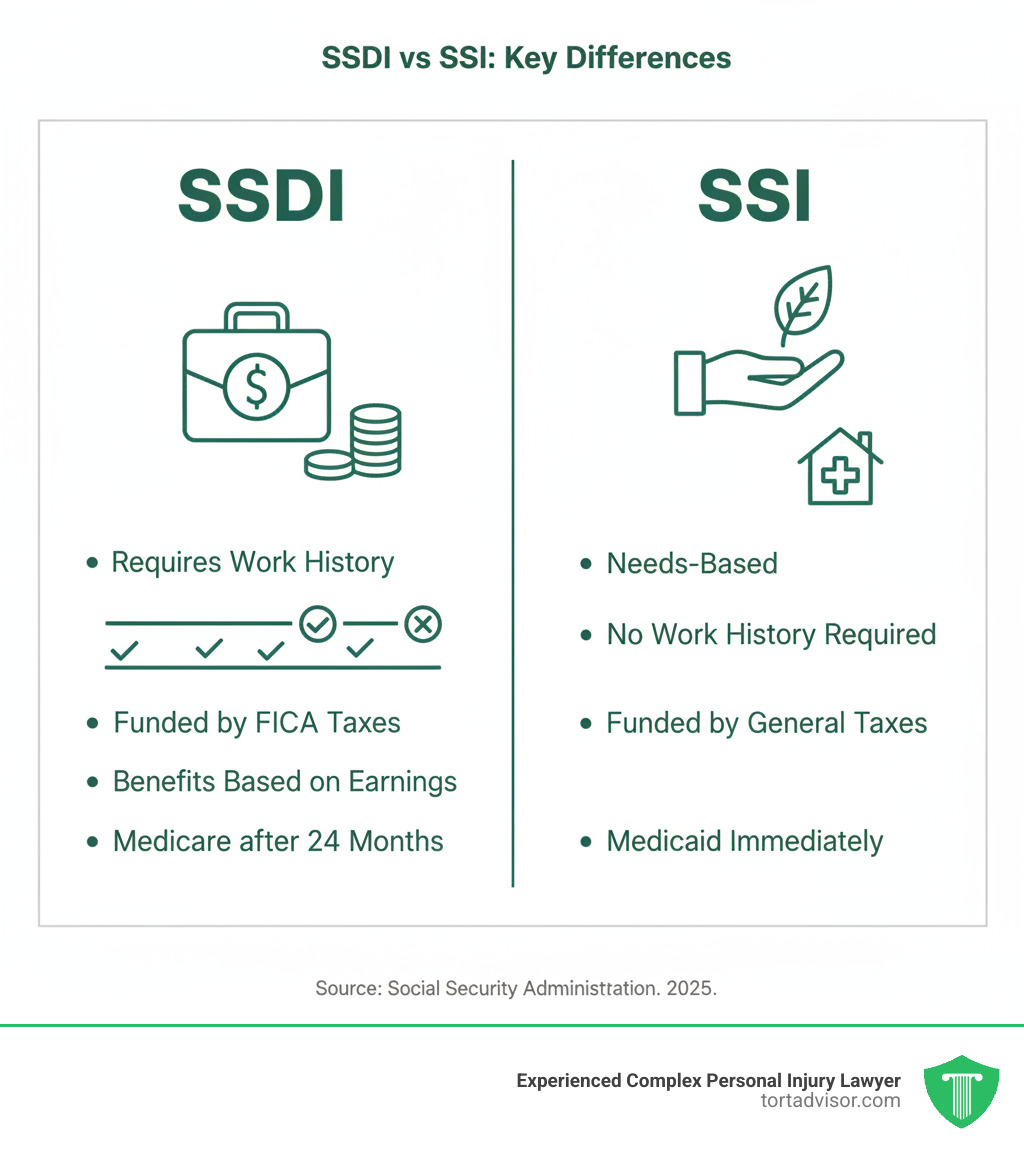
SSDI and SSI are frequently mixed up, but they are separate programs:
- SSDI (Social Security Disability Insurance): Insurance you earn through Social Security taxes. Payments are based on your earnings record, and Medicare eligibility begins after 24 months of benefits.
- SSI (Supplemental Security Income): A need-based program paid for by general tax revenue. No work history is required, but income and assets must be very low (for instance, below $2,000 for one person). It pays a standard federal rate, and recipients usually qualify for Medicaid right away.
If your SSDI check is small and you meet SSI’s financial limits, you may receive both (“concurrent benefits”). You can Learn more about and compare SSDI and SSI benefits.
Special SSDI Rules for Families and Other Situations
SSDI includes provisions for family members and certain circumstances:
- Family Benefits: Once you’re approved, a spouse caring for a child under 16 and unmarried children under 18 may also collect benefits on your record. Learn about family benefits.
- Surviving Spouses: A disabled widow or widower aged 50 to 60 may qualify for benefits based on the late spouse’s record.
- Disabled Adult Child (DAC): Adults disabled before 22 may qualify on a parent’s Social Security record.
- Blindness or Low Vision: Special rules apply, including a higher SGA threshold of $2,700 a month in 2025.
- Incarceration: Benefits are usually suspended during any jail or prison stay longer than 30 days.
SSDI Eligibility FAQs
SSDI eligibility rules can be hard to follow. Below are answers to frequent questions.
Will going back to work affect my SSDI?
The SSA offers “work incentives” so you can try working again without losing benefits right away.
- Trial Work Period (TWP): Nine months, not necessarily in a row, during which you can earn any amount and keep your full SSDI check — a risk-free way to test your ability to work.
- Extended Period of Eligibility (EPE): A 36-month window after the TWP. You’re paid for any month your earnings stay under the Substantial Gainful Activity (SGA) limit ($1,620 a month in 2025, or $2,700 if blind). Earn more and benefits pause, but they can be restarted easily if earnings drop again during the EPE.
Report all work and income to the SSA to prevent overpayments. The SSA explains How returning to work could affect your eligibility.
What if my SSDI application is denied?
Most first-time SSDI applications are rejected, but you can appeal. There are four levels:
- Reconsideration: A different examiner reviews your file plus any new evidence.
- Administrative Law Judge (ALJ) Hearing: A pivotal stage where many claims succeed; you can testify about how your disability affects you.
- Appeals Council: Checks the ALJ’s decision for legal mistakes.
- Federal District Court: The last option is a lawsuit in federal court.
Appeals are long and complicated, and legal help can meaningfully improve your odds. Legal Lawsuit offers disability claim assistance to point you in the right direction. You can also Learn how you can appeal a denial from the SSA.
When and how are SSDI payments made?
Approved benefits arrive once a month, typically by direct deposit, on a date set by your birthday:
- Born on the 1st–10th: Second Wednesday
- Born on the 11th–20th: Third Wednesday
- Born on the 21st–31st: Fourth Wednesday
See the schedule here: Find out when you will receive your benefits. Keep in mind that SSDI benefits can be taxable depending on your total household income; many recipients fall below the taxable threshold, but it’s worth knowing.
Final Thoughts: Claiming the SSDI Benefits You’ve Earned

Meeting SSDI eligibility rules takes work. Work credits, medical standards and the five-step review make for a detailed, demanding process — but understanding them is the first step toward the benefits your years of work have paid for. Applications take time and initial denials are common, so persistence matters. Many people denied at first are approved on appeal, particularly at the hearing stage, so don’t quit if you’re turned down. You don’t have to do this alone. If your claim was denied or the process feels overwhelming, Legal Lawsuit offers disability claim assistance and can connect you with disability attorneys in our network, which reaches across the country, including Alabama, Arizona, California, Florida, Illinois and many more states. You paid into Social Security for exactly this protection. When disability keeps you from working, let us help you pursue the financial stability you deserve. For help with a denied disability claim or general disability claim assistance, request a free, confidential case review today. To estimate your monthly payment, try the instant SSDI benefits calculator — it takes just a few questions.
Related Posts
Quick Answer: The Boy Scouts of America (BSA) filed for Chapter 11 bankruptcy in 2020 after facing tens of thousands [...]
Quick Answer: Survivors of sexual abuse by Catholic priests, nuns, or other Church personnel may be able to file a [...]
Quick Answer: Clergy abuse settlements vary enormously based on the severity of the abuse, the strength of evidence that the [...]