Short answer: This article explains the key facts, eligibility issues, settlement factors, deadlines, and source-backed updates related to this legal topic. Results vary by case facts, evidence, jurisdiction, and representation.
Arson Lawsuit Basics: When Someone Else’s Fire Becomes Your Problem
📋 Table of Contents
- When a Neighbor’s Fire Becomes Your Legal Crisis
- The Palisades Fire Case Study: From New Year’s Spark to Catastrophe
- Proving Liability in a California Wildfire Arson Neighbor Lawsuit
- The Neighbor Dispute: Sexual Assault Allegations and Legal Deflection
- Beyond the Arsonist: Suing Utilities and Government Entities
- Frequently Asked Questions about Wildfire Arson Lawsuits
- Conclusion
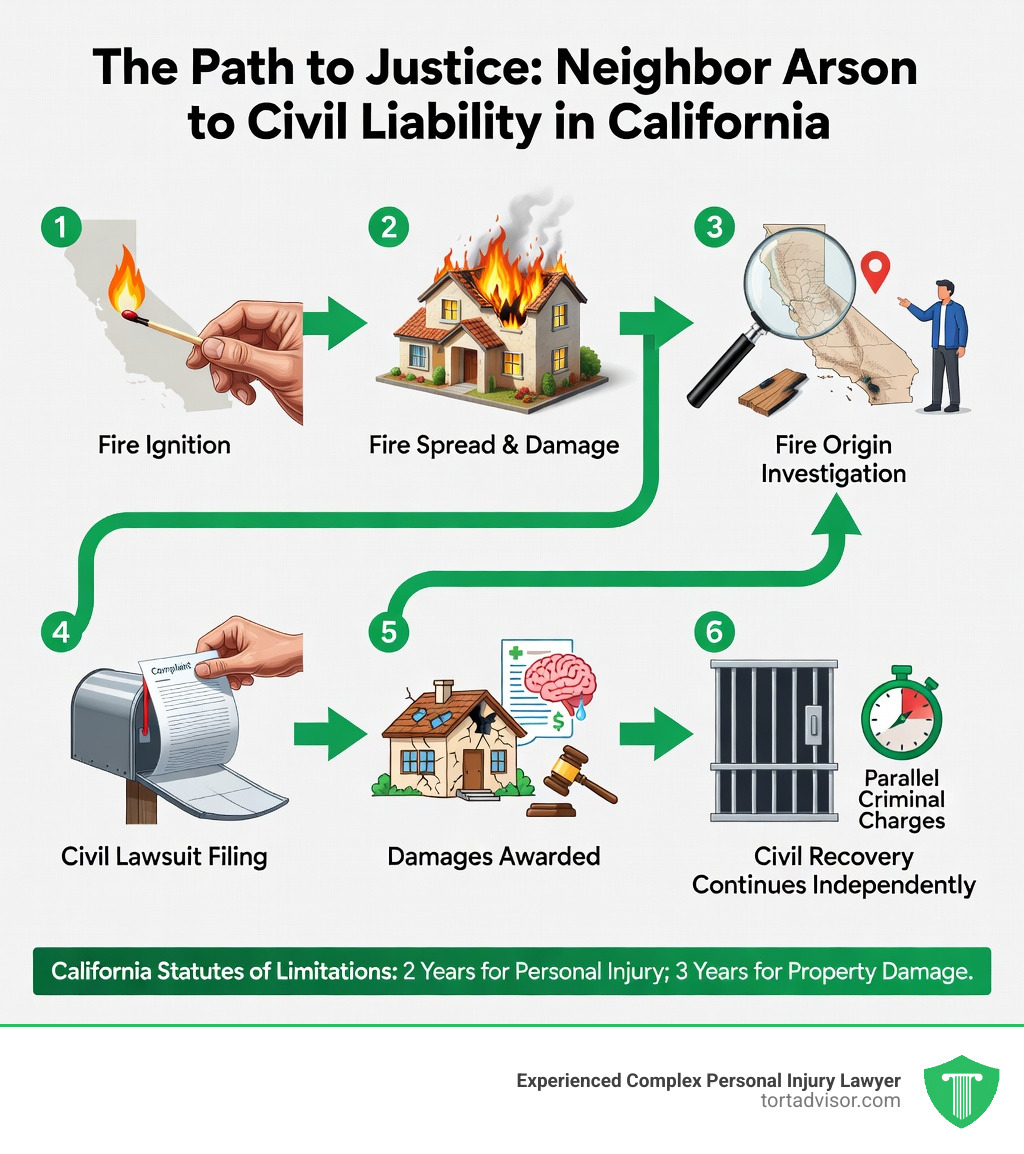
An arson lawsuit against a neighbor over a California wildfire is one of the most complicated injury claims there is. Here are the essentials up front:
In Short: Can you sue a neighbor who caused a wildfire?
- Yes. When a neighbor’s deliberate or careless act starts a fire that damages your property, you can bring a civil claim.
- A criminal conviction is not required to sue in civil court.
- Recoverable losses can include property damage, medical costs, lost earnings, emotional distress and more.
- In California, you generally have 2 years from the fire to sue for personal injury and 3 years for property damage.
- Any criminal case runs on its own track, and your civil claim proceeds independently.
The 2025 Los Angeles fires showed how real this is. Federal prosecutors charged Jonathan Rinderknecht, 29, alleging he set a small brush fire on New Year’s Day that kept smoldering underground before flaring up on January 7 as the devastating Palisades Fire. The toll: 12 deaths, more than 17,000 structures lost and estimated losses of up to $150 billion, placing it among the deadliest fires Los Angeles County has seen.
If a neighbor’s reckless or intentional conduct cost you your home or someone you love, you still have options. California law gives fire victims meaningful ways to pursue accountability.
I’m Mason Arnao. My roots are in technology and data systems, but years of internet research, lead generation and SEO work have taught me how to explain complicated legal subjects, including California wildfire arson neighbor lawsuit claims. Below, I explain how these cases work, which evidence matters and what legal paths are open to you.
Case Study: How the Palisades Fire Allegedly Grew From a New Year’s Spark
The Palisades Fire is a sobering example of how one small careless or malicious act can turn into a historic disaster. It started the morning of January 1, 2025, when a small brush fire ignited near Temescal Ridge while much of Los Angeles was celebrating the new year. Some initially believed it was possibly caused by fireworks, which are a frequent fire source in Southern California.
Firefighters appeared to knock the flames down quickly — or so it seemed at the time.
What followed is something fire investigators dread: a “holdover” fire. Investigators allege the blaze kept smoldering underground in dry roots and organic material, out of sight. On January 7, 2025, driven by Santa Ana winds that reached hurricane-like levels, it erupted.
Early reports said the Palisades wildfire has burned 654 acres, but it rapidly became enormous. In the end, the Palisades Fire together with the Eaton and Hurst fires had burned more than 40,000 acres. The loss of life was devastating, with 27 fatalities across Los Angeles County, twelve of them caused by the Palisades Fire in Pacific Palisades and Malibu.
For survivors, the devastation was complete. Reports counted more than 12,000 homes, structures, and businesses have been destroyed, and early estimates put the losses from the Los Angeles fires total up to $150 billion. If you are dealing with the aftermath, our california-wildfire-2025-update tracks the latest recovery and legal developments.
Proving Fault in a California Wildfire Arson Lawsuit
In any California wildfire arson neighbor lawsuit, how the fire started matters as much as who started it. In the Rinderknecht case, federal prosecutors have assembled a digital evidence trail. Tying a January 1 fire to a disaster that peaked on January 7 is challenging, but prosecutors say their evidence is strong.
According to authorities, Rinderknecht was connected to the fire through:
- iPhone Location Data: Records allegedly placed him within 30 feet of the point of origin on New Year’s Day.
- Uber Records: As a rideshare driver, his car’s movements were logged and allegedly showed repeated returns to the area.
- Video: Prosecutors say he recorded the fire and followed fire engines with his phone.
- Physical Evidence: Investigators reportedly found a lighter in his car consistent with the suspected ignition source.
The defense, including attorney Jerod Gunsberg, is expected to focus on the six days between the first fire and the major blaze, since proving the first fire directly caused the second is the key obstacle. Still, as our wildfire-property-damage-claim-complete-guide explains, origin-and-cause analysis has become remarkably precise, sometimes narrowing an ignition point to within three inches.
So, can you sue a neighbor for fire damage in California? Yes — as long as you can show their intentional or careless conduct was the proximate cause of your losses.
Intent vs. Negligence in an Arson Lawsuit
California defines arson in Penal Code Section 451, but a civil arson lawsuit does not always require proving arson in the criminal sense. Two standards usually come into play:
- Willful and Malicious (Arson): A violation of Penal Code Section 451(b) means the person meant to set the fire. Even burning trash belonging to someone else can qualify, as People v. Maldonado shows.
- Negligence: The more common route, based on a breach of the duty of care — for example, a neighbor who neglects electrical equipment or walks away from a campfire can be liable for the resulting spread.
Attorneys handling california-wildfire-legal-claims work to pinpoint where a neighbor’s responsibility began and how their reckless conduct caused the harm. Under section 451(d), setting fire to property — even brush or “trash” — carries serious penalties and can support civil liability.
Civil Claims vs. Criminal Charges
Many people assume they must wait for a criminal conviction before suing, but the two processes are quite different:
- Criminal Case: Prosecutors must prove guilt “beyond a reasonable doubt,” and the aim is punishment such as prison.
- Civil Case: A plaintiff needs to prove liability by a “preponderance of the evidence” — more likely than not — and the aim is compensating the victim.
A civil California wildfire arson lawsuit can seek damages a criminal court may not award, including california-wildfire-wrongful-death claims when a relative died and punitive damages for especially egregious conduct. To explore what factors affect a claim’s value, try our calculator/california-wildfire-settlement-calculator.
More recently, District Attorney Hochman Announces Additional Charges for wildfire-related offenses, and public records like these can sometimes strengthen a civil claim.
A Neighbor Dispute, Assault Claims and Alleged Deflection
The Rinderknecht matter took an odd turn in March 2025, when he filed his own civil suit against a former neighbor. In that pro se (self-represented) complaint, he alleged he was the target of an attempted sexual assault in a Hollywood apartment building, claiming the neighbor used crack cocaine, exposed himself and tried to assault him while he was cooking.
Why is that relevant? Federal prosecutors noted the alleged incident took place in an apartment that law enforcement was surveilling while the Palisades Fire investigation was underway. Some viewed his claims as “legal deflection” — an effort to cast himself as a victim instead of a suspect.
The suit was dismissed in September 2025 after neither side appeared at the hearing. It may look like a sideshow, but disputes like this often surface around arson cases, and similar tactics — using a separate claim to cloud the picture — show up in other complex wildfire litigation.
For people who lost everything in the fire, the suspect’s claim to be an assault victim did nothing to rebuild homes or bring back loved ones.
Beyond the Suspect: Claims Against Utilities and Government
The person who allegedly lit the match is often not the only party at fault. In many Los Angeles wildfire cases, victims are pursuing larger institutions whose failures let a small fire become a disaster.
For example, two California judges filed suit against the Los Angeles Department of Water and Power (LADWP) after losing their homes, arguing the utility failed to keep reservoirs ready and water pressure up, which helps explain why hydrants went dry at the peak of the fire.
Others are suing Southern California Edison (SCE). While an individual is accused in the Palisades Fire, SCE equipment has been tied to the Eaton and Hurst fires. Southern California Edison has cut power to many customers at times to prevent sparks, and when a utility’s equipment starts a fire, it can face strict liability under inverse condemnation.
Under that doctrine, a utility whose equipment causes a fire can owe damages even without traditional negligence, making it a strong avenue for wildfire-smoke-damage-claims and total losses. A written ruling from Judge Samantha Jessner confirmed that victims may pursue LADWP over the water supply failures.
Wildfire Arson Lawsuit FAQs
Can I sue a neighbor whose carelessness started a wildfire?
Yes. In one case, a Homeowner Sued $25 million Over California Wildfire tied to a faulty electrical box. Protect your home and neighbors by maintaining defensible space around your property, as California fire codes require. A neighbor who ignores fire safety rules or leaves dry brush untrimmed creates a hazard that may lead to liability. Learn more in our category/wildfires section.
What evidence connects an arsonist to fire damage?
Today’s investigations are extremely detailed. Newly released video footage from doorbell cameras or drones often supplies early leads. Investigators also rely on:
- Location data from phones and vehicle GPS.
- Soil testing to detect accelerants.
- Eyewitness accounts from hikers and neighbors.
- Origin-and-cause analysis tracing burn patterns back to one spot.
As the U.S. Forest Service notes, people start fires in many ways, and a well-built tort/wildfire-lawsuit aims to hold the right party responsible.
How does arson affect insurance payouts?
Arson can complicate insurance claims. Questions about vacancy and occupancy often spark coverage disputes during an arson investigation, and an insurer that suspects the owner was involved may deny the claim. For innocent victims, however, the fact that a fire was arson should not block payment.
A larger problem is that many owners face long permit delays or discover they are underinsured because policies were canceled months before the fire. In those situations, suing the responsible neighbor or utility may be the only way to close the financial gap.
Conclusion
Legal Lawsuit understands that an arson lawsuit is about more than money — it is about accountability and the chance to rebuild a life that burned in an instant. Whether a fire was allegedly started by an individual like the Palisades suspect or made worse by a utility’s failures, you may have the right to hold those responsible to account.
Recovery takes time, but you do not have to go through it alone. From insurance subrogation questions to wrongful death claims, Legal Lawsuit can connect you with experienced attorneys in our network through a free, confidential case review. For a full overview of your rights, see our california-wildfire-lawsuit-guide.
Related Posts
Quick Answer: The Boy Scouts of America (BSA) filed for Chapter 11 bankruptcy in 2020 after facing tens of thousands [...]
Quick Answer: Survivors of sexual abuse by Catholic priests, nuns, or other Church personnel may be able to file a [...]
Quick Answer: Clergy abuse settlements vary enormously based on the severity of the abuse, the strength of evidence that the [...]