
Short answer: This article explains the key facts, eligibility issues, settlement factors, deadlines, and source-backed updates related to this legal topic. Results vary by case facts, evidence, jurisdiction, and representation.
In This Guide
What an Employment Law Attorney Does for Workers
Workplace conflicts can upend your income and peace of mind. An experienced employment law attorney helps you resolve those disputes and protect your job, pay and career.
An employment lawyer can:
- Defend your legal rights on the job.
- Explain labor laws so you know your options.
- Look into possible violations by your employer.
- Negotiate with your employer or its lawyers.
- Represent you before agencies or in court.
- Pursue fair compensation when your rights were violated.
Unfair treatment, discrimination and unpaid wages create real stress. This guide explains common employment issues and how to find an attorney who can even the odds against your employer.
Legal Lawsuit’s experience connecting people with legal help gives us practical insight into finding the right employment law attorney for a particular problem.
Your Rights Under Employment Law
Employment law sets the ground rules for the workplace and protects employees throughout their careers. Most states follow “at-will” employment, which lets employers fire people for almost any reason, but never for an illegal one such as discrimination or retaliation.
Some states, California among them, go further than federal law. These overlapping rules are hard to navigate alone, so it pays to know your rights and when to bring in an employment law attorney.
You can also browse our guides to personal injury lawsuits.
What Employment Law Covers
These laws define what employees are entitled to and what employers must do to keep workplaces safe, fair and respectful.
Rules come from federal, state and local sources. Title VII of the Civil Rights Act, the Americans with Disabilities Act (ADA) and the Family and Medical Leave Act (FMLA) set national standards, while states such as California add protections through laws like the Fair Employment and Housing Act (FEHA), and cities may set higher minimum wages. Because the rules differ and change, advice about your situation should come from a qualified employment law attorney.
Cases Employment Lawyers Commonly Handle
An employment law attorney takes on disputes where a worker’s legal rights were violated, including:
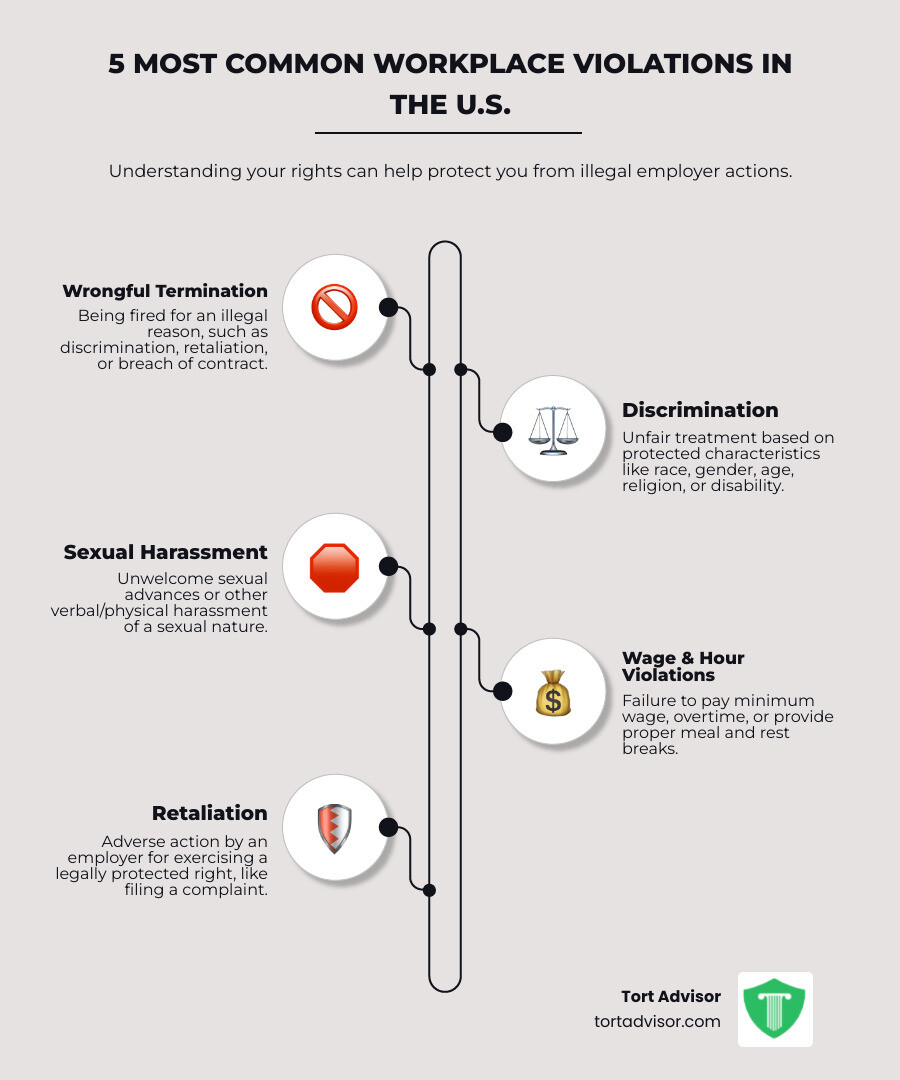
- Wrongful termination: being fired for an unlawful reason such as discrimination, retaliation or breach of contract, which is illegal even in at-will states.
- Discrimination: unequal treatment because of a protected trait, including race, color, religion, sex (covering pregnancy, sexual orientation and gender identity), national origin, age (40 and older), disability or genetic information, with states often adding more categories.
- Sexual harassment: either quid pro quo demands that tie job benefits to sexual favors or a hostile environment created by unwelcome sexual conduct.
- Hostile work environment: abusive or discriminatory conduct severe or pervasive enough to make doing your job unreasonably difficult.
- Wage and hour violations: unpaid minimum wage or overtime, missed meal and rest breaks, misclassification as a contractor or unlawful deductions.
- Retaliation: punishment for protected activity, such as reporting discrimination, filing a workers’ comp claim or reporting illegal conduct (whistleblower claims).
If you think your rights were violated, talk to an employment law attorney.
Core Workplace Rights to Know
Protecting yourself starts with knowing what the law guarantees, including:
- Fair pay: at least the applicable minimum wage and every dollar you earned.
- Overtime: non-exempt workers generally earn 1.5 times their regular rate after 40 hours in a workweek.
- Meal and rest breaks: required by law in many states depending on shift length.
- A safe workplace: freedom from recognized serious hazards under rules enforced by OSHA.
- Protected leave: the FMLA lets eligible employees take unpaid, job-protected leave for qualifying family and medical reasons.
- Reasonable accommodations: under the ADA, employers must accommodate employees with disabilities unless doing so causes undue hardship.
These rights are enforceable. If you believe yours were violated, get legal advice promptly.
When to Hire an Employment Lawyer

Employers usually have legal counsel on their side. An employment law attorney evens that imbalance, knows the procedures and fights for the compensation you are owed.
Who Employment Lawyers Represent
Most employment law attorneys work for one side:
- Plaintiff-side attorneys represent workers. Groups such as the California Employment Lawyers Association (CELA) are made up of lawyers who focus on representing employees.
- Defense attorneys represent companies against employee claims.
If you are an employee, look for an employment law attorney who represents workers only, which avoids conflicts and means their experience is focused on cases like yours.
Reasons to Hire an Employment Attorney
Minor workplace friction may not need a lawyer, but unlawful treatment usually does.
An employment law attorney brings:
- Deep legal knowledge of changing federal, state and local rules.
- An objective view of your case’s strength and likely damages.
- Negotiating skill to secure a fair deal and keep you from signing away rights for too little.
- Trial experience if settlement fails.
- Command of procedures and deadlines, such as the time limits for filing a charge with the EEOC.
- Resources: the time, staff and funding to take on large employers.
When to Call a Lawyer Right Away
Reach out to an employment law attorney promptly if:
- You were fired soon after reporting wrongdoing, complaining about harassment or taking protected leave.
- You were refused FMLA leave or a disability accommodation you were entitled to.
- Your employer ignores serious or ongoing harassment or discrimination.
- You were offered a severance agreement; have a lawyer review it before signing.
- You have unpaid wages, unpaid overtime or denied breaks.
- You were told to do something illegal.
- Something at work feels legally wrong.
Some employment deadlines are very short, as little as 180 days, so document everything and get advice quickly.
How an Employment Claim Moves Forward

Standing up to an employer takes courage. The process is detailed but manageable, and an employment law attorney guides each step, from collecting evidence to meeting deadlines, to give you the best chance at fair compensation.
Evidence to Collect for an Employment Claim
Good records can make or break an employment case. Start saving documents as soon as you suspect a problem, including:
- Emails and texts about the issue, saved somewhere you control, consistent with company policy.
- Performance reviews, especially any that turned negative after you raised concerns.
- Contracts or offer letters.
- The employee handbook and written policies.
- Pay stubs and wage statements.
- Names and contact details of witnesses.
- A written log of incidents with dates, times, people present and what happened.
- Copies of complaints to HR or managers and their replies.
Your employment law attorney can help sort out which evidence matters most.
Filing Deadlines for Employment Claims in California
A statute of limitations is a hard cutoff; miss it and the claim is usually gone no matter how strong it is. California deadlines vary by claim, and many claims first require an administrative complaint with the state Civil Rights Department (formerly the DFEH) or the federal EEOC.
| California Claim Type | General Deadline |
|---|---|
| Discrimination, harassment or retaliation under FEHA | 3 years to file with the Civil Rights Department |
| Wage and hour claims | Generally 2 to 4 years depending on the claim |
| Wrongful termination (common law) | 2 years |
| Federal discrimination (EEOC charge) | 180 or 300 days |
These are general rules with exceptions, so talk to an employment law attorney quickly to make sure your claim is filed in time.
What You Can Recover in an Employment Case
A successful claim can provide several kinds of relief, and your employment law attorney will pursue the strongest outcome available.
Possible remedies include:
- Back pay: wages and benefits you lost.
- Front pay: future lost earnings when returning to the job is not possible.
- Reinstatement: getting your position back.
- Emotional distress damages: compensation for the harm you suffered.
- Punitive damages: available for especially egregious conduct.
- Attorney fees and costs: often shifted to the employer when the worker wins.
- Out-of-pocket losses: such as job search or medical costs.
The right employment law attorney can significantly affect what you recover. For context on how legal recoveries are valued, see how much mass tort lawsuits receive.
Choosing the Right Employment Law Attorney

Picking an employment law attorney is a big decision. You want a dedicated advocate with a strong record who understands your situation and communicates clearly, so use consultations to compare options.
What to Look for in an Employment Attorney
Strong candidates usually offer:
- A focus on employment law, not a little of everything.
- Employee-only representation, which avoids conflicts.
- A record of results, including favorable settlements and verdicts and positive client feedback.
- Clear communication and regular updates. In some states, Board Certification in labor and employment law signals advanced expertise.
How Employment Lawyers Charge
Cost should not keep you from getting help. Many employee-side employment law attorneys use fee arrangements designed to be accessible.
Most worker-side cases use a contingency fee: nothing upfront and a percentage of any recovery, with no attorney fee if the case does not succeed. Cornell Law School explains contingency fees.
Some lawyers bill hourly or require a retainer. Many offer a free first consultation. Confirm the fee arrangement at the start and get it in writing.
Questions to Ask at Your First Consultation
Treat the first meeting as an interview. Consider asking:
- How much of your practice is employment law?
- Do you usually represent employees or employers?
- Have you handled cases like mine?
- Are you Board Certified in labor and employment law, where available?
- What resources can you devote to my case?
- How are you regarded by other lawyers?
- Have you ever been disciplined by a bar association?
- Who will actually work on my case?
- What outcomes are realistic for a case like mine?
- How do you charge, and who pays case costs?
Employment Law FAQs
Answers to questions workers ask most often.
Can my employer fire me for filing a claim?
No. Firing, demoting or otherwise punishing you for exercising legal rights is illegal retaliation, and anti-retaliation laws at the federal and state level protect you.
Protected activity includes reporting discrimination or wage violations, asking for FMLA leave or an accommodation and taking part in an investigation. If you were punished afterward, you may have a retaliation claim. Keep records and contact an employment law attorney promptly.
Must I file with the EEOC before suing?
Frequently, yes. Many federal discrimination claims under Title VII or the ADA require a charge with the EEOC or a state agency first, a step called exhausting administrative remedies.
After a charge is filed, the agency may investigate or offer mediation. If the matter is not resolved, it issues a right-to-sue notice that lets you go to court. Deadlines are strict, so talk with an employment law attorney before filing to make sure the charge is complete and properly filed.
What if the harassment happened away from work?
It can still count. Work-related harassment may be unlawful even when it happens outside the office.
Conduct at company events, on business travel or through work messaging can contribute to a hostile environment for which the employer may be responsible. Do not dismiss after-hours or off-site behavior; document it and review it with an employment law attorney.
Conclusion
Employment law is complicated, but you do not have to face it alone. This guide covered your basic rights, from fair pay to a safe workplace, and warning signs such as wrongful termination and discrimination.
Remember to know your rights, move quickly because deadlines are short, keep evidence and choose the right attorney. An employment law attorney who represents workers and has a strong record is your most valuable ally, and a successful claim may recover back pay, emotional distress damages and, in some cases, punitive damages.
Legal Lawsuit can connect you with independent employment law attorneys who represent workers, for a free, confidential review of your situation.
Do not let unlawful treatment at work go unanswered. Take the first step to protect your rights.
Explore your legal options and request a free case review.
Related Posts
Quick Answer: The Boy Scouts of America (BSA) filed for Chapter 11 bankruptcy in 2020 after facing tens of thousands [...]
Quick Answer: Survivors of sexual abuse by Catholic priests, nuns, or other Church personnel may be able to file a [...]
Quick Answer: Clergy abuse settlements vary enormously based on the severity of the abuse, the strength of evidence that the [...]