Short answer: This article explains the key facts, eligibility issues, settlement factors, deadlines, and source-backed updates related to this legal topic. Results vary by case facts, evidence, jurisdiction, and representation.
Money Trouble After a Crime? Where Victims Can Get Financial Help
📋 Table of Contents
- When a Crime Leaves You Struggling Financially, Here’s Where to Turn
- Understanding the Crime Victims Assistance Fund and How It Works
- Regional Breakdown: Accessing Funds in the US and Canada
- Eligibility and Benefits: What Can You Claim?
- Specialized Compensation for Vulnerable Groups and Historical Cases
- Frequently Asked Questions about Crime Victim Compensation
- Conclusion
A crime victim compensation fund is money set aside to help people get back on their feet financially after a violent crime. These programs can pay for medical care, therapy, lost income and even funeral expenses, and in many cases no conviction is needed before you apply.
The main programs at a glance:
| Program | Where | Who It Helps | Key Benefit |
|---|---|---|---|
| Crime Victims Fund (CVF) | United States (federal) | All U.S. states & territories | Direct compensation plus assistance grants |
| Victims’ Justice Fund (VJF) | Ontario, Canada | People harmed by Criminal Code offences | Pays for victim service programs |
| Crime Victim Assistance Program (CVAP) | British Columbia, Canada | Victims, their families and witnesses | Medical care, counseling, income support |
| Victims Fund | Federal Canada | Groups that support victims | Grants for projects and awareness |
Surviving a crime is hard enough on its own. Then the bills arrive.
Doctor visits, missed shifts, therapy sessions: the costs stack up quickly, and many victims never learn that financial help is available.
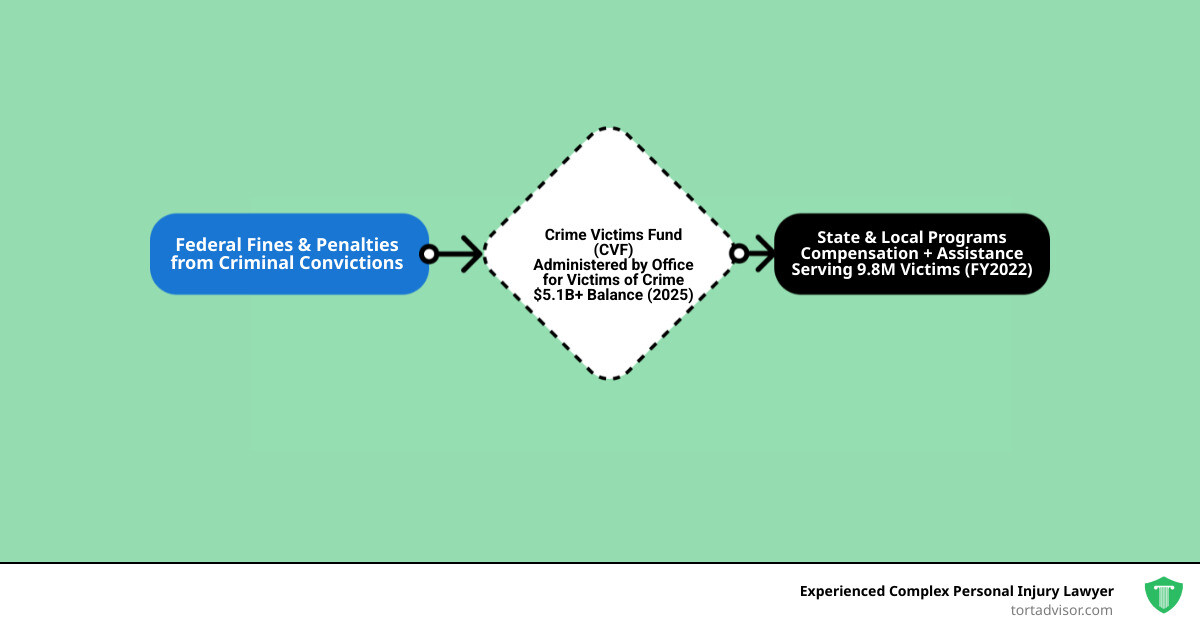
Fortunately, the U.S. and Canada both run systems built to lighten that load. On the U.S. side, the federal Crime Victims Fund held over $5.1 billion as of May 2025, paid for completely by fines and penalties from federal criminal cases rather than by taxpayers. During FY 2022 it supported services for 9.8 million victims through state-run programs.
From Ontario to British Columbia to every U.S. state, genuine programs hold genuine funds for people facing what you are facing.
Below, Legal Lawsuit explains how a crime victim compensation fund works, who is eligible and how to apply.
I’m Mason Arnao. My training is in technology and data systems, but I have spent years digging into complicated compensation and legal questions, including how the crime victims assistance fund system differs from one jurisdiction to the next. Here is what that research turned up, explained plainly, so you can concentrate on getting the support you are owed.
How a Crime Victim Compensation Fund Works

A crime victims assistance fund is not built on taxpayer dollars. One of its most striking features is that offenders themselves pay toward the recovery of the people they hurt.
In the U.S., the foundation is the Victims of Crime Act (VOCA) of 1984, the law that created the federal Crime Victims Fund (CVF). Rather than drawing on taxes, the fund is refilled by federal criminal fines, forfeited bail bonds and special assessments, a system where the people convicted cover the cost.
For a closer look at how individual payouts are handled, see our victim-compensation-fund guide. If you want the legislative background, the Congressional Research Service has published a detailed report, The Crime Victims Fund (CVF): Federal Support for Victims of Crime.
How the Federal Fund Is Run
The Office for Victims of Crime (OVC), part of the Department of Justice since 1988, oversees the fund. Its job is to channel those billions from Washington to the states, where the money can actually reach victims.
An important recent change was the VOCA Fix to Sustain the Crime Victims Fund Act of 2021. Previously, penalties from “deferred prosecution agreements,” where a company pays to avoid going to trial, went to the general Treasury. They now flow straight into the crime victims assistance fund, and because those sums can reach into the billions, the change keeps the fund stable when ordinary criminal fines rise and fall. The official OVC site has more info about victim compensation and what these changes mean for survivors.
Where the Money Comes From and How It Is Divided
The federal balance stood at over $5.1 billion as of May 2025. To get that money to local communities, the OVC sends grants to each U.S. state and territory using a set formula.
Every state receives a base amount, usually $500,000 for victim assistance, with the remainder divided by population. For victim compensation, meaning direct payments to people, Washington gives each state a yearly grant equal to 75% of what that state paid victims two years earlier, which keeps support flowing year after year. The full figures appear in the 2024 Crime Victims Fund Allocations.
Getting Help in the U.S. and Canada, Region by Region
Which program you use depends largely on where the crime took place. Federal governments supply the starting funds, but state and provincial agencies process the actual claims.
| Feature | Ontario (VJF) | British Columbia (CVAP) | U.S. Federal (CVF/VOCA) |
|---|---|---|---|
| Primary Funding | Victim fine surcharges | Provincial budget/fines | Federal fines & penalties |
| Direct Payouts? | No (funds programs) | Yes (to victims/witnesses) | Yes (via state programs) |
| Annual Revenue | $44M – $50M | Varies by year | $1.9B – $2.6B (caps) |
How Ontario’s Victims’ Justice Fund Works
Ontario’s Victims’ Justice Fund (VJF) works differently from U.S. programs. It generally does not pay individual victims for “pain and suffering.” Instead, it brings in $44 million to $50 million a year, largely from victim fine surcharges added to Provincial Offences Act fines (speeding tickets count, parking tickets do not), and uses that money to fund support services.
Those dollars support the Victim/Witness Assistance Program (V/WAP), which guides people through court, along with grants to community groups helping survivors of sexual assault and domestic violence. To locate a particular service in Ontario, start with the Victim Support Directory. The surcharges themselves are required by the Criminal Code of Canada.
BC’s Crime Victim Assistance Program (CVAP)
In British Columbia, your main resource is the Crime Victim Assistance Program (CVAP). It operates under the Crime Victim Assistance Act and offers broad support.
BC revised its rules in January 2024, raising counseling rates and widening eligibility. Benefits span medical and dental bills, job retraining and even cleanup of a crime scene. The program acts as a “payer of last resort,” so when private insurance will not cover something like a therapy appointment, CVAP covers the shortfall.
Who Is Eligible and What a Crime Victim Compensation Fund Pays For
A common misconception is that you cannot use a crime victims assistance fund until a case goes to trial. Not so. Most programs accept applications once the crime has been reported to police, with no conviction or even arrest required.
Benefits commonly include:
- Medical and Dental Expenses: ER visits, surgery or repairing a broken tooth.
- Mental Health Counseling: Frequently the most-used benefit, covering therapy for victims and family members.
- Lost Wages: Income missed because of your injuries or time spent in court.
- Funeral and Burial Costs: Relief for families facing sudden expenses after a death.
- Crime Scene Cleaning: Professional cleanup of a home where violence took place.
After a serious personal violation, talking with an abuse-victim-lawyer can help you decide whether to bring a sexual-abuse-lawsuit alongside your fund application.
Who Qualifies for Crime Victim Compensation?
Applicants generally fit one of three groups:
- Primary Victims: The person the crime directly injured.
- Immediate Family: A victim’s spouse, parents or children, particularly after a homicide.
- Witnesses: Some places, British Columbia among them, offer counseling to people traumatized by witnessing a violent crime.
Canada also helps citizens hurt overseas. When a Canadian suffers a violent crime in another country, the federal government may cover hospital costs or the expense of returning home.
How to Apply, and the Deadlines That Matter
Here is the catch: every crime victims assistance fund sets a filing deadline, essentially its own statute of limitations.
- United States: Most states give you one to three years after the crime to apply.
- British Columbia: Crimes on or after January 1, 2024 carry a two-year window. Earlier crimes had a one-year limit.
- Exceptions: Many jurisdictions pause the clock for minors until they reach 18 or 19, and sexual assault survivors often get far longer deadlines or none at all.
The Victim information and assistance page lists the forms and supporting documents you will need.
Special Programs for Vulnerable Communities and Past Tragedies
At times the usual crime victims assistance fund cannot match the size of a disaster or a community’s particular needs, which is why dedicated programs exist.
Stand-Alone Funds for Historic Events
Some large funds have been created for single events. Best known is the September 11th Victim Compensation Fund (VCF), which shut down in 2004, reopened in 2011 and has since been made effectively permanent (authorized through 2090) as first responders developed cancers years later.
Clergy abuse is another major category. In New Jersey, the state’s five Catholic dioceses each paid over $50 million in settlements before any statewide compensation fund existed. Such funds frequently ask survivors to give up the right to sue in return for a guaranteed payment. If your situation involves a religious institution, make sure you understand your rights in a church-religious-organization-sexual-abuse claim.
Newer Efforts: Canada’s Black Justice Strategy and Victims Week
Governments increasingly acknowledge that certain communities face extra hurdles. Canada’s 2024 Fall Economic Statement set aside $77.9 million to start Canada’s Black Justice Strategy, including $4.4 million through the Victims Fund for culturally grounded supports for Black communities.
Ottawa also funds projects during “Victims and Survivors of Crime Week,” with organizations eligible for up to $10,000 for workshops or awareness events. Comparable targeted help is available to child-sexual-abuse-lawsuit survivors and people pursuing university-sexual-assault-lawsuits.
Crime Victim Compensation Fund FAQs
What won’t these funds cover?
These programs help a great deal, but they have limits. Most crime victims assistance fund programs will NOT pay for:
- Property Loss: A stolen car or a broken window generally is not covered.
- Pain and Suffering: The funds reimburse out-of-pocket costs only. Compensation for pain and suffering usually requires a civil lawsuit.
- Motor Vehicle Accidents: Most states leave out car crashes unless a drunk driver was involved or the vehicle was used as a weapon.
- Double Recovery: If your health plan already covered a bill, the fund will not reimburse it a second time.
Is a lawyer required to apply?
No lawyer is required to apply to a crime victims assistance fund, since the process is meant to be administrative. In complicated matters, such as a teacher-sexual-abuse-lawsuit, legal help can make a big difference.
An attorney can tell you whether a fund’s offer is reasonable or whether a civil suit makes more sense. Some funds require you to sign a “waiver of rights” that blocks you from suing the offender later, and an attorney in our network can help you weigh that choice through a free, confidential case review.
Where can I get support right away?
If you need help today, reach out now rather than waiting on an application.
- Ontario: Contact the provincial Victim Support Line or chat online at 211ontario.ca.
- British Columbia: Reach VictimLink BC, the province’s 24/7 victim service line.
- United States: Get in touch with your state’s VOCA administrator, or search the Directory of victims services for nearby help.
Conclusion
Getting back on solid financial ground is a big part of healing. A state crime victim compensation fund, a specialized federal program or a civil lawsuit can each offer a path forward.
Legal Lawsuit believes no one should have to trade their health for financial security after a crime. If you want to look at options beyond government funds, we can connect you with attorneys in our network who focus on helping survivors.
Take your next step today with our Access the Victim Compensation Fund resources. You have been through enough, and a free, confidential case review can help you protect what comes next.
Related Posts
Quick Answer: The Boy Scouts of America (BSA) filed for Chapter 11 bankruptcy in 2020 after facing tens of thousands [...]
Quick Answer: Survivors of sexual abuse by Catholic priests, nuns, or other Church personnel may be able to file a [...]
Quick Answer: Clergy abuse settlements vary enormously based on the severity of the abuse, the strength of evidence that the [...]