
Short answer: This article explains the key facts, eligibility issues, settlement factors, deadlines, and source-backed updates related to this legal topic. Results vary by case facts, evidence, jurisdiction, and representation.
Hormone Therapy for Breast Cancer: How It Works and Why It Matters
Hormone therapy for breast cancer ranks among the most powerful options oncologists have for slowing or halting tumors that grow in response to estrogen or progesterone.
If you want the main points quickly, start here:
| Question | Quick Answer |
|---|---|
| What does it do? | Blocks or lowers the hormones that drive certain breast cancers |
| Who is it for? | Patients with hormone receptor-positive (HR+) breast cancer, roughly 80% of cases |
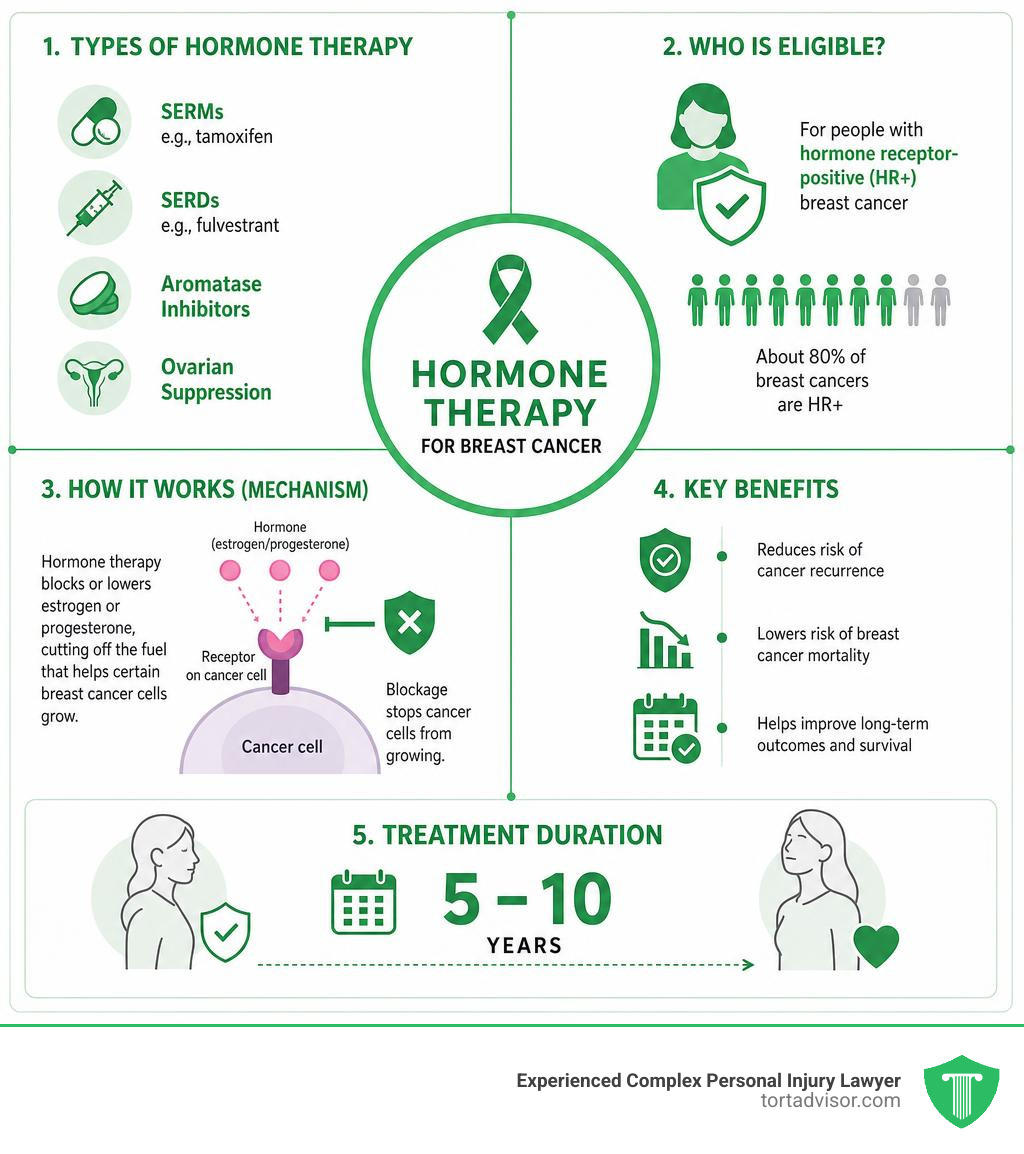
| Main types | SERMs (such as tamoxifen), SERDs (such as fulvestrant), aromatase inhibitors, and ovarian suppression |
| How long? | Usually 5 to 10 years |
| How effective? | Meaningfully lowers the risk of recurrence and of dying from breast cancer |
Roughly two in every three breast cancers are hormone receptor-positive, meaning estrogen or progesterone is helping the cancer cells grow. Hormone therapy, also known as endocrine therapy, works by shutting off that fuel.
Below you’ll find how the treatment works, who is eligible, the side effects to expect, and where the newest options stand.
I’m Mason Arnao. My background is in technology, data systems, and digital marketing, but I’ve spent years digging into complicated medical and legal subjects, hormone therapy for breast cancer among them, to help people facing hard situations see them clearly. This guide aims to give you plain, dependable information so you can ask sharper questions and decide with more confidence.
More on hormone therapy for breast cancer:
How Hormone Therapy for Breast Cancer Works, and Who Qualifies
Understanding hormone therapy for breast cancer starts with tumor biology. Chemotherapy attacks fast-dividing cells throughout the body, but hormone therapy is targeted: it zeroes in on the link between hormones and the cancer cells themselves.
Normally, estrogen and progesterone guide healthy breast development. In about 80% of breast cancers, though, the tumor cells carry proteins called hormone receptors. Think of them as small antennas that grab estrogen and progesterone from the bloodstream and use them to grow and divide. Blocking those receptors, or reducing how much hormone the body makes, can effectively starve the cancer.
The National Cancer Institute explains these mechanisms in detail at Hormone Therapy | Breast Cancer Treatment – NCI.
Who Qualifies for Hormone Therapy for Breast Cancer?
Endocrine therapy isn’t right for every breast cancer patient. Whether you qualify depends on receptor testing of tissue taken during a biopsy or surgery:
- Hormone receptor-positive (HR+): When 1% or more of the tested cancer cells carry estrogen receptors (ER-positive) or progesterone receptors (PR-positive), the tumor counts as hormone receptor-positive, and these patients stand to benefit from hormone therapy.
- Hormone receptor-negative (HR-): Without these receptors, hormone therapy won’t work, so doctors focus on options such as chemotherapy, immunotherapy, or other targeted drugs.
Oncologists also check HER2 status. Whether the tumor is HER2-positive or HER2-negative influences whether hormone therapy should be paired with other targeted medicines. The American Cancer Society explains how pathology results shape treatment at Hormone Therapy for Breast Cancer | Breast Cancer Treatment | American Cancer Society.
The Main Kinds of Endocrine Therapy and How They Work
Doctors can cut off estrogen to breast cancer cells in several ways, and the best choice depends largely on whether you are past menopause.
Here is how the main drug classes used in hormone therapy for breast cancer compare:
| Drug Class | Common Examples | Primary Mechanism | Most Appropriate For |
|---|---|---|---|
| SERMs | Tamoxifen, Toremifene | Keeps estrogen from binding to cancer cells | Premenopausal & Postmenopausal |
| SERDs | Fulvestrant, Elacestrant | Breaks down and eliminates estrogen receptors | Postmenopausal patients (or premenopausal with ovarian suppression) |
| Aromatase Inhibitors | Letrozole, Anastrozole, Exemestane | Halts estrogen production in muscle and fat tissue | Postmenopausal |
| Ovarian Suppression | Goserelin, Leuprolide | Turns off estrogen production in the ovaries | Premenopausal |
SERMs vs. SERDs in Breast Cancer Hormone Therapy
Selective Estrogen Receptor Modulators (SERMs) and Selective Estrogen Receptor Degraders (SERDs) both act on estrogen receptors, but in very different ways.
- SERMs (such as tamoxifen): These drugs occupy the estrogen receptors on breast cancer cells and physically stop estrogen from attaching. They are “selective” because they block estrogen in breast tissue while mimicking it elsewhere, for instance in bone, where they help preserve density.
- SERDs (such as fulvestrant): These attach to the estrogen receptor far more firmly than SERMs and, rather than simply blocking it, make the receptor break apart. The cancer cell is left with fewer “antennas” to pick up growth signals.
Readers who want the molecular detail can consult the academic review Current Endocrine Therapy in Hormone-Receptor-Positive Breast Cancer: From Tumor Biology to the Rationale for Therapeutic Tunning.
Aromatase Inhibitors and Ovarian Suppression
Until menopause, the ovaries supply most of the body’s estrogen. Afterward they stop, but the body still makes a little estrogen by converting androgens, a job handled by an enzyme called aromatase found in fat and muscle.
- Aromatase inhibitors (AIs): Letrozole, anastrozole, and exemestane shut down aromatase and push estrogen in postmenopausal women close to zero. Since AIs can’t stop the ovaries from producing estrogen, they are used only after menopause.
- Ovarian suppression: For premenopausal women at higher risk of recurrence, doctors may pair an AI with a GnRH agonist such as goserelin or leuprolide to quiet the ovaries. This creates a temporary, reversible chemical menopause so younger patients can safely use AIs.
The Mayo Clinic’s Hormone therapy for breast cancer page covers what to expect from ovarian suppression in more detail.
Where Hormone Therapy Fits: Before Surgery, After Surgery, and Advanced Disease
Hormone therapy is flexible and shows up at several points in breast cancer care:

- Neoadjuvant (before surgery): sometimes used to shrink a large hormone receptor-positive tumor first, making removal easier and occasionally allowing a lumpectomy rather than a mastectomy.
- Adjuvant (after surgery): taken for 5 to 10 years after surgery to wipe out microscopic cancer cells that may remain, sharply cutting the chance of recurrence.
- Metastatic disease: when breast cancer has spread, hormone therapy often becomes a main long-term treatment that keeps the disease in check and eases symptoms.
For advanced cancer, oncologists often add targeted drugs such as CDK4/6 inhibitors to hormone therapy to get around hormone resistance. The official guidance on these combinations appears in Endocrine Therapy for Hormone Receptor–Positive Metastatic Breast Cancer: American Society of Clinical Oncology Guideline | Journal of Clinical Oncology.
Handling Side Effects and Drug Interactions
Because it lowers or blocks estrogen, hormone therapy can bring on menopause-like symptoms. They can be difficult, but most are very manageable.

- Hot flashes and night sweats: layered clothing, skipping spicy food, and asking your doctor about non-hormonal medicines (including some antidepressants) can help.
- Bone loss (osteopenia/osteoporosis): AIs can thin bones, so doctors commonly advise regular DEXA scans, weight-bearing exercise, and calcium and vitamin D.
- Joint and muscle aches: common with AIs; gentle exercise, acupuncture, or trying a different AI may ease them.
- Blood clots and uterine cancer risk: uncommon, but tamoxifen slightly raises the risk of clots and changes in the uterine lining. Tell your doctor right away about unusual vaginal bleeding or a swollen leg.
Hormone Therapy for Breast Cancer: Common Questions
How long do patients usually stay on hormone therapy?
In early-stage breast cancer, 5 years is the standard course. For people with a higher chance of recurrence, continuing to 10 years gives stronger protection. A genomic test called the Breast Cancer Index (BCI) can help doctors predict who will gain from going beyond 5 years.
What are the newest developments in hormone therapy?
Oral SERDs like elacestrant are a major step forward for patients with ESR1 mutations, a common change that makes tumors resistant to standard aromatase inhibitors. Pairing hormone therapy with CDK4/6 inhibitors such as ribociclib or abemaciclib has also substantially lengthened progression-free survival in metastatic disease.
Can other drugs interfere with treatment?
Yes. Tamoxifen depends on the liver enzyme CYP2D6 to turn it into its active form. Some antidepressants that strongly inhibit CYP2D6, notably paroxetine and fluoxetine, can block that step and weaken tamoxifen. If you need an antidepressant during tamoxifen treatment, ask about options such as sertraline, citalopram, or venlafaxine.
Conclusion
Hormone therapy is a pillar of personalized cancer care, providing targeted, highly effective protection against recurrence. Still, managing complex treatment, side effects, and drug interactions takes active self-advocacy and a committed care team.
Legal Lawsuit believes health and justice both deserve a fair balance. If outside factors, such as chemicals in consumer products like hair relaxers, may have contributed to a hormone-sensitive cancer, you may have legal options. Legal Lawsuit connects people with experienced attorneys in our network across the U.S., including Alabama, California, Colorado, Connecticut, Delaware, Florida, Georgia, and beyond, through a free, confidential case review.
If you think a product harmed your health, see your legal options with Legal Lawsuit and learn what steps make sense for you.
Related Posts
Quick Answer: The Boy Scouts of America (BSA) filed for Chapter 11 bankruptcy in 2020 after facing tens of thousands [...]
Quick Answer: Survivors of sexual abuse by Catholic priests, nuns, or other Church personnel may be able to file a [...]
Quick Answer: Clergy abuse settlements vary enormously based on the severity of the abuse, the strength of evidence that the [...]