Short answer: This article explains the key facts, eligibility issues, settlement factors, deadlines, and source-backed updates related to this legal topic. Results vary by case facts, evidence, jurisdiction, and representation.
California Wildfire Lawsuit Guide: Why Legal Action Matters More Than Ever
Wildfires are leaving deeper marks across California every year, and many of the worst have been tied to utility company negligence. When failing power lines take homes, families face a long, hard recovery. This California wildfire lawsuit guide explains how a claim can help secure the money needed to rebuild.
📋 Table of Contents
California wildfire lawsuits in brief:
- Who may sue: homeowners, renters, business owners, and families harmed by fires a utility caused.
- Usual defendants: Pacific Gas & Electric (PG&E), Southern California Edison (SCE), and San Diego Gas & Electric (SDG&E).
- What you can recover: property loss, wrongful death, personal injury, evacuation costs, lost income, and emotional distress.
- Legal theories: inverse condemnation, negligence, and safety code violations.
- Nothing upfront: most wildfire attorneys take cases on contingency, so you pay only if you win.
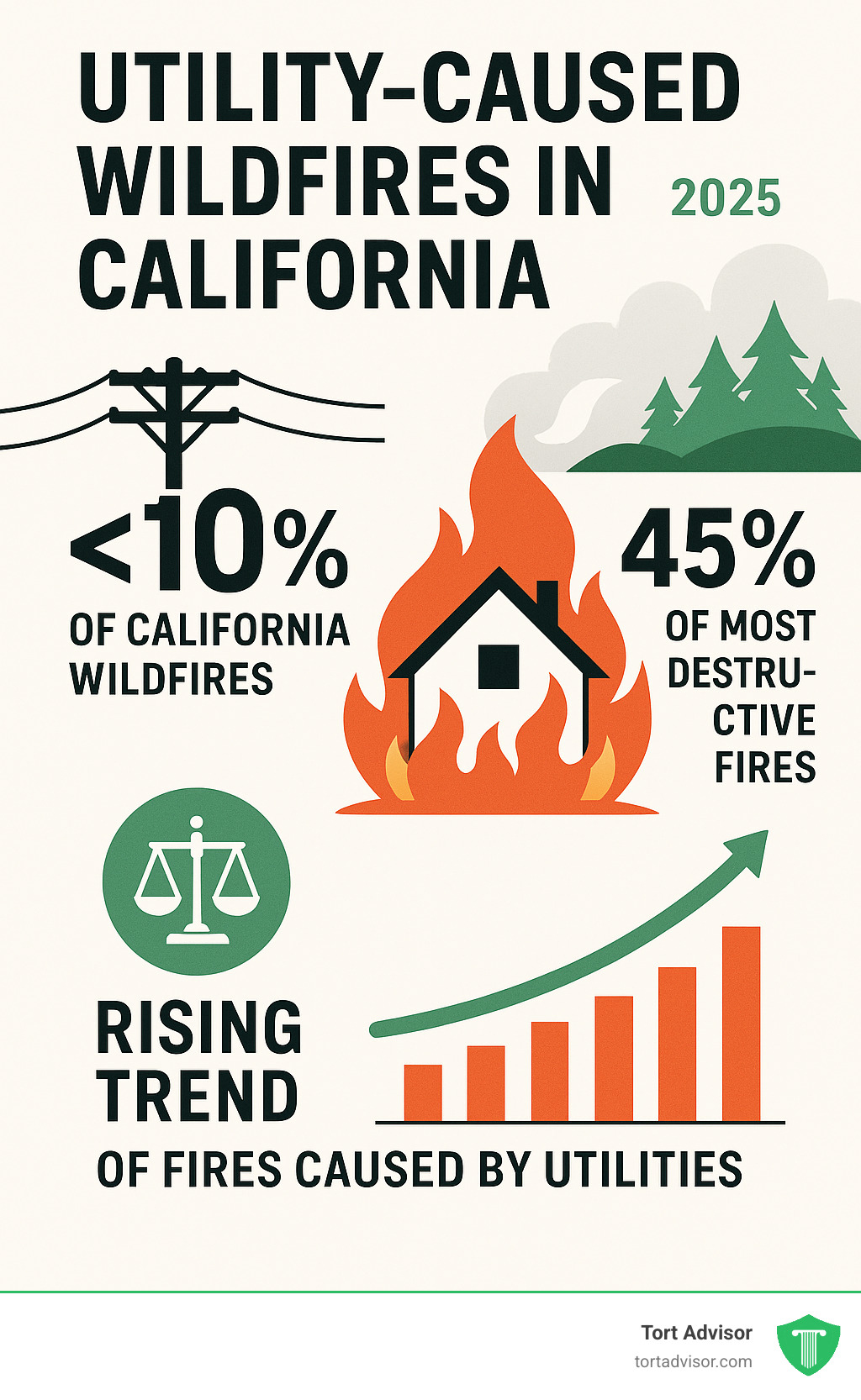
The figures are striking. Utility equipment sparks fewer than 10% of California wildfires, yet it is behind almost half of the most destructive ones. The 2018 Camp Fire alone killed 85 people and wiped out close to 14,000 homes, leading to PG&E’s record $13.5 billion settlement.
More than 1.2 million California homes sit in high wildfire risk zones, so knowing your rights has never mattered more. California’s distinctive inverse condemnation doctrine makes utilities strictly liable for fire damage from their equipment, with no need to prove negligence. If a utility’s line starts a fire that damages your property, the company owes you for those losses.
I’m Mason Arnao. Working with legal data management systems, I’ve seen how deeply these cases affect families, and how much it matters to have accurate information and the right lawyer when you’re facing something this hard.
Who Is Responsible for Wildfire Damage, and How Is It Proven?
After a wildfire hits a community, pinning down the cause is the first step toward accountability. CAL FIRE and other investigators frequently trace fires to faulty power lines or other utility equipment. Although that equipment starts fewer than 10% of wildfires, it accounts for close to half of California’s most destructive fires, often because of aging infrastructure and overgrown vegetation near lines that turns dry terrain into kindling.
Legal Bases for a Wildfire Lawsuit
People harmed by utility-caused fires can pursue compensation on several legal grounds:
- Inverse condemnation: a powerful doctrine specific to California. When a utility’s equipment, treated as a public improvement, damages private property, the utility is strictly liable. You need only show its equipment caused the fire that harmed you, not that the company was careless.
- Negligence: the more familiar claim, requiring proof that the utility didn’t use reasonable care in maintaining or operating its equipment, such as skipping maintenance, neglecting line inspections, or disregarding safety rules. The California Civil Jury Instructions set out the standards for proving it.
- Additional claims: theories such as nuisance (interference with use of your property) and trespass (the fire unlawfully entering your land) may also apply, and violating state laws like Public Utilities Code § 2106 can create direct liability.
The Utilities Most Often Sued
A few major utilities have been named as responsible in many California fires:
- Pacific Gas & Electric (PG&E): its equipment has been tied to several of the worst fires in state history, among them the Camp Fire and the Dixie Fire.
- Southern California Edison (SCE): sued over major Southern California fires including the Thomas and Woolsey fires.
- San Diego Gas & Electric (SDG&E): held responsible for fires in its territory, such as the 2007 Witch and Guejito fires.
Contractors hired to maintain utility equipment can sometimes be liable as well.
Major Fires and Landmark Wildfire Cases
California’s worst wildfires have produced major legal fights that changed how utilities are held to account.

The 2018 Camp Fire: A Turning Point
The Camp Fire leveled the town of Paradise, killed 85 people, and burned more than 18,000 structures. Investigators traced it to faulty PG&E equipment, sparking a massive California wildfire lawsuit. The liability drove PG&E into bankruptcy, and the company pleaded guilty to 84 counts of involuntary manslaughter. A landmark $13.5 billion settlement was funded for victims through the Fire Victim Trust, a strong precedent for utility accountability. CAL FIRE has more background on the Camp Fire.
Other Major Fires Behind Lawsuits
- 2017 North Bay Fires: a cluster of Napa and Sonoma fires, also tied to PG&E equipment, that killed 22 people and destroyed more than 6,000 structures. These claims were folded into the PG&E bankruptcy settlement.
- 2018 Woolsey Fire: allegedly sparked by Southern California Edison (SCE) equipment, it burned nearly 97,000 acres across Los Angeles and Ventura counties, destroyed more than 1,600 structures, and forced close to 300,000 people to evacuate. SCE has settled many of the claims.
- 2021 Dixie Fire: California’s second-largest wildfire, it scorched almost a million acres, was blamed on PG&E equipment, destroyed historic Greenville, and led to continuing litigation.
- 2022 McKinney Fire: starting in the Klamath National Forest, it caused several deaths and destroyed more than 180 structures; lawsuits allege PacifiCorp equipment started it.
These cases reveal a recurring pattern of utility-caused fires and the litigation that follows. For more on specific fires and your options, see Legal Lawsuit’s wildfire lawsuit section.
What Compensation Can You Recover?
If a utility-caused wildfire damaged your property or injured you, you may be owed substantial compensation. A California wildfire lawsuit can recover costs that frequently go well past what insurance pays.
Damages You May Claim
Fire victims can seek payment for many kinds of loss:
- Property damage: what it costs to repair or rebuild your home and other buildings.
- Belongings: the value of everything lost, from furniture to irreplaceable keepsakes.
- Additional Living Expenses (ALE): temporary housing, food, and other necessities while you’re displaced.
- Lost income: missed earnings and reduced future earning ability.
- Business interruption: lost profits and ongoing operating costs for business owners.
- Emotional distress: the psychological toll, including anxiety, depression, and PTSD.
- Personal injury: physical harm like burns or breathing problems from smoke.
- Evacuation costs: reimbursement for what you spent evacuating.
How a Wildfire Case Moves From Claim to Payment
A wildfire lawsuit usually passes through these stages:
- Choosing a lawyer: start by consulting an experienced wildfire attorney; most charge only if you win.
- Investigation and filing: your legal team looks into the cause, collects evidence, and files a complaint, either as an individual case or as part of a larger mass tort against the utility.
- Discovery and negotiation: the sides trade information and evidence, and your lawyer negotiates with the utility’s attorneys toward a fair settlement.
- Resolution: most cases settle; those that don’t may go to trial. PG&E’s bankruptcy, which created the $13.5 billion Fire Victim Trust, shows how these cases can be resolved on a massive scale.
The California Wildfire Fund and Why It Matters
After the catastrophic 2017 and 2018 fires and PG&E’s bankruptcy, California established a $21 billion Wildfire Fund that functions as an insurance pool for big utilities like PG&E, SCE, and SDG&E.
How it works: utilities pay in, along with a surcharge on customers’ electric bills. The goal is to let utilities pay large wildfire claims without collapsing into bankruptcy so they can keep operating and investing in safety. To draw on it, a utility must show it ran its equipment prudently.
The debate: critics say the fund shifts the cost onto ratepayers, who effectively cover a utility’s possible negligence, and worry that another wave of disastrous fires could drain it and leave future victims without a clear route to payment. It also feeds into California’s ongoing homeowners insurance crisis, as insurers pull back from high-risk areas.
For details, see the CPUC’s reports on wildfire mitigation and costs.
How to File a California Wildfire Lawsuit, Step by Step
If a wildfire has upended your life, the right moves early on can make a big difference in your financial recovery. Here’s how to approach it.
Step 1: Stay Safe and Document Everything
Safety comes first. Once you’re out of danger, start recording your losses, which matters for both insurance and any legal claim.
- Wait for the all-clear: don’t go back until officials say your property is safe.
- Photograph and film it all: before moving anything, capture the damage to your home, land, and possessions in detail.
- Build an inventory: list every lost or damaged item with as much detail as you can (brand, age, replacement cost). Old photos or receipts help prove ownership.
- Save every receipt: keep records of fire-related spending like lodging, meals, and clothing; these Additional Living Expenses (ALE) may be recoverable.
The Red Cross provides useful checklists for the days after a fire.
Step 2: Work With Your Insurance Company
Call your insurer right away to open a claim. Remember that, helpful as they may be, insurers are businesses.
- Report quickly: tell your insurer about your losses as soon as possible.
- Know your policy: get a full copy so you understand your limits and deductibles.
- Log every contact: keep notes on each conversation with the insurer.
- Don’t rush to settle: hold off on a final payment until you’re confident it covers everything. If your insurer seems to be acting in bad faith, you may have a separate claim.
Learn more in Legal Lawsuit’s Wildfire section.
Step 3: Get a Free Case Review
Even if you’re insured, talking with an experienced wildfire attorney is smart. They can explain your rights and help make sure you’re fully compensated.
- No upfront fees: most wildfire lawyers work on contingency and are paid only if they win.
- Fuller recovery: an attorney can find every source of compensation, including losses insurance won’t pay, like emotional distress or the full cost of rebuilding to current codes.
- Handling complex cases: suing a major utility is complicated, and an experienced firm has the resources to take on large corporations while you focus on rebuilding.
Finding Justice After a Wildfire
Losing a home, a business, or a loved one to a wildfire is crushing, and learning that a utility’s negligence caused it can make the injustice feel unbearable. A California wildfire lawsuit is more than paperwork; it’s how victims pursue accountability and the resources to rebuild.
From the landmark Camp Fire settlement to continuing cases against PG&E and SCE, the courts have shown these companies can be held responsible. Understanding doctrines like inverse condemnation and negligence is where the path to justice begins.
If a wildfire has affected you or your family, you don’t have to handle the aftermath by yourself. An experienced wildfire attorney can guide you through filing, dealing with insurers, and pursuing everything you’re owed. Legal Lawsuit connects fire victims with experienced attorneys in our network. For a free, no-obligation case review, visit our wildfire lawsuit page.
More on Landmark Wildfire Cases
California has endured many catastrophic wildfires, and several triggered legal battles that reshaped liability and compensation for victims.
Why the 2018 Camp Fire Changed Everything
Few events in California’s wildfire history compare to the 2018 Camp Fire. It destroyed Paradise entirely, took 85 lives, and burned 18,000 structures, giving rise to an enormous California wildfire lawsuit against PG&E.
The legal consequences were enormous. Facing billions in liability from the Camp Fire and earlier fires including the 2017 North Bay Fires, PG&E filed for Chapter 11 bankruptcy in January 2019, an extraordinary step that complicated the cases but ultimately produced a historic resolution.
PG&E pleaded guilty to 84 counts of involuntary manslaughter for the Camp Fire deaths, as the Sacramento Bee reported. Under its bankruptcy reorganization, the company agreed to a $13.5 billion settlement for victims of the 2017 and 2018 fires, paid through the Fire Victim Trust (FVT) set up for the tens of thousands who lost family, homes, and livelihoods. Mikal C. Watts of Watts Law Firm LLP was central to securing that settlement, representing more than 16,000 plaintiffs, about 23% of all claimants.
The Camp Fire cases set a firm precedent: utilities can be held accountable for devastation caused by negligent operations, up to and including bankruptcy and criminal charges. CAL FIRE offers more detail on the Camp Fire.
Other Major Fires That Led to Lawsuits
The Camp Fire is one of many fires that triggered major litigation. The comparison below outlines other notable California wildfire lawsuit cases, their alleged causes, and their outcomes:
| Fire (Year) | Location | Alleged Cause | Structures Lost | Deaths | Legal Outcome / Status |
| North—|—|—|—|—|
Legal Lawsuit is here to help you make sense of the legal issues that come with a California wildfire lawsuit. This information is educational and isn’t formal legal advice, but we’re committed to helping you understand your choices and connect with qualified attorneys so you can move toward recovery with confidence. For more, visit Legal Lawsuit Wildfire Lawsuits.
Related Posts
Quick Answer: The Boy Scouts of America (BSA) filed for Chapter 11 bankruptcy in 2020 after facing tens of thousands [...]
Quick Answer: Survivors of sexual abuse by Catholic priests, nuns, or other Church personnel may be able to file a [...]
Quick Answer: Clergy abuse settlements vary enormously based on the severity of the abuse, the strength of evidence that the [...]