
Short answer: This article explains the key facts, eligibility issues, settlement factors, deadlines, and source-backed updates related to this legal topic. Results vary by case facts, evidence, jurisdiction, and representation.
Delayed Diagnosis Lawsuit Guide: When a Doctor Waits Too Long
How a Late Breast Cancer Diagnosis Can Endanger a Patient’s Life
A delayed breast cancer diagnosis is among the most harmful — and most avoidable — reasons women end up with poorer outcomes, and it is a common basis for a delayed diagnosis lawsuit. Here is a quick summary of what the research tells us:
The essentials of a late breast cancer diagnosis:
- Definition: The lost time — weeks, months or sometimes years — between the moment symptoms show up (or a cancer exists) and the moment it is properly identified and treated
- Where delay comes from: Patients (fear, cost, not knowing the signs) as well as clinicians (assumptions about age, imaging mistakes, weak referral systems)
- Why timing counts: Survival is significantly poorer for women whose treatment starts more than 3 months after symptoms begin, compared with women treated sooner
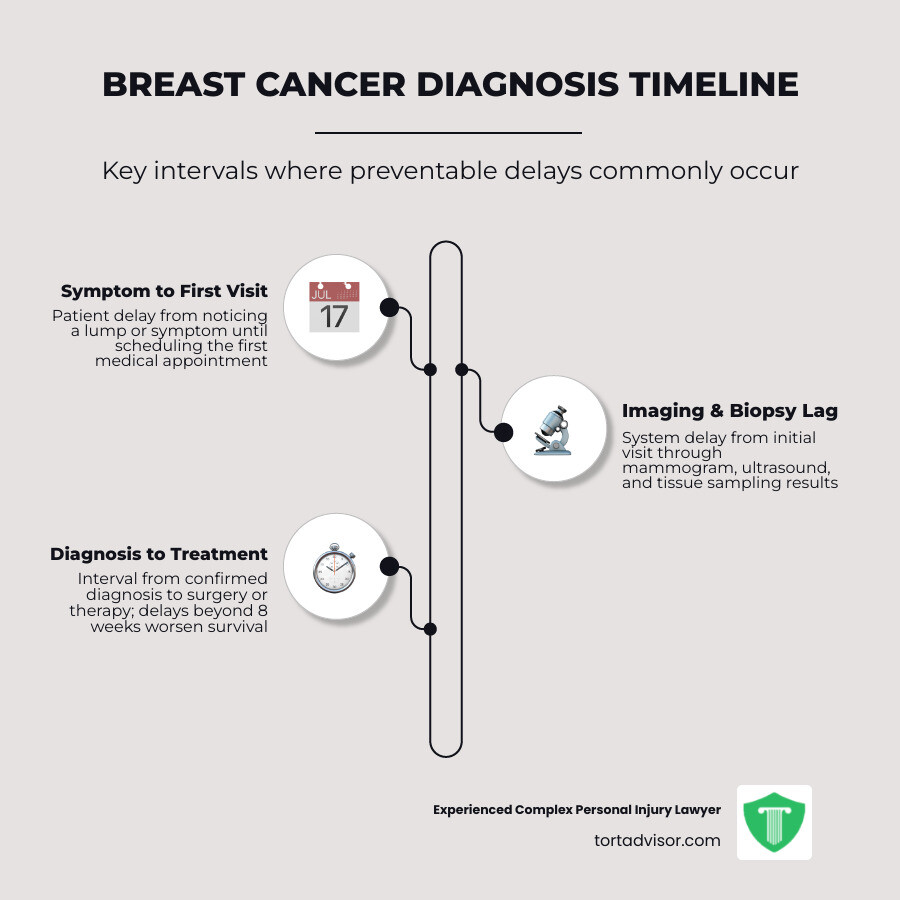
- The 8-week marker: Having surgery more than 8 weeks after diagnosis is tied to noticeably lower odds of survival
- Tumors keep growing: A Dutch screening study recorded average tumor size rising from 10.2 mm to 17.3 mm over the course of a diagnostic delay, a statistically significant increase
- The legal angle: If the delay happened because a provider fell below the accepted standard of care, it may amount to medical malpractice
Few cancers are diagnosed in women more often than breast cancer, and catching it early clearly saves lives. Even so, delays lasting months or years remain common — and the causes are frequently completely avoidable.
Some of that lost time traces back to patients who brush off a lump or postpone an appointment. A large portion, though, starts inside the exam room: a clinician decides a mass is harmless, skips follow-up imaging or misreads a screening study. Younger women can pay the steepest price, because their tumors tend to grow faster than those in older patients, so each added month carries more risk.
Below, we explain why these delays occur, how they change outcomes and what steps you can take.
My name is Mason Arnao. My training is in technology, data systems and digital lead generation, not medicine, but I have spent years digging into complicated injury subjects — delayed breast cancer diagnosis among them — so people can understand their rights when medical care falls short. If you suspect a diagnostic delay hurt you or a family member, this guide will walk you through what likely happened and what choices you have.
Related reading on delayed breast cancer diagnosis:
What Counts as a Delayed Breast Cancer Diagnosis?
A diagnosis is considered delayed when breast cancer was confirmed later than it reasonably should have been. The lost time can occur before the first visit, while tests are underway, after a screening callback, or even once cancer is confirmed but treatment gets postponed.
Delays generally fall into these groups:
- Patient delay: the gap between noticing a symptom and getting medical care
- System delay: slow appointments, imaging, biopsy, pathology, referrals or treatment
- False-negative delay: a cancer exists, yet the imaging or callback is reported as normal or benign
- Follow-up failure: nobody acts on an abnormal finding
Delayed diagnosis vs. misdiagnosis: what is the difference?
With a misdiagnosis, the condition is identified as something else. With a delayed diagnosis, the correct answer arrives late. The two often blend together — a lump might be called a cyst or a fibroadenoma, only to be confirmed as cancer months afterward.
Within screening programs, a delay can follow a callback when a suspicious finding receives a false-negative BI-RADS score, or when a negative biopsy should have prompted further workup but did not.
Common stages where patients lose time
Delays tend to happen at predictable points:
- Symptom appraisal delay: “It’s probably nothing.”
- First-visit delay: difficulty getting seen
- Imaging delay: mammogram, ultrasound or MRI booked too late
- Biopsy delay: a lesion is spotted but tissue testing is put off
- Treatment delay: surgery or cancer care begins late
Each step is another chance for something to slip through the cracks. Patient care should never resemble a team project where nobody is sure whose job it was.
What Causes a Delayed Breast Cancer Diagnosis?

In most cases, a delayed breast cancer diagnosis results from some combination of human mistakes, tumor biology and barriers to care.
Frequent causes include:
- Reassurance from a clinician based on the patient’s age instead of the evidence
- Dense breast tissue that hides lesions
- Changes from pregnancy or breastfeeding that mask a tumor
- Mistakes reading screening images
- Breakdowns in referrals among primary care, radiology and surgery
- Obstacles such as cost, transportation, insurance and scheduling
How providers contribute to late diagnosis in younger women
Younger patients face a particular hurdle: plenty of clinicians still assume a woman is “too young for breast cancer.” Studies of provider-related delays in young women identify this age bias as a leading contributor.
Causes tied to providers include:
- Writing off a lump as hormonal or harmless
- Confusing triple-negative tumors with fibroadenomas on imaging
- Calling pregnancy-associated cancers galactoceles, mastitis or abscesses
- Relying only on mammography in dense breasts when ultrasound or MRI could reveal more
- Skipping a complete triple assessment — clinical exam, suitable imaging and biopsy
The stakes are higher because tumors in women age 40 and younger frequently grow more quickly and are more likely to be aggressive, such as triple-negative or HER2-positive cancers. A “let’s watch it” approach therefore carries far more danger for younger patients.
Delays caused by patients vs. delays caused by the system
Both kinds of delay are important, but they look quite different in practice.
| Type | Common causes | Typical effect |
|---|---|---|
| Patient-related | fear, stigma, expense, travel problems, limited awareness | first visit happens later |
| System-related | booking backlogs, referral gaps, slow imaging, biopsy lag, poor communication | confirmation and treatment happen later |
A nationwide study in Turkiye found that, in that setting, patient-side causes outnumbered provider delays, driven largely by limited knowledge, fear and practical obstacles. U.S. research, on the other hand, shows that access barriers, social vulnerability, race, insurance coverage and travel burden can heavily influence how quickly women are diagnosed.
Why timeliness differs so widely between hospitals and screening programs
Hospitals do not all handle callbacks the same way, and workflow makes a real difference.
A Dutch follow-up study of repeat screening callbacks found that the share of women delayed by 2 years or more ranged from 0% to 4.8% depending on the hospital. In the more recent group, the leading cause — accounting for 74.5% of delays — was an incorrect BI-RADS classification after callback. Even as imaging improved over the years, long delays persisted.
Programs that perform better usually have:
- Multidisciplinary review
- Stable radiology staffing
- Earlier images on hand for comparison
- Fast access to biopsy
- Defined escalation steps when imaging results and symptoms conflict
To dig deeper into screening and system delay trends, review the scientific research on screening recall delays.
The Consequences of a Late Breast Cancer Diagnosis
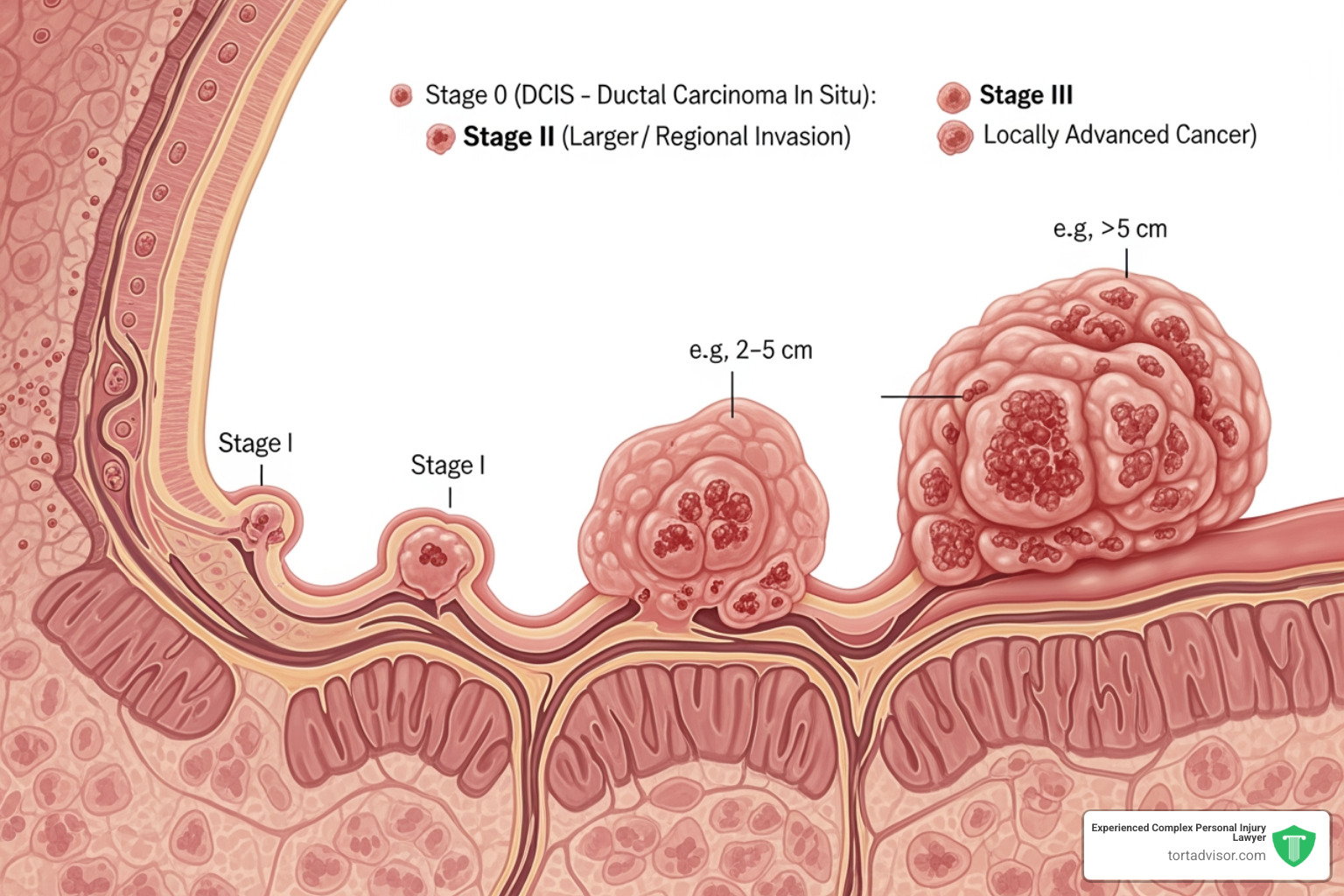
In brief: late-found cancers tend to be bigger, more advanced, more likely to have reached the lymph nodes and tougher to treat.
How waiting affects tumor size and stage
Research on stage progression points in a consistent direction.
One study found that women delayed 6 weeks or longer had more advanced disease than women diagnosed more quickly:
- Longer delay group: 35% stage I, 52% stage II, 12% stage III
- Shorter delay group: 52% stage I, 42% stage II, 5% stage III
Women who waited more than 6 months were roughly twice as likely to have a tumor of 4 cm or larger, and about 40% more likely to have spread to the underarm lymph nodes, compared with women who waited 6 months or less.
In the Dutch screening data, the average tumor measured 10.2 mm at the false-negative callback and 17.3 mm by the following callback. A separate screening review linked primary diagnostic delay to bigger tumors, more lymph node spread and more mastectomies.
How diagnosis and treatment delays affect survival
Once delays grow long enough, survival suffers as well.
A meta-analysis pooling 87 studies concluded that women whose treatment began 3 to 6 months after symptoms started had significantly poorer survival than women treated within 3 months.
Additional figures worth knowing:
- Five-year survival was 80% when surgery came more than 6 weeks late, compared with 90% when the wait was under 2 weeks
- For late-stage patients, waiting 60 days or more between diagnosis and treatment was linked to poorer breast cancer-specific survival (hazard ratio 1.85)
- Large U.S. datasets indicate that surgery more than roughly 8 weeks after diagnosis is tied to lower survival
Not every brief delay alters the result. The point is that preventable delays should never be dismissed as unimportant.
Why tumor behavior can muddy the statistics
Here is the complication: certain studies find longer delays without poorer survival, or even the reverse. Researchers call this the “survival paradox.”
The explanation is that aggressive cancers usually announce themselves quickly — they produce symptoms, look worrying on scans and get investigated fast. Slow-growing cancers can be harder to read and take longer to pin down. In other words, tumor biology can influence both the outlook and how fast a diagnosis is made.
None of this makes delay safe. It simply means the numbers need careful reading. Rapidly growing cancers in younger women, triple-negative disease in particular, can progress from small to advanced far faster than slower tumors.
How Diagnostic Delays Vary by Country and Community
High-income, middle-income and low-resource settings
In many high-income countries, upward of 70% of breast cancers are caught at an early stage thanks to organized screening and faster testing, and five-year survival frequently tops 90%.
Lower-resource regions look very different. Research referenced in the Turkiye study puts five-year survival near 66% in India and roughly 40% in South Africa, and in Sub-Saharan Africa many women are first seen with stage III or IV cancer.
The PLOS Medicine study on healthcare access and timeliness likewise finds that delays stem from several overlapping access barriers rather than a single issue such as distance.
Which U.S. patients face the highest risk of delay?
Delay risk across the United States is uneven. Research points to greater odds of delay among:
- Black women
- Hispanic patients
- Patients on Medicaid or with no insurance
- Residents of areas with high poverty or joblessness
- People dealing with unstable housing or transportation
- Patients with long or complicated trips to reach surgery
- Communities where many residents do not speak English
In an Arkansas study, 12% of patients waited more than 60 days after diagnosis for surgery, and non-Hispanic Black patients faced 82% higher odds of delay than non-Hispanic White patients.
Why cultural beliefs and living conditions still play a role
Research gathering patient perspectives in Tanzania shows delays are social as well as medical. Stigma, family pressure, fear of losing a breast, religious beliefs and financial strain can all push care back. The study is available here: scientific research on patient perspectives in Tanzania.
The specific beliefs may look different in the U.S., yet the pattern is similar: fear, denial, expense, job demands, child care, transportation and mistrust can all slow a diagnosis down. Patient navigators and community outreach exist for exactly this reason.
Lowering Your Risk of a Late Breast Cancer Diagnosis
Steps health systems can take today
Health systems can shrink delays by executing the fundamentals more reliably and more quickly:
- Teach clinicians never to wave off breast symptoms because of age alone
- Choose imaging suited to the patient’s age, including ultrasound or MRI for dense tissue
- Make triple assessment the standard for suspicious findings
- Build fast referral routes to breast specialists
- Provide same-day or expedited imaging and biopsy when feasible
- Review BI-RADS calls and false-negative callbacks
- Measure timeliness as a quality benchmark
What to do if a doctor dismisses your symptoms
When a concern gets waved away, stay courteous but keep pushing.
Warning signs that call for quick follow-up:
- A new lump that does not go away
- Dimpled skin, an inverted nipple or bloody discharge
- A lump that gets bigger
- Ongoing swelling, uneven breasts or a lump in the armpit
- “Benign” imaging results that do not fit your symptoms
Advocacy checklist:
- Note the date the symptom began and how it has changed
- Ask which imaging is right for you and the reason
- Ask whether a biopsy makes sense if the lump persists
- Get copies of your imaging and pathology reports
- See a breast specialist for a second opinion if the reassurance does not add up
When a late diagnosis may support a delayed diagnosis lawsuit
A delay is not automatically malpractice. Legal questions come up when a provider did not meet the standard of care and that lapse caused genuine harm — for example, a more advanced stage, more aggressive treatment or a poorer prognosis.
Possible red flags include:
- Symptoms were recorded in the chart but never investigated
- Abnormal imaging was misinterpreted or never followed up
- A referral or biopsy was put off without good reason
- Test results were never shared with the patient
- Ongoing symptoms were waved away again and again
If this sounds like your situation, these guides can help:
Delayed Breast Cancer Diagnosis and Lawsuit FAQs
Can a false-negative mammogram or callback push a breast cancer diagnosis back by years?
It can. Dutch screening research found that 2.2% to 2.8% of women eventually diagnosed with breast cancer had been delayed 2 years or more following a false-negative callback, often because of incorrect BI-RADS 1 or 2 ratings. Misplaced reassurance can postpone a diagnosis for years.
Is any short delay dangerous, or is tumor type the bigger factor?
Tumor type plays a major role. Some cancers grow slowly and others advance fast. Because younger women more often have fast-growing tumors, even a brief delay may hurt them more. Avoidable delay is never good, and when it stretches into months, the evidence of harm gets much stronger.
How do I find out if a late breast cancer diagnosis harmed me and whether I have a case?
Begin with documentation:
- Ask for your medical records
- Map out a timeline of symptoms, appointments, scans and treatment
- Seek a second medical opinion when appropriate
- Ask whether an earlier diagnosis would likely have changed the stage or treatment
- Get a legal review if the delay looks avoidable
Conclusion
A delayed breast cancer diagnosis can start with an overlooked symptom, a false-negative scan, a postponed biopsy or a clinician who says “you’re probably fine” when the facts suggest otherwise. Your best defense is acting early, getting timely imaging and biopsy, and advocating for yourself with good information.
When care breaks down, learning what went wrong comes first. Legal Lawsuit helps people understand their options and can connect them with experienced attorneys in our network who handle complex injury and malpractice cases nationwide through a free, confidential case review. If you are also looking into other breast-related injury claims, our coverage of breast implant lawsuits may help.
Related Posts
Quick Answer: The Boy Scouts of America (BSA) filed for Chapter 11 bankruptcy in 2020 after facing tens of thousands [...]
Quick Answer: Survivors of sexual abuse by Catholic priests, nuns, or other Church personnel may be able to file a [...]
Quick Answer: Clergy abuse settlements vary enormously based on the severity of the abuse, the strength of evidence that the [...]