
Short answer: This article explains the key facts, eligibility issues, settlement factors, deadlines, and source-backed updates related to this legal topic. Results vary by case facts, evidence, jurisdiction, and representation.
In This Guide
How a Victim Compensation Fund Helps You Recover After a Crime
A victim compensation fund is a government program that gives financial help to people who suffered physical, emotional or financial harm from a violent crime. These programs are an important safety net when insurance does not cover enough or the offender cannot pay restitution.
Victim Compensation Funds at a Glance:
- What They Pay For: Crime-related costs such as medical care, lost income, counseling and funerals
- Where the Money Comes From: Mostly offender fees, fines and government allocations rather than general tax revenue
- Who Qualifies: Usually victims who reported the crime to police and cooperated with the investigation
- Role: The “payer of last resort,” stepping in after insurance and other benefits
- Where They Exist: Federal, state and provincial programs throughout North America
Notable Programs:
- September 11th Victim Compensation Fund ($14.9 billion awarded to more than 65,600 claimants, per recent VCF reporting)
- State programs such as Texas CVC (up to $50,000) and Michigan Crime Victim Compensation
- Canadian provincial programs supported by Justice Canada’s Victims Fund
Compensation and restitution are not the same. Restitution is paid by the offender under a court order, while compensation funds offer prompt financial help whether or not the offender is caught or able to pay.
Being the victim of a crime is traumatic enough without money worries piling on. These programs exist to help you heal and rebuild.
Victim Compensation vs. Restitution: The Basics
The financial fallout of a crime can be as hard as the emotional toll. Two systems can help: victim compensation funds and court-ordered restitution. Knowing the difference can mean getting help quickly instead of waiting months or years.

What Is a Victim Compensation Fund?
A victim compensation fund is a government safety net for people hurt by violent crime. It offers help promptly, whether or not the offender is arrested or convicted, and it works on a no-fault basis, so no one has to prove guilt in court. If you are a victim and meet the requirements, assistance is available.
These programs serve as the payer of last resort, covering what remains after insurance, disability benefits and similar sources, which stretches support further while providing an essential backstop. Most of the money comes from offender fees and fines, so the criminal justice system, rather than general tax dollars, largely pays for them.
Typical requirements include reporting the crime to police within a set time and cooperating with the investigation. Covered costs are broad: medical bills, lost income, counseling and funeral expenses, and many programs also pay for crime scene cleanup and relocation.
How Restitution Differs
Restitution is a court order requiring the offender to repay the victim, with a focus on accountability. Courts can order it for financial losses tied to physical injury, property damage or psychological harm. According to Victims’ Rights in Canada; Restitution Orders, it may be a stand-alone order, a probation condition or part of a conditional sentence.
The weakness of restitution is that it depends on whether the offender can and will pay, and many offenders have little money to pay meaningful amounts.
| Aspect | Victim Compensation Fund | Court-Ordered Restitution |
|---|---|---|
| Money Source | Government programs paid for by offender fees, fines and allocations | Paid directly by the convicted offender |
| Main Goal | Prompt financial help no matter the offender’s situation | Holding offenders responsible for victims’ losses |
| When Available | After reporting the crime and meeting the requirements | Only after a conviction and court order |
| Covered Costs | Medical care, counseling, lost income, funeral costs and more | Particular financial losses from injury or property damage |
| Timing | Usually available fairly soon after the crime | Depends on how long conviction takes and whether the offender can pay |
| Requirements | No-fault, requiring only basic cooperation | Requires proof the offender is legally responsible |
That is why victim compensation funds are so valuable: they can help right away while you seek restitution in court, and the two can work together. If you are weighing every path to recovery, including a lawsuit, see Legal Settlements & Compensation for more on your options.
Put simply, victim compensation funds provide quick help, while restitution makes offenders pay. Both play a part in financial recovery after a crime.
Major Victim Compensation Fund Programs
Victim compensation funds are a lifeline for crime victims. They operate at the federal, state and provincial levels, each with its own rules and resources, so understanding the landscape helps you find the right support.

Some victims pursue broader remedies through Mass Tort Lawsuit Settlements, but these funds offer a more direct route to financial help.
The September 11th Victim Compensation Fund (VCF)
The September 11th Victim Compensation Fund (VCF) was a historic federal response to a national tragedy that compensated victims without drawn-out litigation. It was created by the Air Transportation Safety and System Stabilization Act, and the original fund was overseen by Special Master Kenneth Feinberg.
Its eligibility rules are tied to the 9/11 attacks: applicants must have been at an attack site during set periods and later diagnosed with a covered illness. The exposure zones are the World Trade Center area (9/11/01 – 5/30/02), the Pentagon site (9/11/01 – 11/19/01) and the Shanksville, PA site (9/11/01 – 10/3/01).
Covered conditions include dozens of cancers and serious respiratory illnesses, many of which surfaced years later and led to the fund being reopened. The claims process starts with registration, which protects your rights even if you are not sick now. Since reopening in 2011, the VCF has awarded $14.9 billion to more than 65,600 claimants, according to recent fund reporting. For up-to-date information, visit the official VCF website.
State and Provincial Compensation Programs
The VCF gets the headlines, but state and provincial programs handle most victim compensation day to day.
- Canada: Justice Canada’s Victims Fund supports organizations and programs rather than paying victims directly, encouraging new approaches to victim support and access to justice, including federal funding of $85.3 million over five years for legal services for sexual assault survivors. Ontario’s Victims’ Justice Fund draws $44-50 million a year from victim fine surcharges to support programs.
- U.S. States: State programs often pay victims directly. The Texas Crime Victims’ Compensation Program, funded entirely by offender fees, provides up to $50,000 in benefits plus up to $25,000 more for sexual assault emergency care. See the Texas Crime Victims’ Compensation Program Overview for details.
- Michigan has run its program since 1977 as a payer of last resort; reviews can take anywhere from a day to six months, and there is a 30-day window to appeal. Read What is Crime Victim Compensation in Michigan? to learn more.
- Oregon bases payments on the Workers’ Compensation Fee Schedule and keeps claims for child victims open until age 21, recognizing the lasting effects of childhood trauma.
Every victim compensation fund has its own rules and priorities, so figuring out which program covers you is the key to getting the help available.
How to Apply to a Victim Compensation Fund
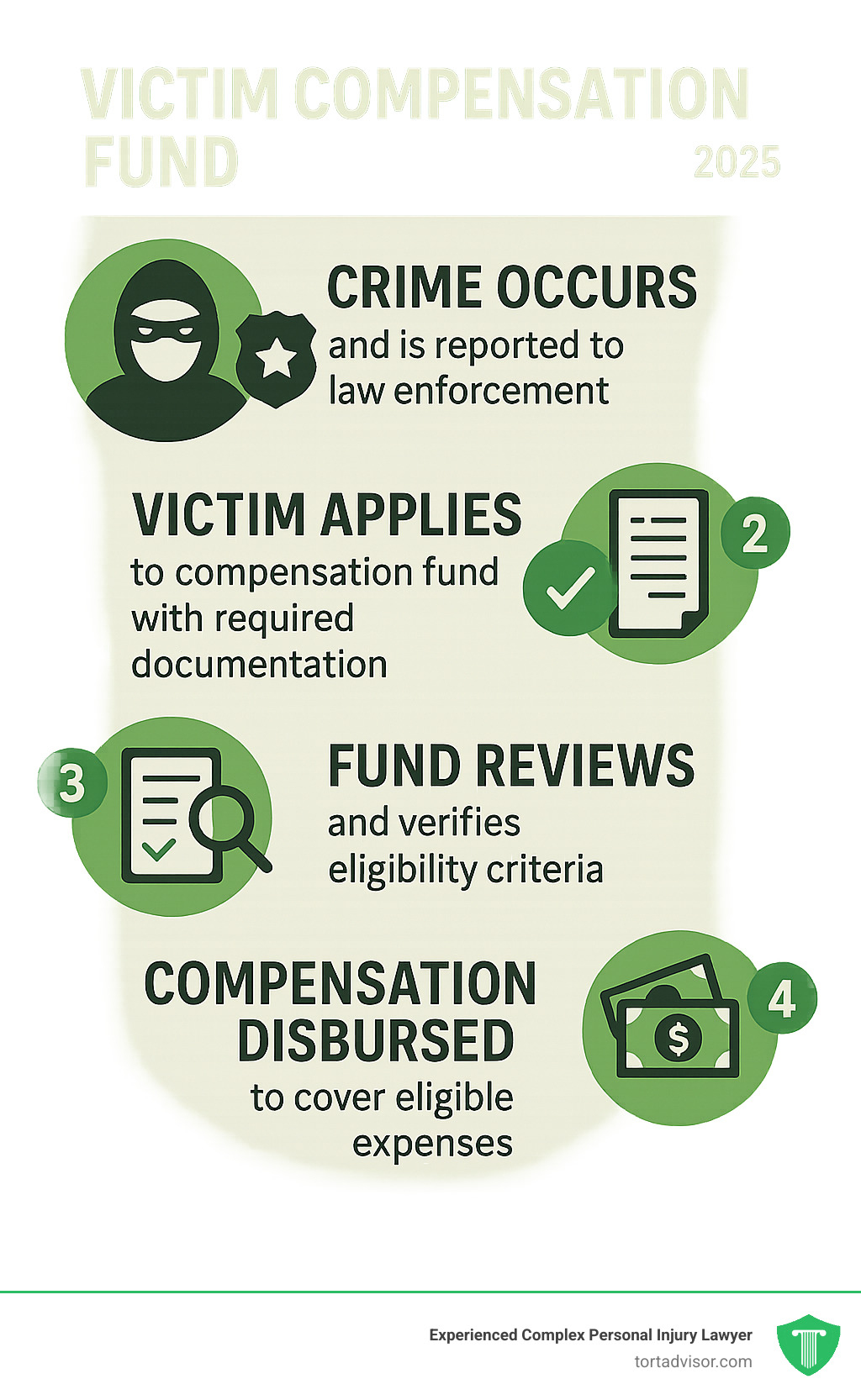
Applying to a victim compensation fund may seem overwhelming, but good preparation makes it manageable, and the steps are similar across most programs.

Knowing what reviewers want improves your odds. Police reports, medical records connecting injuries to the crime and proof of lost income form the core of a strong claim. Because these funds pay last, you also need to show other sources were used, usually with insurance explanation of benefits statements. As with complex legal matters like those covered in How Much Does Mass Tort Lawsuits Receive?, preparation makes a big difference.
Steps to Apply for Victim Compensation
- Check Eligibility: Programs set their own rules on covered crimes, who counts as a victim and police cooperation, so review your jurisdiction’s requirements.
- Find the Right Program: Determine whether a state, provincial or federal fund, such as the 9/11 VCF, applies.
- Collect Documents: Usually the longest step. Gather police reports, medical records, proof of lost income and receipts for other covered costs like counseling or funeral expenses.
- Submit the Application: Online portals tend to be faster, though paper forms are usually available. Make sure everything is complete and accurate to prevent delays.
- Answer Follow-Up Requests: Respond quickly if the program asks for more information so your claim keeps moving.
- Wait for the Decision: Reviews can take weeks or months. Keep copies of everything you send.
Appealing a Denied Victim Compensation Claim
A denial does not have to be final. Most victim compensation fund programs allow appeals, but you need to move fast.
Appeal rights come with firm deadlines. Michigan allows 30 days to file a written appeal, for example, and Texas provides similar rights. Missing the deadline can end your claim.
An appeal lets you submit new evidence or clear up misunderstandings, and many programs offer administrative hearings before an impartial officer. Treat these hearings seriously and prepare thoroughly. Persistence and solid documentation often improve results, and because program staff want to help eligible victims, a clear, well-supported appeal is your strongest approach.
How an Attorney Can Help With Your Claim
A victim compensation fund claim adds legal complexity to an already painful experience. An experienced attorney can guide the process and help you get what you are owed.

An attorney can help by:
- Interpreting the Rules: Programs have detailed eligibility requirements, and a lawyer can identify the right fund and help you avoid common mistakes.
- Claiming Everything Available: Many victims do not realize how many expenses qualify. An attorney makes sure you seek reimbursement for everything from medical care and lost income to counseling and crime scene cleanup.
- Handling Paperwork: Attorneys collect police reports, medical records and other evidence and file everything correctly and on time, preventing denials over technicalities while you focus on recovery.
- Pursuing Appeals: If a claim is denied or underpaid, an attorney can challenge the decision and press for a fair result.
Legal advice is especially important when a fund requires a waiver. Some programs, such as the New Jersey Compensation Fund for Survivors of Church Sexual Abuse of Minors, require survivors to give up the right to sue in exchange for payment. That fund, run by administrators Kenneth Feinberg and Camille Biros, can provide significant compensation but permanently ends the option of a civil lawsuit.
An attorney can help you compare the immediate value of a fund payment with what a lawsuit might be worth, a complicated judgment that benefits from experienced advice.
A victim compensation fund claim matters too much to tackle alone. An experienced attorney can handle the legal details while you focus on moving forward.
Victim Compensation Fund FAQs
Answers to frequent questions about victim compensation funds.
Which crimes usually qualify for compensation?
Most programs cover violent crimes such as assault, robbery, domestic violence, sexual assault and homicide. Many also cover drunk driving crashes, and some, like the 9/11 VCF, cover terrorism. Property crimes are usually excluded unless violence was involved. Rules differ by jurisdiction, so check with your local victim compensation fund.
Is there a deadline to apply for victim compensation?
Yes, and it is strictly enforced. Most programs require an application within one to three years of the crime, and missing it usually means losing the right to compensation. Some programs make exceptions for child victims or for illnesses that appear years later, tying the deadline to diagnosis instead. Apply as early as you can.
Can I get compensation if I have insurance?
Yes, but the fund pays last. You must first claim through sources such as health or auto insurance or disability benefits. The victim compensation fund then covers remaining out-of-pocket costs, like deductibles, co-pays and uncovered expenses, up to program limits, which helps the fund reach as many victims as possible.
Conclusion
The financial aftermath of a crime can be crushing. Victim compensation funds provide a vital safety net that does not depend on whether the offender can pay restitution. From large federal programs like the September 11th VCF, which has awarded $14.9 billion, to state programs in Texas and Michigan, these funds exist to help you recover.
The rules, though, differ a lot from place to place. Whether you live anywhere from Alabama to Wyoming or in a big city like Chicago or Miami, your local program has its own deadlines, eligibility rules and covered costs, and a missed deadline or incomplete paperwork can mean losing money you need for medical bills, lost income and more.
If your claim is denied, an appeal is the next step, and experienced guidance matters. Legal Lawsuit connects crime victims with attorneys in our network who handle victim compensation claims, from the first filing through appeals, through a free, confidential case review.
You should not have to fight a complicated system while you are trying to heal. An experienced attorney can pursue the full compensation available to you, and your financial recovery can start with one step.
Get help with your injury claim and connect with an attorney who can guide you through the victim compensation fund process. Your recovery comes first.
Related Posts
Quick Answer: The Boy Scouts of America (BSA) filed for Chapter 11 bankruptcy in 2020 after facing tens of thousands [...]
Quick Answer: Survivors of sexual abuse by Catholic priests, nuns, or other Church personnel may be able to file a [...]
Quick Answer: Clergy abuse settlements vary enormously based on the severity of the abuse, the strength of evidence that the [...]