

Short answer: This article explains the key facts, eligibility issues, settlement factors, deadlines, and source-backed updates related to this legal topic. Results vary by case facts, evidence, jurisdiction, and representation.
In This Guide
Why Survivors Need the Right Abuse Victim Lawyer
An abuse victim lawyer focuses on helping people who have survived domestic violence, sexual assault and other abuse. During one of the hardest periods of your life, this kind of attorney offers clear legal direction and genuine support, helping you move through criminal and civil proceedings alike.
Their work typically includes bringing civil claims for compensation, securing evidence, shielding you from re-traumatization, and pursuing schools, churches and other institutions that failed you. Most offer a free first consultation and are paid on contingency, so there is nothing to pay upfront.
According to RAINN, a sexual assault happens in the U.S. every 73 seconds. Many survivors carry fear, shame and uncertainty, and few know there are two routes to justice: a criminal case that can punish the abuser, and a civil case that can pay for medical care, lost income and emotional harm.
The law has been shifting in survivors’ favor. Florida, for example, has removed or extended filing deadlines for certain abuse claims, a change often discussed alongside Donna’s Law. Specialized attorney networks play a key role in matching survivors with the right counsel for their circumstances.
Recognizing Abuse and What to Do First
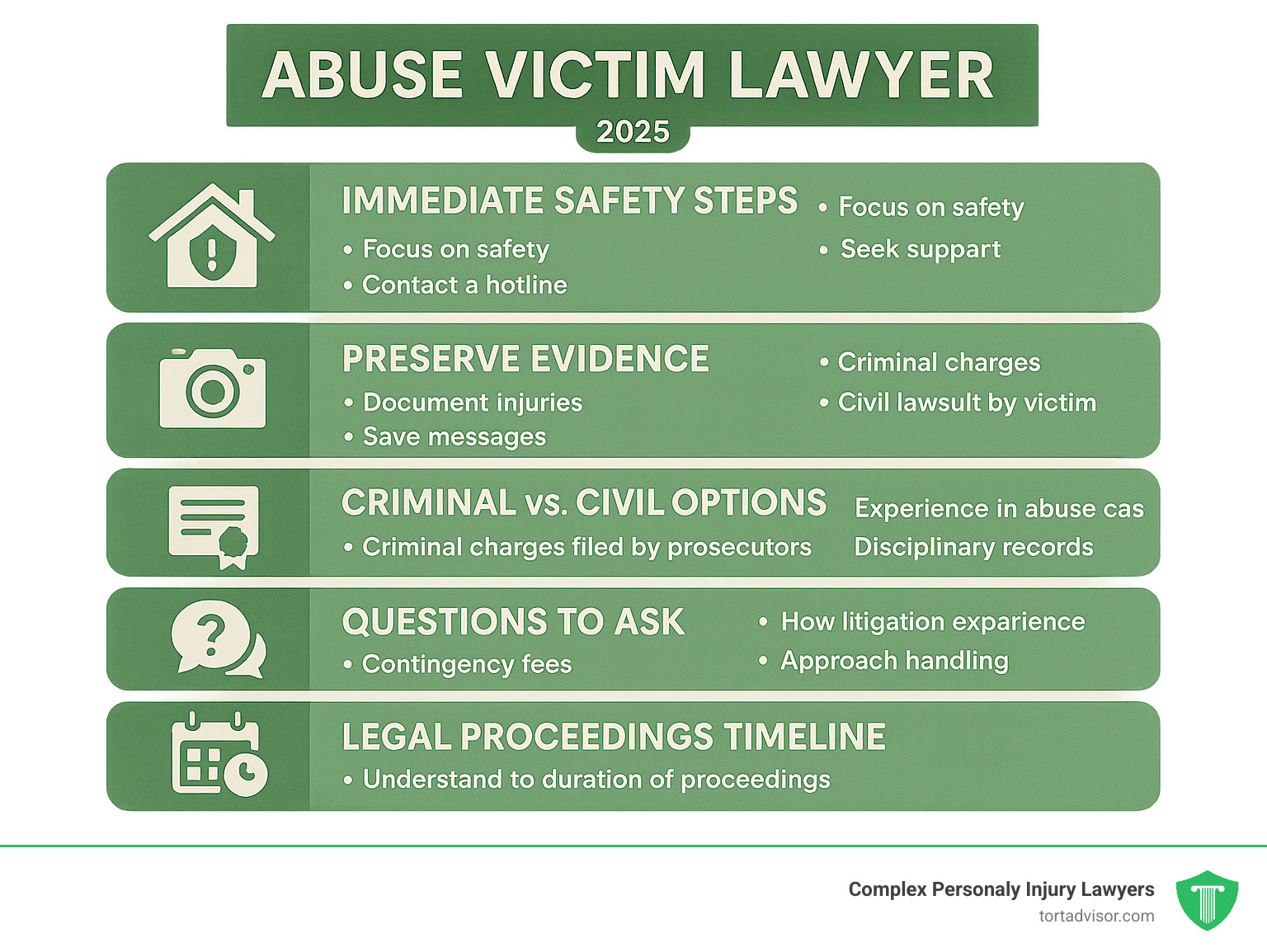
The period after abuse can feel overwhelming. Putting a name to what happened and learning what you can do right now helps you take back some control. An abuse victim lawyer can walk you through the options, but your safety always comes first.
What Counts as Domestic or Sexual Abuse?
Abuse is not limited to physical harm. Domestic violence is a repeated pattern of power and control. Physical abuse means any unwanted physical contact, such as pushing or slapping, and it can be a crime even without visible injury. Sexual abuse is any sexual act without consent; because a child cannot legally consent, any sexual contact between an adult and a minor is a crime. Emotional and verbal abuse, including threats and relentless criticism, can cause equally deep harm. Financial abuse means controlling your access to money, and stalking and cyberstalking involve repeated, unwanted attention that makes you afraid.
Fear, shame and confusion are common reactions to trauma, and none of what happened is your fault. Sites such as WomensLaw.org explain survivors’ legal rights in plain language.
First Steps to Protect Yourself and Your Claim
Nothing matters more than your safety. If you are at risk, move somewhere safe. If you think your devices are being watched, use a phone or computer you trust.
- Get Medical Care: See a doctor even if your injuries seem minor. Clinicians can record injuries and gather evidence that could matter later, whether or not you decide to press charges.
- Protect Physical Evidence: After an assault, try not to shower or change clothes. If you need to change, store the clothing in a paper bag, and photograph any injuries.
- Keep a Record: Hold on to texts, emails and voicemails connected to the abuse. While details are fresh, write down what happened along with dates and times.
- Understand Your Choices: Reporting to police opens a criminal investigation, but you do not need a police report to bring a civil claim for compensation. The two are separate legal tracks.
- Get Support: Help is available around the clock from the National Domestic Violence Hotline (1-800-799-7233) and RAINN (Rape, Abuse & Incest National Network). WomensLaw.org’s Email Hotline also offers guidance.
Each of these steps takes real courage. Put your safety first, and know that an abuse victim lawyer can lay out your legal choices with no pressure to act.
Criminal Cases vs. Civil Lawsuits for Abuse Survivors
Knowing what the law allows is an important part of regaining control. In Florida and across the country, survivors may seek protective orders, criminal charges and civil damages. Remember that these are two independent paths to justice, and you can pursue them at the same time.
Criminal Prosecution and Civil Claims Explained
Plenty of survivors assume a police report is the only option. In reality, the criminal and civil systems do very different jobs.
- Criminal Cases: The government brings the case against the abuser and seeks penalties such as fines or incarceration. Whether to charge is the prosecutor’s call, and the burden of proof is demanding: “beyond a reasonable doubt.” A conviction can feel validating, yet it seldom provides money to the survivor.
- Civil Lawsuits: Working with an abuse victim lawyer, you sue the abuser and any third parties who share responsibility. The aim is financial compensation to help you rebuild. The burden is lighter: a “preponderance of the evidence,” meaning the abuse more likely than not occurred. RAINN estimates that only 5 of every 1,000 perpetrators end up incarcerated, so a civil claim is often the more realistic way to hold someone accountable.
What Compensation a Civil Abuse Lawsuit Can Provide
A civil claim makes abusers answer financially and gives you resources to recover. Compensatory damages cover both concrete and less tangible losses: medical expenses, therapy, lost pay and reduced future earning ability, as well as non-economic harms such as emotional distress, mental anguish and pain and suffering.
When the conduct was especially malicious or reckless, a court may add punitive damages, which exist to punish the wrongdoer and discourage others from doing the same. A seasoned abuse victim lawyer documents every category of loss so nothing is left on the table.
Florida Filing Deadlines for Abuse Lawsuits
The statute of limitations, meaning the deadline to sue, can be complicated in abuse cases, and Florida has changed its laws to give survivors more time.
Adults who were abused as children generally have seven years after turning 18 to file. A delayed-discovery rule can add time measured from when you link your injuries to the abuse. Most notably, Florida has removed the filing deadline for certain child sexual abuse claims, a change commonly associated with Donna’s Law, so some survivors can bring a claim at any age.
These deadlines are easy to misjudge, so have an abuse victim lawyer look at your situation and pin down the date that applies to you.
How an Abuse Victim Lawyer Helps You
The legal system can feel daunting after abuse. An abuse victim lawyer does more than file paperwork; they act as both guide and shield on the road to justice and recovery.

What an Abuse Victim Lawyer Handles for You
An abuse victim lawyer takes on the legal workload so you can concentrate on healing. That means evaluating your case in depth, explaining your choices in everyday language, and running the case from start to finish: collecting medical records and witness accounts, meeting every filing deadline, and negotiating firmly for the strongest possible settlement.
If the case goes to trial, your attorney advocates for you with both strength and care. Attorney Natalie Weatherford describes lawyers in this area as a “protector” who guards clients against harsh defense tactics that can re-traumatize survivors. At every stage, a good lawyer makes sure you can make informed choices about your own case.
Trauma-Informed Representation
Top abuse victim lawyers know the legal process itself can reopen wounds. They work to give you a safe, judgment-free setting where you are listened to and respected, earning your trust through patience and honest communication rather than pressure. This survivor-centered style limits further harm while still building a strong case, and it goes beyond winning: it helps survivors regain a sense of control and links them to therapists, support groups and other healing resources.
Pursuing Justice for Child Sexual Abuse
Child sexual abuse cases call for specialized skill and care. An abuse victim lawyer has to work within a system built to protect children while keeping the child’s interests front and center. Laws such as Maryland’s Child Victims Act of 2023 and Florida’s removal of deadlines for certain claims, often discussed with Donna’s Law, have opened the courthouse doors to survivors many years later.
Many of these claims target institutions that hired carelessly or concealed abuse. A capable attorney looks past the individual abuser to the organizational failures that let the harm happen, and helps families find support services along the way.
Suing Schools, Churches and Other Institutions Over Abuse
Abuse frequently happens because a school, church or other powerful organization failed to act. An abuse victim lawyer knows how to pursue these institutions when they neglect the people in their care or hide misconduct.
When an Organization Can Be Held Liable
Organizations owe a legal duty of care to the people they serve. They may be liable for negligent hiring (skipping background checks), negligent supervision (not monitoring staff) or cover-ups. Failures like these allow abuse to happen again and again.
With an abuse victim lawyer, you may be able to bring claims against organizations such as:
- Schools and universities where staff, teachers or coaches abused students.
- Churches and religious groups that concealed or enabled abuse by clergy.
- Foster care agencies that did not properly vet or oversee foster parents.
- Youth programs, including sports leagues, where adults misused positions of trust.
- Hospitals and healthcare providers where doctors or therapists harmed patients.
- Employers that did not stop sexual harassment and abuse.
- Rideshare platforms that did not keep riders safe.
Common Kinds of Institutional Abuse Claims
Institutional cases usually involve a deep breach of trust by teachers, coaches, clergy, doctors or therapists who misused their authority. Abuse within foster care is especially devastating because it targets children who are already at risk. Often the organization is liable because it did nothing after learning of the abuse. A skilled abuse victim lawyer can expose those failures and push institutions to change so others are protected.
How to Choose the Right Abuse Victim Lawyer
Picking the right abuse victim lawyer matters. Look for someone with relevant experience who truly understands what survivors go through.

Where to Look for an Attorney and Support
Trusted resources can point you to a qualified lawyer. The National Crime Victim Bar Association links survivors with attorneys who focus on these cases, and state and local bar associations run referral programs. Legal Lawsuit can also connect you with attorneys in our network who handle abuse claims in states from Alabama to Florida to California.
Therapists and support groups are good sources of referrals, as are RAINN and WomensLaw.org. Online directories can help you start, but always check credentials and look for an attorney who handles abuse cases on a regular basis.
Questions to Ask an Abuse Victim Lawyer Before Hiring
The first meeting is usually free and is your opportunity to size up the lawyer. Bring these questions:
- How much of your work involves abuse cases? Look for focus, not a general practice.
- Have you handled cases like mine? Ask about results in similar matters, particularly claims against institutions.
- How and how often will you update me? Reliable communication brings real peace of mind.
- How are you paid? Most charge on contingency, so you owe nothing unless money is recovered. Get this confirmed.
- How will you shield me from re-traumatization during the case? A strong lawyer will have concrete ways to ease the emotional toll.
- Do you try cases in court? Most claims settle, but the defense should know your attorney is ready for trial.
Through a free, confidential case review, Legal Lawsuit connects survivors with attorneys in our network who combine compassionate support with effective advocacy.
Abuse Lawsuit FAQs
Questions are normal when you are thinking about legal action. Below are answers to the ones survivors ask most.
Is a police report required to file a civil abuse lawsuit?
No. A civil lawsuit does not depend on a police report or criminal charges. The two systems operate separately: criminal courts punish offenders, while civil courts compensate survivors for what they suffered. An abuse victim lawyer can bring your civil claim whether or not a criminal case exists.
What does an abuse victim lawyer cost?
The majority of abuse victim lawyers take cases on contingency, so there is no upfront cost. The attorney is paid a percentage of whatever settlement or verdict they recover for you, and if nothing is recovered, you owe no attorney fee. This lets any survivor get skilled legal help without financial risk.
Can I still sue if the abuse happened years ago?
Quite possibly. Many survivors file decades after the fact. States do set deadlines known as statutes of limitations, but a growing number have extended them or opened “look-back windows” for older cases, particularly involving child sexual abuse.
Florida, for instance, has eliminated the deadline for certain child sexual abuse claims, a change often linked to Donna’s Law. The rules are complicated, so a conversation with an abuse victim lawyer is always worthwhile. Many survivors learn their claim is still open.
Your First Step Toward Justice and Healing
What happened to you matters, and you are entitled to seek justice. The road ahead may feel daunting, but you do not have to travel it by yourself. You can hold the people responsible to account and pursue compensation that supports your recovery. Getting your voice and your power back is within reach.
The right abuse victim lawyer is a partner who will advocate hard for you while treating you with the care you deserve. Reaching out to an attorney takes enormous courage, and that first call is itself a win over fear.
Legal Lawsuit understands how hard that first step is. Through a free, confidential case review, we connect survivors with attorneys in our network who focus on abuse cases nationwide, from Florida to California, and who have experience holding both individuals and institutions responsible.
These attorneys know how to work through complicated laws and, above all, how to protect you from being re-traumatized as the case moves forward. Whether the abuse happened recently or long ago, you may still have legal options.
The case review is free, and contingency representation means no upfront cost. The chance at justice and the resources to heal are worth that one conversation.
Take the next step today. Learn about your legal options and begin moving toward the justice and healing you deserve. Read more about survivors’ rights at legallawsuit.com.
Related Posts
Quick Answer: The Boy Scouts of America (BSA) filed for Chapter 11 bankruptcy in 2020 after facing tens of thousands [...]
Quick Answer: Survivors of sexual abuse by Catholic priests, nuns, or other Church personnel may be able to file a [...]
Quick Answer: Clergy abuse settlements vary enormously based on the severity of the abuse, the strength of evidence that the [...]

