
Short answer: This article explains the key facts, eligibility issues, settlement factors, deadlines, and source-backed updates related to this legal topic. Results vary by case facts, evidence, jurisdiction, and representation.
Filing a Cancer Lawsuit: Your Rights and Next Steps
How a Cancer Lawsuit Works
A cancer diagnosis takes a heavy physical and emotional toll. It is even harder to accept if the illness might have been prevented, or if someone else’s negligence played a part. A cancer lawsuit is a civil claim brought when there is reason to believe a person’s cancer resulted from another party’s carelessness or misconduct.
The essentials of a cancer lawsuit:
- What it is: A legal claim for accountability and money damages when another party’s fault led to cancer.
- Who may file: Patients or their families when cancer is tied to a missed diagnosis, toxic exposure or a defective product.
- Typical causes: Medical mistakes, job-site hazards, dangerous consumer goods and environmental pollution.
- Possible compensation: Medical expenses, lost earnings and pain and suffering.
- Getting started: Talking with an experienced attorney is the essential first step toward understanding your options.
Nobody should have to live with the devastating effects of cancer because someone else was careless. Cancer lawsuits hold the responsible parties to account and help patients and families recover from crushing medical bills and lost income, offering a real path to justice.
My experience in technology and internet marketing has taught me how to manage complex data, a skill that matters when building a strong cancer lawsuit. As an informational writer, my goal is to make these complicated legal topics easy to follow so you understand your rights and choices.
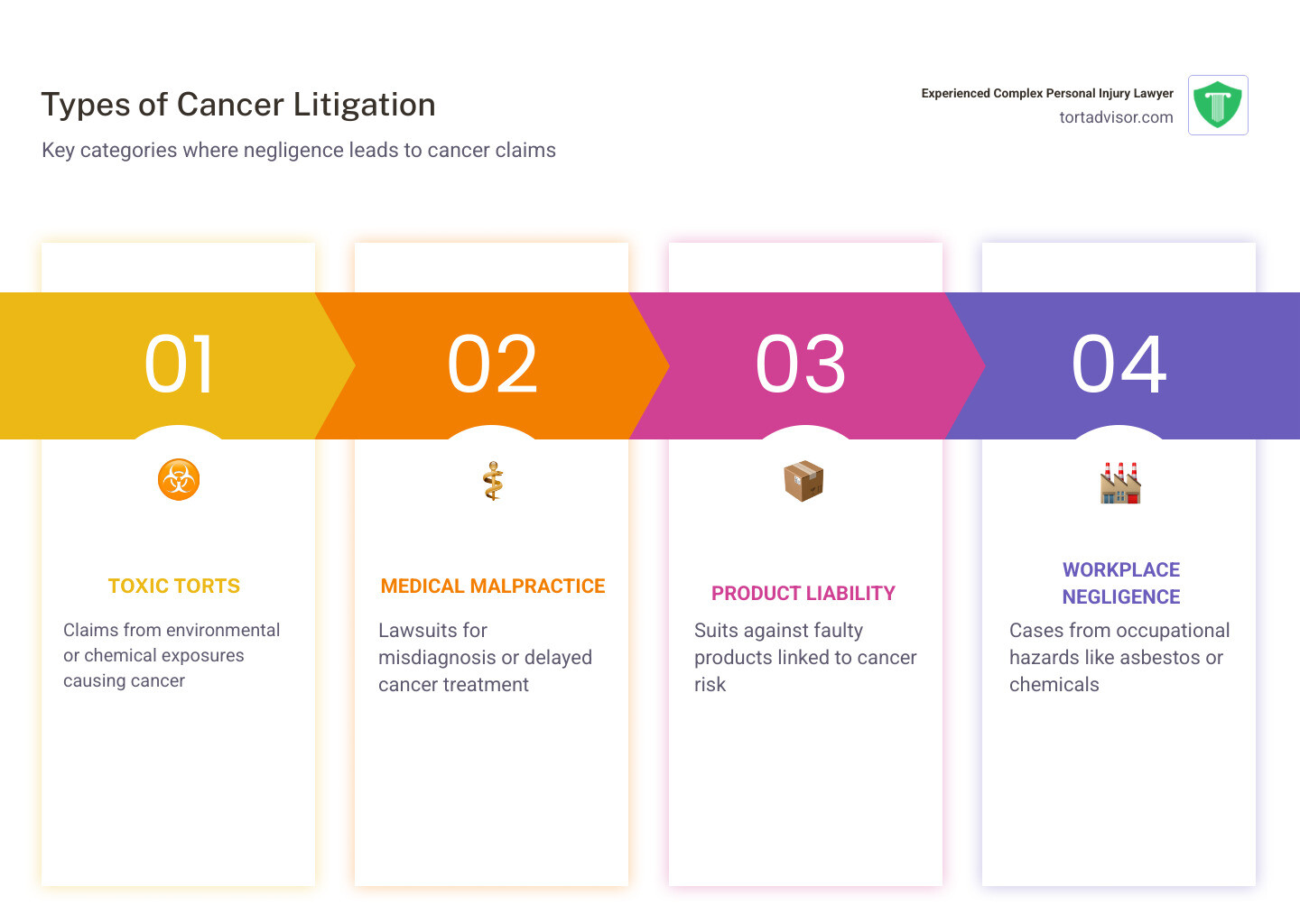
The Main Types of Cancer Lawsuits

Cancer cases do not all follow the same legal path. The category depends on how the exposure or negligence happened, and most claims fall into four groups: toxic torts, medical malpractice, product liability and workplace negligence.
Toxic Tort and Environmental Contamination Claims
A toxic tort is a claim against the maker or distributor of a chemical or substance that caused cancer, and it often involves many people exposed to the same hazard (a mass tort). Many families are now looking into a PFAS Cancer Lawsuit over “forever chemicals” detected in drinking water in states such as Alabama, California and New Jersey. Claims are also growing in the Hair Relaxer Cancer Lawsuit, which links chemicals in straightening products to uterine and ovarian cancer.
Product Liability
Product liability applies when a consumer product is dangerous by design or carries inadequate warnings. Medical device litigation is a leading example; read more about breast implant cancer and BIA-ALCL, a rare lymphoma tied to textured implants.
Workplace Negligence
Many workers are exposed to carcinogens every day on the job. Firefighters exposed to AFFF often ask what cancers are linked to firefighting foam exposure. Whether on a New York construction site or in a Virginia shipyard, employers must provide a safe workplace, and those that fail to supply protective equipment or warn about asbestos can be held responsible.
Missed Diagnosis and Medical Negligence
In some cases a third party did not cause the cancer, but a doctor’s failure to spot it let the disease advance. Medical negligence happens when a provider falls short of the “standard of care,” meaning they did not do what a comparably trained professional would have done in the same circumstances.
Scarbrough v. Alabama Cancer Care LLC et al illustrates how these disputes play out when patients believe their diagnosis or treatment fell below professional standards. Common issues include:
- Not ordering needed screening tests.
- Misreading lab or pathology results.
- Waiting too long to refer to a specialist.
Toxic Exposure and Workplace Hazards
Certain substances come up again and again in cancer litigation. Asbestos, tied to mesothelioma and lung cancer, is the best known. Glyphosate, the active ingredient in Roundup, has been linked to non-Hodgkin lymphoma. Benzene, found in industrial solvents and even some recalled antifungal sprays, is another recognized carcinogen behind many claims.
Who Qualifies for a Cancer Lawsuit and How Negligence Is Proven
Winning a cancer lawsuit takes more than showing you have cancer and used a particular product. The claim has to link the two in legal terms by proving four elements:
- Duty of Care: The defendant, such as a manufacturer or physician, was legally required to protect your safety.
- Breach: They did not meet that obligation, for example by staying silent about a known danger.
- Causation: That failure directly led to your cancer.
- Damages: You suffered real losses, such as medical costs and pain.
Causation is usually the toughest element. It calls for expert witnesses, often oncologists or toxicologists, who can testify that the exposure was “more likely than not” a substantial factor in the diagnosis. You may wonder, is there still a chance for compensation despite the 2024 federal court dismissals? Often the answer is yes, because state courts may apply different evidence standards than federal courts, letting many claims move forward even when an MDL (Multidistrict Litigation) stalls.
Who Is Allowed to File?
Usually the person diagnosed with cancer files as the plaintiff. If the patient has died, an estate representative or surviving relatives may bring a wrongful death claim. Many patients also look to disability benefits for financial stability; the SSDI for Cancer Complete Guide explains how to pursue Social Security benefits while a case is pending.
Connecting the Exposure to the Diagnosis
These cases stand on science. Attorneys review:
- Latency: Some cancers appear 10 to 50 years after exposure, which is typical in asbestos cases.
- Dose and Duration: How much of the substance you encountered, and for how long.
- Research: Studies such as the University of Washington analysis that suggested glyphosate raises NHL risk by 41% carry significant weight.
- Exposure Records: Job records, purchase receipts and even testing of local water. If water is your concern, the PFAS Cancer Risk Complete Guide covers these links in depth.
Cancer Lawsuit Compensation: What Damages Cover
A cancer lawsuit aims to “make the plaintiff whole,” even though money can never truly restore your health. Damages generally fall into three groups.
Economic and Non-Economic Damages
Economic damages are the measurable, documented losses, including cancer treatment costs, which can be very high without insurance, and lost pay if you can no longer work. You may also be eligible for cancer disability benefits to help with everyday expenses.
Non-economic damages are less concrete and include:
- Pain and Suffering: The physical pain and emotional distress caused by the illness.
- Loss of Consortium: The strain the disease places on your marriage.
- Disfigurement: Physical changes caused by surgery or treatment.
When a company’s conduct is especially egregious, a jury may also award punitive damages, which punish the defendant and deter similar behavior rather than compensate you. One Pennsylvania man, for instance, initially won a large jury verdict against Bayer over Roundup exposure that included a significant punitive award. If money is tight now, resources for financial help during cancer can help bridge the gap until a case resolves.
How a Cancer Lawsuit Moves From Diagnosis to Settlement
A cancer lawsuit takes time. It begins with a case evaluation of your medical history and exposure. After the complaint is filed, the case enters “discovery,” when both sides exchange evidence. You may be asked to sit for a deposition, answering questions under oath, and your attorney will typically depose the company’s scientists and executives.
Steps in Filing a Cancer Lawsuit
- Case Review: Talking with an experienced attorney to see whether you have a claim.
- Complaint: Formally opening the case in court.
- Discovery: Collecting evidence such as medical records and internal company documents.
- Experts: Retaining specialists to establish the cancer link.
- Settlement or Trial: Most cases settle, though some are decided by a jury.
If you cannot work in the meantime, begin the SSDI application for cancer early, since that process can be as demanding as the lawsuit.
Class Actions and MDLs in Cancer Litigation
“Class action” and “MDL” are often used interchangeably, but they are not the same:
- Class Action: A single case represents an entire group, and if the class prevails, members share in one recovery.
- MDL (Multidistrict Litigation): Many individual cases, such as those in the Roundup lawsuit, are combined before one judge for discovery to save time, yet each plaintiff keeps a separate case and an individual settlement based on their own health.
- Trust Funds: In the asbestos lawsuit context, many companies went bankrupt and were required to create trust funds, estimated to hold more than $30 billion, to pay future claimants.
If your cancer involves a medical device, joining a breast cancer class action lawsuit may be an option when the facts fit.
Major Cancer Lawsuit Settlements and Verdicts
Cancer litigation keeps evolving as new verdicts and settlements arrive. Some of the most notable developments, as of this update:
- Roundup (Glyphosate): Bayer announced a proposed $7.25 billion tiered national class settlement aimed at resolving tens of thousands of claims, following large individual verdicts such as a $78 million award in October 2024 to a man with non-Hodgkin lymphoma.
- Asbestos: Bankruptcy trusts are estimated to hold more than $30 billion. What an individual family recovers depends on factors such as the diagnosis, the extent and length of exposure, and how many companies’ products were involved.
- Zantac (Ranitidine): GSK (GlaxoSmithKline) agreed to pay up to $2.2 billion to resolve roughly 80,000 cases centered on evidence that the drug could break down into NDMA, a probable carcinogen.
- Talcum Powder: Johnson & Johnson has faced major verdicts, including $966 million in a California mesothelioma case, and testimony from former FDA commissioners has alleged the company concealed asbestos risks in its talc for 50 years.
- Insurance Denials: Manufacturers are not the only defendants. In one case, Aetna got approval for a $3.4M deal in a cancer treatment denial suit after refusing to cover proton beam therapy as “experimental.”
Mesothelioma and Asbestos Compensation
For veterans and tradespeople, a mesothelioma lawsuit is still a key route to accountability. Veterans are estimated to account for roughly a third of asbestos-related diagnoses, and many can also pursue VA disability benefits, which provide substantial monthly payments at a 100% rating for service-connected lung cancer.
Drug and Product Liability Developments
Uterine cancer hair relaxer claims are also advancing as more women step forward. On the pharmaceutical side, “innovator liability” is gaining attention: the idea that a brand-name drugmaker can be liable for harm from a generic version because it controlled the warning label.
Cancer Lawsuit FAQs
Can I still sue if I smoked?
Yes, and many people assume otherwise. In asbestos cases, doctors recognize a “synergistic effect”: smoking and asbestos together multiply cancer risk rather than simply adding to it. Even if you smoked, asbestos companies can still be held responsible for their share of your illness if you were exposed on the job.
How long do I have to file a cancer claim?
It depends on your state, but the “discovery rule” often helps. Under it, the deadline usually starts when you learned, or should have learned, that your cancer was connected to someone’s negligence. Because cancer can take decades to develop, a claim may be possible long after the exposure. Once you are diagnosed and suspect a link, though, move quickly; many states, including California, Florida and Texas, allow only about 1 to 3 years.
What does a cancer lawyer cost?
Nearly all cancer attorneys use a contingency fee arrangement, which means:
- Nothing upfront: You pay nothing to open the case.
- The attorney carries the risk: If the case does not win or settle, you owe no fee for the lawyer’s time.
- A set percentage: The attorney receives an agreed share of the final recovery to cover their work and costly expenses such as expert witnesses and filing fees.
Conclusion
Cancer upends everything, but you do not have to face the legal side alone. Legal Lawsuit connects patients and families with experienced attorneys in our network through a free, confidential case review, whether the claim involves a multibillion-dollar drug company or a wrongful insurance denial.
If you think your diagnosis could have been prevented, act now. Whether you want to explore a PFAS cancer lawsuit or a breast implant lawsuit, Legal Lawsuit can help you find the right next step. Filing deadlines apply, so request your free case review today.
Related Posts
Quick Answer: The Boy Scouts of America (BSA) filed for Chapter 11 bankruptcy in 2020 after facing tens of thousands [...]
Quick Answer: Survivors of sexual abuse by Catholic priests, nuns, or other Church personnel may be able to file a [...]
Quick Answer: Clergy abuse settlements vary enormously based on the severity of the abuse, the strength of evidence that the [...]