
Short answer: This article explains the key facts, eligibility issues, settlement factors, deadlines, and source-backed updates related to this legal topic. Results vary by case facts, evidence, jurisdiction, and representation.
How Much Is a Cancer Misdiagnosis Lawsuit Settlement Worth?
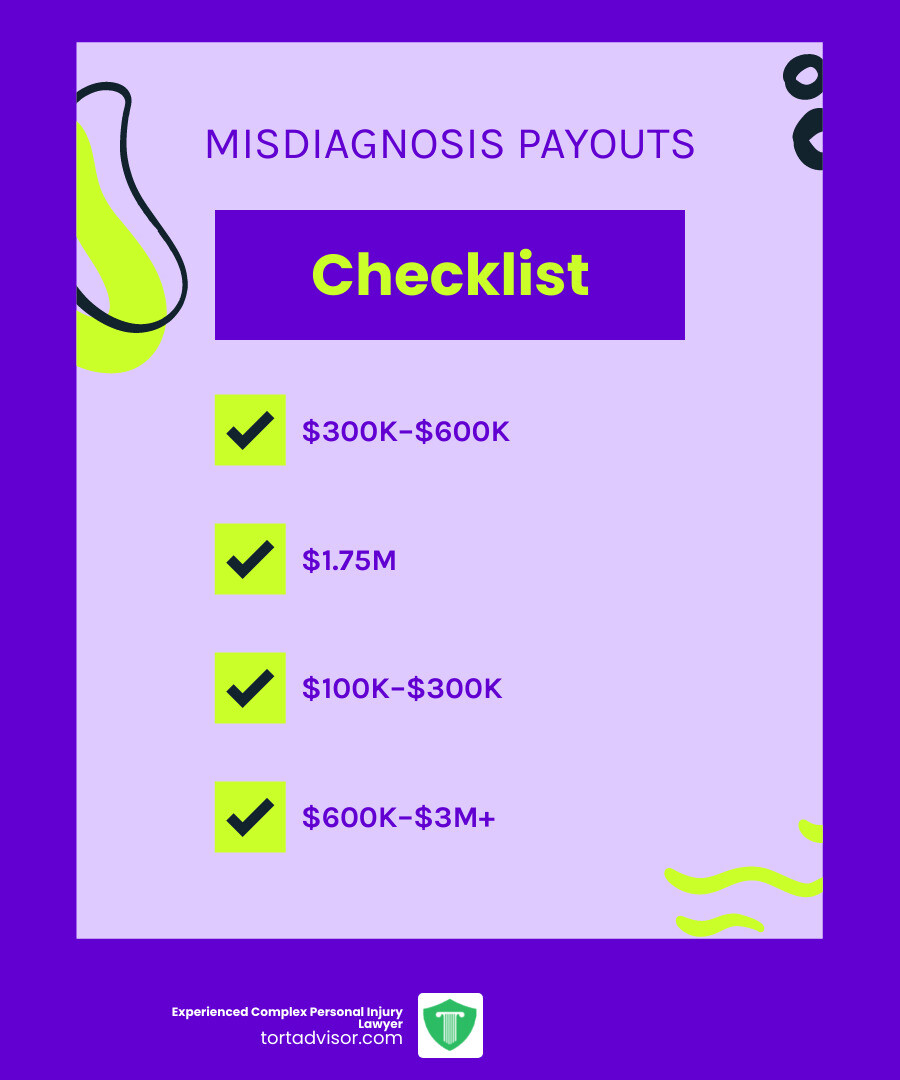
There is no reliable single number for a cancer misdiagnosis lawsuit settlement. Value depends mainly on how much the delay changed the cancer’s stage and prognosis, the added treatment it caused, lost income, whether the patient died and the limits of the provider’s insurance, and claims involving wrongful death, late-stage progression or long delays are generally worth the most. At a glance:
| Scenario | Reported Range (Varies Widely) |
|---|---|
| Limited harm, brief delay | $100,000 – $300,000 |
| Moderate harm, meaningful delay | $300,000 – $600,000 |
| Serious harm, stage progression or death | $600,000 – $3M+ |
| Reported median jury verdict (cancer malpractice) | $1.75 million |
Missing a cancer diagnosis is more than a clinical mistake; it can separate a treatable tumor from a terminal one. Research suggests close to 40% of serious injuries and deaths from diagnostic errors involve cancer, affecting roughly 100,000 Americans a year. When a doctor misses cancer, the fallout spreads: harsher treatment, lower survival odds, lost income and deep emotional harm for patients and families. That is why these cases carry such high stakes, and why it helps to understand how compensation is actually determined before you decide whether to bring a claim. I’m Mason Arnao. My background is in technology and data systems, and my work in internet research and lead generation has involved studying legal settlement data, including cancer misdiagnosis lawsuit settlement outcomes, so readers can see past the hype. The sections below explain what you need to know to make an informed choice.
What Determines a Cancer Misdiagnosis Lawsuit Settlement
When people talk about the value of a cancer misdiagnosis lawsuit settlement, it helps to separate settlements from verdicts. A settlement is a negotiated agreement, usually with an insurer, reached outside court; a verdict is a jury’s decision after trial. Cases that reach a jury tend to involve clear negligence and catastrophic harm, so reported verdicts often exceed typical settlements, while most claims settle because trials are costly and unpredictable for insurers. Johns Hopkins research identifies diagnostic errors as the leading cause of medical malpractice claims in the U.S., and cancer accounts for a large share, close to 38%, of those claims. Because these cases are complicated, any “average” is only a rough reference point; your recovery depends on the physical and financial harm the error caused you. If the misdiagnosis has kept you from working, you may also want to look into other support, such as SSDI for cancer.
How the Type of Cancer Affects Settlement Value
Cancers differ, and so do the claims they produce. Some grow far faster than others: a six-month delay with an aggressive lung cancer can do much more damage than the same delay with a slow-growing prostate cancer. Research suggests cancer is misdiagnosed more than 10% of the time, with lymphoma and breast cancer among the most frequently missed. Reported insurance data shows how malpractice payouts can vary by cancer type:
| Cancer Type | Reported Average Payout (Varies) |
|---|---|
| Colorectal Cancer | $750,000 |
| Prostate Cancer | $749,000 |
| Breast Cancer | $698,000 |
| Lung Cancer | $555,000 |
| Melanoma | $692,492 |
| Other Cancers | $725,719 |
Lung cancer claims vary enormously. Cases involving nonsmokers or younger patients often carry greater value because the lost life expectancy is larger.
How Cancer Stage Shapes Settlement Value
The single biggest factor in a cancer misdiagnosis lawsuit settlement is “stage progression.” When a doctor’s error lets a highly treatable Stage I cancer advance to metastatic Stage IV, the claim’s value rises sharply. Attorneys typically examine:
- How Treatment Changed: Did the delay force aggressive chemotherapy and radiation instead of a simpler operation?
- Change in Prognosis: How much did the delay lower your statistical chance of survival?
- Spread: Has the cancer moved to other organs such as the bones or brain?
Environmental exposures can also contribute to some cancers and complicate diagnosis. See our guide to PFAS prostate cancer lawsuits to learn how a cancer’s cause can affect legal strategy.
Factors That Shape Your Cancer Misdiagnosis Settlement

Every patient and every case is different. In valuing a claim, attorneys sort damages into two broad groups: economic and non-economic.
Economic Damages (Your Financial Losses)
These are the measurable money losses you have suffered, including:
- Medical Costs: Everything from the original missed diagnosis to the additional treatment needed because the cancer advanced.
- Missed Wages: Income lost to treatment or recovery time.
- Reduced Earning Capacity: When the misdiagnosis caused lasting disability that keeps you from your career.
Non-Economic Damages (The Personal Toll)
These are harder to measure and usually require an experienced attorney to value:
- Pain and Suffering: The physical pain of advanced cancer and the distress of knowing it could have been caught.
- Loss of Consortium: The effect on your relationship with your spouse or family.
- Diminished Quality of Life: Losing the ability to enjoy hobbies, travel or time with loved ones as before.
Other Factors That Affect Value
- Comparative Fault: Did you contribute to the delay? If a doctor told you to return in three months and you waited a year, the insurer will try to lower your recovery.
- Policy Limits: Settlements are often limited by the doctor’s or hospital’s malpractice coverage.
- Where You Live: Some states cap non-economic damages, which can limit your total recovery regardless of how much you suffered.
If your cancer involves a medical device or product, our guide to breast cancer class action lawsuits may also apply.
Proving Negligence in a Cancer Misdiagnosis Claim
Recovering a cancer misdiagnosis lawsuit settlement requires proving malpractice, not just a wrong diagnosis. Your attorney must show the doctor was negligent by establishing four elements:
- A Doctor-Patient Relationship: The doctor owed you a “duty of care,” usually the simplest element to show.
- A Breach of the Standard of Care: The doctor did not do what a reasonably competent physician in the same specialty would have done; for example, a radiologist who fails to report a visible lung mass on an X-ray.
- Causation: The negligence must be tied directly to the harm, meaning the delay caused the injury, not merely the cancer itself.
- Measurable Harm: You suffered real damages, such as higher medical costs, a worse prognosis or pain.
Expert testimony is central. Attorneys retain independent physicians to review your records and explain how the original doctor fell short. Proving these elements also matters in toxic exposure cases, such as PFAS cancer lawsuits.
Examples of Cancer Misdiagnosis Claim Scenarios
These common scenarios show the kinds of facts that tend to drive higher or lower claim values. Every case is different, and actual results depend on the evidence and the state.
- Lung Cancer, Repeated Missed Imaging: Several X-rays over two years showed a growing mass that went unaddressed until the cancer reached Stage IV. Long, documented delays like this are among the highest-value claims.
- Breast Cancer, No Biopsy: A suspicious lump was never biopsied, and the delay led to a double mastectomy and aggressive chemotherapy, substantially increasing damages.
- Prostate Cancer, Fatal Delay: A years-long delay in diagnosis ended in the patient’s death, opening the door to a wrongful death claim by the family.
- Breast Cancer, Spread to Bone: A one-year delay allowed the cancer to metastasize to the bones, worsening prognosis and treatment.
- Lung Cancer, Results Never Shared: An older patient was never told about abnormal findings on two chest CT scans, and the cancer was found at Stage IV; the patient’s age and life expectancy affect value in cases like this.
A study of primary care diagnostic errors found that cancer accounted for 46% of missed-diagnosis malpractice claims in primary care, pointing to a systemic problem that often takes legal action to address. Sometimes cancer is not only missed but caused by outside products, as in firefighting foam cancer lawsuits.
Cancer Misdiagnosis Claim FAQs
What is a typical cancer misdiagnosis lawsuit settlement in the U.S.?
There is no dependable “typical” figure, and published averages can mislead. When negligence causes the death of a young parent or main earner, claims can be worth far more, while a delay of a few weeks that did not change treatment may be worth much less. Some cancer symptoms also mimic other conditions, which makes diagnosis harder; for an example of symptom overlap, see PFAS exposure symptoms.
How long do I have to file?
This deadline is critical. In many states, including Florida, you generally have two years from when you discovered, or should have discovered, the misdiagnosis to sue, and missing it ends your right to recover. The Florida medical malpractice statute explains how the discovery rule may affect timing when an error was concealed.
What should I do if I suspect a misdiagnosis?
- Get a Second Opinion: Your health comes first, so see a specialist in a different hospital system right away.
- Collect Records: Request copies of all imaging (X-ray and CT discs), pathology reports and physician notes.
- Keep a Journal: Track pain levels, emotional state and how daily life has changed.
- Avoid Insurer Statements: Do not give a statement if an adjuster calls; they look for reasons to pay less.
- Talk to an Attorney: The sooner an investigation starts, the better the chance of preserving evidence.
If you think environmental toxins caused your cancer, also review the PFAS lawsuit criteria.
Conclusion
A cancer misdiagnosis is a heavy load, and you do not have to carry it alone. Published figures for a cancer misdiagnosis lawsuit settlement are only a rough benchmark; your situation is your own. Holding providers accountable is also about preventing the same mistake from harming someone else. Legal Lawsuit helps you connect with attorneys in our network who handle complex medical malpractice cases, whether the issue is a delayed diagnosis or a failure to treat. If your situation involves complications such as implants, see our guide to breast implant cancer lawsuits. Request a free, confidential case review to take the next step.
Related Posts
Quick Answer: The Boy Scouts of America (BSA) filed for Chapter 11 bankruptcy in 2020 after facing tens of thousands [...]
Quick Answer: Survivors of sexual abuse by Catholic priests, nuns, or other Church personnel may be able to file a [...]
Quick Answer: Clergy abuse settlements vary enormously based on the severity of the abuse, the strength of evidence that the [...]