
Short answer: This article explains the key facts, eligibility issues, settlement factors, deadlines, and source-backed updates related to this legal topic. Results vary by case facts, evidence, jurisdiction, and representation.
📋 Table of Contents
- PFAS Exposure is Linked to Prostate Cancer – Here’s What You Need to Know
- The Scientific Link: How PFAS and AFFF Lead to Prostate Cancer
- High-Risk Groups for PFAS Exposure and Prostate Cancer
- Filing a PFAS Prostate Cancer Lawsuit
- Frequently Asked Questions about PFAS and Prostate Cancer
- Know Your Rights and Take Action
PFAS and Prostate Cancer: What the Link Means for You
If you developed PFAS prostate cancer after exposure to the “forever chemicals” in firefighting foam and other products, a lawsuit may be an option. These claims are building momentum as studies keep pointing to meaningful connections between PFAS and cancer.
PFAS Prostate Cancer Lawsuits at a Glance:
- Who may file: Firefighters, service members and people living near contaminated sites who were diagnosed with prostate cancer
- Evidence you’ll need: Medical records confirming the diagnosis plus proof of PFAS exposure
- Cost to start: Nothing up front — attorneys work on contingency
- Where things stand: Thousands of cases are consolidated in federal court (MDL 2873)
- Claim value: No set amount; it depends on diagnosis, treatment, exposure history and documented losses
PFAS (per- and polyfluoroalkyl substances) are synthetic chemicals found in the firefighting foam known as AFFF. These “forever chemicals” resist breaking down in nature and accumulate in the body over time.
According to Zero Cancer, service members may face roughly double the prostate cancer risk of civilians — a striking figure that underscores the link between on-the-job PFAS exposure and cancer.
Claims tend to be strongest for:
- Firefighters who routinely used AFFF
- Service members stationed at bases with documented contamination
- Residents who drank polluted water near bases or airports
Through our work helping people connect with experienced attorneys, we’ve seen how PFAS prostate cancer lawsuit claims can deliver vital compensation for medical bills and other losses, and our research background helps us explain the complex science behind these toxic exposure cases.
Related PFAS prostate cancer topics:
- PFAS Cancer Risk Complete Guide
- PFAS Exposure Risks
- PFAS Lawsuit Settlement Amounts Per Person
How PFAS and AFFF May Lead to Prostate Cancer: The Science
Per- and polyfluoroalkyl substances (PFAS) are long-lasting synthetic chemicals that have found their way into everyday products and into our bodies. Their resistance to heat, water and oil makes them useful — and dangerous. A powerful carbon-fluorine bond keeps them from breaking down in the environment or the body, which is why they’re called “forever chemicals.”
Aqueous Film-Forming Foam (AFFF) is among the biggest sources of PFAS contamination and especially relevant to prostate cancer claims. This specialized foam was built to smother intensely flammable liquid fires, such as petroleum blazes, and its effectiveness comes straight from the PFAS inside it.
The central problem is bioaccumulation: PFAS that enter the body tend to stay and build up. Research, including work from the National Cancer Institute, suggests PFOA and related perfluorinated chemicals may be tied to higher rates of prostate cancer diagnosis and death. Scientists are still mapping the mechanisms, but endocrine disruption — interference with the body’s hormones — and other cell damage are thought to play a role. See our PFAS Cancer Risk Complete Guide for a broader look at the risks.
What Exactly Are PFAS?
PFAS are a family of thousands of synthetic compounds manufactured since the 1940s. They’re nicknamed “forever chemicals” because their structure makes them extraordinarily stable and slow to degrade. The two best known — and most often at the center of health debates and litigation — are Perfluorooctanoic Acid (PFOA) and Perfluorooctane Sulfonate (PFOS).
Because they repel water, grease and oil and hold up at high temperatures, PFAS found their way into a huge range of products, such as:
- Non-stick pans (Teflon, for example)
- Waterproof clothing and outdoor equipment
- Stain-repellent carpet and furniture fabric
- Food packaging like pizza boxes and microwave popcorn bags
- Some personal care items, including certain cosmetics and dental floss
- Industrial uses such as chrome plating and electronics production
- And firefighting foams — AFFF above all.
PFAS are so widespread that nearly everyone carries some in their bloodstream. The U.S. Environmental Protection Agency (EPA) has issued a health advisory for PFOA and PFOS, recognizing the potential harm of long-term exposure.
What Does PFAS Do Inside the Body?
The biggest worry is how long PFAS linger. Unlike many toxins, they aren’t readily broken down or flushed out; they collect in organs and tissues where they may do damage.
A key way PFAS are thought to affect health is by disrupting hormones. They can interfere with the endocrine system, which controls growth, metabolism and reproduction — a particular concern for men’s prostate health. 2021 research even suggested PFAS may contribute to prostate cancer, and that a high-fat diet may speed the disease’s progression.
Apart from hormone disruption, PFAS exposure has been associated with:
- Cell damage: Altering how cells work and possibly triggering uncontrolled growth.
- Immune problems: Weakening the body’s defenses against infection and disease, possibly increasing cancer susceptibility.
- Liver harm: Because the liver filters toxins, PFAS tend to accumulate there.

The International Agency for Research on Cancer (IARC) has classified PFOA as carcinogenic and PFOS as possibly carcinogenic to humans, highlighting the serious health stakes. To learn which warning signs to watch for, see our PFAS Exposure Symptoms page.
What Is AFFF, and Why Is It Harmful?
Aqueous Film-Forming Foam (AFFF) came into wide use in the 1960s. Developed by the U.S. Navy and 3M to combat highly flammable liquid fires such as jet fuel blazes, it forms a vapor-blocking film that puts fires out fast, making it extremely effective in emergencies.
Its danger comes from its key ingredients — PFAS. For decades, AFFF was used heavily in military and civilian settings, including:
- Military installations: In training, emergency response and equipment upkeep.
- Commercial airports: For fire suppression and drills.
- Industrial sites: Wherever large fuel or chemical fires were possible.
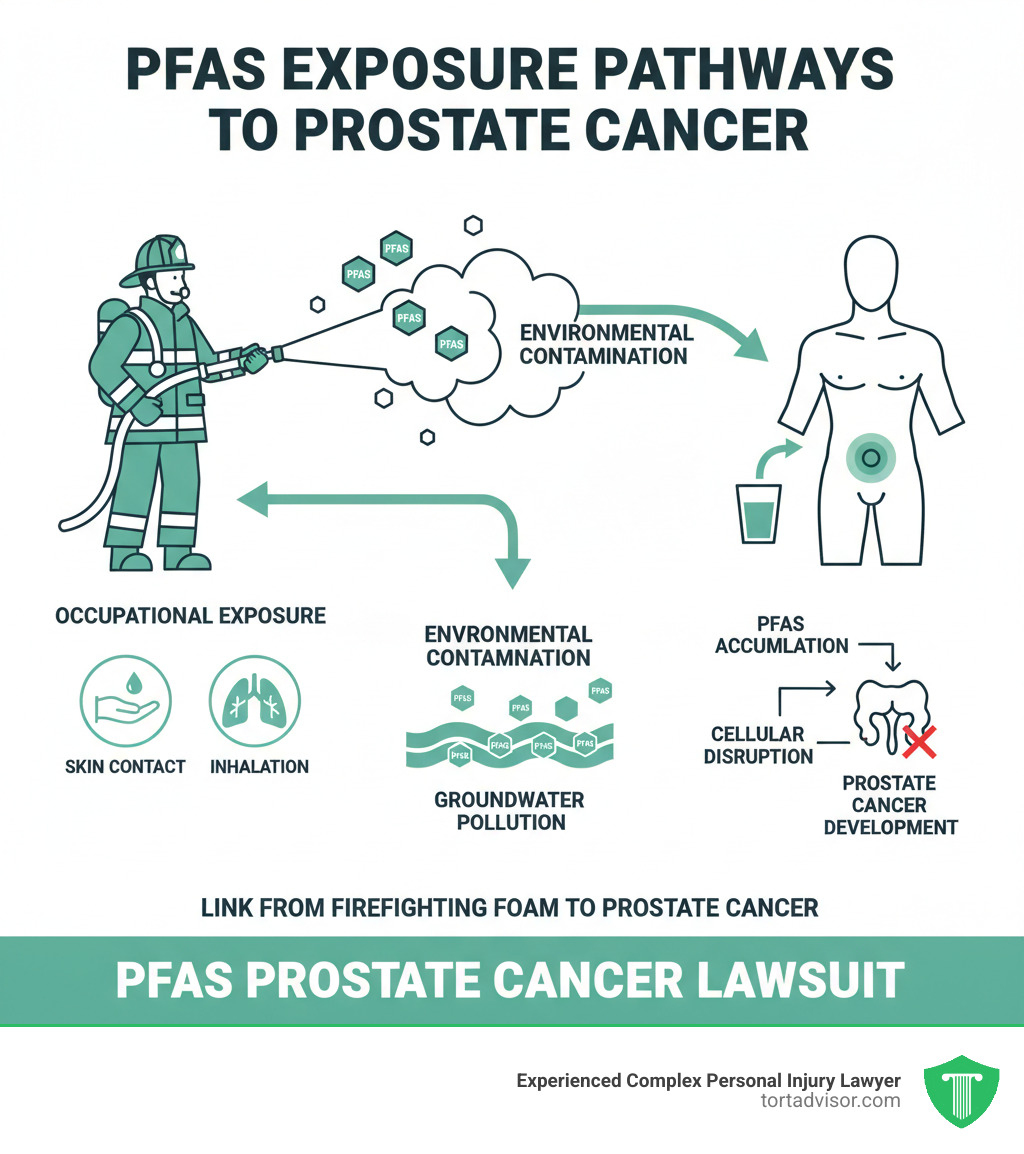
AFFF use exposed countless people directly. Firefighters and service members who handled the foam took in PFAS by breathing fumes, through skin contact and by accidental ingestion. AFFF also caused widespread environmental contamination: once sprayed, it soaked into the ground, polluting soil, groundwater and nearby drinking water, so even people who never touched it could be exposed through their tap. Both the Centers for Disease Control and Prevention (CDC) and the Environmental Protection Agency (EPA) have cautioned that the toxic chemicals in AFFF may contribute to certain health risks. For the wider legal picture, see our Firefighting Foam Cancer Lawsuit page.
Who Faces the Highest PFAS Prostate Cancer Risk?
Knowing who is most exposed to PFAS — and therefore at greater risk of illnesses like prostate cancer — is essential. Because these chemicals are everywhere, exposure can happen through workplace contact or simply by drinking tap water.

People in certain jobs and those living near particular contamination sites face notably higher odds of exposure. For a full overview of how people encounter these chemicals, read our PFAS Exposure Risks guide.
Firefighters and Airport Workers
Firefighters and airport crews on the front lines were put at risk, unknowingly, every time they used AFFF.
They faced some of the most direct and intense PFAS exposure through:
- Handling the foam: Mixing, spraying and cleaning up AFFF in real emergencies and routine drills.
- Breathing in vapors: Mist and fumes released when the foam was deployed.
- Absorption through the skin: Contact with the foam, even through gear, could let PFAS in.
- Tainted protective equipment: PFAS were also used to make some turnout gear water- and stain-resistant, extending exposure.
Many firefighters in city departments, military units and airports served for decades, meaning long-term, heavy exposure. Australia’s National Research Centre for Environmental Toxicology found firefighters were more likely to carry fluorinated surfactants in their blood. Such repeated exposure puts them at high risk for PFAS-related cancers, prostate cancer among them.
Active-Duty Service Members and Veterans
Service members also experienced heavy PFAS exposure without knowing it. AFFF was the standard for fighting fuel fires on bases around the world, and its extensive use caused widespread contamination.
Many U.S. bases have significant PFAS contamination; the Department of Defense has identified 715 installations needing PFAS assessment. Anyone who served at or lived near these bases may have been exposed.

The connection between military service and prostate cancer is troubling. Some research indicates service members are about twice as likely as civilians to develop prostate cancer, a gap often linked to occupational exposures — with PFAS a leading suspect.
Military roles and exposure routes with elevated risk include:
- Air Force Firefighters: Worked directly with AFFF.
- Navy Personnel: Exposed aboard ships and in shipyards where AFFF was used; Navy veterans may have encountered PFAS in firefighting foam.
- Army and Marine Corps Personnel: Took part in fire training or were stationed at bases with contaminated water.
- Everyone on Base: Anyone who drank contaminated base water. Many U.S. installations have significant PFAS contamination, and you can check an interactive map of bases with known PFAS problems to see whether yours is listed.
The VA recognizes that PFAS exposure during service may raise the risk of certain cancers — an important acknowledgment for veterans seeking justice.
People Living Near Contaminated Sites
The danger isn’t limited to the workplace. Environmental contamination can affect whole communities, and AFFF is the single largest source of PFAS in drinking water, with a devastating environmental toll.
People living near these sites are especially vulnerable:
- Military bases: Heavy AFFF use has polluted groundwater that often spreads beyond base boundaries.
- Commercial airports: Frequent AFFF use has caused local contamination, much like at bases.
- Manufacturing plants: Facilities that made or used PFAS — chemical plants and textile mills, for example — are major sources of environmental release.
These communities often deal with contaminated municipal water or private wells affected by PFAS runoff. An estimated 200 million-plus Americans live where tap water exceeds the EPA’s recommended PFAS safety levels, with serious health consequences, including higher prostate cancer risk. To learn about legal action addressing this widespread problem, see our PFAS Cancer Water Contamination Lawsuits section.
How to File a PFAS Prostate Cancer Lawsuit
If you or a family member has a prostate cancer diagnosis tied to PFAS exposure, legal options may be available. These cases rest on product liability and negligence law, holding manufacturers responsible for failing to warn the public and regulators about PFAS dangers they allegedly understood.
Companies such as 3M and DuPont are accused of knowing about PFAS toxicity for decades while continuing to make and sell the chemicals. That alleged failure to warn, together with the widespread contamination their products caused, underpins many of these lawsuits.
Most individual AFFF and PFAS injury suits have been consolidated into Multidistrict Litigation — MDL 2873 — in the U.S. District Court for the District of South Carolina, which handles similar cases more efficiently. MDLs often feature “bellwether trials,” test cases that show how juries react to the evidence and help guide settlement talks for everyone else. For the newest developments, read our PFAS Lawsuit Update Today.
Who Qualifies for a PFAS Prostate Cancer Claim?
A strong PFAS prostate cancer lawsuit depends on meeting certain criteria. Legal Lawsuit can help you understand them and connect with an attorney, but in general you’ll need to show:
- Evidence of PFAS Exposure: Proof that you were exposed, especially through AFFF or contaminated water, such as:
- Job records: Showing work as a civilian or military firefighter, at an airport or in an industrial setting where AFFF was used.
- Service records: Documenting assignments at bases known for PFAS contamination.
- Where you lived: Proof of residence near a contaminated site — a base, airport or plant — and use of its drinking water.
- Water test results: Documentation of PFAS in your drinking water.
- A Prostate Cancer Diagnosis: Confirmation from a physician, including when you were diagnosed and details about how the cancer progressed and was treated.
- A Link Between the Two: Scientific evidence and expert testimony showing your exposure likely contributed to your cancer, supported by a growing body of research.
Eligibility can be complicated, and Legal Lawsuit aims to make it easier to understand. For the full list of requirements, see our PFAS Lawsuit Criteria page.
Evidence That Supports a PFAS Prostate Cancer Claim
A strong PFAS prostate cancer claim takes careful documentation of your exposure, your diagnosis and the connection between them. Important evidence includes:
- Medical Records: Thorough documentation is essential — your diagnosis, biopsy and pathology results, treatment history (surgery, radiation, chemotherapy) and records of how the disease began and progressed. A physician’s testimony or expert report can strengthen the PFAS connection.
- Work History: For occupational exposure, detailed records of your work as a firefighter, service member or industrial worker, including dates, roles and any documentation of AFFF use or exposure events.
- Military Records: For veterans, records showing where and when you served, which can be matched against known contaminated bases.
- Your Own Account: Your description of the exposure, symptoms and how cancer has affected your life adds a personal dimension; relatives can offer supporting statements too.
- Environmental Reports and Water Testing: For drinking water exposure, reports of PFAS levels in your area’s water supply or results from testing your private well.
- Expert Testimony on Causation: Medical and scientific experts explain the link between PFAS and prostate cancer and show your exposure was a significant contributing factor.
Pulling this evidence together can feel overwhelming during cancer treatment. Experienced attorneys in our network can take on the work of gathering and organizing the documentation needed to build a strong case.
PFAS Prostate Cancer Lawsuit Damages and Settlement Value
A successful PFAS prostate cancer lawsuit may provide substantial compensation, or “damages,” for losses caused by your illness and the manufacturers’ negligence. Claims usually seek:
- Medical Costs: Past and future expenses for prostate cancer care — appointments, testing, surgery, medication, radiation, chemotherapy and rehabilitation.
- Lost Income and Earning Capacity: Compensation if cancer or its treatment kept you from working, ended your career or reduced your earning ability.
- Pain and Suffering: Non-economic damages for physical pain, emotional distress, mental anguish and lower quality of life.
- Loss of Consortium: If the cancer has strained your marriage, your spouse may seek damages for lost companionship, affection and support.
- Punitive Damages: Where a court finds extreme negligence or malice, punitive damages may be awarded to punish the defendants and discourage similar behavior.
Predicting settlement values for AFFF and PFAS cases — particularly for a specific cancer like prostate cancer — is difficult because every case is different, and no personal-injury settlement figures have been finalized. Value will likely depend on how strong the exposure evidence is, the stage and treatment of the cancer, lost income, age and how the bellwether trials turn out. Any published estimates are speculative, not guarantees.
For a clearer sense of what your claim may be worth, try our interactive PFAS Settlement Calculator, and see our PFAS Lawsuit Settlement Amounts Per Person page for more on how payouts are evaluated.
PFAS Prostate Cancer FAQs
You probably have plenty of questions about PFAS, prostate cancer and your legal rights. Here are answers to some of the most common ones.
What other long-term health problems are linked to PFAS?
Beyond prostate cancer, PFAS exposure is tied to many serious conditions. These “forever chemicals” can affect several body systems, and research repeatedly connects them to:
- Kidney cancer: A study in the Journal of the American Medical Association reported a statistically significant association between PFOA exposure and higher kidney cancer risk.
- Testicular cancer: The same JAMA research also linked PFOA exposure to greater testicular cancer risk.
- Thyroid disease: PFAS can disturb thyroid hormones, causing hypothyroidism or hyperthyroidism that may progress to thyroid cancer.
- Ulcerative colitis: The JAMA study also tied PFOA exposure to this chronic inflammatory bowel disease.
- Liver damage: The liver is especially vulnerable to PFAS buildup, which can lead to liver disease, including cancer.
- Weakened immunity: PFAS can suppress immune function, raising susceptibility to infection and blunting vaccine response.
- Bladder cancer: Research has found elevated bladder cancer risk with PFAS exposure.
- Breast cancer: The International Journal of Cancer reported a positive association between PFOS exposure and breast cancer.
- Developmental problems: Childhood PFAS exposure has been linked to developmental delays.
- Reproductive harm and lower fertility: PFAS can affect reproductive health in men and women alike.
These far-reaching health effects show why PFAS contamination must be addressed and those responsible held accountable.
What legal options do veterans with prostate cancer have?
Veterans whose prostate cancer may be tied to PFAS exposure during service have several paths:
- VA Disability Benefits: The Department of Veterans Affairs acknowledges PFAS exposure may raise the risk of certain cancers. It hasn’t formally recognized PFAS as a direct cause of prostate cancer, but it is studying the issue, especially the link between PFAS and kidney cancer — a meaningful step. Veterans can apply for disability compensation through the VA, and the Sergeant First Class (SFC) Heath Robinson Honoring our Promise to Address Comprehensive Toxics (PACT) Act has broadened health care and benefits for toxic-exposed veterans, which may extend to PFAS-related conditions.
- Suing the Manufacturers: Veterans can bring civil claims against the makers of PFAS and AFFF, such as 3M and DuPont. These suits are not against the U.S. government; they seek compensation from the companies that produced and sold the chemicals while allegedly knowing the risks and failing to warn. The goal is to recover medical costs, lost income, pain and suffering and more.
Legal Lawsuit can help veterans connect with attorneys who handle both VA benefits questions and civil claims to pursue every available source of compensation.
What does a PFAS lawyer cost?
Cost shouldn’t keep anyone from justice, particularly when facing a serious illness caused by corporate negligence. That’s why attorneys in our network handle these cases on a contingency fee basis.
What that means for you:
- Nothing Up Front: You pay no attorney fees out of pocket to begin your PFAS prostate cancer lawsuit.
- Paid Only on Recovery: The attorney’s fee depends on a successful settlement or verdict; if no compensation is recovered, you owe no attorney fees.
- Free Case Review: You can request a free, confidential case review to discuss your situation, evaluate your claim and learn your options, with no financial commitment.
This setup lets individuals and families take on powerful corporations without the added burden of legal bills, opening the courthouse doors to everyone.
Know Your Rights — and Take the Next Step
The connection between widespread PFAS chemicals and serious illnesses like prostate cancer is a major public health problem. Manufacturers allegedly put profits ahead of safety for far too long, leaving people and communities to bear the consequences.
Legal Lawsuit believes these companies should be held accountable. If you or a loved one has been diagnosed with prostate cancer and has a history of PFAS exposure — through military service, firefighting or living near a contaminated site — look into your legal options. You have rights, and compensation may be available for medical bills, lost income and the pain and suffering you’ve endured.
Legal Lawsuit helps people connect with attorneys in our network who handle complex personal injury and toxic tort cases across the country.
You don’t have to take this on alone. The legal process can be intimidating, but with experienced representation you can navigate it effectively. If you or someone you love was diagnosed with prostate cancer after PFAS exposure, explore your options for a PFAS Cancer Lawsuit and request a free, confidential case review to understand your rights and take the first step toward protecting your future.
Additional Resources
Related Posts
Quick Answer: The Boy Scouts of America (BSA) filed for Chapter 11 bankruptcy in 2020 after facing tens of thousands [...]
Quick Answer: Survivors of sexual abuse by Catholic priests, nuns, or other Church personnel may be able to file a [...]
Quick Answer: Clergy abuse settlements vary enormously based on the severity of the abuse, the strength of evidence that the [...]