

Short answer: This article explains the key facts, eligibility issues, settlement factors, deadlines, and source-backed updates related to this legal topic. Results vary by case facts, evidence, jurisdiction, and representation.
PFAS Lawsuit Criteria: Who Is Eligible to File
PFAS lawsuit criteria decide who can pursue compensation for illnesses tied to exposure to toxic “forever chemicals.” If you were exposed to PFAS and later developed a related health condition, you may be eligible to bring a claim against the manufacturers responsible.
In This Guide
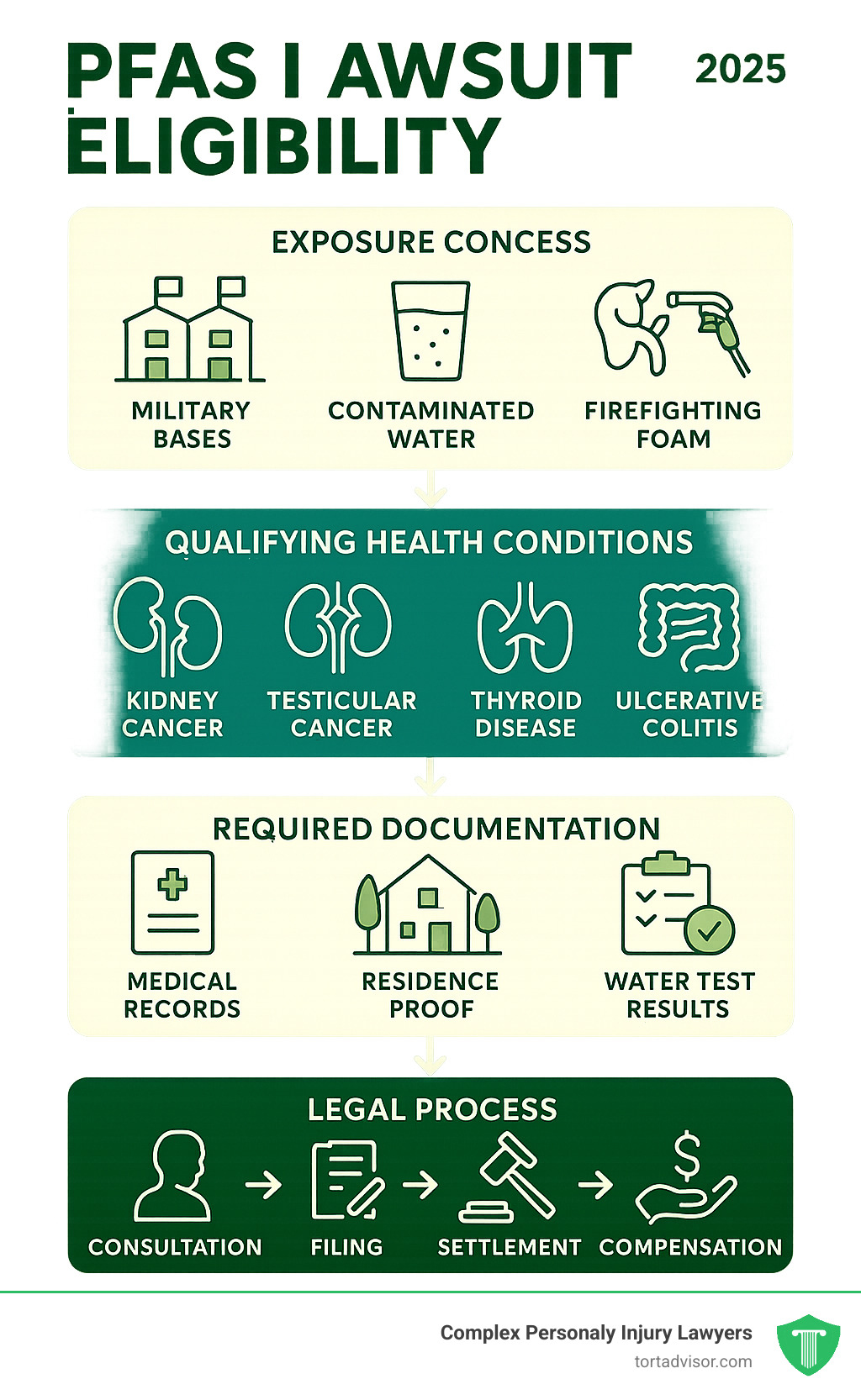
The Main PFAS Lawsuit Requirements:
- Proof of Exposure – Records showing contact with PFAS through tainted water, your job or military service
- A Qualifying Diagnosis – Kidney cancer, testicular cancer, thyroid disease, ulcerative colitis or liver damage
- Medical Records – Documentation tying your illness to PFAS exposure
- Location Link – Living or working in an area with known contamination
- Filing Deadline – Bringing the claim within your state’s statute of limitations
Firefighting foam claims make up the biggest share of PFAS litigation, a docket that has grown to many thousands of cases (more than 8,000 at one point, and rising). In drinking water supplier cases, 3M agreed to pay between $10.5 billion and $12.5 billion, and DuPont reached a $1.185 billion settlement.
According to federal health researchers, roughly 97% of Americans have been exposed to PFAS. The chemicals have turned up in thousands of water systems across the country, especially around military bases, where more than 700 sites have documented PFAS releases.
I’m Mason Arnao. Through my technology company’s work on data management and lead generation systems, I have helped connect thousands of people with legal resources for complex matters, including evaluations against the PFAS lawsuit criteria. That work in data analysis and client matching has shown me how much eligibility rules shape the way cases turn out.
What Are PFAS, and Why Should You Be Concerned?
PFAS, short for per- and polyfluoroalkyl substances, are now widely known, though not for good reasons. They earned the nickname “forever chemicals” because they barely break down, whether in soil, water or the human body. That staying power has led to widespread contamination and real health worries, and it is exactly why litigation matters: the companies behind these chemicals should answer for the harm they cause. The EPA’s current understanding of PFAS risks keeps developing, which highlights how serious the problem is.
Why “Forever Chemicals” Are Dangerous
These synthetic chemicals date back to the 1940s and 1950s and have been used in nonstick pans, water-repellent clothing and countless other goods because they shrug off heat, water and grease. The catch is that the same properties let them build up in people and the environment, a process called bioaccumulation, and once absorbed they are very hard to eliminate. Federal research cited by the NIEHS indicates that 97% of all Americans have been exposed to PFAS. They can disrupt the endocrine system, interfering with hormones and potentially setting off a chain of health problems. It is unsettling that something so widespread can also be so persistent and harmful.
Where PFAS Contamination Comes From
PFAS pollution has many sources. Factories and industrial plants used and released these chemicals for decades, and groups such as the NRDC explain how they end up in everyday products. Military installations are another big contributor, mostly because of heavy use of Aqueous Film-Forming Foam (AFFF), a PFAS-based firefighting foam, in drills and emergencies. Records show over 700 military sites contaminated groundwater or drinking water. Landfills add to the problem as PFAS from discarded goods seep into soil and water, and consumer items like food wrappers and stain-resistant carpet add more, with much of it eventually reaching drinking water.
Illnesses Associated With PFAS Exposure
Scientists have tied PFAS exposure to a long and troubling list of possible health effects, including:
- Kidney cancer
- Testicular cancer
- Thyroid disease (potentially including thyroid cancer)
- Ulcerative colitis
- Liver damage
- High cholesterol
- Developmental problems in children
- Higher risk of preeclampsia
- Reduced immune response
- Reproductive problems
The C8 Science Panel’s findings offered some of the first and most thorough evidence of probable links between PFOA, one type of PFAS, and these conditions. Legal Lawsuit also explains common PFAS Exposure Symptoms so you can recognize the warning signs.
PFAS Lawsuit Criteria: Do You Qualify?

Working out whether you qualify for a PFAS claim is less mysterious than it sounds. The PFAS lawsuit criteria boil down to a few clear requirements: solid evidence that you were exposed, a diagnosis that fits, and records that back it all up.
If PFAS has harmed you, the courts do offer routes to accountability. Here is what each requirement involves.
Who Can File a PFAS Lawsuit?
A surprisingly wide range of people may be able to sue. Forever chemicals have reached people in many different ways, and the law recognizes several types of exposure as grounds for a claim.
People living in contaminated communities often have strong claims, particularly if they lived near factories or bases where PFAS got into drinking water. Many cases involve families who drank tainted water for years without knowing it.
Workers in manufacturing and aviation were exposed on the job. Employment in chemical production, waste handling or aviation likely meant higher PFAS exposure than most people experience.
Service members and veterans are among the biggest groups in PFAS litigation. Serving at a base that used firefighting foam in training or emergencies may have meant exposure to harmful levels, and more than 700 military sites nationwide have documented contamination.
Firefighters stand out because they handled AFFF (aqueous film-forming foam) directly while protecting the public. Both civilian and military firefighters have developed serious illnesses from this occupational exposure. Read more on the Firefighting Foam Cancer Lawsuit page.
Cities and water utilities are suing too, seeking to recoup the enormous cost of cleaning up contaminated water and protecting residents.
The Two Core PFAS Lawsuit Requirements: Exposure and Diagnosis
Every solid PFAS claim rests on two essential elements, and both must be present. Together they form the base of the case.
The first element is evidence of exposure, meaning proof that you encountered PFAS in significant amounts. That can include records showing you lived or worked in a known contamination area, such as near a PFAS plant or a base that used firefighting foam. Water test results showing PFAS in your supply are strong proof, military records can place you at an affected base, and job history can show you worked in an industry that used the chemicals.
The second element is evidence of diagnosis: medical records establishing that you have a qualifying illness scientists have tied to PFAS. Ideally your doctor’s notes link the condition to toxic exposure, and tests such as biopsies confirm the diagnosis.
The catch is that only certain illnesses qualify, and the link between PFAS and your condition must be supported by science. Courts look to established medical research to decide which conditions can be connected to exposure. For more on specific health risks, see the PFAS Exposure Risks page.
Evidence That Strengthens a PFAS Claim
Collecting the right proof can feel like a big job. It helps to think of it as assembling a clear story of how PFAS exposure led to your illness.
Medical records are essential. They document your diagnosis, your treatment and how the condition has changed, and they should clearly show when symptoms began and how they progressed.
Proof of where you lived shows you were in a contaminated area during the relevant period. Utility bills, deeds, tax records or leases can all establish residence.
In job-related cases, your work history is key evidence. Detailed records of employers, duties and length of employment can decide an occupational exposure claim.
Water quality reports supply hard numbers on contamination. Whether they come from your city’s water system or from private well testing, they show which chemicals were in your water and when.
Expert testimony connects the science to the law. Medical experts can explain how PFAS caused your illness, and scientists can translate complex studies for judges and juries.
Scientific research itself underpins PFAS litigation. Years of studies documenting links between these chemicals and specific diseases provide the evidentiary foundation for claims.
Pulling this evidence together takes time, but it pays off in a stronger case. If your claim involves cancer, the PFAS Cancer Lawsuits section explains the evidence those cases typically require.
How to File a PFAS Lawsuit and Pursue Compensation

Starting a legal claim can feel like too much when you are already sick. Knowing how the process works takes some of the fear out of it. A PFAS lawsuit follows a series of defined steps with set timelines and requirements, and with good guidance you can get through them with confidence.
First Steps If You Think You Were Exposed to PFAS
If you believe PFAS exposure is behind health problems you are having, move quickly. Start by seeing a doctor. Share your full exposure history and symptoms, including whether you lived near a military base, handled firefighting foam or lived somewhere with known water contamination. PFAS blood testing is not routine, but your doctor can evaluate your health and record any conditions that may be connected.
Keep every record you can find, since this is the backbone of your claim. Collect medical files, utility bills, deeds and job records that show where you lived and worked during possible exposure. The more you have, the stronger your position.
If you rely on a private well, have it tested for PFAS by an accredited lab. If you are on city water, past water quality reports can still be useful evidence. Many communities only learned of contamination once testing detected these chemicals.
Above all, speak with an attorney who handles toxic tort cases as early as you can. They can tell you whether you meet the PFAS lawsuit criteria and walk you through each step. Statutes of limitations apply, and missing one could end your chance at compensation.
What Compensation a PFAS Lawsuit Can Provide
A successful PFAS claim aims to make up for what you have lost and help with what lies ahead. Medical costs are usually a large piece, covering past, current and future care for a PFAS-related illness, from appointments and prescriptions to specialized treatment and monitoring.
Lost income damages repay wages missed because of illness, treatment or recovery. If the condition permanently limits your ability to work, lost earning capacity damages account for the drop in future earnings.
Pain and suffering damages acknowledge harms that have no price tag, including physical pain, emotional distress and a diminished quality of life. When PFAS exposure causes a death, wrongful death damages help surviving relatives with funeral costs and the loss of income and companionship.
Medical monitoring is especially relevant in PFAS cases because the chemicals linger in the body for years, making regular screening important for early detection. Punitive damages are sometimes awarded when a company acted with particular recklessness, though they are less common.
How the AFFF MDL Affects Your PFAS Claim
Litigation over Aqueous Film-Forming Foam (AFFF) is the biggest group of PFAS cases in the courts. The cases are consolidated in a Multidistrict Litigation (MDL) in South Carolina, which streamlines thousands of similar claims against 3M, DuPont and other chemical makers.
Consolidation has already yielded major results. 3M agreed to pay between $10.5 billion and $12.5 billion to resolve drinking water supplier claims, and DuPont settled for $1.185 billion. Those deals mainly go to public water systems for cleanup, but they show how costly PFAS contamination has become for manufacturers.
Bellwether trials for personal injury claims were scheduled to begin in 2025; check the latest PFAS lawsuit update for current timing. These test trials center on conditions such as kidney cancer, testicular cancer, thyroid disease and ulcerative colitis, and their results are expected to shape how thousands of other injury claims are valued and resolved.
The picture keeps changing, including growing fights between manufacturers and their insurers over who pays for these huge liabilities. That complexity is one more reason individual claimants benefit from experienced counsel.
PFAS Lawsuit FAQs

PFAS exposure and the legal options that follow raise a lot of questions, and that is completely normal. The same concerns come up again and again: cost, deadlines and whether you qualify at all. Here are direct answers.
What does it cost to file a PFAS lawsuit?
Good news: you generally do not need thousands of dollars upfront to pursue a claim under the PFAS lawsuit criteria. Most toxic tort attorneys charge on a contingency fee basis, meaning they are paid only if you are.
In practice, there are no upfront legal fees. The attorney is paid only after obtaining a settlement or winning a verdict, and the fee is a percentage of your recovery rather than money out of your pocket in advance.
There are also case costs, such as expert fees, filing fees and administrative expenses. Reputable firms usually advance these and are repaid from the settlement or award. The system exists so ordinary people can take on huge corporations without needing deep pockets.
What is the deadline to file a PFAS claim?
This deserves your attention. There is no single answer because each state sets its own statute of limitations, the legal clock that limits how long you have to sue.
What makes it confusing is that the deadline is often measured from your diagnosis date for a PFAS-related illness rather than from the exposure itself. Your exposure may have been decades ago while your diagnosis is recent.
Some states allow only one or two years after diagnosis. Miss that window and even a strong case may be lost for good. That is why it is wise to talk with an attorney promptly; even if you are unsure about your claim, finding out early beats running out of time.
Can I file a PFAS claim without a cancer diagnosis?
Yes. This is one of the most common misunderstandings. Cancer cases get the headlines, but a number of other serious PFAS-linked conditions may also qualify for a claim.
Researchers keep finding new associations between PFAS and disease. Multiple studies have tied thyroid disease to PFAS exposure, and ulcerative colitis, a painful inflammatory bowel disease, has also been linked to these chemicals. Claims also involve liver damage, where PFAS produces measurable changes in liver enzymes and function.
Research has even connected high cholesterol and developmental problems in children to PFAS exposure. If exposure happened during pregnancy or early childhood, developmental conditions may support a claim.
What matters is not cancer specifically but a diagnosed condition that research has tied to PFAS. An experienced attorney can review your medical history and exposure to see whether your condition meets the legal requirements. Do not rule yourself out just because your diagnosis is not cancer.
Why an Experienced Attorney Matters for a PFAS Claim

Going up against massive chemical companies alone is not a fair fight. PFAS cases rank among the most complicated personal injury matters today, combining advanced science, complex legal theories and defendants with nearly unlimited resources. The right attorney is essential to showing you meet the PFAS lawsuit criteria and to recovering the compensation you deserve.
Why PFAS Cases Are Hard to Prove
Proving a PFAS case can feel like assembling a puzzle with microscopic pieces on one side and decades of corporate records on the other. These claims fall under product liability law, so it is not enough to show exposure and illness; the claim must also show that particular companies knew, or should have known, their products were dangerous.
The scientific proof required is demanding. A claim has to connect specific PFAS compounds, your route of exposure and your diagnosis, which means working through toxicology research, environmental test data and epidemiological studies. It is nothing like proving someone ran a red light.
Expert witnesses are critical. Cases need physicians who can explain how PFAS affects the body, environmental scientists who can trace how contamination spread and toxicologists who can link exposure levels to health effects. These experts are expensive, and finding the right ones takes deep toxic tort experience.
Then there is the challenge of facing large corporations like 3M and DuPont. Their legal teams are enormous and their budgets dwarf most injury cases. Expect them to contest every piece of evidence, attack every expert and use every procedural tactic to limit what they pay.
The law keeps moving as well. Developments such as the new PFAS lawsuits filed against major corporations on October 18, 2024 show how quickly this area changes, and keeping up requires focused, specialized knowledge.
How to Choose the Right PFAS Attorney
PFAS litigation is not a job for just any lawyer. You would not have your family doctor perform brain surgery, and you should not hand a PFAS case to a general personal injury practice.
Toxic tort experience is a must. Your attorney should understand the particular challenge of proving causation in chemical exposure cases, be comfortable with PFAS science and know how to work with complex medical and environmental evidence.
A solid record in mass litigation matters just as much. PFAS claims often run through MDL procedures and bellwether trials alongside hundreds or thousands of related cases, and handling that takes experience most general practitioners lack.
Your attorney also needs the financial resources to carry a complex case. Expert fees, scientific testing and investigation can add up to significant sums, and the right firm can advance those costs instead of asking you to pay them.
Look for attorneys with good client feedback and a reputation for both strong advocacy and genuine care. PFAS cases can last years, so you want a team that keeps you informed and supported.
Finally, reputable PFAS attorneys provide free case evaluations, because people facing serious illness should not have to pay to learn whether they have a claim.
How Legal Lawsuit Connects You With PFAS Attorneys
Dealing with the legal system while seriously ill is confusing, exhausting and the last thing you should have to manage. That is the reason Legal Lawsuit exists.
Legal Lawsuit is a legal-information resource, not a law firm. Through a free, confidential case review, we help people harmed by PFAS connect with experienced attorneys in our network who handle complex personal injury and toxic exposure litigation.
When PFAS exposure has damaged your health, you need an advocate who understands both the PFAS lawsuit criteria and the human toll of these cases. Attorneys in our network have seen how forever chemicals can upend lives and are committed to pursuing the full compensation you deserve.
Facing corporations with vast resources can be intimidating, but you do not have to do it alone. If you think you meet the PFAS lawsuit criteria, an experienced advocate can make the difference between a successful claim and walking away with nothing.
Want to know where you stand? See if you qualify for a PFAS cancer lawsuit today. Your health and future are too important to leave to chance.
Related Posts
Quick Answer: The Boy Scouts of America (BSA) filed for Chapter 11 bankruptcy in 2020 after facing tens of thousands [...]
Quick Answer: Survivors of sexual abuse by Catholic priests, nuns, or other Church personnel may be able to file a [...]
Quick Answer: Clergy abuse settlements vary enormously based on the severity of the abuse, the strength of evidence that the [...]

