

Short answer: This article explains the key facts, eligibility issues, settlement factors, deadlines, and source-backed updates related to this legal topic. Results vary by case facts, evidence, jurisdiction, and representation.
In This Guide
Social Security Disability in Iowa: An Overview
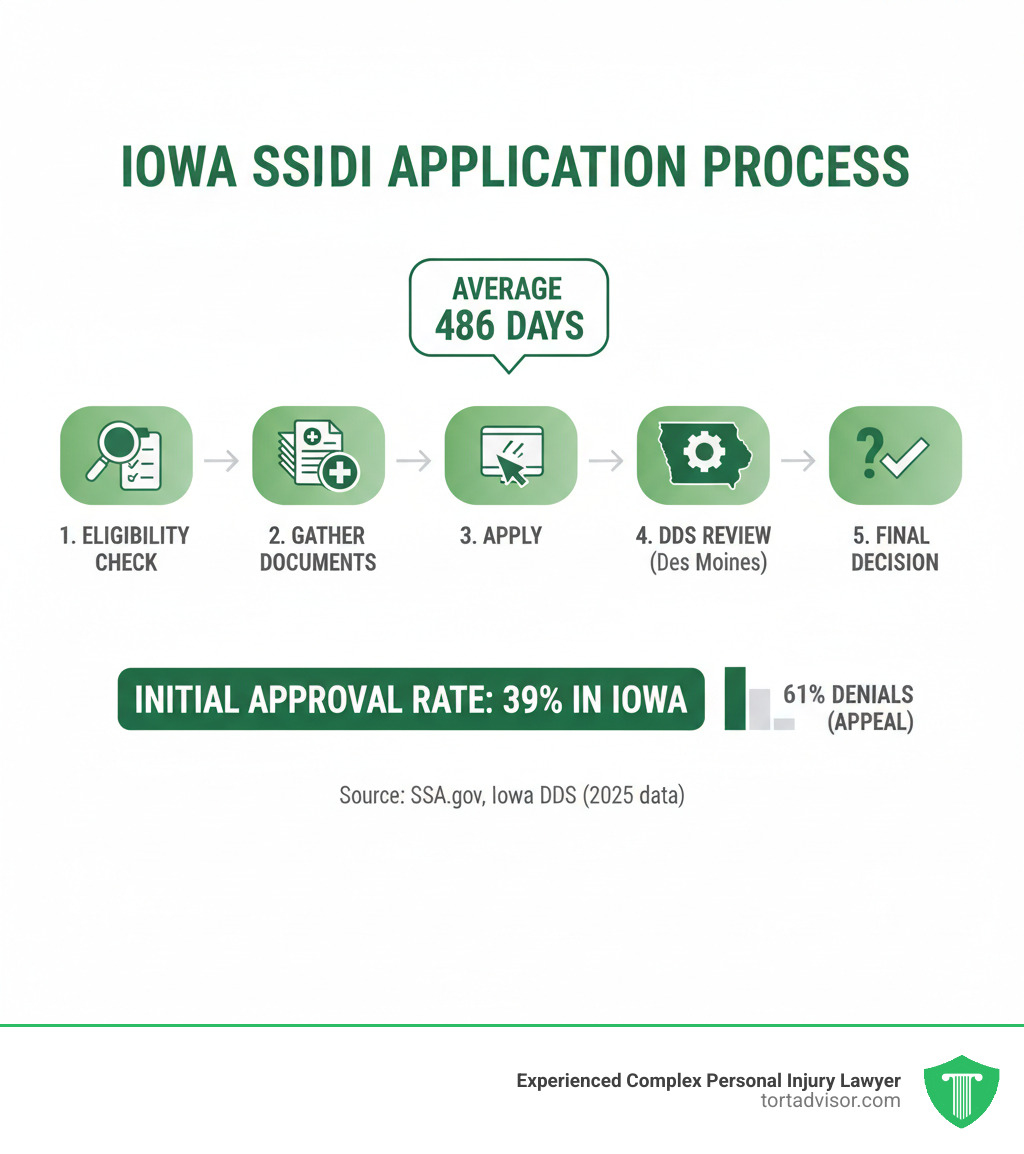
Filing for Social Security disability in Iowa takes several steps, but Iowans have access to both federal SSDI benefits and local help. The basic steps:
- Confirm eligibility: enough work credits and a qualifying medical condition.
- Collect documents: medical records, work history and personal details.
- Apply: online at ssa.gov, by calling 1-800-772-1213 or at a local Social Security office.
- DDS review: Iowa Disability Determination Services evaluates the medical evidence.
- Await a decision: initial decisions in Iowa often take many months.
- Appeal a denial: most first applications are denied, but appeals frequently succeed.
SSDI is an essential lifeline for Iowans who cannot work because of serious health conditions. You apply through the federal SSA, and the medical decision is made by Iowa’s DDS, which handles tens of thousands of claims each year. I’m Mason Arnao, and my background in data systems has given me insight into how agencies evaluate disability claims and what documentation makes a difference.
Iowa SSDI terms to know:
- For help with your claim, see our disability claim assistance page at legallawsuit.com/disability-claim-assistance/.
Who Qualifies for SSDI in Iowa
Before applying for Social Security disability in Iowa, make sure you meet the requirements. SSDI is insurance you paid for through Social Security taxes, and eligibility rests on your work record and your medical condition, both of which must satisfy SSA rules.
| Feature | Social Security Disability Insurance (SSDI) | Supplemental Security Income (SSI) |
|---|---|---|
| Funding | Funded by Social Security payroll taxes | Funded by general federal revenue |
| Eligibility | Based on work credits plus a qualifying disability | Based on limited income and resources plus disability, blindness or age 65+ |
| Work History | Required | Not required |
| Medical | Must meet the SSA disability standard | Must meet the SSA disability standard, or be 65+ or blind |
| Benefit Amount | Depends on your lifetime covered earnings | Federal benefit rate, with some states adding a supplement |
| Medicare | Medicare after 24 months of SSDI entitlement | Usually eligible for Medicaid |
| Typical Payment | $1,035.62 | $491.03 |
Work and Medical Requirements
The SSA uses work credits. In 2026, one credit is earned for each $1,890 in covered earnings, up to four a year. Most adults need 40 credits, with fewer required for younger workers, and must pass a recent work test (generally 20 credits in the 10 years before disability) and a duration of work test. You also cannot be performing substantial gainful activity (SGA), which in 2026 means earning more than $1,690 a month ($2,830 if blind). The condition must be a medically determinable impairment expected to last at least 12 months or result in death, so a fracture that heals in six months will not qualify, while serious chronic conditions often do. The SSA’s disability pages at ssa.gov explain how to apply.
Qualifying Conditions and How Age Matters
The SSA’s Listing of Impairments (the Blue Book) describes qualifying conditions across 14 body systems, including musculoskeletal, mental, cardiovascular and neurological disorders. Meeting a listing can speed approval, and a condition that is medically equal in severity can also qualify. Age matters: the SSA’s medical-vocational “grid rules” recognize that adapting to new work is harder as you get older, so the rules are more favorable at age 50 and up, while younger claimants generally must show they cannot do even sedentary work. Education and past work also count. Your residual functional capacity (RFC), an assessment of what you can still do, such as how long you can stand or how much you can lift, helps decide whether any jobs remain available to you. Understanding these rules is the first step in a successful Iowa claim.
How to Apply for Social Security Disability in Iowa
Once you know you qualify, careful preparation makes applying easier. Here is the process for Social Security disability in Iowa.

Several application methods are available, and gathering your documents first saves frustration. You can start online through the SSA’s disability application page.
Step 1: Collect Your Information
Pull together what the SSA needs. Personal information includes your Social Security Number, birth certificate and proof of citizenship or lawful status, plus information on a spouse and minor children if relevant, and bank details for direct deposit. Medical evidence matters most: list every doctor, hospital and clinic with addresses, phone numbers, visit dates and tests, and gather records, results and a full medication list. The SSA-827 medical release lets the SSA request records directly. For work history, describe your recent jobs, duties and why your condition prevents that work, and collect recent W-2s or tax returns and details of other disability benefits.
Step 2: Apply Online, by Phone or in Person
Next, choose how to apply. Online filing is convenient: you can work at your own pace, save progress and apply anytime with step-by-step guidance. By phone, call the SSA at 1-800-772-1213 (TTY 1-800-325-0778) for help from a representative. In person, use the SSA office locator to find the nearest office and make an appointment to avoid long waits. Whichever method you choose, accuracy and completeness are essential, so double-check everything.
After You Apply: How Iowa Reviews Your Claim
Once your Iowa application is submitted, the SSA sends it to a state agency for the medical decision. Knowing how that works can ease the wait.
Iowa Disability Determination Services
Although you apply through the SSA, Iowa’s Disability Determination Services in Des Moines makes the medical determination. A disability examiner requests records from the providers you listed, covering your condition, treatment and functional limits, so it helps if your doctors know about your claim and respond quickly. If the evidence is not enough, DDS may schedule a consultative examination paid for by Social Security. A medical or psychological consultant works with the examiner to review the file. Iowa Workforce Development’s website has more about how Iowa DDS operates.
Checking Your Iowa SSDI Claim Status
The wait can be long, but you can follow your claim online. A free my Social Security account shows whether your case is in initial review, with DDS or decided, and lets you manage your information. You can also check status directly on the SSA website. Iowa initial decisions often take the better part of a year. Approved claims typically include back pay to your entitlement date (within program limits), so a long wait does not necessarily mean lost benefits. Report any new treatment or changes in your condition to DDS, since new information can matter.
Appealing an SSDI Denial in Iowa
A denial letter is discouraging, but it is not the end. Most first applications in Iowa, as nationally, are denied, and many people win benefits on appeal. The system has several review levels precisely because first decisions are not always right.

The Four Appeal Levels
You have 60 days after receiving a denial to appeal, and the deadline is firm. Level 1: Reconsideration. A different examiner and consultant at Iowa DDS review the file and any new evidence; approval rates at this stage are low. Level 2: ALJ hearing. You present your case to an administrative law judge and testify about how your condition affects you. Approval rates are substantially higher at hearings, though the wait can exceed a year. Level 3: Appeals Council. If the judge denies the claim, the Council can review for legal or procedural errors and may affirm, reverse or send the case back. Level 4: Federal court. The last step is a lawsuit in U.S. District Court, which requires an experienced attorney. The SSA’s appeals page explains each level.
How a Disability Lawyer Improves Your Odds
The SSDI system is complicated, and handling it alone while managing a health condition is hard. A disability lawyer can make a real difference.
- Knowledge of the rules: lawyers know SSA regulations and how they apply to your facts.
- Targeted evidence: they know which medical evidence persuades and can work with your doctors on reports addressing SSA criteria.
- Hearing preparation: they prepare you, present your case and cross-examine vocational and medical experts.
- Better outcomes: represented claimants tend to fare better, especially at hearings.
Legal Lawsuit can connect you with independent attorneys who handle SSDI claims; learn more at legallawsuit.com/tort/ssdi-lawsuits/. Most disability attorneys work on contingency, are paid only if you win and have fees capped by the SSA, so you can get help without upfront cost.
Iowa SSDI FAQs
Common questions about filing for Social Security disability in Iowa.
How much SSDI can I receive in Iowa?
SSDI is not a set amount; it is based on your average lifetime covered earnings, so higher earnings mean a higher benefit. Nationally, the average SSDI check is about $1,630 a month in 2026, and your amount depends on your own record. A family maximum may limit total benefits paid on your record. For an estimate, try our SSDI benefit calculator at legallawsuit.com/calculator/ssdi-settlement-calculator/.
How long does the SSDI process take in Iowa?
Expect it to take time. A realistic Iowa timeline:
- Initial decision: often many months.
- Reconsideration: typically several more months if denied.
- ALJ hearing: the longest wait, often a year or more for a hearing date.
From application through a hearing decision, the process can take two years or longer. The SSA’s Compassionate Allowances program can speed claims for certain severe conditions, sometimes to a few weeks.
Can I work while applying for or receiving SSDI?
Yes, within limits. While applying: earning above the SGA limit, $1,690 a month in 2026 for non-blind individuals, will likely lead to denial. After approval: SSA work incentives let you test working without losing benefits right away.
- The Trial Work Period lets you work for nine months (not necessarily in a row) and keep full benefits regardless of earnings.
- After that, a 36-month Extended Period of Eligibility pays benefits for any month earnings fall below SGA.
- The Ticket to Work program offers free employment support.
Report all work and earnings to the SSA promptly, or you may face overpayments you must repay. Because the rules are complex, check with the SSA or a disability attorney before returning to work.
Getting the Right Support for Your Iowa Claim
Securing Social Security disability in Iowa can take two years or more, but the benefits are a crucial source of stability. Initial denials are common, and many claims are won on appeal, especially at the hearing stage. Start with a complete, well-documented application, and if you are denied, do not miss the 60-day appeal deadline. Appeals often go better with experienced help: an attorney knows how to present medical evidence, prepare you for a hearing and navigate SSA rules. Legal Lawsuit can connect you with independent SSDI attorneys (see legallawsuit.com/tort/ssdi-lawsuits/), who typically work on contingency so there is nothing to pay upfront. You earned these benefits through years of work, and with the right support you can secure them.
Related Posts
Quick Answer: The Boy Scouts of America (BSA) filed for Chapter 11 bankruptcy in 2020 after facing tens of thousands [...]
Quick Answer: Survivors of sexual abuse by Catholic priests, nuns, or other Church personnel may be able to file a [...]
Quick Answer: Clergy abuse settlements vary enormously based on the severity of the abuse, the strength of evidence that the [...]

