
Short answer: This article explains the key facts, eligibility issues, settlement factors, deadlines, and source-backed updates related to this legal topic. Results vary by case facts, evidence, jurisdiction, and representation.
What This Guide Covers
- Why Understanding Disability Benefits Matters When You Need Them Most
- Understanding the Two Main Types of Disability Benefits
- Your Disability Benefits Guide to Eligibility Requirements
- The Step-by-Step Process for Applying for Benefits
- Managing Your Benefits: Payments, Work, and Denials
- Frequently Asked Questions about Disability Benefits
- Conclusion
Why Knowing How Disability Benefits Work Matters Most When You Need Them
This disability benefits guide matters because disability can happen to anyone — the SSA estimates a 20-year-old has roughly a 1-in-4 chance of becoming disabled before reaching retirement age. When a health condition keeps you from working, support from the Social Security Administration (SSA) can be a lifeline. There are two main SSA programs:
- Social Security Disability Insurance (SSDI): For people who worked and paid Social Security taxes.
- Supplemental Security Income (SSI): For people with limited income, whether or not they have worked.
Key Facts:
- The condition must block substantial work for 12 months or longer, or be expected to result in death.
- SSDI depends on having earned enough work credits.
- SSI applies tight limits on income and assets.
- Initial decisions typically take 6–8 months.
- Denials can be appealed (roughly 70% of first-time claims are turned down).
- Spouses and children may qualify for benefits too.
The application calls for detailed medical proof and a lot of patience with a complicated system. This guide breaks it all down — eligibility, applying, appeals, and managing benefits once approved. I’m Mason Arnao, and my focus is turning complicated systems into clear steps. Consider this your starting point for getting the support you are entitled to.
Key links from this disability benefits guide:
- Denied disability claim
- Disability claim assistance
- how to claim social security disability insurance arkansas
SSDI and SSI: The Two Main Disability Programs
The SSA runs two federal disability programs: Social Security Disability Insurance (SSDI) and Supplemental Security Income (SSI). Both pay monthly benefits, but they work very differently. SSDI is earned — it functions like insurance paid for by the Social Security taxes taken out of your paychecks, so eligibility depends on your work record. SSI is based on need, offering a safety net for disabled people with very little income or savings, regardless of whether they have worked.

Knowing which program fits you matters, because the rules, payment amounts, and health coverage are quite different. Some people qualify for both. The SSA’s website lets you compare SSDI and SSI in more detail.
SSDI and SSI Compared Side by Side
The main distinctions are summarized below:
| Criteria | Social Security Disability Insurance (SSDI) | Supplemental Security Income (SSI) |
|---|---|---|
| Funding Source | Paid for by Social Security taxes from you and your employers. | Paid for by general U.S. Treasury tax revenue. |
| Technical Eligibility | You need enough past work (“work credits”). | You must show financial need (limited income and assets). |
| Medical Eligibility | You must meet the SSA’s strict disability definition. | Uses the identical medical standard as SSDI. |
| Health Coverage | Leads to Medicare after a 24-month wait. | Generally leads to Medicaid right away. |
| Benefit Amount | Calculated from your average lifetime earnings. | A set federal amount, lowered by other income. |
Put simply, SSDI depends on what you paid in through work, and SSI depends on financial need. Both apply the same medical test for disability. They differ in their non-medical rules, how payments are figured, and whether you end up with Medicare or Medicaid.
Eligibility Requirements Explained in This Disability Benefits Guide
The SSA defines disability narrowly, focusing on whether you can work; a diagnosis by itself will not qualify you. Your condition must be severe enough to stop you from performing “substantial gainful activity” (SGA), which in 2025 generally meant earning over $1,620 a month. It also must be expected to last at least 12 months in a row or end in death. The SSA evaluates impairments using its listing of qualifying conditions, called the “Blue Book.” Matching a listing can speed approval, but you still need strong medical proof — records, test results, and doctors’ statements describing your functional limits.

Who Qualifies for SSDI
SSDI requires meeting the medical standard and being “insured” through past work, which is measured in work credits earned by paying Social Security taxes.
- The 20/40 Rule: Most people need 40 credits, including 20 earned during the 10 years just before becoming disabled.
- Younger Workers: Younger applicants need fewer credits; someone disabled at 24, for example, may need only 6.
The work must also be fairly recent. The SSA’s benefits questionnaire can help you check your credits.
Who Qualifies for SSI
SSI looks at financial need instead of work history, and its limits are tight:
- Assets: Countable resources cannot exceed $2,000 for one person or $3,000 for a couple. A home, one car, and personal belongings usually do not count.
- Income: Other income, such as wages or other benefits, lowers the maximum federal SSI payment.
- Residency: You must live in the U.S. and be a citizen or qualified non-citizen.
Since some income and assets are excluded, it is worth applying for SSI if you think you might qualify.
Special Rules for People Who Are Blind or Have Low Vision
Applicants who are legally blind (20/200 vision or worse in the better eye, or a visual field of 20 degrees or less) get more favorable rules. The biggest is a higher SGA limit: in 2025, blind individuals could earn as much as $2,700 a month and still qualify. SSDI work credit rules are also more flexible. The SSA explains these rules in its publication for people who are blind or have low vision.
How to Apply for Disability Benefits, Step by Step
You can choose the application method that suits you. Applying through the SSA’s online application is usually quickest, but you can also call the SSA at 1-800-772-1213 (TTY 1-800-325-0778) or book an appointment at a local Social Security office. Most important, don’t hold off on applying just to collect every document first. Your application date can affect when benefits start, so begin as soon as your condition stops you from working; the SSA can help track down missing records later.

What You Will Need to Apply
The SSA needs detailed information about your health and your work to process the claim. Have the following ready:
- Personal Details: Your birth certificate and Social Security number.
- Medical Information: Names and contact details for every doctor, hospital, and clinic that has treated you, a list of medications, and dates of lab work or imaging.
- Employment History: A description of the jobs you held over the past 15 years and what each involved.
- Financial Records: A recent W-2 or tax return and your bank details for direct deposit.
The Disability Claim Timeline: What Happens After You Apply
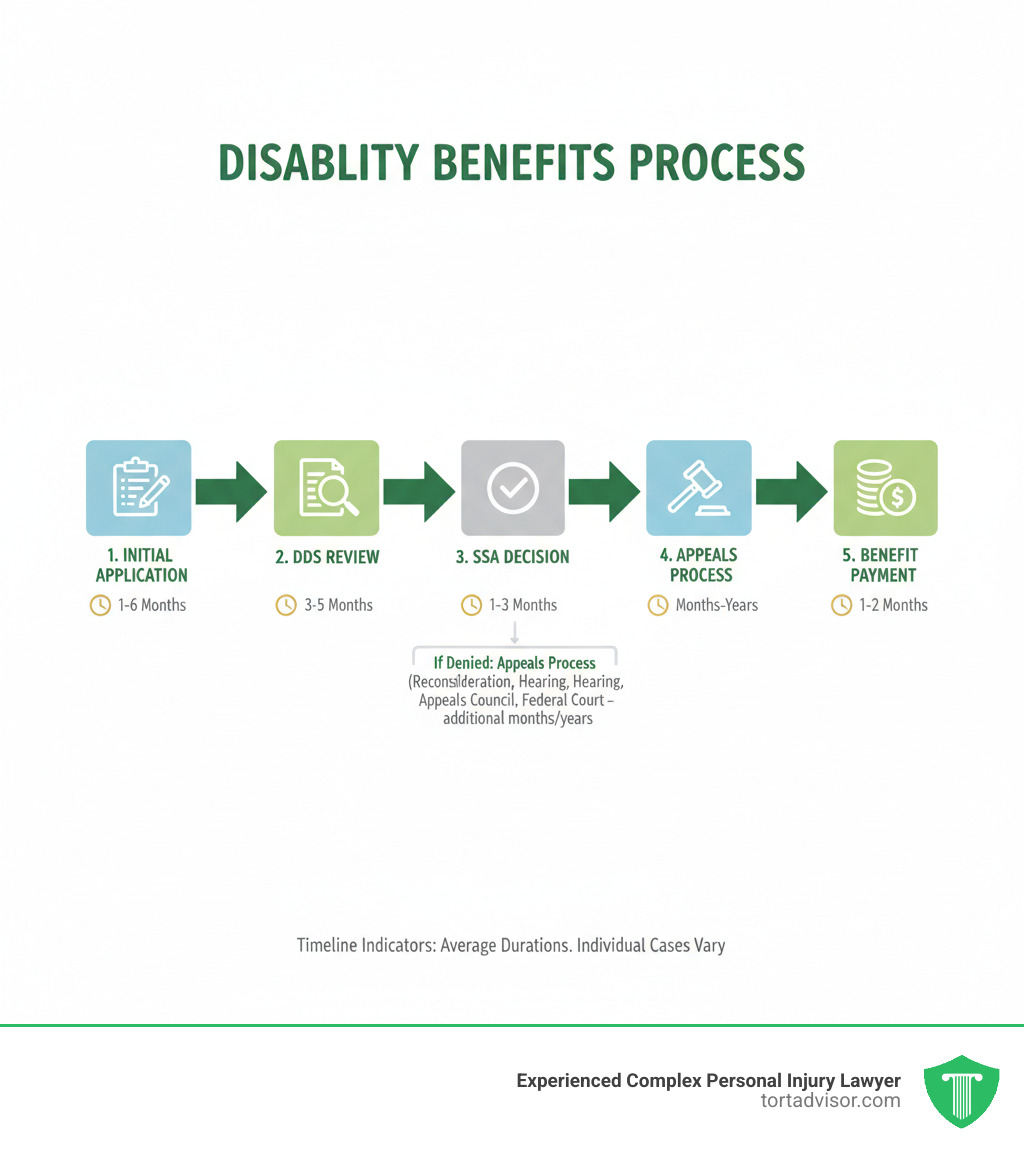
Once you apply, your claim is reviewed in stages. The SSA first confirms you meet the non-medical requirements. Your file then goes to your state’s Disability Determination Services (DDS), where specialists handle the medical review using a five-step evaluation to decide whether you meet the SSA’s disability definition. DDS collects your medical records and may schedule a consultative exam. A first decision usually takes 6 to 8 months. Approved SSDI claims have a 5-month waiting period before payments start; SSI does not. Because the process is long and complicated, many people turn to Disability Claim Assistance for help.
After Approval or Denial: Payments, Working, and Appeals
Being approved brings financial relief along with ongoing obligations. Knowing how payments are made, what to do after a denial, and how working affects benefits will help you manage them well.
How Disability Payments Are Calculated
How much you receive depends on the program.
- SSDI: Payments are based on your average lifetime earnings. The average monthly payment was about $1,352 in late 2023, though your own amount depends on your earnings record.
- SSI: Payments start from a set federal rate ($914 for an individual in 2023), may be supplemented by your state, and are reduced by other income.
For a personal estimate, use the SSA’s online benefit calculator or our SSDI Benefit Calculator. Benefits are paid monthly by direct deposit on a schedule tied to your birth date, and the SSA publishes the payment calendar.
If Your Disability Claim Is Denied
Close to 70% of first-time claims are denied, but that is not the final word — you can appeal. There are four levels of appeal, each another chance to prove your claim:
- Reconsideration: A different examiner takes a fresh look at your file.
- ALJ Hearing: You make your case in person before an Administrative Law Judge, a stage where many claims are approved.
- Appeals Council: The council reviews the judge’s decision.
- Federal Court: As a last step, you can sue in federal court.
Appeals take time, but sticking with it pays off. If you are dealing with a Denied Disability Claim, getting professional help is strongly recommended. The SSA also explains how to file an appeal.
Working While on Benefits and Reporting Changes
SSA work incentives let you try returning to work without losing benefits right away. Under the Trial Work Period (TWP), SSDI recipients can work for up to nine months while keeping full benefits, and the Ticket to Work program provides free job support. The Red Book – A Guide to Work Incentives has the details. You must tell the SSA about changes such as starting or stopping work, pay changes, or medical improvement, and you can handle much of this online through a “my Social Security” account.
Benefits for Family Members and Health Insurance
When you receive SSDI, certain relatives may qualify for benefits as well, including a spouse who is 62 or older or caring for your young child, and unmarried children under 18. The SSA’s website covers family benefits, including rules for surviving and divorced spouses. Health coverage is another important piece:
- SSDI recipients qualify for Medicare after 24 months (the wait is waived for ALS and ESRD).
- SSI recipients usually qualify for Medicaid right away.
Disability Benefits Questions, Answered
Below are clear answers to questions people often ask about disability benefits.
Is it possible to collect SSDI and SSI together?
Yes — these are called “concurrent benefits.” This usually happens when your work history qualifies you for SSDI but the monthly amount is very small, so SSI tops it up to the federal limit. One big plus is that SSI may give you Medicaid right away while you wait for Medicare to start. The SSA explains when you can receive SSI and SSDI at the same time.
How do disability benefits differ from workers’ compensation?
They are designed for different situations.
- Social Security Disability (SSDI/SSI): A federal program for serious, long-lasting disabilities from any cause that keep you from working.
- Workers’ Compensation: State-run insurance for injuries or illnesses that happened on the job.
It is sometimes possible to receive both, though SSDI may be reduced if the combined amount is more than 80% of what you earned before becoming disabled.
Can members of my family get benefits?
Yes. If you receive SSDI, some family members may qualify based on your work record, including spouses, former spouses, and children who meet certain requirements. These auxiliary benefits add support for your household without lowering your own payment. The SSA has detailed information on family benefits and eligibility for surviving and divorced spouses.
Conclusion
Working through the disability benefits system can be complicated and frustrating. SSDI and SSI have strict requirements, the paperwork is heavy, and the waits can be long — all while you are coping with a serious health problem. This disability benefits guide gives you a clear map, but information is only the beginning. With close to 70% of first applications denied, many people feel overwhelmed. An experienced disability attorney can meaningfully improve your chances by knowing what evidence the SSA wants, how to build a strong file, and how to handle appeals. The right advocate can be the difference between a denial and an approval. Legal Lawsuit is a legal-information site that helps people understand their options and connect with experienced disability attorneys in our network through a free, confidential case review. You don’t have to do this alone — when you are ready, we can help you find skilled legal support to pursue the benefits you deserve.
Related Posts
Quick Answer: The Boy Scouts of America (BSA) filed for Chapter 11 bankruptcy in 2020 after facing tens of thousands [...]
Quick Answer: Survivors of sexual abuse by Catholic priests, nuns, or other Church personnel may be able to file a [...]
Quick Answer: Clergy abuse settlements vary enormously based on the severity of the abuse, the strength of evidence that the [...]