
Short answer: This article explains the key facts, eligibility issues, settlement factors, deadlines, and source-backed updates related to this legal topic. Results vary by case facts, evidence, jurisdiction, and representation.
📋 Table of Contents
How Medicare With SSDI Works, and Why It Matters
SSDI and Medicare are connected federal programs that support people living with disabilities. The essentials:
- SSDI (Social Security Disability Insurance): pays monthly cash benefits to people with enough work history who can’t work because of a severe disability.
- Medicare: the federal health program SSDI recipients qualify for automatically after 24 months.
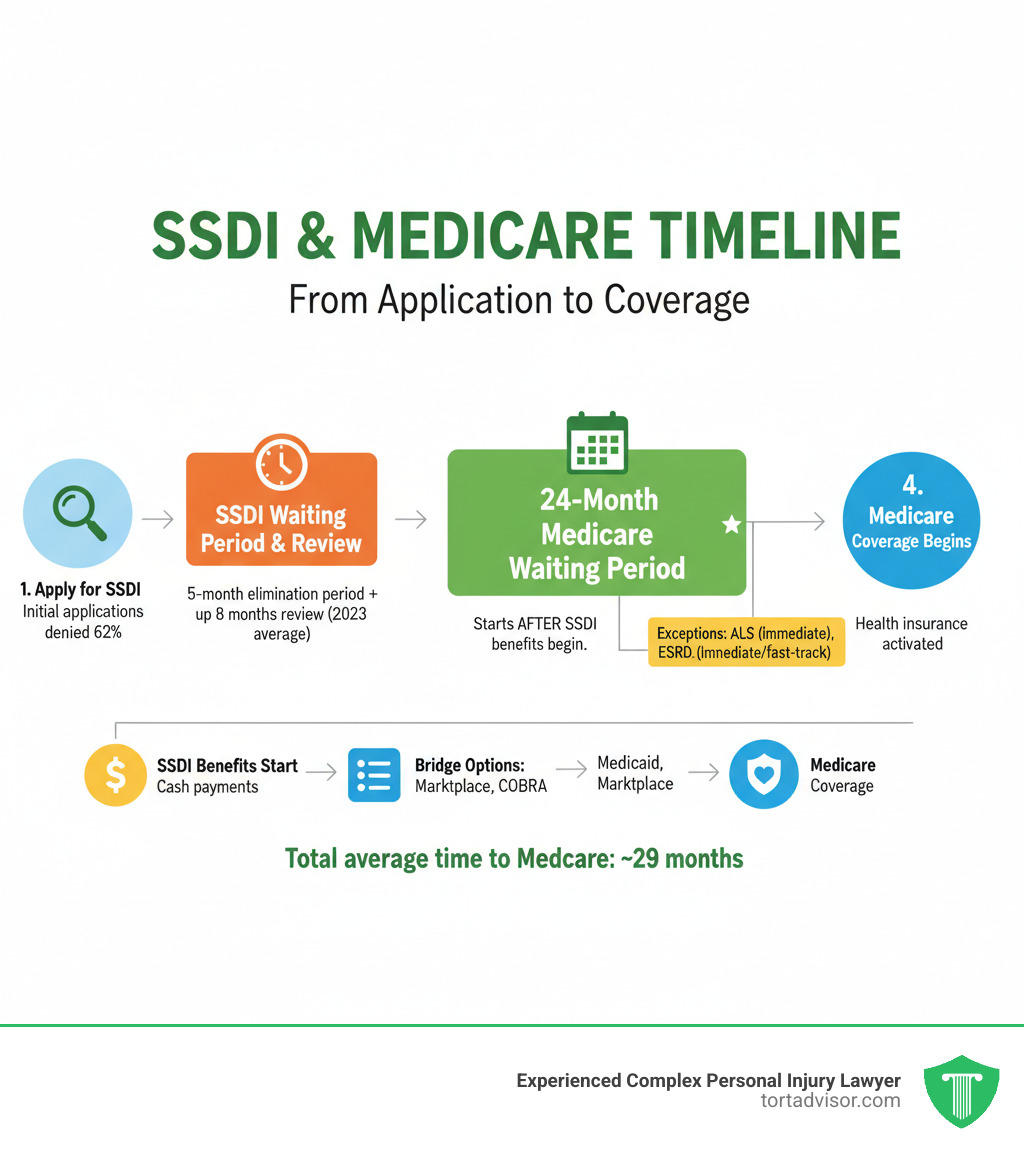
- The 24-month clock: runs from your SSDI entitlement date, not the date you applied or became disabled.
- Exceptions: people with ALS (Lou Gehrig’s disease) or End-Stage Renal Disease (ESRD) get Medicare right away.
- Covering the gap: Medicaid, Marketplace plans, or COBRA can keep you insured while you wait.
Knowing how these programs connect matters. Disability benefits lead to health coverage, but the timing trips many people up. Typically, 29 months pass between the onset of disability and the start of Medicare: a 5-month SSDI waiting period followed by the 24-month Medicare wait. The hardest part is SSDI approval itself. 62% of initial applications are denied, and average processing has stretched to almost 8 months. Many applicants spend years in appeals before benefits and the coverage tied to them arrive. Accurate information matters when your health and finances are at stake.
Key Medicare with SSDI topics:
How SSDI Leads to Medicare Coverage
When a disability keeps you from working, Social Security Disability Insurance (SSDI) is frequently the first step toward both income and health coverage. SSDI and Medicare are designed to work together, and understanding how is essential.
What Is SSDI?
SSDI is a federal insurance program administered by the Social Security Administration (SSA). It pays a monthly benefit to people who can no longer work because of a serious medical condition. You earn it through the Social Security (FICA) taxes taken from your paychecks over the years. Most people need roughly ten years of work to build enough work credits. The SSA also applies a strict disability standard: your condition must stop you from engaging in “substantial gainful activity” (earning above a set monthly amount) and must be expected to last at least 12 months or end in death.
How SSDI Eligibility Opens the Door to Medicare
Being approved for SSDI sets up automatic Medicare eligibility, even before age 65. Once you have received SSDI for 24 months, Medicare kicks in on its own, so approval brings comprehensive health coverage along with monthly income. In 2021, 8.1 million people younger than 65 had Medicare because they qualified through SSDI. That connection is an important safety net. Read more about The Connection Between Social Security Disability Benefits and Health Coverage to see how these programs protect you.
Why SSDI Approval Is So Hard
Winning SSDI approval is tough. The paperwork is complicated, waits are long, and most first-time applicants are turned down: 62% of initial claims are denied. Building a case takes thorough medical evidence and frequently more than one try. First decisions now take close to 8 months on average, and appeals can drag on for years. That is why experienced legal help matters. If you have a Denied Disability Claim, keep going. An attorney can guide you through the Disability Appeal Process and assemble the evidence the SSA needs. Representation can meaningfully improve your odds and shorten the wait, which matters when both income and health coverage depend on the outcome.
The 24-Month Medicare Wait and How to Stay Insured
Most people approved for SSDI must wait 24 months before Medicare with SSDI begins. Here is how that waiting period works and how to keep coverage in the meantime.

How the 24-Month Waiting Period Works
The 24 months are counted from your SSDI “entitlement date,” which usually falls five months after the date the SSA says your disability began. Together that makes a 29-month gap between disability onset and Medicare (a 5-month SSDI wait plus the 24-month Medicare wait). After two years of SSDI payments, you are enrolled in Medicare Parts A and B automatically, and your Medicare card arrives by mail roughly three months before coverage begins.
When the Waiting Period Doesn’t Apply
Two serious conditions speed up Medicare eligibility:
- Amyotrophic Lateral Sclerosis (ALS): With ALS (Lou Gehrig’s disease), Medicare starts in the same month as your SSDI benefits, with no wait at all.
- End-Stage Renal Disease (ESRD): For permanent kidney failure that requires dialysis or a transplant, Medicare may begin as soon as the fourth month of dialysis.
Coverage Options During the Wait
Keeping health insurance through the waiting period is essential. Your main choices:
- Medicaid: a joint state-federal program for people with limited income and assets. SSI recipients usually qualify automatically, and SSDI-only recipients should still apply through their state Medicaid office or Healthcare.gov.
- Marketplace (ACA) plans: if you earn too much for Medicaid, Healthcare.gov plans may come with premium tax credits, which stop when Medicare begins.
- COBRA: lets you stay on a former employer’s plan for as long as 18 months if you pay the full premium. It costs more, but your care stays consistent.
- Private coverage: buying directly from an insurer is possible, though usually the priciest route without subsidies.
Choosing Medicare Coverage When You’re on SSDI
When Medicare starts, it helps to know what each part covers so you can pick the right plan.

Medicare Parts A, B, C, and D
- Part A (Hospital Insurance): pays for inpatient hospital care, skilled nursing facility stays, and hospice. Most people on SSDI owe no Part A premium.
- Part B (Medical Insurance): pays for doctor appointments, outpatient services, and preventive care. It carries a monthly premium that is normally taken out of your Social Security check.
- Part C (Medicare Advantage): private plans that combine Parts A and B, and often Part D, many with added dental, vision, and hearing benefits.
- Part D (Prescription Drug Coverage): optional drug coverage, available as a separate plan or built into a Medicare Advantage plan.
Original Medicare or Medicare Advantage?
There are two main routes for Medicare with SSDI. Original Medicare (Parts A & B) is run by the government and lets you see any doctor or hospital in the country that takes Medicare, with no referrals. The downside is out-of-pocket costs like deductibles and coinsurance, no yearly spending limit, and the need for a separate Part D drug plan. Medicare Advantage plans come from private insurers and generally include drug coverage plus extras, but they usually limit you to a network and may require referrals for specialists. Which is better depends on your medical needs, your budget, and how much flexibility you want.
Covering the Gaps: Medigap, SNPs, and Programs That Lower Costs
A few programs can ease Medicare expenses:
- Medigap (Medicare Supplement) plans: private policies that pair with Original Medicare to pick up deductibles, coinsurance, and similar costs. Whether people under 65 on SSDI can buy them depends on the state.
- Medicare Special Needs Plans (SNPs): Medicare Advantage plans designed for people with particular chronic conditions or who qualify for both Medicare and Medicaid.
- Medicare Savings Programs and Extra Help: state Medicare Savings Programs can cover premiums and deductibles for people with limited income, and the federal Extra Help program lowers Part D drug costs. Check eligibility on Medicare’s page on help with costs.
Work, Other Insurance, and Your Benefits
Circumstances shift. You might want to go back to work or need to line up other coverage alongside SSDI and Medicare. Knowing the rules keeps your income and health care steady.
Going Back to Work While on SSDI
SSA work incentives let you ease back into a job without losing benefits right away.
- Trial Work Period (TWP): you can try working for at least nine months and still get your full SSDI benefit, however much you earn.
- Continued Medicare: even if your income ends your SSDI cash payments, Medicare can continue for at least 8.5 years after you return to work.
- Ticket to Work Program: a free, voluntary program that provides job training and vocational rehabilitation to help you get and keep work.
Be sure to report all earnings to the SSA. The SSA’s guide to working with a disability has more detail.
How Other Coverage Interacts With SSDI and Medicare
When you carry more than one health plan, “coordination of benefits” rules decide which pays first.
- Job-based insurance: with a large employer (100 or more workers), the employer plan pays first and Medicare pays second. With a smaller employer (under 100), Medicare usually pays first.
- COBRA: Medicare normally pays first when you have both. For people with End-Stage Renal Disease, COBRA pays first during the first 30 months.
- VA benefits: Medicare and VA can’t both pay for the same service; you decide which to use each time you get care.
SSDI vs. SSI: How Health Coverage Differs
SSDI and SSI are separate programs, and each comes with its own health coverage rules.
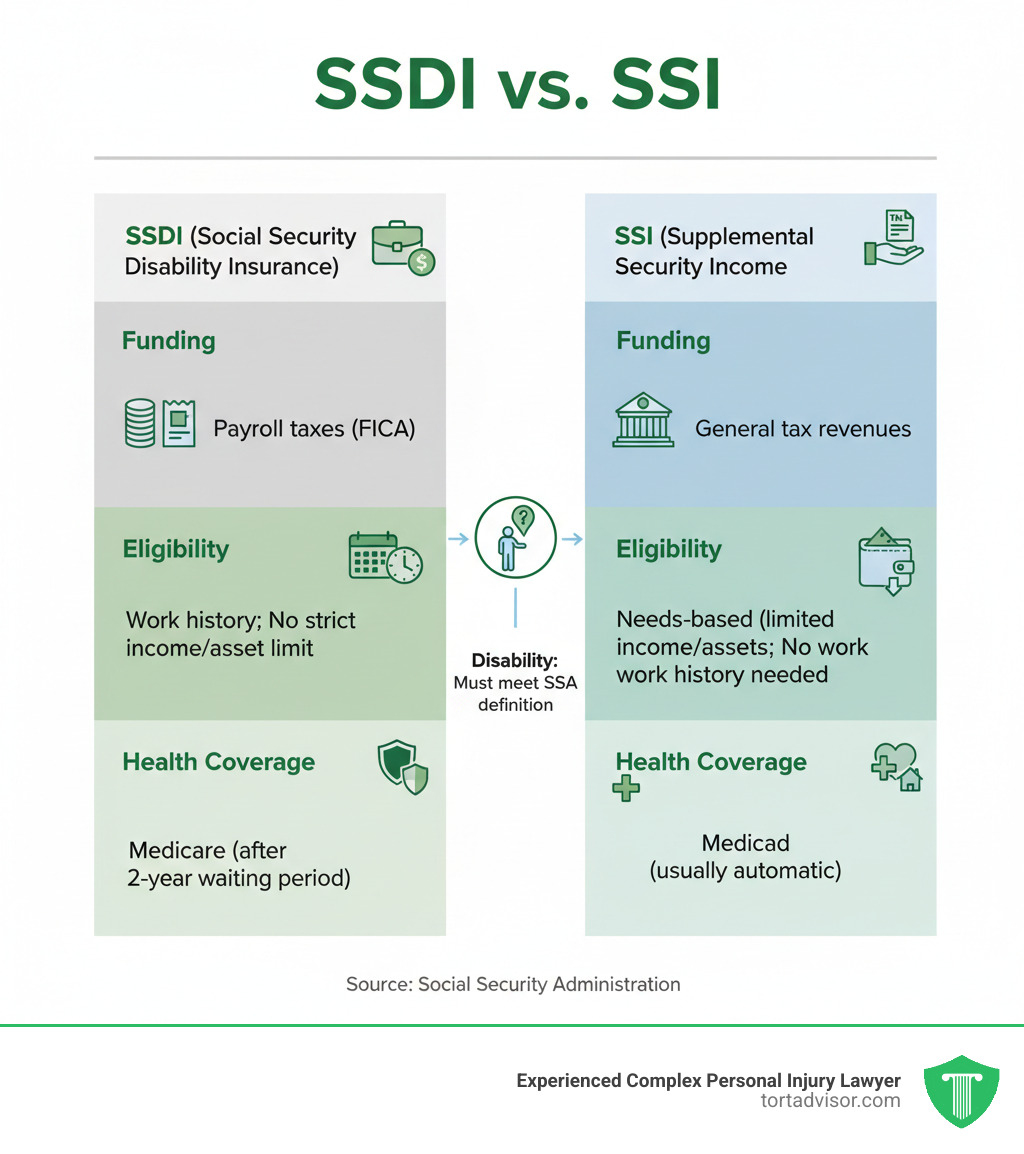
| Feature | SSDI (Social Security Disability Insurance) | SSI (Supplemental Security Income) |
|---|---|---|
| Funding | Payroll (FICA) taxes | General tax revenue |
| Eligibility | Depends on work history and Social Security taxes paid; no income or asset test | Based on financial need (limited income and assets); work history not required |
| Disability | Must satisfy the SSA’s strict disability definition | Must satisfy the SSA’s strict disability definition, or be blind, or be 65 or older |
| Health Coverage | Medicare (after the 24-month wait) | Medicaid (usually available right away) |
| Benefit Amt. | Tied to average lifetime earnings (about $1,500/month on average in 2022) | Federal base rate reduced by other income (about $650/month on average in 2022) |
| Dual Eligibility | You can get both if your SSDI payment is low enough to qualify for SSI | You can get both if your SSDI payment is low enough to qualify for SSI |
Put simply, SSDI is earned through work and leads to Medicare after 24 months, while SSI is based on need and leads to Medicaid, usually right away. People with small SSDI checks may qualify for both (“dual eligibility”) and receive Medicare and Medicaid together. Estimate your benefit with our SSDI Benefit Calculator.
Medicare With SSDI: Frequently Asked Questions
Answers to the questions people ask most about SSDI and Medicare.
Should I keep my Marketplace (ACA) plan once Medicare starts?
You can, but it rarely makes sense. Medicare coverage ends your eligibility for Marketplace premium tax credits, so you would pay full price. Many people do better dropping the Marketplace plan and looking at Medigap supplement options alongside Original Medicare. During the 24-month wait, though, a Marketplace plan can be a vital source of coverage.
Can I turn down Medicare Part B?
Yes, but think carefully. If you decline Part B without other “creditable coverage,” such as insurance through a current employer, you could owe a lifelong late enrollment penalty if you sign up later. That penalty adds 10% to your Part B premium for every year you could have enrolled but didn’t. Unless you have other strong coverage, signing up for Part B when you first qualify is usually the safer move.
If I return to work, how long does Medicare last?
Work incentives let you keep premium-free Part A for at least 8.5 years after going back to work, even if your earnings end your SSDI cash benefit. That period combines the nine-month Trial Work Period with another 7 years and 9 months, so you can test your ability to work without immediately risking your health coverage.
Getting Help Securing Your SSDI and Medicare Benefits
Working through Medicare with SSDI is complicated, from the first application and the 24-month wait to picking coverage. Smart choices about supplemental plans, work incentives, and savings programs protect both your health and your finances. For free one-on-one help with Medicare options, contact your State Health Insurance Assistance Program (SHIP). Still, every one of these decisions hinges on being approved for SSDI. With 62% of first applications denied and long waits, approval is a real hurdle. If you were denied or the process feels like too much, experienced legal help is invaluable. An attorney can present your case clearly, collect the medical evidence, and handle appeals. Attorneys in the Legal Lawsuit network focus on disability law and understand how to build a strong claim, which can help you get approved sooner. Your health and income are too important to leave to chance. To connect with someone who can help with SSDI lawsuits, request a free, confidential case review today.
Related Posts
Quick Answer: The Boy Scouts of America (BSA) filed for Chapter 11 bankruptcy in 2020 after facing tens of thousands [...]
Quick Answer: Survivors of sexual abuse by Catholic priests, nuns, or other Church personnel may be able to file a [...]
Quick Answer: Clergy abuse settlements vary enormously based on the severity of the abuse, the strength of evidence that the [...]