
Short answer: This article explains the key facts, eligibility issues, settlement factors, deadlines, and source-backed updates related to this legal topic. Results vary by case facts, evidence, jurisdiction, and representation.
Gummy Bear Implant Claims: What the Allergan Recall Means for Your Health and Legal Rights
In This Guide
Gummy bear implant claims stem from one of the largest medical device recalls in recent memory. If Allergan BIOCELL textured implants were placed in your body, you may hold legal rights you have not yet heard about.
The key facts at a glance:
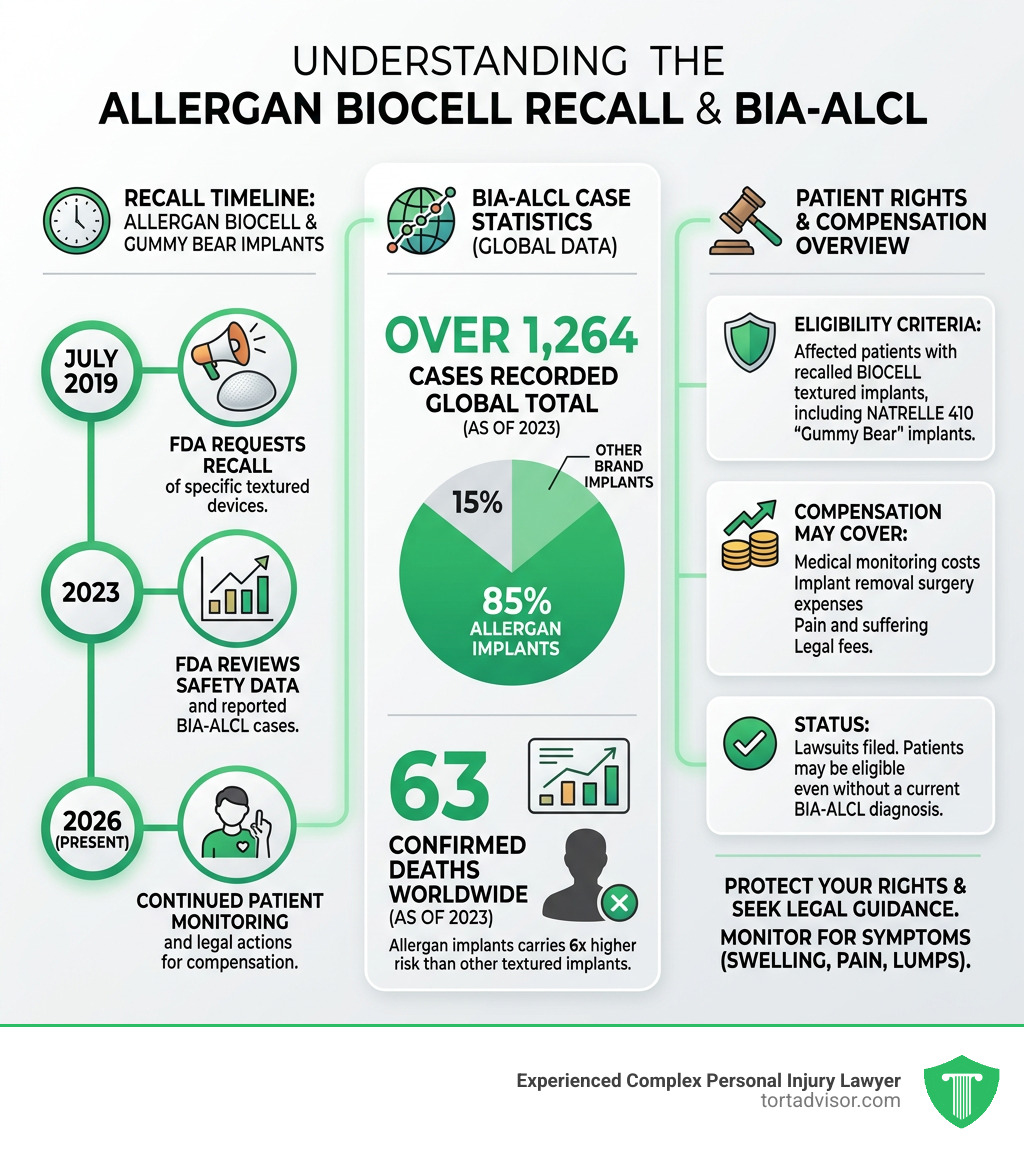
- The recall: At the FDA’s request, Allergan pulled every BIOCELL textured breast implant from the global market in July 2019, Natrelle 410 “gummy bear” implants included.
- The reason: The devices were tied to a rare cancer, Breast Implant-Associated Anaplastic Large Cell Lymphoma (BIA-ALCL), and Allergan’s implants carried roughly six times the risk seen with other textured implants.
- The case count: By 2023, FDA records showed 1,264 BIA-ALCL cases around the world, 85% connected to Allergan implants, along with 63 deaths.
- Is surgery necessary right away? If you have no symptoms, the FDA does not advise removal. You should still watch for warning signs such as swelling, lumps or breast pain.
- Is compensation possible? Yes. Allergan faces lawsuits, and patients may qualify for compensation even without a BIA-ALCL diagnosis.
The fallout is financial and legal as well as medical. Allergan agreed to pay for replacement implants but not for the surgery to remove the old ones unless BIA-ALCL had been confirmed, leaving many women to cover large surgical bills on their own.
One cancer survivor spent eight years trying to get her recalled implants taken out, turned away repeatedly by insurers and surgeons who pointed to FDA guidance against routine removal. Many other women report similar experiences.
I’m Mason Arnao. My work in data systems, research and digital advocacy has shown me how recalls like the one behind gummy bear implant claims affect real people trying to navigate complicated legal and medical systems. This guide explains your rights and the steps you can take.
Why Gummy Bear Implants Were Recalled: The BIA-ALCL Link
The gummy bear implant recall was a sweeping FDA safety action taken in 2019. It was not a technicality; regulators were responding to a direct connection between one manufacturing method and a rare cancer.
Data showed Allergan BIOCELL textured implants appeared far more often than expected among cases of Breast Implant-Associated Anaplastic Large Cell Lymphoma (BIA-ALCL), so the FDA asked Allergan to recall them. BIA-ALCL is an uncommon T-cell lymphoma of the immune system, but it does not strike at random: it is strongly associated with textured implant surfaces.
What Makes an Implant a “Gummy Bear” Implant?
“Gummy bear” is a catchy marketing label. Clinically, these devices are called “form-stable” or “highly cohesive” silicone gel implants. The name comes from the dense, firm gel: slice one open and the silicone holds its shape, much like the candy.
They are built to hold a set shape, frequently a teardrop, and are nearly always textured so they do not rotate in the breast. That pairing of cohesive gel with the rough BIOCELL surface is central to the gummy bear implants recall. Surgeons liked their natural appearance, but the “velcro-like” texture meant to anchor them proved to be a biological trigger in some patients.
How BIOCELL Texturing Is Tied to Cancer
Why were these particular implants singled out worldwide? The explanation points to the “lost salt” method Allergan used to texture BIOCELL shells, which leaves deep, uneven pores in the surface.
Researchers have proposed two main explanations:
- Bacterial Biofilm: Bacteria can lodge in the deep pores and form a “biofilm” that keeps the body in a state of mild, chronic inflammation. Over the years, that ongoing immune reaction may push T-cells to become lymphoma.
- Silicone Particles: Friction between the rough shell and surrounding tissue may shed tiny silicone particles, which can also drive chronic inflammation.
Whichever explanation proves correct, the numbers are striking. If a diagnosis worries you, a breast implant cancer lawyer can explain whether your implant’s manufacturer may be responsible.
| Feature | Smooth Implants | BIOCELL Textured Implants |
|---|---|---|
| BIA-ALCL Risk | Negligible/None identified | About 6x the risk of other brands |
| Surface | Smooth, slippery | Rough, “velcro-like” |
| Common Use | Cosmetic augmentation | Reconstruction/Form-stable |
| Recall Status | Generally safe | Voluntarily recalled (2019) |
Which Implants Were Recalled and Symptoms to Watch For
Surgery between 2006 and 2019 means there is a real possibility your implants are on the recall list. Look at your implant card or medical records and compare your devices with the models below.
Allergan Models Covered by the Gummy Bear Implant Recall
The recall reached well beyond a single implant type, sweeping in much of Allergan’s BIOCELL lineup, including:
- Natrelle 410 Highly Cohesive Anatomically Shaped (the original “Gummy Bear”)
- Natrelle Silicone-Filled Textured Implants (Styles 110, 115, 120, TRL, TRLP and others)
- Natrelle Saline-Filled Textured Implants (Styles 163, 168, 363, 468)
- Natrelle Inspira (textured versions)
- Tissue Expanders: Placed during the first phase of reconstruction, namely the Natrelle 133 Plus and the Natrelle 133 with Suture Tabs.
Across later breast implant recall 2023 developments, these models are still the main focus of legal and medical follow-up.
Warning Signs of BIA-ALCL and Related Complications
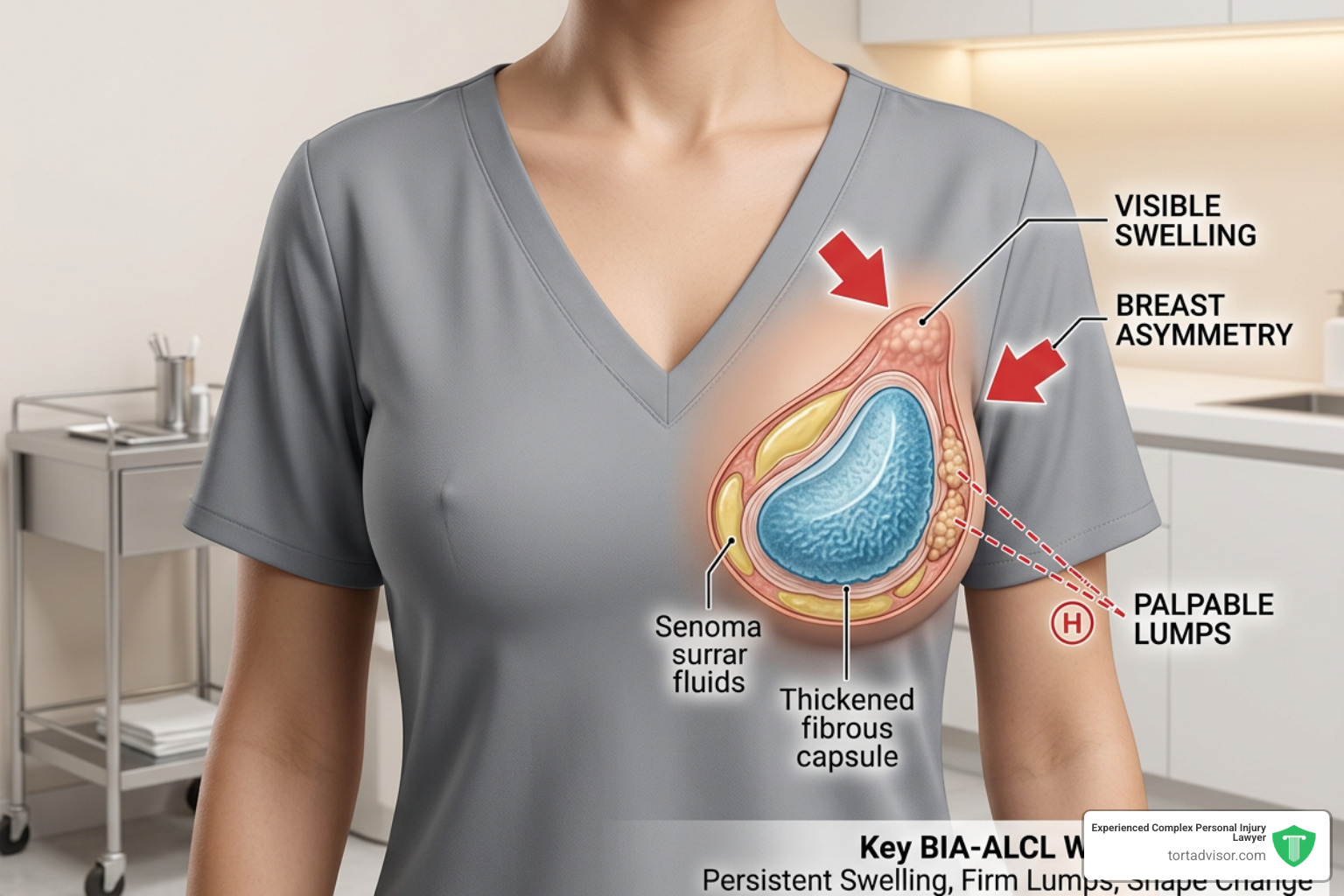
BIA-ALCL is an immune system cancer, not breast cancer, and it develops in the fluid (seroma) or scar capsule around the implant. Signs typically emerge 3 to 14 years after surgery. Patients should look out for:
- Late Seroma: New swelling or fluid buildup in one breast well after the incision has healed.
- Lumps: A firm mass in the breast or underarm.
- Capsular Contracture: The breast becoming noticeably hard or tight.
- Uneven Breasts: One side abruptly becoming larger or changing shape.
- Whole-Body Symptoms: Fatigue, rashes or weight loss without a clear cause.
See a doctor promptly if any of these appear. You can also review Legal Lawsuit’s breast implant lawsuit articles to learn how other women with similar symptoms have pursued claims.
Gummy Bear Implant Claims: Your Rights and Compensation
A manufacturer that sells a device with six times the cancer risk of rival products may face liability under product liability law. For patients affected by the recall, a claim is about far more than a refund; it seeks accountability for medical costs, ongoing monitoring and emotional harm.
How to File a Gummy Bear Implant Lawsuit
Many patients are stuck in a bind: a recalled device that may raise cancer risk is still in their body, yet insurers refuse to cover removal because they are not “sick yet.” Allergan’s original offer paid only for replacement implants, leaving surgeon, anesthesia and operating room charges to the patient, costs that can be substantial.
An Allergan claim, handled by an attorney, may seek to recover:
- Surgery Costs: The full expense of explant (removal) surgery and capsulectomy.
- Medical Monitoring: Ongoing MRIs and doctor visits to screen for cancer.
- Pain and Suffering: Damages for the stress of living with what feels like a “ticking time bomb.”
- Lost Income: Pay missed while undergoing surgery and recovering.
To get a sense of what your claim may be worth, try the breast implant settlement calculator or read the breast implant class action lawsuit guide.
Claims for Silicone Migration and Toxicity
Cancer is not the only concern. “Gummy bear” implants are also being examined for “gel bleed,” or silicone migration. In one study of 389 women, close to 99% had silicone particles in their tissue, and more than 86% showed migration beyond the breast capsule.
Leaking silicone can set off a body-wide inflammatory reaction that many patients call “Breast Implant Illness” (BII), with symptoms such as joint pain, brain fog and lymph node involvement. If that sounds familiar, a breast implant lawsuit silicone toxicity claim may be the strongest way to fund a “total capsulectomy,” which removes the implant along with the entire scar capsule.
Medical Guidance and Safer Alternatives
According to the FDA’s breast implant guidance, routine removal is not recommended for people without symptoms. Still, having no symptoms does not always mean nothing is wrong.
Should Implants Come Out If You Feel Fine?
Only you can make this call. The odds of BIA-ALCL are statistically small (under 0.03% for BIOCELL implants), but for a cancer survivor or someone carrying a BRCA mutation, any added risk may feel unacceptable.
We recommend:
- Ongoing Monitoring: If you keep your implants, plan on an MRI every 2-3 years to catch “silent” ruptures or fluid.
- Weighing Risks: Balance the risks of another operation against the reassurance of going “flat” or switching to smooth implants.
- Protecting Your Claim: Even if you hold off, record your implant type now. Taking part in a breast cancer class action lawsuit investigation can help preserve your rights.
Reconstruction and Revision Choices
Choosing removal does not leave you without choices. Many women move to safer alternatives such as:
- Smooth Silicone or Saline Implants: No known association with BIA-ALCL.
- Fat Transfer: Your own fat adds natural volume with no foreign device.
- Removal Only: Going implant-free, often paired with a breast lift for appearance.
For removal, most specialists favor an “en-bloc” or total capsulectomy so all potentially affected tissue comes out. Learn more about breast implant claims and connect with attorneys in our network.
Gummy Bear Implant Recall FAQs
Will recalled implants definitely give me cancer?
No. Most women with these implants will never get BIA-ALCL. The recall was precautionary: the relative risk was much higher than with other models, even though the absolute risk for any one person is low.
Does Allergan cover removal surgery if I have no symptoms?
Usually not. Allergan’s warranty program generally pays only for the replacement implant, and surgical fees are typically covered only after a confirmed BIA-ALCL diagnosis. That gap is a major reason women are pursuing legal claims to recover their out-of-pocket costs.
What is the deadline to file a gummy bear implant claim?
It depends on your state’s statute of limitations. Often the deadline runs from when you discovered, or reasonably should have discovered, the injury or its connection to the recall. Because these rules differ greatly from state to state, talk with an attorney soon.
Conclusion
The gummy bear implant recall has left hundreds of thousands of women unsure what comes next. Whether you have symptoms today or simply worry about the long-term effects of BIOCELL texturing, you are entitled to straight answers and fair treatment.
Legal Lawsuit connects readers with experienced attorneys in our network who handle complex personal injury and product liability claims. No woman should have to trade her financial security for her physical safety.
If the Allergan recall has affected you, you do not have to face it by yourself. Try the breast implant settlement calculator to understand your options, then request a free, confidential case review.
Related Posts
Quick Answer: The Boy Scouts of America (BSA) filed for Chapter 11 bankruptcy in 2020 after facing tens of thousands [...]
Quick Answer: Survivors of sexual abuse by Catholic priests, nuns, or other Church personnel may be able to file a [...]
Quick Answer: Clergy abuse settlements vary enormously based on the severity of the abuse, the strength of evidence that the [...]