
Short answer: This article explains the key facts, eligibility issues, settlement factors, deadlines, and source-backed updates related to this legal topic. Results vary by case facts, evidence, jurisdiction, and representation.
Gummy Bear Implant Recall: The Essentials
Guide Contents
- What You Need to Know About the Gummy Bear Implant Recall
- Understanding Gummy Bear Implants and the BIOCELL Connection
- The Allergan Gummy Bear Implant Recall: Why and Which Models?
- Health Risks: BIA-ALCL Symptoms and Silicone Migration
- Global Regulatory Actions and FDA Guidelines for 2026
- Next Steps: Identification and Legal Options
- Frequently Asked Questions about Gummy Bear Implant Recalls
- Conclusion
The gummy bear implant recall ranks among the biggest medical device safety actions in recent memory, so anyone with breast implants should find out whether theirs are included.
Quick Answer:
| Question | Answer |
|---|---|
| Is every gummy bear implant recalled? | No — only Allergan’s BIOCELL textured devices |
| Which manufacturer was affected? | Allergan (Natrelle 410, Natrelle saline and silicone, Inspira, and tissue expanders) |
| What prompted the recall? | An association with BIA-ALCL, an uncommon but serious lymphoma |
| How much greater is the risk? | Roughly 6 times that of other textured implants |
| Do I need them removed right away? | Not if you have no symptoms — talk to your doctor |
| Which symptoms matter? | Sudden swelling, breast pain, new lumps, or a change in symmetry |
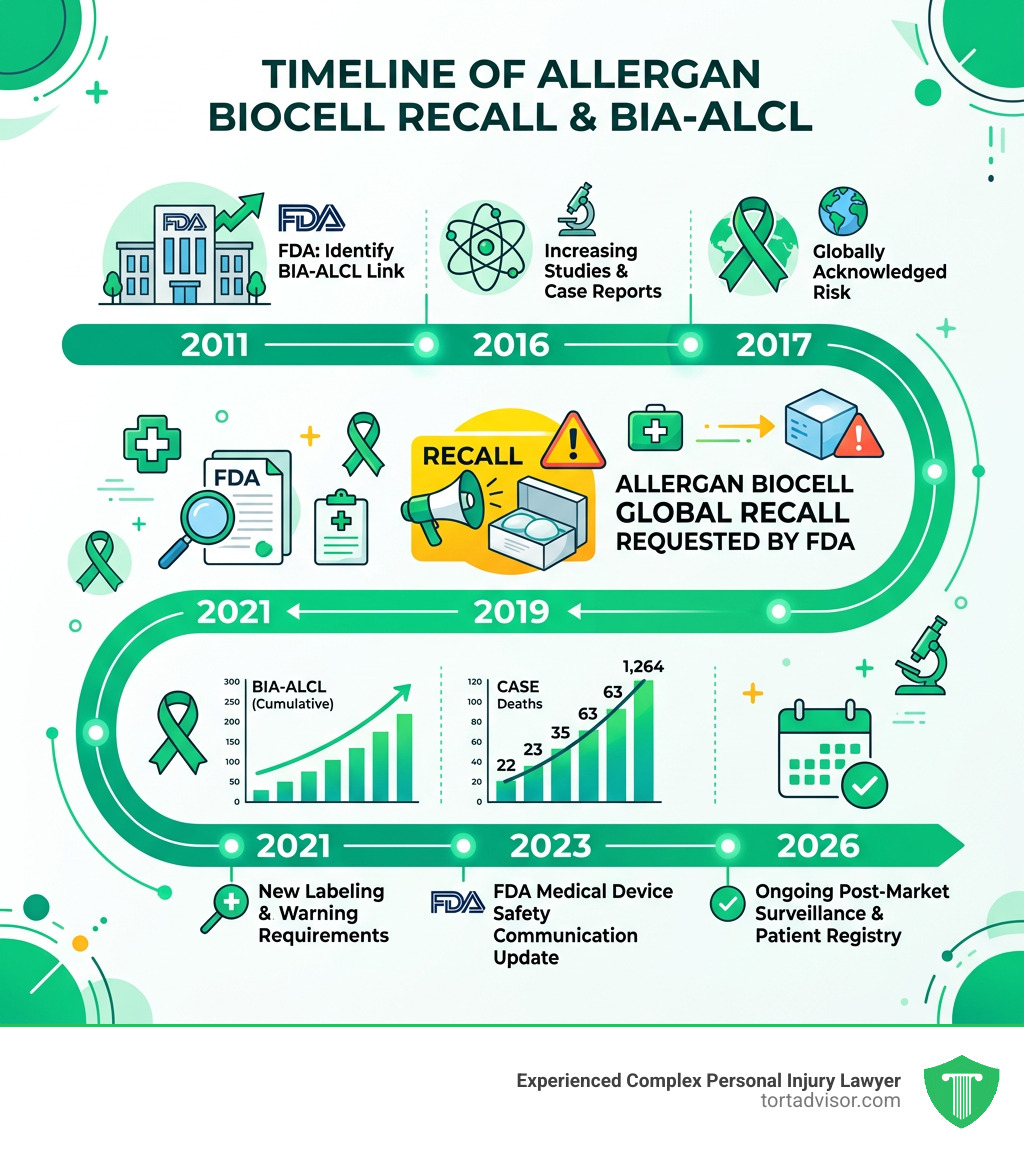
In July 2019, the FDA asked Allergan to withdraw its BIOCELL textured breast implants worldwide after data revealed an outsized connection to breast implant-associated anaplastic large cell lymphoma (BIA-ALCL). By 2023, the agency had logged 1,264 BIA-ALCL cases around the world, 85% of them involving Allergan implants, along with 63 patient deaths.
This was far from an ordinary recall. Hundreds of thousands of women worldwide are affected, and problems can surface years after the original surgery.
I’m Mason Arnao. My background in data systems and online lead generation has involved years of helping people facing complicated problems — the gummy bear implant recall among them — find dependable legal and medical resources. Below, I explain what was recalled and why, what the health risks are, and what to do next.
What Gummy Bear Implants Are and How BIOCELL Fits In
Making sense of the gummy bear implant recall starts with knowing what these devices are. “Gummy bear” is not a medical term; plastic surgeons came up with the nickname because of how the implants behave. Slice a traditional silicone implant in half and the gel may slowly seep out. Slice a gummy bear implant and the gel holds its shape, much like the candy.
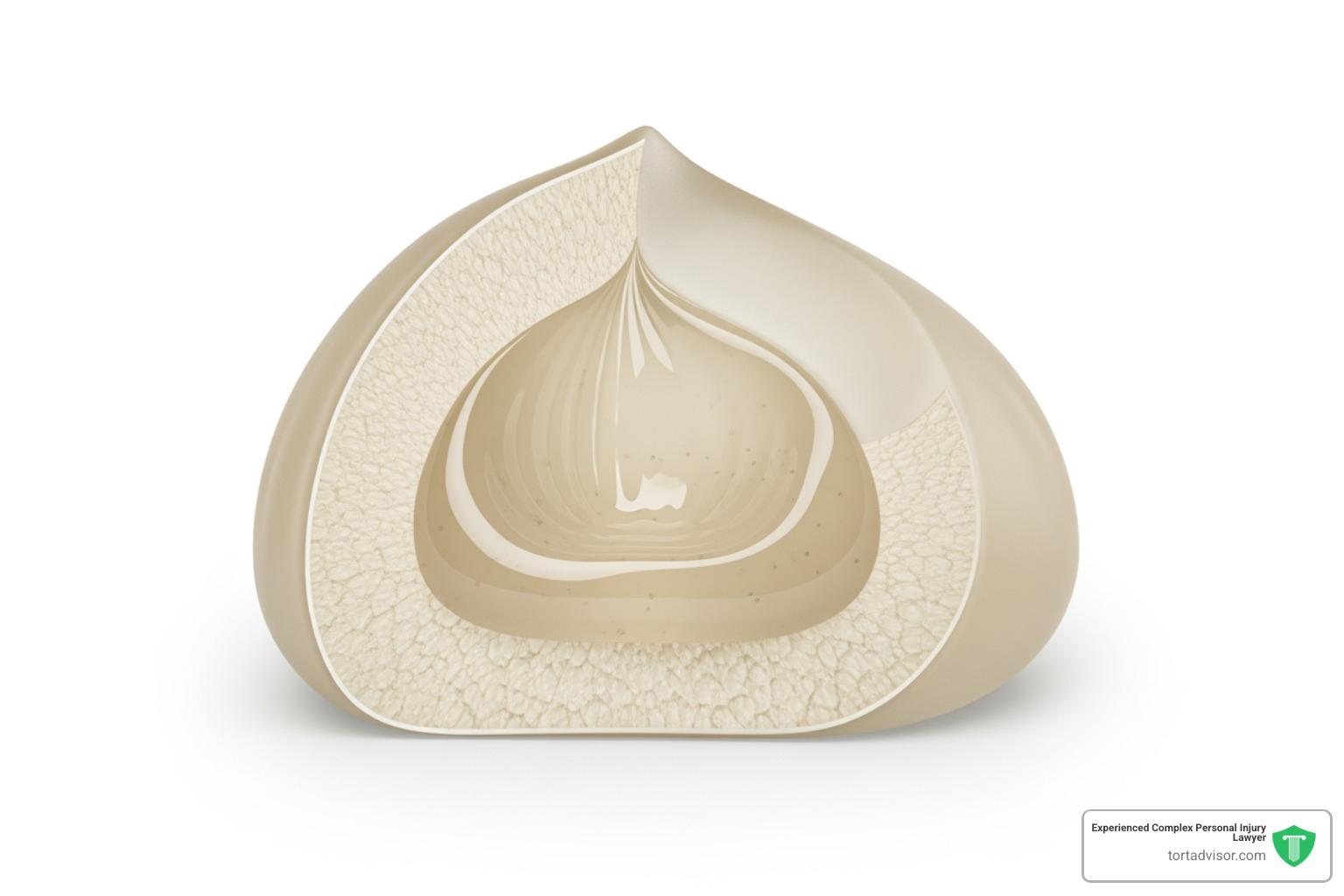
Technically, they are “highly cohesive” or “form-stable” implants, filled with a dense, cross-linked silicone gel that keeps its form — frequently a natural teardrop shape — even if the shell tears. The design won praise for a more natural appearance and less visible rippling, but it also came with particular manufacturing demands, most notably a textured outer shell.
There are real advantages and drawbacks of gummy bear implants. They are less prone to folding or wrinkling. On the other hand, because they are firmer and cannot be compressed through a small opening, they need a somewhat longer incision (around 6cm versus about 4cm for standard gel implants).
| Feature | Smooth-Surface Gummy Bear Implants | Textured (BIOCELL) Gummy Bear Implants |
|---|---|---|
| Surface | Slick and smooth | Rough, like sandpaper |
| Tissue Adherence | Shifts freely within the pocket | Grips tissue with a “Velcro” effect |
| Recall Status | Usually NOT part of the recall | RECALLED (Allergan BIOCELL) |
| Cancer Risk | Low/Baseline | Much higher (associated with BIA-ALCL) |
How “Gummy Bear” Implants Work
Known in the industry as fifth-generation implants, these devices rely on a heavily cross-linked gel. The technology grew out of the FDA’s 1990s moratorium on silicone implants and was meant to offer a safer, “leak-resistant” option. Research on cohesive gel stability indicates that the dense gel makes it less likely silicone will immediately spread into nearby tissue if the shell fails. As explained below, though, “less likely” is not the same as “never.”
How BIOCELL Texturing Created the Problem
The real cause of the gummy bear implant recall was not the cohesive gel but the shell’s surface. Allergan created its BIOCELL texture using a proprietary “lost salt” method: salt crystals were pressed onto the shell during production and then rinsed off, leaving deep, uneven pores.
That aggressive texture was meant to anchor the implant to the chest wall so a teardrop-shaped device would not rotate. Researchers theorize, however, that the deep pores may harbor bacteria or release tiny silicone fragments, causing long-term inflammation — and that chronic irritation is thought to set off BIA-ALCL, a cancer of the immune system. Our guide on breast implant silicone toxicity lawsuits covers the biological effects in more depth.
Why Allergan’s Gummy Bear Implants Were Recalled — and Which Models
Plastic surgery changed abruptly in July 2019. After the FDA’s official recall announcement, Allergan launched a voluntary worldwide recall of every BIOCELL textured product. The move responded directly to evidence that Allergan’s texture carried roughly six times the BIA-ALCL risk of textured implants from competing manufacturers.
To find out whether you are affected, start by identifying your implant model. For more on the legal background, visit our page on the gummy bear implants recall.
Natrelle Models Included in the Recall
Both silicone and saline textured implants are covered, plus tissue expanders used in breast reconstruction. Affected models include:
- Natrelle 410 Highly Cohesive Anatomically Shaped Implants (the original “Gummy Bear” styles: 410LL, 410LM, 410LH, 410ML, 410MM, 410MH, 410SL, 410SM, 410SH)
- Natrelle Silicone-Filled Textured Implants (Styles 110, 115, 120, TRL, TRLP, TRM, TRF, TRX, TCL, TCLP, TCM, TCF, TCX, TSL, TSLP, TSM, TSF, TSX)
- Natrelle Saline-Filled Textured Implants (Styles 163, 168, 363, 468)
- Natrelle Inspira Silicone-Filled Textured Implants
- Natrelle 133 Tissue Expanders (mostly used after mastectomy)
What Led to the Recall
The FDA based its decision on a review of 573 unique BIA-ALCL cases worldwide, 481 of which involved Allergan implants. The death data was even more alarming: of 33 deaths reported at that point, the implant maker was known in 13, and 12 of those 13 patients had Allergan devices. That lopsided risk is why the 2023 breast implant recall updates matter so much for patient safety.
Health Risks: BIA-ALCL Warning Signs and Silicone Migration
The main health concern behind the gummy bear implant recall is Breast Implant-Associated Anaplastic Large Cell Lymphoma (BIA-ALCL). Importantly, BIA-ALCL is not breast cancer. It is a form of non-Hodgkin lymphoma, a cancer of the immune system, that forms in the scar capsule and fluid around the implant.
Signs typically appear years after implantation, about 8 years on average. If you notice any of these, reach out to a doctor or a breast implant cancer lawyer right away:
- Seroma: Rapid, noticeable swelling from fluid collecting around the implant.
- Ongoing Pain: An aching or sharp pain that does not resolve.
- Lumps: New masses in the breast or underarm.
- Asymmetry: One breast suddenly appearing noticeably larger or differently shaped.
BIA-ALCL by the Numbers
Reported cases have kept rising since the recall. The FDA’s most recent BIA-ALCL surveillance figures show 1,264 cases and 63 deaths worldwide as of 2023. Where the implant surface was known, 918 cases involved textured devices, and 1,079 of all cases (about 85%) were linked to Allergan.
Concerns About Silicone Leakage and Migration
BIA-ALCL gets the most attention, but “gel bleed,” or silicone migration, remains a concern. Even form-stable gummy bear implants can release silicone.
In a Dutch case series, 98.8% of the women studied had silicone particles in their tissue, and 86.6% showed migration beyond the capsule, frequently into lymph nodes. This can trigger body-wide inflammation even without a classic rupture. Research on silicone migration in cohesive implants offers further detail.
Regulatory Action Worldwide and FDA Guidance for 2026
The gummy bear implant recall extended well beyond the U.S. France moved early, banning several kinds of textured implants in 2018, and Australia’s TGA and Health Canada’s suspension of macro-textured implants came soon afterward.
Our breast implant class action lawsuit guide explains how these international findings can support claims in the U.S.
FDA Advice for Patients Without Symptoms
As of 2026, the FDA’s position has not changed: if you have a recalled implant but no symptoms, preventive removal is not recommended. Surgical risks such as infection, anesthesia complications, and scarring are generally viewed as greater than the present risk of BIA-ALCL, which has been estimated at under 0.03% in some groups.
The FDA advises the following instead:
- Ongoing Monitoring: Perform self-checks and keep up with clinical exams.
- Imaging: An MRI is suggested three years after implantation and every two years after that to detect “silent” ruptures.
- Keeping Up to Date: Check the FDA’s BIA-ALCL questions and answers for new safety information.
How Risk Compares Across Countries
Estimated risk differs from country to country depending on which implants are common. In Canada, the BIA-ALCL risk with macro-textured implants is estimated at about 1 in 1,306, compared with 1 in 19,551 for micro-textured implants, and Canada has reported no confirmed cases tied only to smooth implants. In Australia, TGA recall guidance offers comparable local figures.
What to Do Next: Identify Your Implants and Know Your Legal Options
If you are unsure what kind of implants you have, there is no need to panic — this information can be found. Once you know, review your options on our breast implant lawsuits page.
Finding Out Which Implant You Have
- Implant ID Card: Surgeons usually hand patients a card listing the manufacturer, style, and serial number.
- Surgical Records: You are legally entitled to your medical records, so ask the surgeon’s office or the hospital that performed the procedure.
- Implant Registries: In some places, a registry such as the National Breast Implant Registry (NBIR) may hold your information.
Talking With Doctors and Attorneys
If you choose removal — because of symptoms or serious anxiety — surgeons commonly recommend a “total capsulectomy” or “en-bloc” procedure, which takes out the implant and its entire scar capsule in one piece. It is considered the standard approach for treating BIA-ALCL and helps ensure no loose silicone is left behind.
Legally, you may be able to recover the cost of medical monitoring and implant removal, as well as compensation for pain and suffering, particularly if you have been diagnosed with BIA-ALCL or a systemic illness. Our coverage of the breast cancer class action lawsuit offers more background on these cases.
Gummy Bear Implant Recall: Common Questions
Is every gummy bear implant part of the recall?
No. The gummy bear implant recall covers devices with Allergan’s BIOCELL textured surface. Gummy bear implants from other makers, such as Sientra or Mentor, and smooth-surface implants were not included in this recall. Always confirm your exact brand and model.
What do the latest BIA-ALCL numbers show for recalled gummy bear implants?
Based on 2026 projections, reported cases are still edging upward as older implants hit the 10-to-15-year mark. The pace of new cases may level off because of the 2019 recall, but women who still have these implants will remain at risk for years.
Should I have my implants removed if I feel fine?
Most medical authorities, including the FDA and the American Society of Plastic Surgeons, advise against removal for patients without symptoms. Still, if worry about a recalled device is hurting your quality of life, that is a legitimate reason to talk with your doctor about elective removal.
Conclusion
Legal Lawsuit believes no one should face a medical crisis without support. The gummy bear implant recall has left many women unsure about their health and what comes next. As a legal-information site, we help you understand your options and connect with attorneys in our network who focus on medical product liability.
If one of these recalled devices has affected you, you may be entitled to compensation. Try our breast implant settlement calculator for a sense of the factors that shape case value, then request a free, confidential case review. Your health matters most — take the next step to protect it.
Related Posts
Quick Answer: The Boy Scouts of America (BSA) filed for Chapter 11 bankruptcy in 2020 after facing tens of thousands [...]
Quick Answer: Survivors of sexual abuse by Catholic priests, nuns, or other Church personnel may be able to file a [...]
Quick Answer: Clergy abuse settlements vary enormously based on the severity of the abuse, the strength of evidence that the [...]