Short answer: This article explains the key facts, eligibility issues, settlement factors, deadlines, and source-backed updates related to this legal topic. Results vary by case facts, evidence, jurisdiction, and representation.
📋 Table of Contents
- The Truth About Breast Implant Lawsuit Silicone Toxicity
- Decoding Silicone Toxicity: Symptoms & Science
- Understanding Breast Implant Lawsuit Silicone Toxicity
- Legal Landscape: From Dow Corning to Allergan MDL
- Filing Your Claim: Deadlines, Eligibility & Strategy
- Frequently Asked Questions about Silicone Implant Litigation
- Conclusion
Silicone Breast Implant Lawsuit Facts: What the Toxicity Claims Really Involve
Researching a silicone breast implant lawsuit or silicone toxicity? Start with these essentials:
- Where Litigation Stands: Huge class settlements worth billions of dollars came in the 1990s; newer cases center on BIA-ALCL, a cancer tied to textured implants
- What the Science Says: Several large epidemiological studies have not confirmed a link between silicone implants and systemic disease
- Typical Legal Theories: Failure to warn, design defect, negligence and breach of warranty
- Local Problems: Capsular contracture, rupture, scarring and inflammation are well established
- FDA’s Current Stance: Silicone implants are approved, but patients need ongoing monitoring for complications
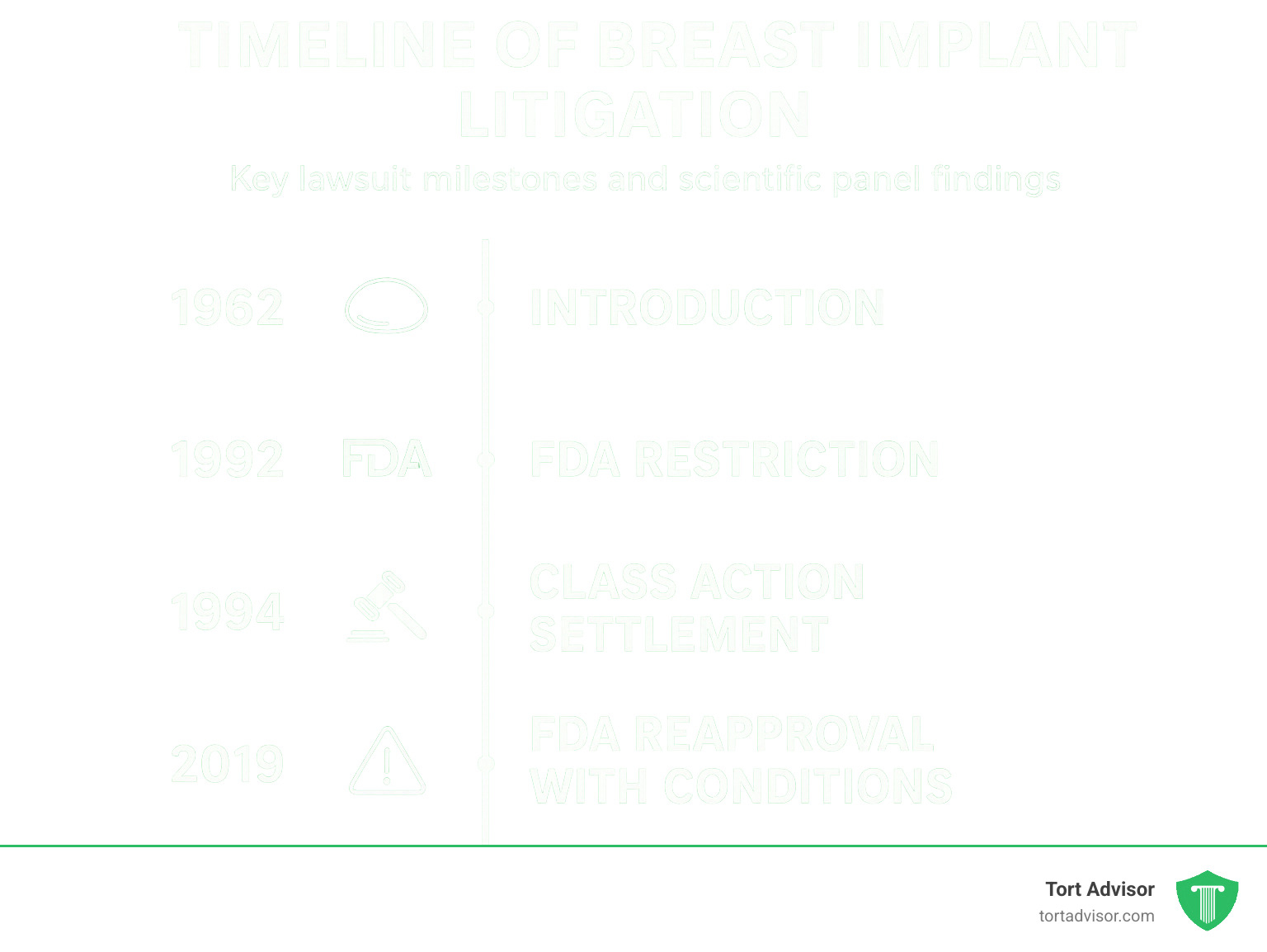
The history of silicone implant toxicity litigation has swung through scientific disputes, courtroom fights and patient activism. Ever since they debuted in 1962, silicone breast implants have been at the heart of one of the largest mass torts the U.S. has seen. A handful of lawsuits in the 1980s grew into hundreds of thousands by the 1990s, as women alleged their implants caused disabling autoimmune illness and body-wide toxicity.
The FDA restricted silicone implants in 1992 and billions were paid in settlements, yet scientists still disagree. Leading scientific panels found too little evidence tying implants to systemic disease, while many women keep reporting a group of symptoms now commonly called “breast implant illness.”
Current litigation has narrowed to specific harms such as breast implant-associated anaplastic large cell lymphoma (BIA-ALCL), with more than 700 cases reported around the world, mostly in women with textured implants.
I’m Mason Arnao. Having followed silicone implant litigation for more than ten years, I have watched science, law and public opinion shape the results for thousands of claimants. Here is what you should know if you think silicone breast implants harmed you.
Silicone Toxicity Explained: Symptoms and Science
In a silicone breast implant lawsuit, “toxicity” refers to possible health effects when silicone from an implant interacts with the body. Silicone is a man-made polymer of silicon, oxygen, carbon and hydrogen, and although manufacturers long called it largely inert, some evidence suggests it may be less harmless than once believed.
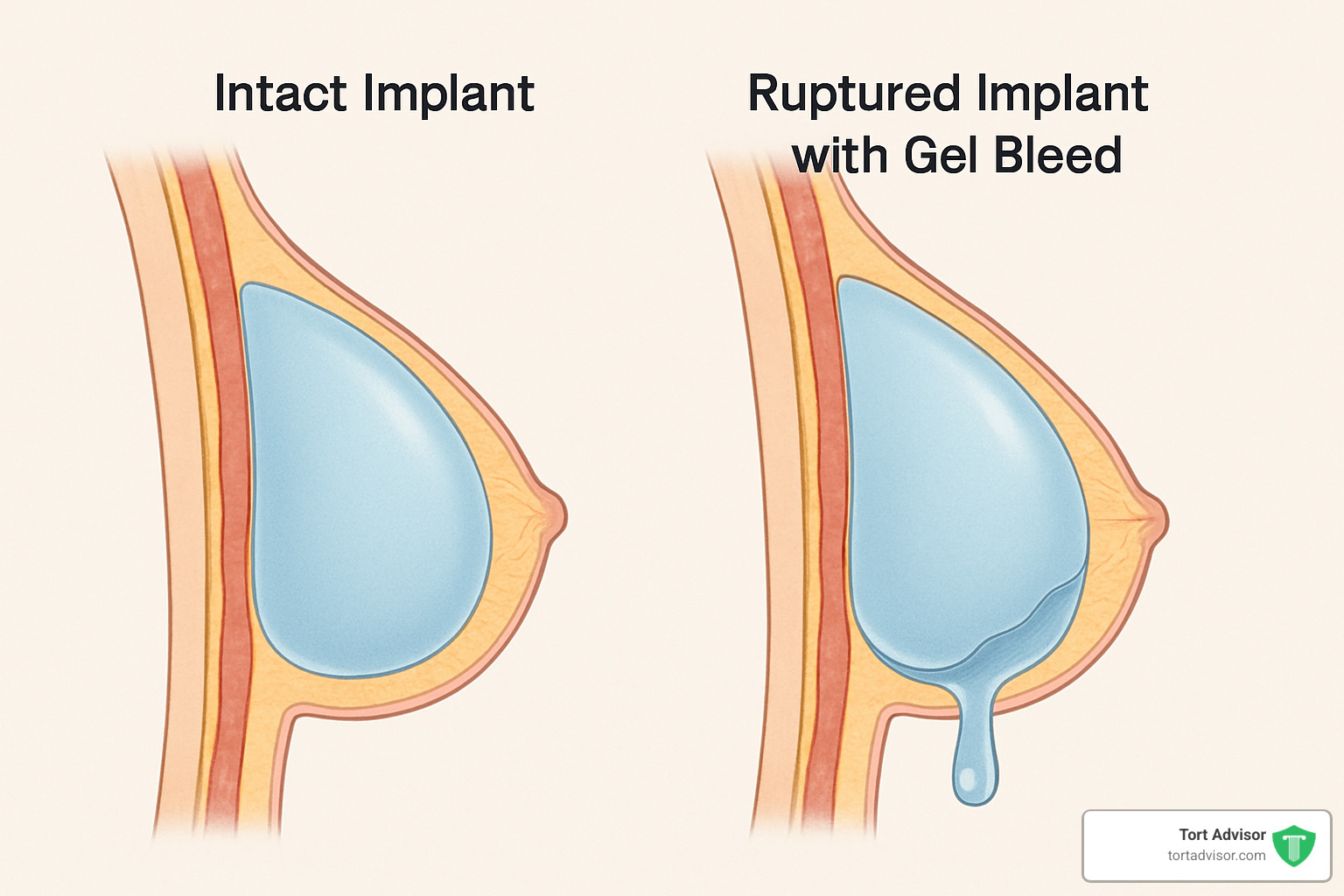
A key worry is “gel bleed,” in which tiny silicone molecules seep through the implant shell even when it has not ruptured. Low molecular weight silicones may move into nearby tissue and possibly reach the bloodstream or lymph system.
Reported symptoms generally fall into two groups:
- Local problems: Capsular contracture (hardened scar tissue around the implant), inflammation, pain and cosmetic deformity
- Body-wide effects: Fatigue, joint pain, memory and focus problems, rashes and symptoms resembling autoimmune disease
Among the gravest complications is BIA-ALCL, an uncommon form of non-Hodgkin lymphoma. FDA data show more than 700 cases reported worldwide and 36 deaths linked to the disease.
Siliconosis and “Breast Implant Illness”
“Siliconosis” is a term for a cluster of symptoms some women with silicone implants report. The symptoms often look like autoimmune conditions but may not match a recognized diagnosis.
Frequently reported symptoms:
- Exhaustion and brain fog: Ongoing fatigue and trouble focusing
- Joint and muscle pain: Widespread aches resembling fibromyalgia
- Skin problems: Rashes and sensitivity without a clear cause
- Chest discomfort: Pain or tightness in the breast or chest
- Hair loss: Thinning or unusual shedding
- Breathing problems: Shortness of breath or a lingering cough
In serious cases, migrating silicone can cause major complications; one documented case described a woman who developed pulmonary fibrosis and embolism after her implant leaked.
Many doctors doubt that implants cause body-wide effects, but patient advocates point to thousands of women who say their symptoms eased after explant surgery.
What Lab Studies Suggest
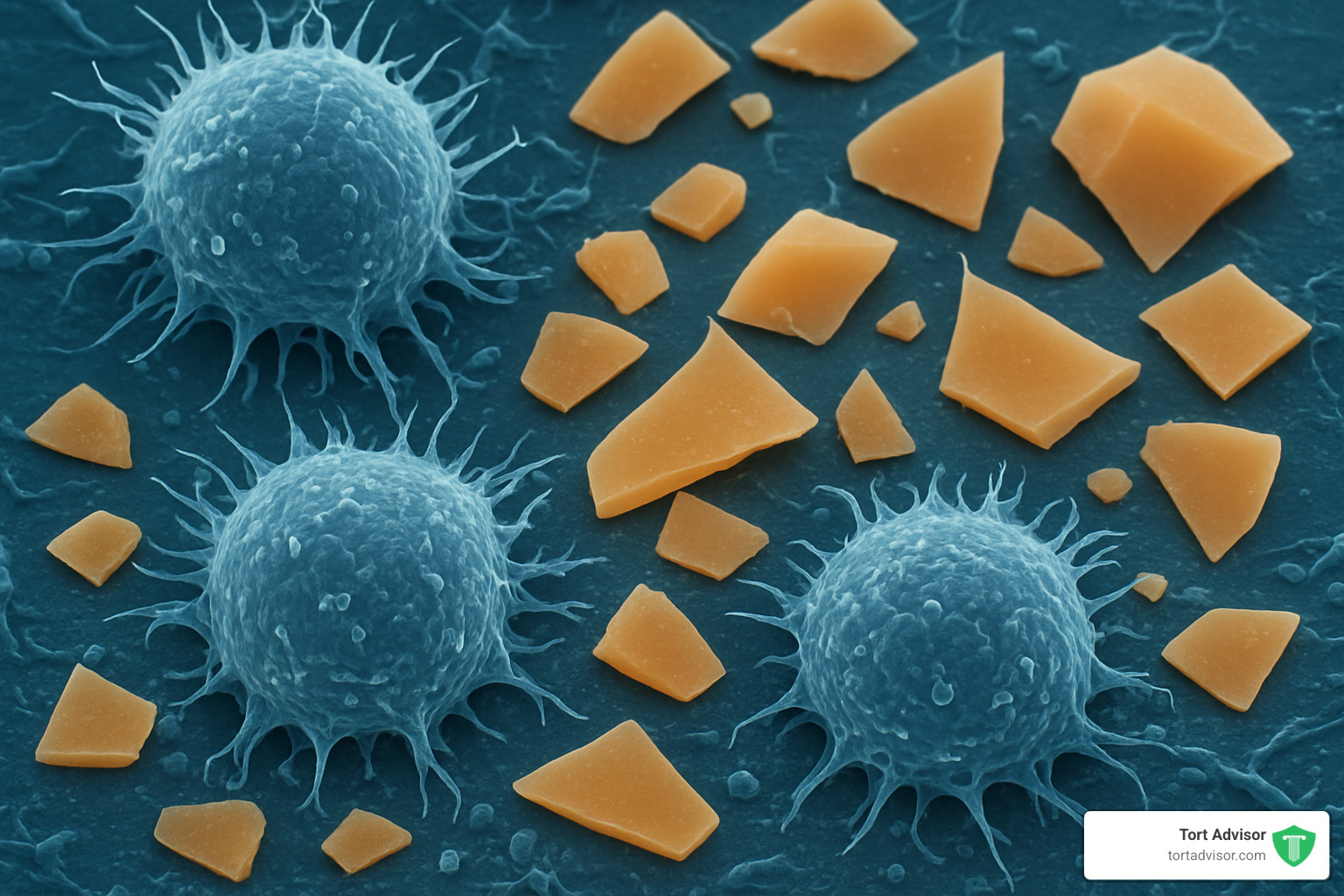
Newer research has started to explore how silicone might cause harm at the cellular level. A 2020 study in Scientific Reports found that low molecular weight silicones can kill cells under laboratory conditions.
Key findings included:
- Cyclic silicones, especially D4, can set off apoptosis (programmed cell death) in human cells
- Smaller molecules were more toxic than larger ones
- The cells died through the intrinsic apoptotic pathway
- Sensitivity to silicone differed between cell types
These lab results offer a possible biological explanation for symptoms some implant patients describe.
What Major Scientific Panels Concluded
Over the years, several prominent scientific bodies have reviewed the safety evidence on silicone implants:
-
Institute of Medicine (1999): After examining more than 1,200 papers and 17 epidemiological studies, the IOM found no convincing evidence that silicone implants cause systemic disease, while noting that local complications are common.
-
American College of Rheumatology (1995): The ACR stated that the evidence was “compelling” that silicone implants pose no demonstrable risk of connective-tissue or rheumatic disease.
-
FDA Actions (2020): The FDA kept silicone implants on the market but tightened monitoring and added BIA-ALCL warnings. It now advises screening for silent rupture by MRI 5-6 years after surgery and every 2-3 years after that.
The Medical Basis of a Silicone Breast Implant Lawsuit
Silicone implant claims rest on a tangle of medical complications, patient accounts and scientific findings, and understanding each piece helps explain how these lawsuits work.
Capsular contracture is a good place to start: it affects as many as 20% of women with implants. The body builds abnormally hard scar tissue around the implant, often causing pain, discomfort and visible distortion of the breast.
Rupture rates are another major concern. Research has found that roughly 40% of implants fail within six years and about 63% by 12 years — well over half over the long run.
Most troubling are “silent” ruptures, a problem specific to silicone. Saline implants visibly deflate when they break, but silicone implants can leak with no obvious signs because the gel often stays inside the scar capsule, so detection usually requires specialized imaging such as MRI.
Notably, the FDA places silicone breast implants in Class III, its highest-risk device category, which requires premarket approval.
Common Allegations in Silicone Implant Cases
Women who bring a silicone breast implant lawsuit usually make several core allegations. A frequent one is negligent design — that the maker knew or should have known of basic flaws that let silicone leak or the shell rupture.
Failure to warn is also common: plaintiffs say manufacturers did not properly disclose known risks to patients or surgeons, leaving women unable to make fully informed choices.
Some suits allege fraudulent concealment, claiming companies purposely kept internal research about possible harms from regulators and the public.
Many also assert breach of warranty, contending the implants did not perform as the manufacturer promised.
The case that opened the door was Maria Stern’s 1984 suit against Dow Corning, in which internal memos surfaced suggesting the company may have known of possible risks while still promoting implants as safe.
Scientific Panels and FDA Findings That Shaped the Cases
Findings from scientific panels have strongly influenced how silicone implant litigation developed over time.
The Institute of Medicine’s 1999 report was a turning point. It concluded that connective tissue disease, cancer, neurological disease and other systemic complaints occur no more often in women with implants than in women without them.
Several studies in the New England Journal of Medicine from 1992 to 1995 likewise found no statistically significant link between implants and connective tissue disease.
The FDA now takes something of a middle path — keeping silicone implants available while requiring close monitoring and openly recognizing both common local complications and rare but serious risks like BIA-ALCL. Its safety communication summarizes the known risks.
Newer Research and Ongoing Disputes
The science is still developing. Lab studies showing silicone-triggered cell death point to possible ways harm could occur, yet large population studies still find relative risks near 1.0 — meaning no added risk — for most systemic diseases.
That gap between lab results, patient experiences and population data sits at the center of the debate, and some researchers think genetic or immune differences could make certain people more sensitive to silicone.
Silicone Implant Litigation History: Dow Corning to the Allergan MDL
Silicone implant litigation stretches across nearly forty years, with major turns that have affected hundreds of thousands of women.
It started in 1984, when Maria Stern won her landmark case against Dow Corning. Lawsuits soon multiplied into the thousands by the early 1990s, and federal courts formed a multidistrict litigation (MDL) to handle the volume.
In 1992, the FDA restricted silicone implants until more safety data were available. Together with congressional testimony and heavy media attention, that move set off an explosion of lawsuits.
In 1994, manufacturers proposed a $4.25 billion global settlement meant to cover about 250,000 women, but it collapsed when claims far exceeded projections, and Dow Corning filed for bankruptcy protection in 1995.
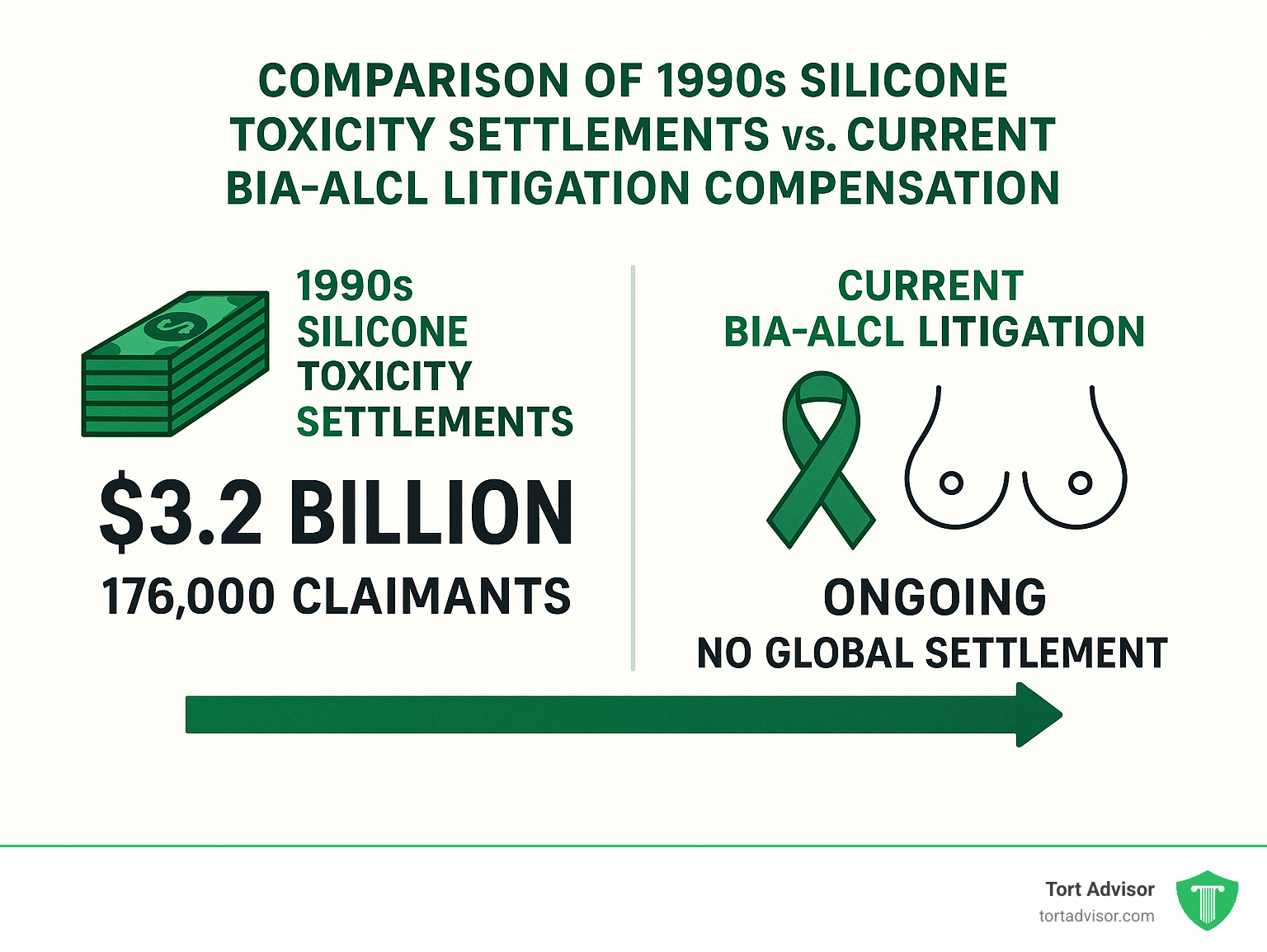
After lengthy negotiations, Dow Corning agreed to a revised $3.2 billion settlement for 176,000 women, while Bristol-Myers Squibb, Baxter Healthcare, 3M and other makers settled separately.
The tide turned after the Institute of Medicine’s influential 1999 report found no convincing link to systemic disease; manufacturers then started winning roughly 80% of the cases that reached trial.
Litigation today centers mainly on BIA-ALCL, especially involving Allergan’s Biocell textured implants, which the FDA asked Allergan to recall in 2019 after finding they carried a disproportionate risk.
Past Settlements and Compensation
What women harmed by implants have been able to recover has differed greatly depending on when and how they brought claims.
The Dow Corning settlement created a $3.2 billion fund for 176,000 women and a 30-year program covering present and future complications. Women with documented diseases could receive tiered payments based on severity, and those needing removal could get up to $5,000 in explant assistance.
By comparison, the Allergan BIA-ALCL litigation is still ongoing without a global settlement as of this update. Allergan’s early warranty programs offered only $1,000 toward diagnostic testing and $7,500 toward BIA-ALCL surgery, sums widely criticized as too small for a life-threatening cancer.
Legal Theories: Strict Liability, Negligence and Failure to Warn
Plaintiffs in silicone implant cases usually rely on several legal theories.
Strict liability does not require proof of carelessness — only that the product was unreasonably dangerous and caused harm without being substantially altered.
Negligence requires showing the maker breached its duty of care and that the breach caused the injury, typically by proving the company did not use reasonable care in designing, manufacturing or testing the implants.
Failure to warn asks whether risks were properly disclosed, and it becomes especially strong when internal documents show a company knew of dangers but did not adequately inform doctors or patients.
Breach of warranty claims say the implants fell short of explicit promises or basic safety expectations.
Expert Witnesses and the “Silicone Doctors” Controversy
Expert testimony is central to any silicone breast implant lawsuit, since both sides rely on medical and scientific experts to prove or disprove causation.
At the height of 1990s litigation, a controversy arose over so-called “silicone doctors,” physicians who often testified for plaintiffs. Some treated thousands of women with claimed implant illnesses and received many referrals from plaintiffs’ lawyers.
Those arrangements raised ethical questions, and the American Medical Association’s Opinion 9.07 addressed physician testimony directly, stressing honesty and avoidance of financial conflicts of interest.
As courts got better at weighing scientific evidence, judges became more skeptical of expert opinions lacking peer-reviewed support, and many cases were dismissed after plaintiffs’ experts were excluded under the Daubert standard, which demands testimony that is both relevant and reliable.
Filing a Silicone Breast Implant Lawsuit: Deadlines, Eligibility and Strategy
Considering a claim over harm from silicone implants? Your options depend on when you got the implants, what injuries you have and which settlement programs or lawsuits are open right now.
Timing is critical. Every state sets its own statute of limitations for product liability claims, commonly 1-6 years from when you discovered the injury. This “discovery rule” matters a great deal in implant cases, because complications often appear years after surgery.
A strong claim needs solid records: proof you received silicone implants, imaging and surgical reports documenting complications, a clear timeline of symptoms and treatment, and medical opinions tying your condition to the implants.
Your records tell the story, so collect them thoroughly — the original implant surgery records, every later MRI, ultrasound and mammogram, detailed notes on symptoms and treatment, and explant surgery reports if your implants were removed.
If you are thinking about removal, talk with both your doctor and a lawyer first. Explant surgery may be medically necessary and can produce important evidence, but its timing can affect both your health and the strength of your claim.
Implant Claim Deadlines and Requirements
Each legal route has its own deadlines and requirements:
For the SF-DCT (the Dow Corning settlement), most deadlines have expired since the program dates to the 1990s. The last day to file disease claims was June 3, 2019, and explant assistance claims were due by June 2, 2014, though the fund still processes claims filed earlier.
The Allergan BIA-ALCL MDL is active litigation. It uses a simplified short-form complaint, but state filing deadlines still apply, and you will need proof that you received Allergan textured implants and were diagnosed with BIA-ALCL.
Individual lawsuits are still possible, particularly for recent injuries or newly discovered complications. They are governed by your state’s filing deadline and may be filed in state or federal court depending on the facts.
How to Check a Claim’s Status and Get Help
If you already filed, these resources can help you track it:
For SF-DCT claims, go to www.sfdct.com and enter your Settlement ID number, use the helpline listed on that site, or reach out to the claims office that handles your claim type.
For claims filed under MDL-926, check the official MDL website using your claim number or contact the claims administrator with questions.
In current litigation, your attorney should keep you updated. Court websites frequently post MDL status reports, and case management orders list upcoming deadlines and hearings.
Legal Lawsuit is a legal-information site that can connect you with experienced attorneys in our network who handle silicone breast implant lawsuit claims and can offer guidance tailored to your situation through a free, confidential case review. More info about breast-implant services
Strengthening Your Claim
These practical steps can help build your case and support a fuller recovery:
Track symptoms closely with a daily journal of physical symptoms, emotional effects and activity limits. Get the right imaging — routine MRIs can catch silent ruptures and provide key evidence.
Log every expense, including medical bills, travel to appointments, lost pay and other financial effects. Connect with support groups where other implant patients share useful information and resources.
Look at every potential claim — depending on the facts, you may have grounds against manufacturers, surgeons or medical facilities.

Silicone Breast Implant Lawsuit FAQs
Can silicone implants cause autoimmune disease or cancer?
The science on silicone implants and health is complicated.
On autoimmune disease, the leading panels have been fairly clear: both the Institute of Medicine and the American College of Rheumatology found insufficient evidence that silicone implants cause conditions such as lupus or rheumatoid arthritis, and large population studies consistently show relative risks around 1.0, meaning no added risk.
Cancer is a different matter. There is no evidence that silicone implants cause breast cancer itself, but strong data now tie textured implants — particularly Allergan’s Biocell line — to a rare cancer, breast implant-associated anaplastic large cell lymphoma (BIA-ALCL). With more than 700 cases and 36 deaths worldwide, the FDA found Allergan’s textured implants carried roughly six times the risk of other textured implants.
Then there is what many women call “Breast Implant Illness.” It is not an official diagnosis, but thousands of women describe a cluster of fatigue, joint pain and brain fog, and recent lab findings that silicone can activate cell death pathways may help explain why many feel better after removal.
How much compensation might a successful claim bring?
Compensation in a silicone breast implant lawsuit varies enormously depending on several factors.
The type and severity of the injury matter most; BIA-ALCL cases generally carry far more value than claims based on local complications or disputed systemic symptoms. The strength of the causation evidence is also critical, since claims with clear scientific support connecting the implant to the injury tend to do better.
History offers some context. The 1990s Dow Corning settlement averaged roughly $18,800 per claimant, while some individual jury verdicts in the early 1990s reached into the millions of dollars.
For current BIA-ALCL claims, no global settlement exists as of this update, so any projected per-person amount is speculation. Value will likely turn on the stage of the cancer, the treatment required, lasting effects and proof of the specific implant used.
Keep in mind that attorney fees (commonly 33-40% of the recovery) and any medical liens are usually paid out of a settlement.
Should I have my implants removed before suing?
This decision involves medical and legal questions and deserves careful thought.
Medically, implants should be removed only when your health requires it or your doctor recommends it, because explant surgery has risks of its own, including scarring, infection and cosmetic changes. If you are diagnosed with BIA-ALCL, prompt removal of the implants and surrounding tissue is standard treatment and should not be postponed.
Legally, removal can produce useful evidence, especially if the surgeon finds a rupture or leak. The condition of the removed implants can support causation, and records showing removal was medically necessary can strengthen your damages.
The FDA’s guidance is balanced: do not remove implants if you have no symptoms, consider routine MRI or ultrasound to find silent ruptures, and weigh the risks and benefits carefully with your doctor.
The best approach is to get both medical and legal advice before deciding, with your health always coming first and legal strategy second.
More info about breast-implant lawsuits
Conclusion
Making sense of a silicone breast implant lawsuit means understanding both the changing science and the legal framework built over four decades of litigation.
The evidence is mixed. Large epidemiological studies have not confirmed links between silicone implants and most systemic diseases, yet lab research keeps identifying possible ways harm could occur. Local problems such as capsular contracture and rupture are well documented, and certain risks, like BIA-ALCL with textured implants, rest on strong evidence.
The law mirrors that uncertainty. The giant class actions of the 1990s produced billions in settlements even though causation was disputed, while today’s cases focus more tightly on complications with stronger scientific backing, especially BIA-ALCL tied to textured implants.
If you are weighing your options after complications, records are essential. Keep everything related to your implant surgery, symptoms, treatment and any removal, because these documents will be the foundation of a claim.
Deadlines matter as well. Filing limits differ by state, and settlement programs have their own cutoffs that cannot be missed.
You should not handle this alone. Experienced guidance is vital where medicine and law overlap this much, and both specialized doctors and seasoned attorneys can help you work through it.
Every situation is different. Your implant type, symptoms, medical history and even your state all influence the legal remedies available to you.
These cases show how hard it can be to prove causation for complex conditions, and also how litigation can spur regulation and research that make medical devices safer for everyone.
If you think silicone breast implants harmed you, Legal Lawsuit can connect you with attorneys in our network who handle these complex cases. Our network covers all 50 states, so you can get guidance suited to your circumstances and your state’s laws.
Learn more about breast implant lawsuits and your legal options in our comprehensive resource center.
Pursuing a silicone breast implant lawsuit is not easy, but with good information and the right support, you can make confident decisions about your health and your legal rights.
Related Posts
Quick Answer: The Boy Scouts of America (BSA) filed for Chapter 11 bankruptcy in 2020 after facing tens of thousands [...]
Quick Answer: Survivors of sexual abuse by Catholic priests, nuns, or other Church personnel may be able to file a [...]
Quick Answer: Clergy abuse settlements vary enormously based on the severity of the abuse, the strength of evidence that the [...]