
Short answer: This article explains the key facts, eligibility issues, settlement factors, deadlines, and source-backed updates related to this legal topic. Results vary by case facts, evidence, jurisdiction, and representation.
In This Guide
SSDI Approval Time at a Glance
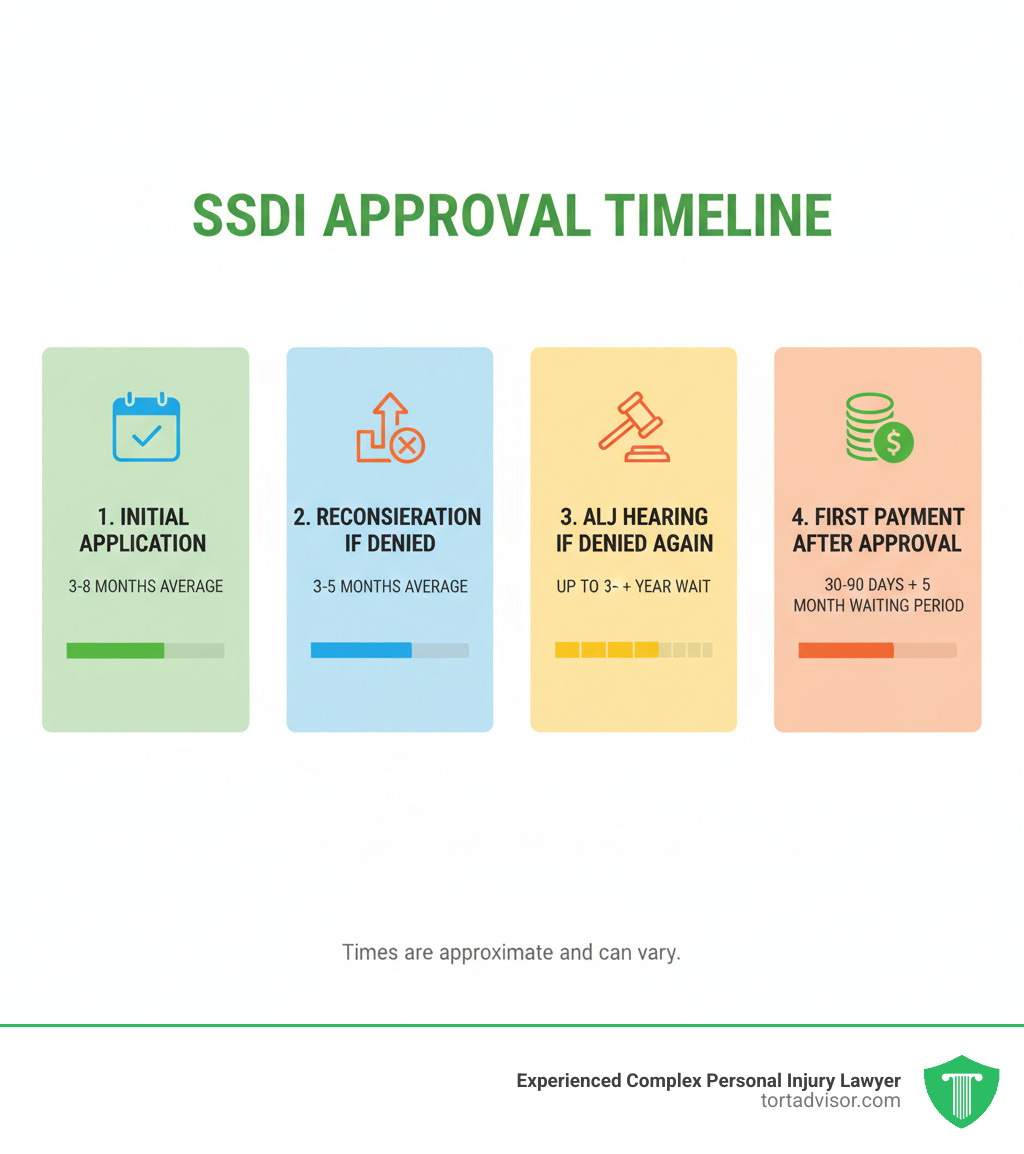
Your SSDI approval time depends on where your claim is decided. A typical path looks like this:
- Initial decision: often several months (the national average was about 202 days in FY 2023)
- Reconsideration after a denial: often 3 to 5 months (about 107 days on average in FY 2023)
- ALJ hearing: commonly a year or longer to be scheduled and decided
- First check after approval: usually 30 to 90 days
Waiting on Social Security Disability Insurance while you cannot work is stressful. Many applicants wait six months or more for a first decision, and because denials are common, appeals can stretch the wait by months or years. Knowing each stage, the usual causes of delay and the ways to speed things up helps you plan. Even approval does not mean money arrives immediately; payment processing can take additional time, and occasionally much longer. Certain conditions qualify for faster handling through Compassionate Allowances (CAL) or Quick Disability Determination (QDD), sometimes producing approval within weeks. For everyone else, a complete, well-documented application is the best way to avoid delays. This guide covers the timeline from filing to first payment, including the five-month waiting period, back pay and appeals.
Related guides:
- How to complete a disability benefits application
- What to do after a denied disability claim
- How the disability appeal process works
Each Stage of an SSDI Claim
Your claim passes through several levels of review, handled by different offices. Knowing the path helps you anticipate what comes next.

It begins at a Social Security field office, which checks non-medical rules such as work credits, then goes to Disability Determination Services (DDS), the state agency that decides the medical question. After a denial you can request reconsideration, then an Administrative Law Judge (ALJ) hearing, followed if needed by the Appeals Council and federal court. Most approvals come before those last two levels. Each stage adds time but is another chance to win. The SSA’s appeals page explains the process.
Initial Application
You can apply online, by phone or in person. The SSA first confirms non-medical eligibility, including enough work credits under the recent work and duration of work tests. Then DDS gathers your medical records, evaluates your condition and may schedule a consultative exam if more information is needed. Ready to begin? See how to apply for SSDI.
Reconsideration Level
Most first applications are denied. You then have 60 days from receiving the denial to request reconsideration, where a different DDS examiner reviews your file and any new evidence. Approval rates at this step are low, and it typically adds 3 to 5 months (about 107 days on average in FY 2023). It is still required before a hearing, and the denial letter’s reasons show what to strengthen. Our guide to the disability appeal process has more strategies.
The ALJ Hearing
After a reconsideration denial, the ALJ hearing is often your best opportunity. You can testify about how your condition affects you, and your representative can question medical and vocational experts. Approval rates are higher here because the judge hears from you directly, but waits for a hearing can exceed a year. With good preparation and representation, the hearing can turn a denial into an approval.
Average SSDI Approval Times
There is no single answer to how long SSDI takes, but many people wait six months or more for an initial decision, a hard stretch when you are already unable to work.
Initial Decision Data
SSA data put the average initial processing time at about 202 days in FY 2023, up from 184 days in FY 2022, and times vary by state depending on staffing and workload. The SSA publishes current state-by-state processing data on its disability determination processing time page. Keep in mind these figures cover only the first decision; appeals add more.
What Affects How Long a Decision Takes
Several factors explain why some claims move faster than others:
- Accuracy: incomplete or inconsistent forms force the SSA to follow up, adding weeks or months.
- Medical records: slow responses from providers or gaps in your file stall the claim.
- Doctor support: detailed opinions about your limits on standing, lifting or concentrating strengthen the claim.
- Consultative exams: if your records are thin, an SSA-arranged exam adds time.
- Agency workload: backlogs and staffing shortages slow everyone.
- Quality review: some claims are pulled for extra review.
- Technical denials: missing work credits can end a claim before the medical review.
Ways to Shorten Your SSDI Approval Time
You cannot fix SSA backlogs, but you can avoid the delays you control.
- Complete every section. Thorough answers prevent follow-up questions.
- Send medical records with the application. A complete medical file can cut waiting time significantly.
- Ask for detailed doctor statements. A letter describing your prognosis and work limits helps the reviewer.
- Answer SSA requests right away. Your delay becomes the claim’s delay.
- Stay consistent. Make sure your work history and limitations match across all forms.
Some claims are fast-tracked. Compassionate Allowances (CAL) cover conditions that clearly meet SSA standards, such as certain aggressive cancers and ALS, and can lead to approval within weeks. Quick Disability Determination (QDD) speeds claims with strong evidence, and some veterans also qualify for expedited processing. For more help, see our disability claim assistance resources and what evidence you need to prove your case.
After Approval: First Payment and Back Pay
An approval letter, called an award notice, is a big relief, but there are a few more steps. It lists your monthly benefit, your established onset date and when payments start. Setting up direct deposit gets money to you fastest.

The Five-Month Waiting Period and Your First Check
SSDI includes a required five-month waiting period that starts from your established onset date, not the date you applied or were approved. If your onset month is January, the waiting period runs February through June, and July is your first month of entitlement. Most people receive a first payment 30 to 90 days after approval. The waiting period does not apply to people with ALS approved on or after July 23, 2020. The SSA’s approval process page has details.
How SSDI Back Pay Is Calculated
Back pay covers months you were entitled to benefits before regular payments began. A key limit applies: SSDI retroactive benefits generally reach back no more than 12 months before your application date, which is why applying promptly matters. For example, if your disability began in January 2022 and you applied in January 2024, your waiting period was already satisfied in 2022, so retroactive benefits could reach back only to January 2023, and the months before that are lost. Back pay is usually paid as a lump sum.
SSDI vs. SSI Payment Timing
The two programs pay on different schedules.
- SSDI is based on your work record, has the five-month wait and limits retroactive benefits to 12 months before you applied. Payments usually arrive on the second, third or fourth Wednesday of the month depending on your birth date.
- SSI is need-based with no waiting period, so payments can start the month after you apply once approved, and back pay generally runs from the application date. Payments usually arrive on the first of the month.
SSDI beneficiaries become eligible for Medicare after 24 months of entitlement, while SSI recipients often qualify for Medicaid right away. Some people with low SSDI payments receive both. Compare the two programs to learn more.
Delays, Denials and Appeals
Setbacks are a normal part of SSDI, and many successful claimants were denied at first. Understanding why delays happen helps you respond. Common causes of delay in processing and payment include:
- Missing information: the most frequent cause, since the SSA must pause to request it.
- Misplaced documents: paperwork can be lost and need resubmitting.
- Agency workload: backlogs slow all claims.
- Complex conditions: unusual cases may need extra medical review.
- Payment processing: the gap between approval and payment can widen due to manual calculations or system issues.
If your SSDI claim is denied, it is not the end, and many people win on appeal. Here is what to do:
- Read the denial notice closely. It explains the SSA’s reasons, which shape your appeal.
- Appeal on time. You have 60 days from receiving the notice; missing it usually means starting over.
- Add medical evidence. Use the window to get updated records and detailed statements about your limitations.
- Get help. A disability attorney knows what the SSA looks for. Learn more about handling a denied disability claim.
SSDI Appeal Levels and Timing
Each appeal level adds time:
- Reconsideration: a new examiner reviews the claim, averaging about 107 days in FY 2023, with low approval rates but required.
- ALJ hearing: often the best chance for approval since you testify in person, though waits can top a year. The SSA publishes hearing processing times online.
- Appeals Council: review of the judge’s decision for errors, adding months.
- Federal court: a lawsuit that can take over a year and generally needs an attorney.
Persistence pays off; many claimants who keep appealing eventually win.
Medicare, Family Benefits and Checking Your Status
SSDI approval brings more than monthly checks, including a path to Medicare and possible benefits for family members.
When Does Medicare Start for SSDI Beneficiaries?
Medicare begins after 24 months of SSDI entitlement, counted after the five-month waiting period, so coverage often starts about 29 months after the onset date. You are then enrolled automatically in Part A (hospital) and Part B (medical); Part A is usually premium-free, while the Part B premium is typically deducted from your check. People with ALS skip the 24-month wait. Your spouse and children may also qualify for benefits on your record.
How to Check Your SSDI Claim Status
You can follow your claim in several ways:
- Online: your my Social Security account shows claim status and documents.
- By phone: call the SSA at 1-800-772-1213, expecting possible hold times.
- In person: visit your local office, ideally with an appointment.
If you have a representative, they will track the claim for you.
Your Medicare Choices
Once eligible, you can stay with Original Medicare (Parts A and B) or consider alternatives:
- Medicare Advantage (Part C): private plans combining Parts A and B, often with drug, dental and vision coverage. Review your health plan options.
- Part D (prescription drugs): with Original Medicare, a separate Part D plan helps cover medications. See how to get drug coverage.
Medicaid and Medicare Savings Programs can help people with limited income pay premiums and other costs.
SSDI Approval Time FAQs
How fast can an SSDI claim be approved?
Claims that qualify for Compassionate Allowances or Quick Disability Determination can be approved within weeks, sometimes in under a month, for severe, readily documented conditions such as certain cancers or ALS. Most other claims take several months at minimum.
Does a lawyer speed up SSDI approval?
A lawyer cannot make the SSA work faster, but can prevent the mistakes and gaps that cause delays by submitting a complete, well-documented claim, meeting deadlines and handling communication, which can shorten the overall wait. See what a lawyer can do for you for more.
How far back can SSDI back pay go?
Retroactive SSDI benefits are generally limited to 12 months before your application date, regardless of when the disability started. If your disability began two years before you applied, roughly a year of potential benefits could be lost, which is why applying as soon as you stop working matters.
Conclusion
The SSDI approval time can be long, with first decisions taking months and appeals often lasting more than a year, plus the five-month waiting period and payment processing. Preparation is your best tool: a complete application with strong medical evidence prevents avoidable delays, and prompt, well-supported appeals improve your chances after a denial. Legal Lawsuit can connect you with independent attorneys who handle Social Security disability claims and know what the SSA requires. Request a free review of your SSDI claim.
Related Posts
Quick Answer: The Boy Scouts of America (BSA) filed for Chapter 11 bankruptcy in 2020 after facing tens of thousands [...]
Quick Answer: Survivors of sexual abuse by Catholic priests, nuns, or other Church personnel may be able to file a [...]
Quick Answer: Clergy abuse settlements vary enormously based on the severity of the abuse, the strength of evidence that the [...]