No Fault States: How PIP Claims Work and When You Can Sue
By Mason ArnaoUpdated

By Mason ArnaoReviewed by Mason Arnao
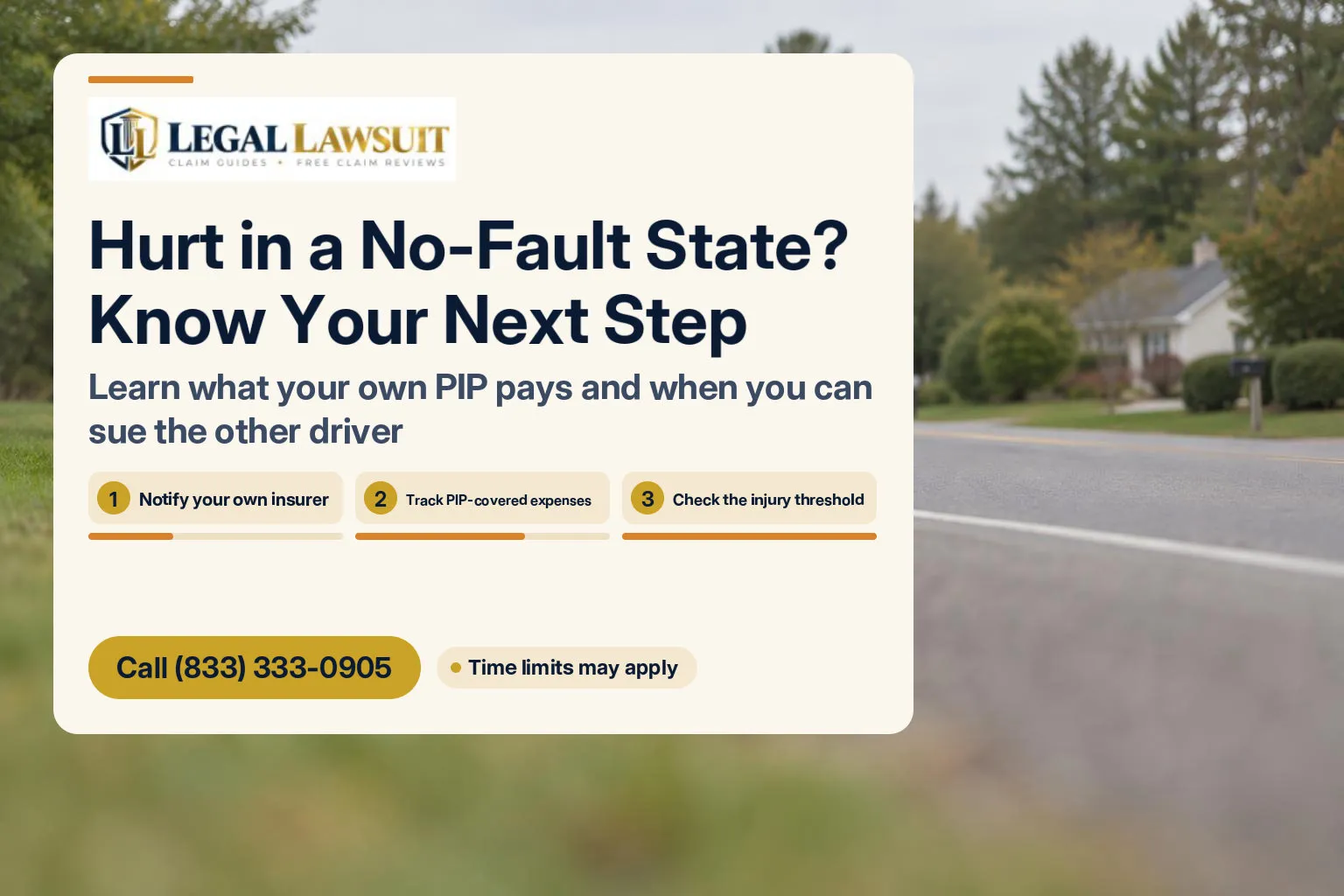
If you live in one of the no fault states, you usually file first with your own auto insurer, not the other driver’s, and you don’t have to prove who caused the crash. Your personal injury protection (PIP) pays you and your passengers regardless of fault, typically covering medical costs, lost wages and funeral costs, and you can still sue the driver who hit you if your injuries pass your state’s threshold, such as a clearly defined injury or death.
The details depend on where you live. In New York, for example, basic No-Fault pays up to $50,000 per person but does not cover car repairs. Florida’s statute lists four injury categories that open the door to pain and suffering damages. Pennsylvania lets drivers choose between limited tort and full tort, and that choice affects your right to sue.
This guide covers who pays first in a no-fault state compared with an at-fault state, and what PIP does and doesn’t pay for. It walks through how to file a PIP claim with your own insurer and when an injury is serious enough to step outside the no-fault system. It also explains how Pennsylvania’s tort choice works and what options you have if PIP runs out or the other driver can’t pay.
What living in a no-fault state means for your injury claim
If you were hurt in a car crash in a no-fault state, the short answer is this: you usually start by claiming your injury costs from your own auto insurer, not the other driver’s. Your right to sue the at-fault driver is limited until your injury meets certain thresholds.
According to the National Association of Insurance Commissioners’ consumer guide to no-fault auto coverage, here’s how the system works:
- You don’t have to prove who caused the crash. Under no-fault laws, each person files a claim with their own insurer instead of suing to get paid for injuries.
- Personal injury protection (PIP) covers you and your passengers. PIP pays you and the people riding in your car regardless of who was at fault.
- Benefits vary by state. They usually include medical costs, lost wages and funeral costs.
- Lawsuits are still possible in some cases. You can sue if your injury passes certain thresholds, such as clearly defined injuries or death.
In practice, the first call after a crash usually goes to your own insurance company. Whether you can also bring a claim against the other driver depends on how serious your injuries are and on your state’s specific rules.
Confirm your state’s system first
Lists of “no-fault states” published online don’t always agree, and some states offer a mix of options. The most reliable way to know which rules apply to you is to check with your state insurance department. It can tell you whether your state uses no-fault coverage, what your policy must include and what thresholds apply to lawsuits.
The sections below explain who pays first, what PIP does and doesn’t cover, how to file, and when you may be able to step outside the no-fault system.
No fault insurance vs. an at fault state: who pays first
The short answer: in a no-fault state, you start with your own insurance company, not the other driver’s. In an at-fault state, you generally start with the insurer of the driver who caused the crash. This first step shapes everything that follows.
In a no-fault state: your own policy pays first
According to the National Association of Insurance Commissioners’ auto insurance guide, drivers in no-fault states file claims with their own insurer and don’t have to prove who caused the accident. Personal injury protection (PIP) pays you and your passengers no matter who was at fault. In practice, your first call after a crash is usually to your own insurance company, even if the other driver clearly caused it.
Why fault still matters
No-fault doesn’t make fault irrelevant. The same NAIC guidance explains that lawsuits are still possible once an injury passes certain thresholds, such as clearly defined injuries or death. That is why policies in no-fault states also carry residual bodily injury liability coverage. It protects you if someone you injured meets a threshold and sues you. Once a case crosses that line, who caused the crash becomes a central question again.
In an at-fault state: the claim usually runs through the other driver
In a traditional at-fault system, an injured person typically seeks payment from the at-fault driver’s liability coverage. That usually means showing the other driver was responsible before money is paid. How fault is weighed varies by state. For the general steps, from reporting the crash to negotiating with an insurer, see our guide to how a personal injury claim works from start to finish.
| Question | No-fault state | At-fault state |
|---|---|---|
| Where you usually file first | Your own insurer (PIP) | The at-fault driver’s insurer |
| Do you need to prove fault to get paid first? | No | Generally, yes |
| Can you sue the other driver? | Only past a threshold | Yes, under that state’s rules |

What PIP pays for, and what it doesn’t
PIP mainly covers the money you lose because you were hurt: medical bills, lost income and certain everyday costs. It does not cover damage to your car. Exactly what’s included, and how much, depends on your state. Generally, the National Association of Insurance Commissioners explains that PIP benefits typically include medical costs, lost wages and funeral costs for you and your passengers, no matter who caused the crash.
Example: what New York’s No-Fault coverage includes
New York’s Department of Financial Services spells out what basic No-Fault coverage pays in New York:
- Medical costs for your crash injuries.
- Lost earnings while you can’t work.
- Other reasonable, necessary expenses, such as household help and transportation to medical appointments.
In New York, basic No-Fault pays these economic losses up to $50,000 per person. It covers the driver, passengers and pedestrians hit by the insured car.
What New York No-Fault won’t cover
- Vehicle and property damage. No-Fault does not pay to repair your car, anyone else’s vehicle or other property. That falls under other parts of an auto policy.
- Costs beyond the limit. Once the $50,000 basic benefit is used up, No-Fault stops paying.
One point that often surprises people: in New York, No-Fault pays before your health insurance on crash injuries. Your PIP claim usually comes first, even if you have good health coverage.
Your state’s rules may look different
New York is only one example. Benefit types, dollar limits and who counts as covered vary from state to state, so check your own policy and your state insurance department’s guidance. If you live in Florida, our step-by-step guide to filing a PIP claim in Florida walks through how that state’s system works.
How to file a PIP claim with your own insurer
The short version: report the crash to the insurer that provides your PIP coverage, keep proof of every cost, and check your policy for the deadlines that apply to you. You’re dealing with your own company, so you don’t have to prove the other driver caused the crash.
- Tell the right insurer. Notify the company named on the policy that carries your PIP coverage. Who’s covered depends on your state. In New York, the state’s Department of Financial Services auto insurance guide says No-Fault covers the driver, passengers and pedestrians injured by the insured vehicle.
- Keep records of each loss. According to New York DFS, No-Fault can pay for medical costs, lost earnings, household help and transportation to treatment. Keep a folder, paper or digital, with:
- Medical bills and treatment records
- Pay stubs or employer letters showing missed work
- Receipts for help with chores you couldn’t do
- Mileage logs or ride receipts for trips to appointments
- Check your deadlines. Notice and proof-of-claim deadlines vary by state and policy, and there is no single national rule. Read your policy carefully, and ask your adjuster in writing what deadlines apply and what forms they need.
A New York eligibility rule to know
New York DFS notes that you can lose No-Fault eligibility if you were driving while intoxicated or impaired by drugs. If this could apply to your situation, read the DFS guidance on the rule and its limits closely before you assume a claim is closed to you.
If you were on foot
Pedestrians often aren’t sure whose policy to file under. Our guide to filing an insurance claim after being hit as a pedestrian walks through that step by step.
When you can step outside no-fault: injury thresholds
Living in a no-fault state doesn’t always stop you from suing the driver who caused your crash. It means your injury usually has to pass a legal “threshold” first. Nationally, the NAIC notes that these thresholds are based on things like clearly defined injuries or death. Each state sets its own rules. Here is how two no-fault states draw the line.
New York
According to the New York Department of Financial Services, you can sue in only two situations:
- Economic losses: to recover economic losses above what No-Fault pays.
- Pain and suffering: to recover non-economic damages, but only if you have a “serious injury” as the state’s Insurance Law defines it.
Florida
Under Florida Statutes § 627.737, you can recover damages for pain, suffering, mental anguish and inconvenience only if the injury involves one of these:
- Significant and permanent loss of an important bodily function
- Permanent injury within a reasonable degree of medical probability, other than scarring or disfigurement
- Significant and permanent scarring or disfigurement
- Death
The same statute also says punitive damages are not allowed in a lawsuit against an auto liability insurer for damages above its policy limits.
When a crash takes someone’s life, families often have different questions and deadlines to work through. Our guide to filing a wrongful death claim after a fatal crash explains how those claims work.
What decides whether you qualify
Whether your injury meets a threshold depends on your medical evidence and your state’s law. It doesn’t depend on how the insurer first labels your claim. Keeping complete treatment records, diagnoses and follow-up notes helps show what your injury actually is. No one can promise in advance that a particular injury will qualify or what a claim might be worth.
Choice no-fault: Pennsylvania’s limited tort and full tort
In Pennsylvania, your right to sue after a crash can depend on a choice made when your auto policy was set up. Drivers there choose between two options, limited tort and full tort, and that choice can shape your claim long after the paperwork is filed away.
According to the Pennsylvania Insurance Department’s auto insurance guide, the two options work like this:
| Option | What it costs you | What it means if you’re hurt |
|---|---|---|
| Limited tort | Lower premium | You can’t recover some damages, such as pain and suffering, unless your injury fits one of the exceptions in the law |
| Full tort | No limited tort discount | Your right to sue is not restricted |
If you don’t remember choosing
Many people have no memory of picking either option. The same guide explains that if you did not specifically choose limited tort, you are treated as having full tort. Still, don’t rely on memory in either direction. A discount you accepted years ago could mean you chose limited tort without realizing what it meant.
Check your policy before deciding anything
- Find your policy’s declarations page. This is the summary sheet your insurer sends at each renewal.
- Look for the tort option listed on it. It may say “limited tort” or “full tort.”
- If you can’t find it, or the wording is unclear, ask your insurer in writing to confirm which option was in effect on the date of your accident.
- Keep a copy of that page with your other claim records.
Knowing which option you have tells you whether the question is simply “can I sue?” or “does my injury qualify for an exception?” If you have limited tort and aren’t sure where your injury falls, LegalLawsuit can help you understand your options and connect with someone who can review your situation.

If PIP runs out or the other driver can’t pay
Using up your PIP benefits does not necessarily mean you have to absorb the rest of your losses yourself. What you can do next depends on your state’s rules and on how much insurance the at-fault driver carries.
Losses that go beyond your no-fault benefits
In New York, basic No-Fault coverage is $50,000 per person. According to the state’s insurance regulator, you can sue the at-fault driver for economic loss above what No-Fault pays, such as medical bills or lost earnings that exceed your benefits. Claims for pain and suffering are a separate matter. In New York, those require a “serious injury,” as explained in the threshold section above.
What pays when you sue the other driver
When an injured person sues a driver in a no-fault state, the coverage that responds is that driver’s residual bodily injury liability insurance. This means the amount you can realistically collect often depends on whether the at-fault driver carries that coverage and how high their limits are.
When the at-fault driver has little or no insurance
If the other driver has no insurance, or has too little to cover your losses, your own policy may be the next place to look. Our guide to filing an uninsured or underinsured motorist claim explains how that coverage works and how to start a claim.
Getting organized for the next step
Whichever path applies to you, it helps to have your records in one place. Useful documents include:
- A running total of the PIP benefits you have received
- Medical bills and wage records that go beyond those benefits
- The other driver’s insurance information
- Your own policy declarations page
LegalLawsuit’s free guides walk through each type of claim step by step, so you can work through them at your own pace. Your policy and your state’s rules will determine which options fit your situation.
For state-specific deadlines and refused payments, see Florida no-fault PIP deadlines and what to do when a car insurance claim is denied.
Keep researching on LegalLawsuit
Frequently asked questions
Does PIP pay if I caused the accident?
Yes. In a no-fault state, you file with your own insurer and don’t have to prove who was at fault. PIP pays you and your passengers regardless of fault, typically covering medical costs, lost wages and funeral costs. Causing the crash doesn’t by itself shut you out of your own PIP benefits, though your policy may still have exclusions worth reading.
Will no-fault insurance pay to fix my car?
No. No-fault benefits are about injuries, not property. New York’s insurance regulator explains that No-Fault coverage does not pay for car repairs. Vehicle damage is handled through other parts of an auto policy, such as collision coverage, or through a claim against the at-fault driver’s insurer. Check your declarations page to see which property coverages you carry.
Can I sue for pain and suffering in a no-fault state?
Sometimes, but only if your injury crosses your state’s threshold. In Florida, the law exempts drivers from lawsuits to the extent PIP benefits are payable, and pain and suffering damages are allowed only for injuries in four statutory categories. If your injury doesn’t fit one of those categories, PIP is generally your main source of recovery.
Other no-fault states set their own lines. New York, for example, uses a “serious injury” standard for non-economic damages, described in the state regulator’s guide linked above. Because these thresholds turn on medical facts, keeping thorough treatment records matters if you think your injury may qualify.
I live in Pennsylvania and don’t remember choosing limited tort. Which do I have?
If you never specifically selected limited tort, you most likely have full tort. Pennsylvania’s insurance department explains that full tort applies when limited tort was not specifically chosen, and full tort keeps your unrestricted right to seek pain and suffering damages. Limited tort costs less but restricts that recovery unless an exception applies.
To confirm, look at your policy’s declarations page or ask your insurer for a copy of your signed tort selection form. That document settles the question, and it’s worth having in hand before you make decisions about a claim.
Is no-fault insurance the same thing as PIP?
They’re closely connected but not identical. “No-fault” describes the system: after a crash, you turn to your own insurer first instead of proving the other driver was to blame. PIP, or personal injury protection, is the coverage that actually pays those injury benefits under that system, as described in the NAIC explanation linked in the first answer. Think of no-fault as the rules and PIP as the policy that delivers the money.
Sources
- Does your vehicle have the right protection? Best practices for buying auto insurance · National Association of Insurance Commissioners (NAIC) · 2025-03-26
- Auto Insurance Information for Consumers · New York State Department of Financial Services
- Florida Statutes § 627.737 – Tort exemption; limitation on right to damages; punitive damages · The Florida Senate · 2026-01-01
- Auto Insurance Guide · Pennsylvania Insurance Department
This article is general information, not legal advice. Laws and deadlines vary by state and change over time; check the linked sources or speak with a licensed attorney about your situation.
Related Posts

Florida's no-fault (PIP) law is still in effect in 2026, and the clock starts the day of the crash. This guide walks through each deadline in your own PIP claim, from the 14-day treatment window to the 30-day payment rule and what to do if payment stalls.
There's no single national deadline for a car insurance claim. Each state sets its own clocks. This guide goes stage by stage, from acknowledgment to payment, with the actual deadlines in Texas, California and New York, and covers what can slow each stage down.
After a crash, the adjuster who calls may work for your insurer or for the other driver's. This guide explains what each one asks for, what your policy requires, and which requests (recorded statements, signed releases, early offers) you can take time to think over or decline.