Florida Yellow Light Law: What It Means for Your Crash Claim
By Mason ArnaoUpdated

By Mason ArnaoReviewed by Mason Arnao
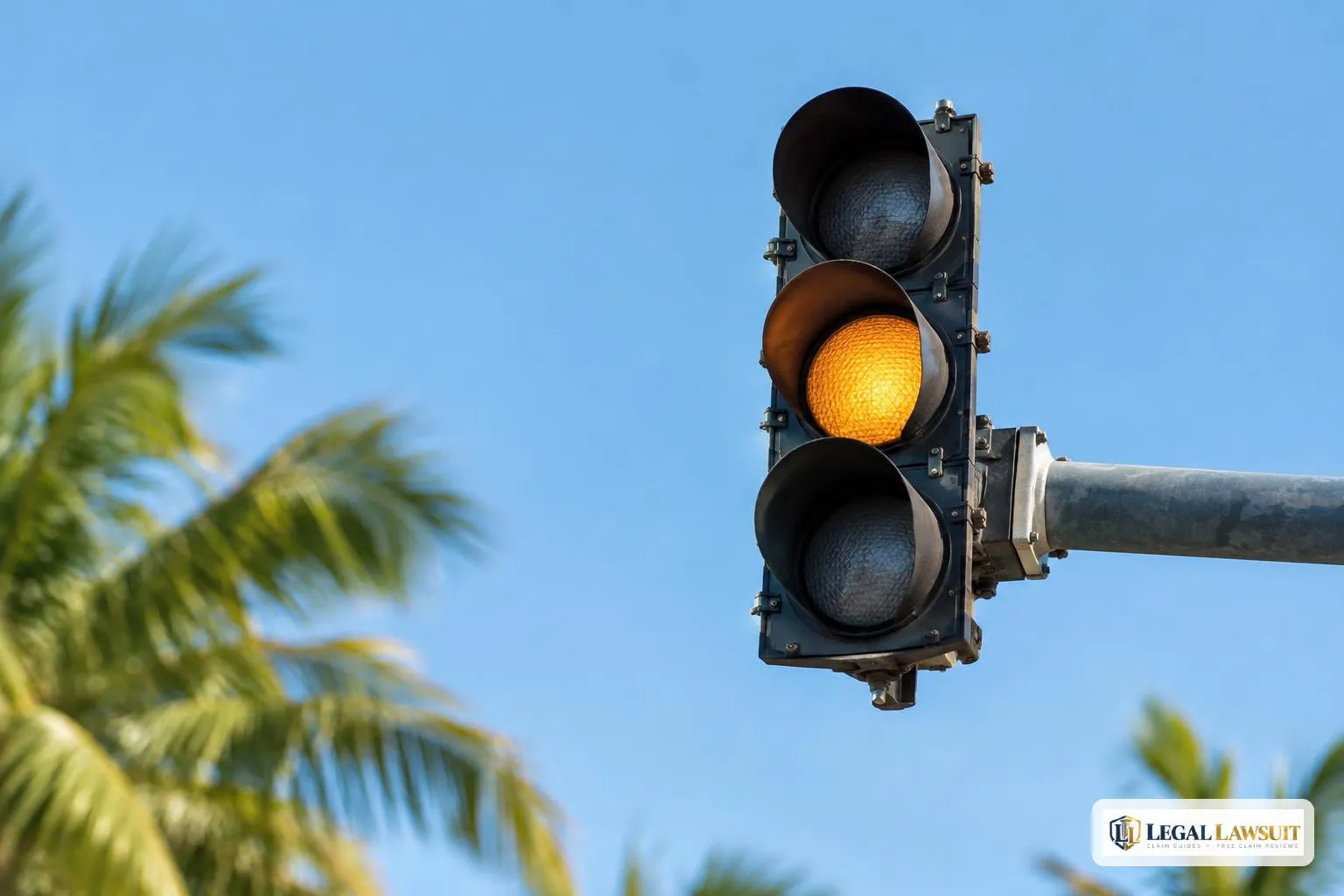
Under the Florida yellow light law, driving through a yellow light is not illegal by itself: a steady yellow is a warning that the red signal is about to show, and drivers may not enter the intersection once it does. If you were hit while the light was changing, that alone does not end your claim, but your recovery can be reduced by your own share of fault, and under Florida’s comparative fault statute a person found more than 50 percent at fault for their own harm cannot recover damages in a negligence case.
That makes the exact moment the light changed central to many intersection crash claims. When drivers remember the signal differently, the question becomes what the evidence can show about who entered the intersection on which color.
This guide covers what Florida’s signal statute says about yellow lights, red lights and pedestrians, and how long a yellow light lasts. Florida’s traffic engineering standards call for a yellow interval of at least 3 and no more than 6 seconds, calculated from the approach speed. It also explains what a red light camera notice means, including the $158 penalty and your right to a hearing without paying first. It then walks through how fault is divided in a Florida crash claim, the evidence that can show what the signal displayed, and practical next steps if the light is the main dispute in your claim.
Is it illegal to drive through a yellow light in Florida?
Short answer: Florida’s signal law treats a steady yellow light as a warning, not a stop command. The statute’s ban on entering the intersection applies once the light turns red.
Under Florida Statutes § 316.075, which governs traffic control signals, a steady yellow signal does two things:
- It warns drivers that the green movement is ending or that a red signal is about to follow (section 316.075(1)(b)).
- It makes clear that vehicles may not enter the intersection once the red is showing.
The same statute requires every traffic signal to show a yellow “caution” light between the green and the red (section 316.075(3)(a)). That yellow phase exists so drivers get notice before the right-of-way changes.
What this means in plain language
Under the statute’s wording, the line you cannot cross is entering on red. Going through on yellow is not the violation the statute describes. That does not mean speeding up to “beat” a yellow is legal in every situation, and it certainly does not mean it is safe. A yellow is a signal to judge whether you can stop, not an invitation to hurry.
Why the statute is only part of your claim
If you were in a crash at a changing light, keep two questions separate:
- What does the law say about the signal? This section covers that.
- Who will an insurer or court hold responsible for the crash? That depends on the evidence, how each driver acted, and Florida’s rules for splitting fault.
A driver who entered on yellow can still be blamed for part of a crash. A driver with a green light can still have duties toward others. The sections below explain how yellow timing works, what red light cameras record, how Florida divides fault, and which evidence can show what the signal actually displayed.
What Florida’s signal statute says about yellow, red and pedestrians
In short, Florida law treats a steady yellow as a warning, not a stop command. Once the light turns red, though, drivers may not enter the intersection. All of these rules come from Florida Statutes § 316.075, the state’s traffic control signal law. Here is how each color works, so you can compare it with what happened in your crash.
| Signal | What the statute requires | Who it mainly affects |
|---|---|---|
| Steady green | Drivers may proceed cautiously, straight or turning, unless a sign prohibits the turn. They still must yield to pedestrians lawfully in an adjacent crosswalk and to other vehicles lawfully in the intersection when the green appears. | Drivers entering on green, especially when turning |
| Steady yellow | Warns that the green movement is ending or that red is about to show. Once red appears, vehicles must not enter the intersection. | Drivers approaching as the light changes |
| Steady yellow (pedestrians) | Unless a pedestrian signal says otherwise, it tells pedestrians there isn’t enough time to cross before red. No pedestrian may start crossing. | People on foot at the curb |
| Steady red | Stop before the near-side crosswalk, or before the intersection if there is no crosswalk. Stay stopped until green shows. | All drivers facing red |
Turning on red
The red-light rule has exceptions. After a full stop, a driver may turn right on red. A driver may also turn left from a one-way street onto another one-way street. In both cases, the driver must yield to pedestrians and to other traffic using the intersection. These turns are not allowed where a sign prohibits them. A city or county can ban turns on red at a particular intersection, and the ban takes effect once a sign giving notice is posted.
Why the wording matters
Notice what the yellow rule does not say. It does not require every driver to stop the instant the light turns yellow. That is why many intersection disputes come down to one question: what was the light showing at the moment each vehicle or person entered? The green-light duty to yield also matters. A driver with a fresh green can still share responsibility if someone was already lawfully in the intersection.
How long does a yellow light last in Florida?
There is no single yellow-light length for every Florida intersection. The Florida Department of Transportation’s Traffic Engineering Manual, Chapter 3 (January 2026 edition) tells engineers to program the yellow change interval for at least 3 seconds and no more than 6 seconds. The exact time depends on the intersection.
Signal timing is engineered and documented, so it is something you can check. You don’t have to rely on what you or the other driver remember.
How FDOT sets the yellow time
- Based on approach speed: Engineers use a formula tied to how fast traffic approaches the intersection. Faster approaches generally need more time to stop safely.
- Rounded up: The calculated time is rounded up to the nearest 0.1 second, never down.
- Kept within limits: The result must fall within the 3-to-6-second range in the manual.
What “red clearance” means
After the yellow ends, many signals give a short red clearance interval. During this period, the lights facing every direction show red at the same time. It gives a driver who entered on yellow time to finish crossing before cross traffic gets a green. FDOT’s manual includes standards for setting this interval as well.
This all-red window matters in crash claims. A driver who entered on the final moment of yellow may still have been in the intersection when the other side’s light turned green.
A note on local signals
These standards come from FDOT’s manual. Cities and counties operate many signals, and the timing at your crash location may differ. If the light’s timing is disputed, ask for the actual timing records for that intersection. Don’t assume a particular number applies.
Red light cameras: what they enforce and what a notice means
A red light camera is not set up to ticket you for driving through a yellow. Under Florida’s Mark Wandall Traffic Safety Program statute, § 316.0083, cameras enforce failure to stop at a red signal under § 316.074(1) or § 316.075(1)(c)1. That is the red-signal rule. Entering on yellow is not what the program enforces.
What happens if you get a notice
Under that same statute, the notice goes to the registered owner of the vehicle, even if someone else was driving. It states a $158 penalty and gives you these options:
- Pay the penalty.
- Submit an affidavit naming the person who had care, custody or control of the car at the time.
- Request a hearing. You cannot be required to pay before a hearing you have requested.
About deadlines: different parts of the 2025 statute word their timing differently. Rely on the deadline printed on your own notice rather than a number you read online. If anything on the notice is unclear, contact the office listed on it and ask before the date passes.
Why camera footage can matter for a crash claim
If a camera covered the intersection where your crash happened, its images or video may help show what the signal displayed at the moment of impact. In a dispute over who had the light, that kind of recording can be more reliable than memory. Find out early whether a camera was there. We cover how to request and preserve this kind of evidence in the evidence section below.
Hit at a changing light? How fault is split in a Florida crash claim
If you were hurt in a crash at a light that was changing, the signal color can affect how much compensation you can recover. Florida uses comparative fault, which means each driver’s share of blame affects the outcome.
The two rules that matter
- Your share of fault reduces your damages. Under Florida’s comparative fault statute, section 768.81, any damages you recover are reduced in proportion to your own share of fault.
- More than half the fault can bar recovery. The same statute says a party found more than 50 percent at fault for their own harm cannot recover damages in a negligence action.
Why yellow versus red can move the percentages
The signal statute gives each driver specific duties. Under Florida Statutes § 316.075, a steady yellow is a warning, and traffic may not enter the intersection once the red is showing. A driver with a green light still has to yield to vehicles that are lawfully in the intersection. In a changing-light crash, this usually leads to three questions:
- Did each driver enter the intersection before the light turned red, or after?
- Was the other vehicle lawfully in the intersection when the light changed?
- Did the driver with the green light yield as the statute requires?
The answers can shift fault from one driver to the other, so the facts about timing matter. No one can predict how fault will be divided in a particular crash without looking at the evidence.
Your PIP benefits are a separate track
Personal injury protection (PIP) is handled through its own process with its own steps. Our guide to filing your Florida PIP claim walks through that process separately from the fault questions above.
If a family member helping with your claim prefers to read in Spanish, the page Falla comparativa en choques explains how a percentage of fault can reduce or eliminate a claim. It also covers how Florida, Texas and New York differ.
Evidence that shows what the signal displayed
When the color of the light is the main dispute, the strongest evidence is anything recorded at the moment of the crash. Your own clear account, written down early, comes next. Start gathering it as soon as you can. Recordings and records are not kept forever, so it’s best to ask promptly rather than assume they will still be there later.
Footage and the crash report
Ask early for any intersection video and for the crash report. Our guide on how to request traffic camera footage and the police report walks through who to contact and what to include in your request. Nearby businesses, buses and other drivers’ dash cameras may also have captured the signal.
Red light camera records
Some Florida cities and counties run red light camera programs. These cameras are used to enforce failure to stop at a steady red signal under Florida’s Mark Wandall Traffic Safety Program. If the crash happened at an intersection with one of these cameras, ask whether the local agency has images or video from that time.
Signal timing records
Yellow and all-red phases are not random. They are programmed to engineering standards, including FDOT’s rules for calculating yellow change and red clearance intervals based on approach speed. The agency that maintains the signal may have timing records. These records can help show how long each phase lasted, which you can compare against where each vehicle was when the light changed.
Your own notes
While your memory is fresh, write down:
- What color you saw, and when you first noticed it change
- Which lane you were in and which direction you were traveling
- Your approximate speed
- Names and phone numbers of anyone who saw the crash
- The time of day, the weather, and anything that blocked your view
Stick to what you actually observed. A careful “I’m not sure” is more useful than a guess that someone can later show was wrong.

Next steps if the light is the main dispute in your claim
When the color of the light is the main dispute, the claim usually turns on proof. These steps can help.
- Gather the signal evidence. Collect everything that shows what the light displayed and when: photos, video, witness names, the crash report, and your own notes written while your memory is fresh. Keep copies in one place, with dates.
- Put the signal facts in your demand. Insurers respond to specifics. When writing a demand letter that lays out the signal evidence, connect each piece of proof to what the light showed when you and the other driver entered the intersection.
- Check the insurer’s “ran the yellow” argument against the statute. Florida’s signal statute, section 316.075 treats a steady yellow as a warning. The stop requirement applies once the red shows. The statute also says a driver facing a green light must yield to vehicles already lawfully in the intersection. If an adjuster calls entering on yellow “running the light,” ask them to point to the statutory language they are relying on.
- Understand what a fault percentage means for you. Under Florida’s comparative fault law, section 768.81, your damages are reduced by your share of fault. If you are found more than 50 percent at fault for your own harm, you cannot recover damages in a negligence action. Because of this, a dispute over a few seconds of signal timing can decide whether you recover anything at all.
Where to get help
Legal Lawsuit’s guides can help you organize your documents, follow the steps of the claim, and know what questions to ask. This article is general information, not legal advice. No guide can guarantee how an insurer, judge, or jury will view your facts.
If the other side is contesting fault, or the insurer has assigned you a large share of blame, consider speaking with a licensed Florida attorney. A lawyer can review your evidence and explain how Florida law applies to your specific crash.
Keep researching on Legal Lawsuit
Frequently asked questions
Can I get a ticket for driving through a yellow light in Florida?
Under Florida’s traffic signal statute, § 316.075, a steady yellow is a warning that the green movement is ending and a red is about to show. The stop requirement attaches to the steady red, not the yellow. If your vehicle entered while the light was still yellow, the signal statute’s red-light stop rule is not what applied at that moment. Once red appears, you may not enter.
Do Florida red light cameras ticket drivers who enter on yellow?
Florida’s camera program is built around red-light violations. Under the Mark Wandall Traffic Safety Program, § 316.0083, cameras enforce failure to stop at a steady red under § 316.074(1) or § 316.075(1)(c)1. The notice goes to the vehicle’s registered owner and carries a $158 penalty.
The law also includes an affidavit option, for example if someone else was driving. You also have a right to a hearing, and you do not have to pay before that hearing takes place.
How long is a yellow light in Florida?
There is no single number for every intersection. The FDOT Traffic Engineering Manual requires the yellow change interval to be programmed for at least 3 seconds and no more than 6 seconds. The exact length comes from a formula based on the approach speed, and the result is rounded up to the nearest 0.1 second. Faster roads generally get longer yellows within that range.
If I was already in the intersection when the light turned red and got hit, can I still make a claim?
Possibly. The signal statute, § 316.075, says drivers facing a green light must yield to vehicles lawfully within the intersection. That rule can matter if you entered on yellow and were still clearing the intersection when cross traffic got a green. Whether your entry was lawful is often the very point the other side disputes, so the timing evidence matters.
Fault can also be shared. Under Florida’s comparative fault law, § 768.81, any damages you recover are reduced by your own percentage of fault, and a person found more than 50 percent at fault for their own harm cannot recover in a negligence action.
Can a pedestrian start crossing on a yellow light in Florida?
No. Under the same signal statute, § 316.075, a pedestrian facing a steady yellow may not start crossing the roadway. A pedestrian who began crossing earlier and is still in the road when the light changes is in a different position from one who stepped off the curb after the yellow appeared. In a pedestrian crash claim, when the person began crossing can be a key fact.
Sources
- Florida Statutes § 316.0083 – Mark Wandall Traffic Safety Program; administration; report (2025) · The Florida Senate
- FDOT Traffic Engineering Manual, Chapter 3 – Signals (January 2026) · Florida Department of Transportation · 2026-01-01
- Florida Statutes § 768.81 – Comparative fault · The Florida Senate
This article is general information, not legal advice. Laws and deadlines vary by state and change over time; check the linked sources or speak with a licensed attorney about your situation.
Related Posts

Your car is repaired, but its history now lowers what it's worth. This guide explains who usually pays for that lost value, what proof insurers ask for, and how to submit the claim in writing.
An adjuster sent you a medical release to sign after your crash. Here is what a broad authorization can unlock, how a release to your own insurer differs from one to the other driver's insurer, how to narrow it, and how to get your records yourself under HIPAA.
Who covers your rental after a crash depends on fault, the coverage you bought, and whether your car is repaired or totaled. This guide covers the three ways a rental gets paid for, what limits the rental, and what to do while the other insurer is still deciding fault.