
Short answer: This article explains the key facts, eligibility issues, settlement factors, deadlines, and source-backed updates related to this legal topic. Results vary by case facts, evidence, jurisdiction, and representation.
📋 Table of Contents
Car Accident Lawsuits Guide: How the Process Works
This car accident lawsuits guide starts with the basics: a lawsuit is a formal civil court case filed when an insurance claim doesn’t produce fair payment for injuries and losses. Most cases open as informal insurance claims, but suing becomes necessary when talks stall or an insurer acts in bad faith.
Car Accident Lawsuits at a Glance:
- Goal: full payment for medical costs, lost income, vehicle damage, and pain and suffering.
- When to sue: when an insurer denies the claim, offers too little, or contests who was at fault.
- What’s involved: filing a complaint, exchanging evidence (discovery), and possibly a trial.
- Legal foundation: most cases rest on proving the other driver’s negligence caused your injuries.
- Recovery: economic damages (like medical bills) plus non-economic damages (like pain and suffering).
Insurers commonly try to pay as little as possible, which can leave injured people in a bind. A claim is an informal negotiation with an adjuster; a lawsuit is a formal court case. Knowing when to move from one to the other is key to protecting your rights.
I’m Mason Arnao. Working alongside personal injury law firms has given me a close view of how car accident lawsuits unfold, and it’s shown me how important it is for injured people to understand the process and find experienced attorneys to advocate for them.
More on car accident lawsuits:
Insurance Claim or Lawsuit? Knowing When to Escalate
After a crash, the sensible first move is an insurance claim, which opens an informal negotiation with an adjuster. Most cases end there. But if the insurer isn’t dealing fairly, you need to recognize when it’s time for a car accident lawsuit.
A lawsuit is a formal court process, needed once informal negotiation with the insurer falls apart. For serious injuries, it’s frequently the only way to obtain fair compensation.

Going the Insurance Claim Route
With a claim, you give the adjuster evidence such as medical records and proof of lost pay. The adjuster’s job is to protect the insurer’s finances by keeping your payment low, which can mean a fast lowball offer before your injuries are fully known or an attempt to pin the crash on you.
A seasoned personal injury lawyer is your best ally at this stage, building a solid claim, negotiating firmly, and keeping you from accepting less than your case is worth.
When to File a Lawsuit
Some situations clearly point to filing a car accident lawsuit:
- Low offers: if the offer won’t cover your medical costs, lost income, and pain and suffering, legal action makes sense.
- Denied claims: when an insurer rejects a valid claim, suing may be the only option left.
- Contested fault: if liability is in doubt, a lawsuit’s formal discovery process is needed to nail down the facts.
- Catastrophic injuries: with severe harm like a spinal cord injury or TBI, what you need will probably exceed anything an insurer offers voluntarily, so a lawsuit is nearly always required to fund future care and account for lost quality of life.
A capable attorney can assess your case, walk you through the upsides and downsides of suing, and help you choose the best route. Often, simply filing suit brings the insurer back with a more reasonable offer.
The Stages of a Car Accident Lawsuit
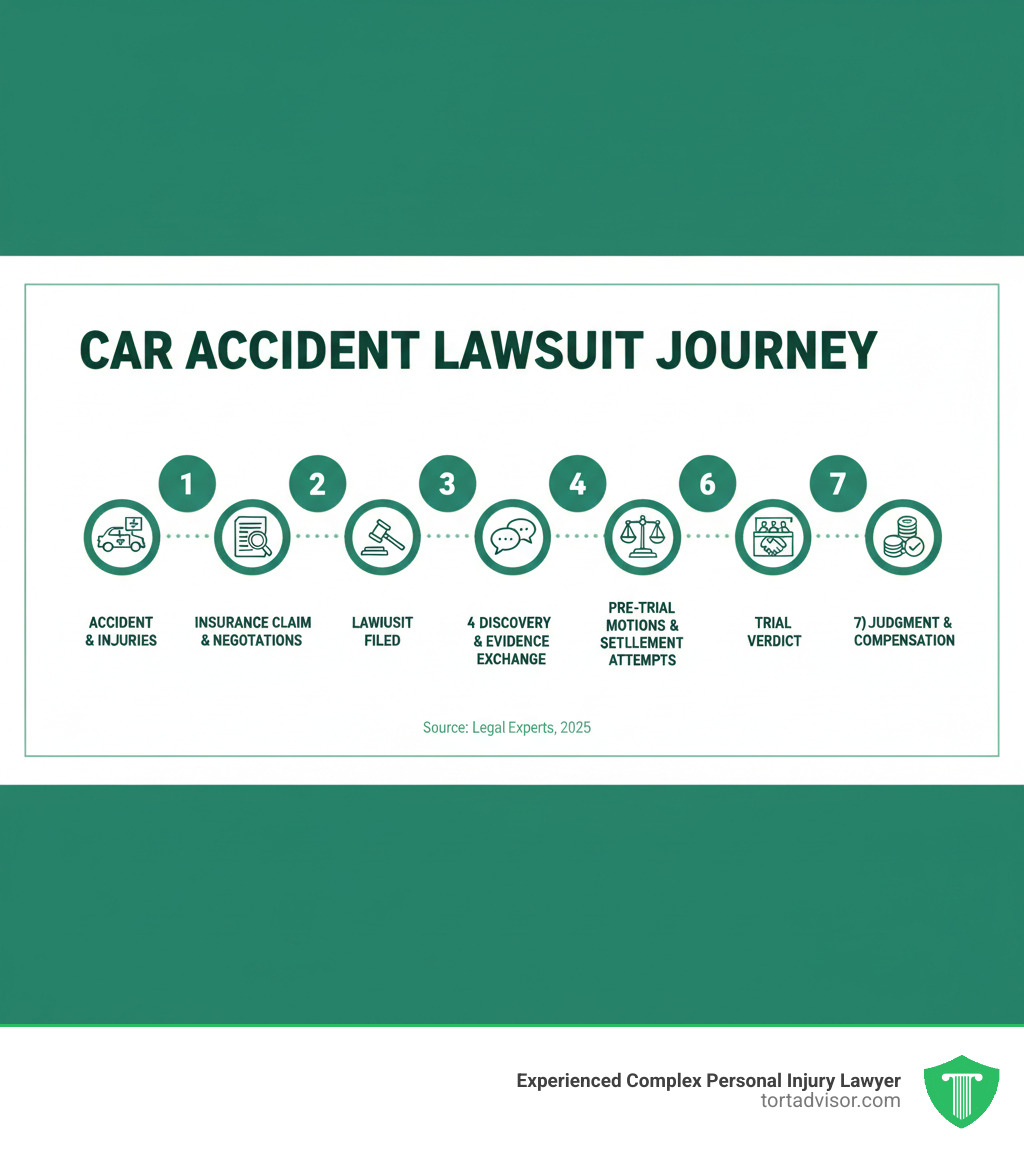
If you move forward with a car accident lawsuit, it helps to know the roadmap. Cases pass through several distinct phases, though most settle before the last one.

Stage 1: Starting the Case
Your attorney opens the case by filing a complaint, a document explaining what happened, why the defendant (the at-fault party) is liable, and what damages you suffered. The court issues a summons that is formally delivered to the defendant, who must respond with an answer to your allegations and may file a counterclaim blaming you.
Stage 2: Discovery
Discovery is the evidence-gathering phase and usually the longest. Each side shares information to gauge the case’s strengths and weak spots, using tools such as:
- Interrogatories: written questions answered under oath.
- Requests for production: formal demands for documents like photos, medical records, and police reports.
- Depositions: sworn testimony from parties and witnesses taken outside court.
- Independent Medical Examinations (IMEs): an exam by a doctor the defense selects.
Stage 3: Pretrial Motions and Last-Round Negotiations
As discovery wraps up, both sides see the case more clearly, which often restarts settlement talks. Lawyers may file pretrial motions, such as a motion for summary judgment asking the judge to decide without a trial. Many courts require mediation (assisted negotiation) or arbitration (a decision by a neutral third party) to push toward settlement, and efforts to settle continue right up to trial.
Stage 4: Trial
Without a settlement, the case is tried. A trial generally includes:
- Picking a jury: selecting impartial jurors.
- Opening statements: each side previews its case.
- Evidence: witnesses testify and face cross-examination, and documents are introduced.
- Closing arguments: each side sums up and asks for a favorable result.
- Verdict: the jury deliberates and decides liability and damages.
A skilled attorney leads you through every stage and makes sure your story comes through clearly.
How to Prove Your Car Accident Case
Winning a car accident lawsuit means showing the other driver was negligent and that this negligence caused your injuries, which depends on core legal principles, state law, and above all the tort of negligence.
The Four Elements of Negligence
Your attorney has to prove four things:
- Duty of care: the other driver was legally required to drive safely.
- Breach: they fell short of that duty, for example by texting, speeding, or running a red light.
- Causation: that breach directly caused your injuries.
- Damages: you suffered real, measurable harm like medical costs, lost pay, or pain and suffering.
Proving these takes strong evidence, from police reports and witness accounts to expert analysis, and an experienced lawyer knows how to assemble it into a persuasive case.
At-Fault vs. No-Fault States
Car accident rules vary by state. Most follow an at-fault approach: the driver who caused the crash pays for the damage, so you claim against their insurer and can sue them if talks fail.
A smaller group of states uses a no-fault approach, where your own Personal Injury Protection (PIP) under no-fault insurance covers early medical bills and lost wages no matter who caused the crash. To sue the at-fault driver for more, such as pain and suffering, your injuries must clear a lawsuit threshold, either monetary (medical costs above a set amount) or verbal (an injury defined as “serious,” like a fracture or permanent disfigurement).
Common Defenses in Car Accident Lawsuits
The defense will work to shrink or erase its liability. Typical defenses include:
- Statute of limitations: a firm filing deadline; miss it and the case is barred permanently, which is why contacting a lawyer early matters. Read more about the statute of limitations.
- Shared fault: the defense argues you were partly responsible, and state rules differ sharply:
- Contributory negligence: in a few states, being found even 1% at fault wipes out recovery entirely. See contributory negligence.
- Comparative negligence: used by most states, it reduces your award by your share of fault. Under a modified version, you recover nothing once your fault passes a cutoff, usually 50% or 51%. See comparative negligence.
Figuring Out and Claiming Compensation
Getting the damages number right is essential in any car accident lawsuit. The aim is to be paid for every loss, financial and personal, and those losses fall into two main groups.

Special vs. General Damages
Special damages, also called economic damages, are your measurable money losses, proven with bills, receipts, and employment records. They cover:
- Medical costs: everything from the ambulance to future surgeries.
- Lost pay: income you missed while unable to work.
- Reduced earning capacity: the drop in your ability to earn because of your injuries.
- Vehicle damage: what it costs to fix or replace your car.
General damages, or non-economic damages, cover personal losses that don’t come with a price tag, such as:
- Pain and suffering: the physical pain and emotional strain of your injuries.
- Emotional distress: anxiety, depression, or PTSD caused by the crash.
- Loss of enjoyment of life: no longer being able to enjoy activities and hobbies you used to love.
- Loss of consortium: a spouse’s claim for lost companionship and support.
Valuing general damages takes skill and experience to show how much the crash has diminished your quality of life.
Damage Caps and Special Claims
State law can limit what you recover. Many states cap non-economic damages, which can restrict payment for pain and suffering, while punitive damages may be available to punish especially reckless conduct.
When a crash is fatal, surviving relatives can bring a wrongful death claim for lost financial support and companionship. See our guide to common motor vehicle accident injuries for more.
Collecting Your Award When the Defendant Can’t Pay
A verdict is only part of the job; the money still has to be collected. Usually the defendant’s liability insurer pays. If the at-fault driver has no insurance or too little, your own uninsured/underinsured motorist (UM/UIM) coverage can fill the gap. If the driver was on the job, their employer may be liable, and as a last resort it may be possible to go after the defendant’s personal assets, though that process is complicated.
What a Car Accident Lawyer Does for You
Dealing with the legal system after a crash can be overwhelming. A seasoned car accident lawyer serves as your advocate and guide, managing the complicated parts so you can concentrate on healing.
How a Lawyer Supports Your Car Accident Lawsuit
Your lawyer handles every part of the case, including:
- Case review: a candid read on how strong your claim is and what it may be worth.
- Collecting evidence: getting police reports, medical records, and witness statements, and securing key proof like surveillance video.
- Bringing in experts: accident reconstructionists, doctors, and economists who make the claim credible.
- Dealing with insurers: taking over all contact with adjusters trained to cut payouts, and pushing back on their tactics to reach a fair settlement.
- Representing you in court: if no fair deal is offered, trying the case before a judge and jury.
The focus is always on getting the full value of your claim, and an attorney keeps you from being pushed into accepting too little. Read more about what a personal injury lawyer can do for you.
How Contingency Fees Work
Plenty of injured people worry about what a lawyer costs. Most car accident attorneys use a contingency fee agreement:
- Nothing upfront. The lawyer is paid only if the case succeeds.
- A share of the recovery. Usually 33-40% of the settlement or verdict, which ties your lawyer’s pay to how much they recover for you.
- Costs handled separately. Filing fees, expert fees, and similar expenses are usually fronted by the firm and repaid from the recovery, so anyone can get capable representation regardless of finances.
For the details, see our guide on how much a personal injury lawyer costs. Legal Lawsuit connects you with experienced attorneys in our network who handle car accident lawsuits.
Car Accident Lawsuit FAQs
Questions are normal after a crash. Here are plain answers to some of the most common ones about car accident lawsuits.
What should I do right after a car accident?
Safety first; move your car out of traffic if you can. Then take these steps:
- Call 911: it brings medical help and produces an official police report.
- Swap information: get the other driver’s name, contact details, and insurance, and don’t admit fault.
- Record the scene: photograph and film vehicle damage, the area, and any visible injuries, and collect witness contact details.
- Get checked out: see a doctor quickly even if you feel okay, since adrenaline can hide injuries and a prompt visit links your condition to the crash.
- Notify your insurer: report the crash to your own company promptly as your policy requires. Our guide on how to report a motor vehicle accident has more.
How long does a car accident lawsuit take?
It varies widely. A straightforward car accident lawsuit may settle in a few months, while one with severe injuries or disputed fault can run a year or longer. Injury severity, court schedules, and the other side’s willingness to negotiate all affect timing. A typical case that goes to trial may take 9-12 months, though your lawyer will aim to resolve it efficiently without giving up value.
Can I sue after taking an insurance settlement?
In nearly every case, no. Accepting a settlement means signing a “release of liability,” a binding document that ends further claims from that crash, even if new injuries surface or costs turn out higher. That’s why it’s essential to talk to an experienced attorney before signing anything or accepting an offer, so the settlement truly covers your present and future losses.
Conclusion
As this guide shows, car accident lawsuits are complicated. Proving negligence, handling court procedure, and valuing compensation all call for legal know-how, and insurers employ lawyers whose job is to protect profits, counting on you to feel too overwhelmed to push back.
Legal Lawsuit understands how much a crash can turn life upside down. That’s why we connect injured people with experienced, vetted attorneys in our network who have the resources and drive to take on tough cases.

You don’t have to handle this by yourself. Whether you’re facing a lowball offer, a denial, or serious injuries, the right lawyer can change the outcome, and most personal injury attorneys work on contingency, so you pay nothing unless they win.
Protect your rights before the filing deadline passes. Take the first step today with a free, confidential case review for your car accident lawsuit, and we’ll connect you with an attorney ready to advocate for you.
Estimate your claim: before talking to an insurer, get an educational estimate of what your case may be worth with our free Car Accident Settlement Calculator.
Related Posts
Quick Answer: The Boy Scouts of America (BSA) filed for Chapter 11 bankruptcy in 2020 after facing tens of thousands [...]
Quick Answer: Survivors of sexual abuse by Catholic priests, nuns, or other Church personnel may be able to file a [...]
Quick Answer: Clergy abuse settlements vary enormously based on the severity of the abuse, the strength of evidence that the [...]