

Short answer: This article explains the key facts, eligibility issues, settlement factors, deadlines, and source-backed updates related to this legal topic. Results vary by case facts, evidence, jurisdiction, and representation.
📋 Table of Contents
- Understanding Personal Injury Lawyer Fees: What You Need to Know
- The Contingency Fee: No Win, No Fee Explained
- Beyond the Percentage: Understanding Case Costs and Expenses
- How much does a personal injury lawyer cost across different scenarios?
- Is Hiring a Personal Injury Lawyer Worth the Cost?
- Frequently Asked Questions about Personal Injury Lawyer Costs
- Conclusion: Making an Informed Decision
Personal Injury Lawyer Fees: The Essentials
How much does a personal injury lawyer cost? It’s usually among the very first things injured people ask before hiring anyone. Encouragingly, the majority of injury attorneys work on contingency — there’s no charge up front, and you pay only if the case brings in money.
Quick Answer:
- Contingency Fee: Typically 33%–40% of the settlement or verdict
- Money Due Up Front: Usually nothing
- If the Case Is Lost: Normally no attorney fee is owed
- Other Expenses: Case costs such as filing fees, experts and medical records
- Common Rates: About 33% when a case settles, 40% when it goes to trial
With medical bills stacking up and paychecks missed, many accident victims assume a lawyer is out of reach — and that fear stops plenty of people from getting help they need. In reality, contingency arrangements put skilled representation within reach of anyone, whatever their finances.
Under this system, the lawyer shoulders the financial risk, putting in time, money and know-how without any promise of being paid. That gives experienced attorneys every reason to push for the strongest result.
I’m Mason Arnao. My background is in technology and business operations, where I’ve helped service companies simplify how they work with clients — including explaining how much a personal injury lawyer costs and how fee structures work. Experience with SaaS platforms and client-management systems gives me a practical view of how legal fees are set up and what clients should expect.
How the Contingency Fee Works: “No Win, No Fee”
Imagine you’re already juggling medical bills, lost income and the strain of recovering from a crash. Paying a lawyer thousands of dollars before anything happens is the last thing you need — which is exactly why the contingency fee model matters so much.

With a contingency fee, your attorney is paid only if your case succeeds. No recovery, no fee. That simple rule clears away the cost barrier that would otherwise keep many injured people from getting legal help.
In practice, rather than billing by the hour or demanding a retainer, the lawyer keeps a share of whatever compensation is recovered for you — whether it comes from a settlement or a court judgment — and that payment is taken from the recovery itself.
The result is that your interests and your lawyer’s line up. Because the attorney’s pay depends on how well you do, they have a built-in reason to go after the largest recovery possible.
This model suits injury cases especially well because it moves the financial risk off you and onto the attorney, who invests time, skill and money with no guaranteed payday. That means experienced help is available no matter what your bank account looks like right now.
To learn more about how injury cases unfold, read our Personal Injury Lawsuits guide. Cornell Law’s explanation of contingency fees also covers the legal background of this arrangement.
What Percentage Do Injury Lawyers Usually Take?
For most people asking how much a personal injury lawyer costs, the answer is 33% to 40% of the total recovery. Where your fee lands in that range often depends on how far the case goes.
The most typical fee is one-third (33.3%). Martindale-Nolo research found that 72% of personal injury claimants paid 33% or less in attorney fees. That standard rate generally applies to cases resolved before trial.
Cases demanding more work can carry a higher percentage. A case that goes to trial frequently involves a 40% contingency fee to reflect the added time, preparation and risk of litigating in court.
Some lawyers use a sliding scale, raising the fee as the case grows more involved — for instance, 33% for an early settlement, 36% once a lawsuit is filed, and 40% if it reaches trial.
Fees are sometimes negotiable, particularly in simple cases where fault is obvious. Medical malpractice, defective product and other complex cases may justify a higher percentage given the specialized skill and heavy resources they require.
Above all, insist on a written agreement that states exactly what percentage you’ll pay and when. That clarity prevents surprises and shows you precisely what a personal injury lawyer will cost in your situation.
Beyond the Fee: Case Costs and Litigation Expenses
If you’re asking how much a personal injury lawyer costs, remember the attorney’s percentage is only part of the picture. Case costs and expenses are a second piece that can noticeably affect what you take home.
Put simply, the attorney fee pays for the lawyer’s skill and time, while case costs are the real out-of-pocket expenses the firm pays while pursuing your claim. They’re entirely separate, and understanding that distinction helps you avoid unpleasant surprises later.
Encouragingly, you usually won’t pay those costs as they arise. Injury firms commonly advance case expenses for you and are reimbursed from the final settlement or award.
It’s another built-in protection. You already have medical bills and missed wages to deal with — you shouldn’t have to fund expert witnesses or filing fees while you’re trying to heal.
Court filing fees cover officially opening the lawsuit and submitting key documents. Expert witness fees can be significant — a doctor may be needed to explain your injuries, or an accident reconstructionist to show how the crash happened. Experts commonly charge from $500 to more than $10,000, depending on their specialty and the work involved.
Deposition and transcript costs accumulate whenever sworn testimony is taken from witnesses, doctors or the other side; court reporters bill for their time and the written transcript, frequently $500 or more per session. Other expenses include medical record fees to obtain your full treatment history, investigation costs such as police reports or private investigators, and routine postage and copying for the paperwork a case produces.
Expect anything from a few hundred dollars in a simple case to several thousand in a complicated one. What matters is a written agreement explaining exactly how these costs are handled and when they’re repaid.
How Case Costs Change What You Take Home
This detail has a real effect on your net recovery: the order in which costs and fees come out of a settlement can shift what you receive by thousands of dollars.

Firms handle it one of two ways. The client-friendly method subtracts costs first and figures the fee on the remainder. The firm-friendly method figures the fee on the full settlement and then subtracts costs from what’s left.
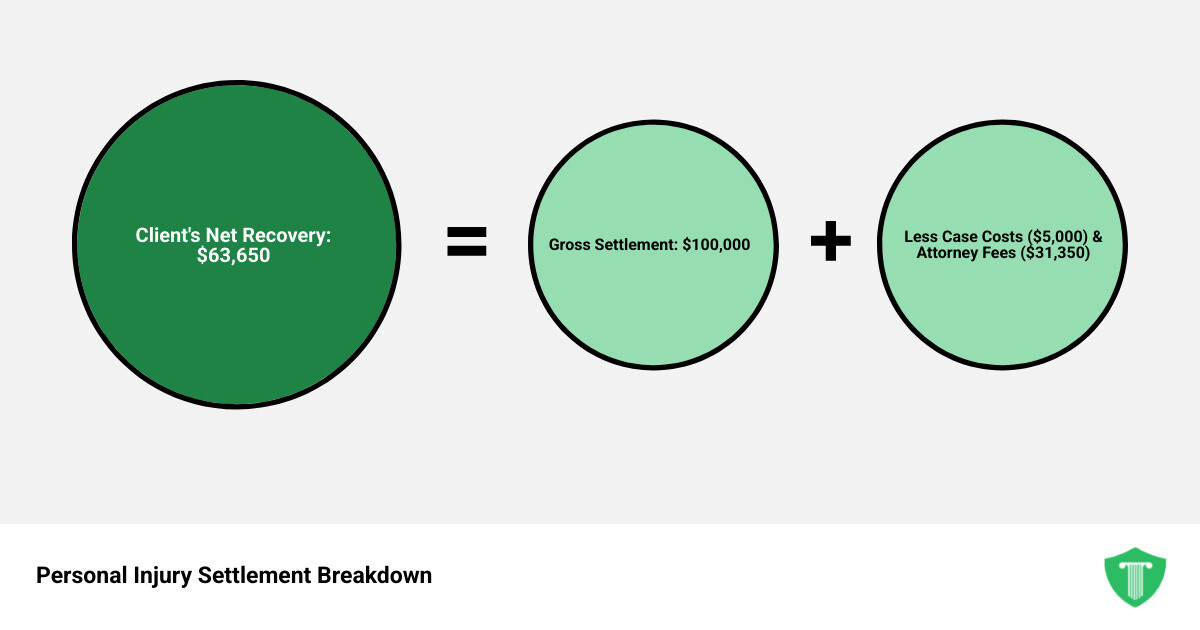
Suppose a $100,000 settlement carries $10,000 in costs and a 33% fee. Under the client-friendly method, the $10,000 comes off first, leaving $90,000; the 33% fee is $29,700, and you receive $60,300.
Under the firm-friendly method, the 33% fee is taken from the whole $100,000 ($33,000), and the $10,000 in costs then comes out of the remaining $67,000, leaving you $57,000 — a $3,300 gap.
Many reputable firms use the client-friendly method because it’s fairer to the client. Make sure your agreement says which method applies — it’s exactly the kind of detail that determines how much a personal injury lawyer really costs.
Some states, California among them, have laws requiring lawyers to clearly explain how costs affect a client’s recovery. You can read the details of California law on fee agreements to see those consumer protections in action.
From a simple car crash claim to something more involved like Mass Tort Litigation Support, understanding these cost structures helps you choose representation wisely.
What a Personal Injury Lawyer Costs in Different Situations
There’s no universal answer to how much a personal injury lawyer costs. The route your case takes shapes the final number: the contingency model stays the same, but the percentage and total expenses can vary a great deal with your circumstances.

Knowing what drives those differences helps you choose representation wisely. Below are the main cost factors and the fee arrangements you may come across.
What Affects the Final Cost of an Injury Lawyer?
A handful of factors influence both the contingency percentage and the overall expense of an injury case.
Complexity matters most. A simple fender-bender with obvious fault and minor injuries usually stays at the standard 33%. A tangled medical malpractice case with several doctors, mountains of records and difficult liability questions may warrant something nearer 40% because of the extra expertise and resources involved.
The attorney’s experience and reputation count too. Veteran lawyers with strong histories of large settlements and verdicts may ask for a higher percentage — and their skill at negotiating often produces a meaningfully bigger recovery that can justify it.
The odds of trial directly affect cost. Quick settlements are cheaper to handle than cases needing extensive courtroom preparation, so if trial looks likely, the percentage may reflect the added time, expense and risk.
Location can nudge fee structures a little, though contingency remains the norm everywhere. Legal Lawsuit helps you connect with attorneys in our network across all states, so you can find solid representation wherever the accident happened.
The kind of case also matters. A slip and fall usually needs fewer resources than a complex product liability claim over a defective medical device. That’s why Legal Lawsuit aims to match you with attorneys experienced in your specific type of case, such as our Best Motor Vehicle Accident Attorney connections.
How Other Fee Arrangements Compare
Contingency fees dominate injury law, but looking at the alternatives shows why “no win, no fee” works so well for injured people.
Hourly billing is the traditional approach: you pay for each hour the attorney spends on your matter. Lawyers nationally average roughly $300 an hour, with rates from about $150 to $500 or more based on experience and location. For someone already struggling with medical bills and lost income, those charges can mount fast.
Retainers are upfront deposits the lawyer bills against hour by hour; when the money runs out, you top it up to keep going. They’re common in business and family law but rare in injury cases, precisely because they put a financial wall in front of injured clients.
Flat fees are a fixed price for a defined service no matter how long it takes — think drafting a contract or handling an uncontested divorce. Injury cases are too unpredictable and vary too much in complexity for flat fees to fit.
Contingency fees prevail in injury law because they remove the financial obstacles to justice: no money is needed to start, and a fee is owed only if compensation is recovered. That aligns the attorney’s incentives with your goal of the best possible result.
Can the At-Fault Party Be Made to Cover Your Legal Fees?
Plenty of people expect the person who hurt them to pay their attorney fees in addition to damages. In the U.S., that seldom happens, thanks to a principle known as the “American Rule.”
That rule says each side pays its own lawyer, win or lose. So even with a total victory, the defendant usually won’t be ordered to cover your legal bills; your attorney’s fee comes out of the settlement or award under your contingency agreement.
A few exceptions exist, though they rarely apply to everyday injury claims. Contract provisions occasionally make the loser pay the winner’s fees, mostly in business disputes. Certain statutes shift fees in areas such as civil rights or consumer protection, but ordinary accident cases generally don’t qualify.
Judges sometimes order sanctions making one side pay the other’s fees, but only for frivolous suits or bad-faith litigation conduct — rare situations, not the norm.
The upshot: in nearly every injury case, attorney fees come out of your recovery, and under contingency that only happens when compensation is actually obtained, so there’s no upfront risk to you.
Is a Personal Injury Lawyer Worth the Fee?
You may be thinking that even on contingency, handing over a share of your settlement is still a cost. That’s true. The better question is whether it pays off — and for many injured people, the evidence suggests it does.

Consider the trade-off: would you prefer all of a small settlement or roughly two-thirds of a much bigger one? With a skilled attorney, the math frequently tips in your favor.
The gap in outcomes can be large. Industry studies are widely cited as finding that injured people with attorneys recover around three times as much as those who handle claims alone. Insurers know what they’re doing when they lowball unrepresented claimants — they’re betting you don’t know what your claim is worth.
Adjusters negotiate for a living, and most claimants don’t. They handle claims like yours daily and know which pressure points, deadlines and tactics push people toward accepting too little. Once an attorney gets involved, that balance shifts — the adjuster now faces someone who knows the playbook.
Something many people overlook: lien negotiation alone can put real money back in your pocket. If your health insurer paid medical bills after the accident, it will usually want to be repaid from your settlement. These medical liens or subrogation claims can consume a big share of your recovery.
Attorneys routinely negotiate such liens down. As a hypothetical, if your insurer paid $5,000 toward an ER visit originally billed at $15,000, a lawyer might negotiate the lien to $2,000 or less — savings that can go a long way toward offsetting the fee.
The legal process is harder than it appears. Injury law involves firm deadlines, complex evidence rules and detailed damage calculations. Blow one deadline and the case can be thrown out; under-document your pain and suffering and you leave money behind. An attorney manages all of it while you recover.
Your peace of mind has value. Juggling insurers, medical providers and legal paperwork while healing is exhausting, and many injured people find that handing it off lets them actually focus on getting better.
People tend to underestimate their claims. You may think only medical bills and lost pay count, but pain and suffering, emotional distress, lost enjoyment of life and future medical needs can be significant — and hard to value without experience.
So while how much a personal injury lawyer costs is a fair question, the bigger one is what going without a lawyer could cost you. In many cases, injured people keep more money even after the fee is paid.
Still unsure whether you need help? Our guide “Do I Need a Personal Injury Lawyer?” walks through the factors that matter in your case.
Personal Injury Lawyer Cost FAQs
Worrying about cost is normal when you’re hurt and thinking about hiring a lawyer. Here are clear answers to the questions people ask most about how much a personal injury lawyer costs.
What do I owe a personal injury lawyer if I lose?
One of the most reassuring features of contingency representation: if the case doesn’t recover money, you usually owe no attorney fee. For the lawyer’s services, “no win, no fee” really means just that.
That removes the fear of a huge legal bill after a loss. The attorney is paid only when you are, so they’re as invested in a good outcome as you are.
There’s one important caveat. Even without an attorney fee, you could still owe case costs — the litigation expenses described above, such as filing fees and expert charges. Some firms expect repayment of advanced costs regardless of outcome; others absorb them if the case is lost.
That’s why a clear, written fee agreement matters so much. Before signing, confirm whether you’d owe case costs after a loss. The best firms explain this openly from day one.
Do I have to pay anything up front to hire an injury lawyer?
Generally, no — there are usually no upfront costs to hire a personal injury lawyer. That’s one of the biggest benefits of contingency representation and why legal help is open to everyone, whatever their finances.
Most injury attorneys, including those in the Legal Lawsuit network, offer a free first consultation, so you can talk with an experienced lawyer, review your case and options, and learn how fees work without paying anything. It’s a low-pressure way to gather the facts before you decide.
Attorney fees aren’t paid up front, but case expenses do build up as the case moves along. Firms typically advance them, so you won’t be writing checks for filing fees, records or experts along the way; they’re tracked and repaid from the settlement at the end.
That way you can concentrate on recovering while the attorney carries both the legal work and the cost of pursuing your claim.
What happens to fees if I change lawyers partway through?
You can always switch attorneys if you’re unhappy, and you won’t be hit with two full fees — the system protects clients here.
If your case later succeeds, the total fee taken from the settlement still stays within the normal contingency range. You won’t pay beyond the agreed percentage, usually the 33%–40% discussed above.
In practice, your first lawyer is compensated for the reasonable value of work done before the switch, your new lawyer is paid for handling the case from there, and the two firms divide the overall contingency fee according to each one’s contribution.
The first attorney may place an attorney’s lien on the settlement to secure their share at the end — a routine step that protects both lawyers without adding surprise costs for you.
Bottom line: you should never feel stuck with a lawyer who isn’t serving you well. The rules safeguard your right to good representation without penalizing you for changing course.
Final Thoughts: Choosing With Confidence
After an injury, figuring out how much a personal injury lawyer costs shouldn’t add to your stress. The strength of the contingency system is that it tears down financial barriers and opens quality representation to everyone, whatever their circumstances.
The core lesson is straightforward: you don’t need cash up front to get strong legal help. With contingency fees usually between 33% and 40%, you pay only when compensation is recovered, so your attorney succeeds only when you do.
Still, informed clients fare best. A clear, written fee agreement is essential — it should explain how the fee is calculated, when case costs come out and what happens in each scenario. Ask questions freely; a reputable attorney will be glad to explain every detail.
Good questions to raise: Are costs taken out before or after the fee? What happens if the case is lost? Could I owe anything regardless of outcome? Does the fee change if the case goes to trial? Those conversations help you decide wisely and avoid surprises.
Legal Lawsuit values transparency because informed people make better choices. Our role is to help you connect with trusted attorneys in our network while making sure you understand every part of the process, including the money side.
Going without proper representation can cost far more than hiring an experienced attorney. Insurers rely on unrepresented people accepting low offers — don’t let that be your story.
Ready to pursue the compensation you deserve? Request a free, confidential case review for your Personal Injury Lawsuit through Legal Lawsuit today. It starts with a simple conversation and costs nothing to begin.
Additional Resources
Related Posts
Quick Answer: The Boy Scouts of America (BSA) filed for Chapter 11 bankruptcy in 2020 after facing tens of thousands [...]
Quick Answer: Survivors of sexual abuse by Catholic priests, nuns, or other Church personnel may be able to file a [...]
Quick Answer: Clergy abuse settlements vary enormously based on the severity of the abuse, the strength of evidence that the [...]

