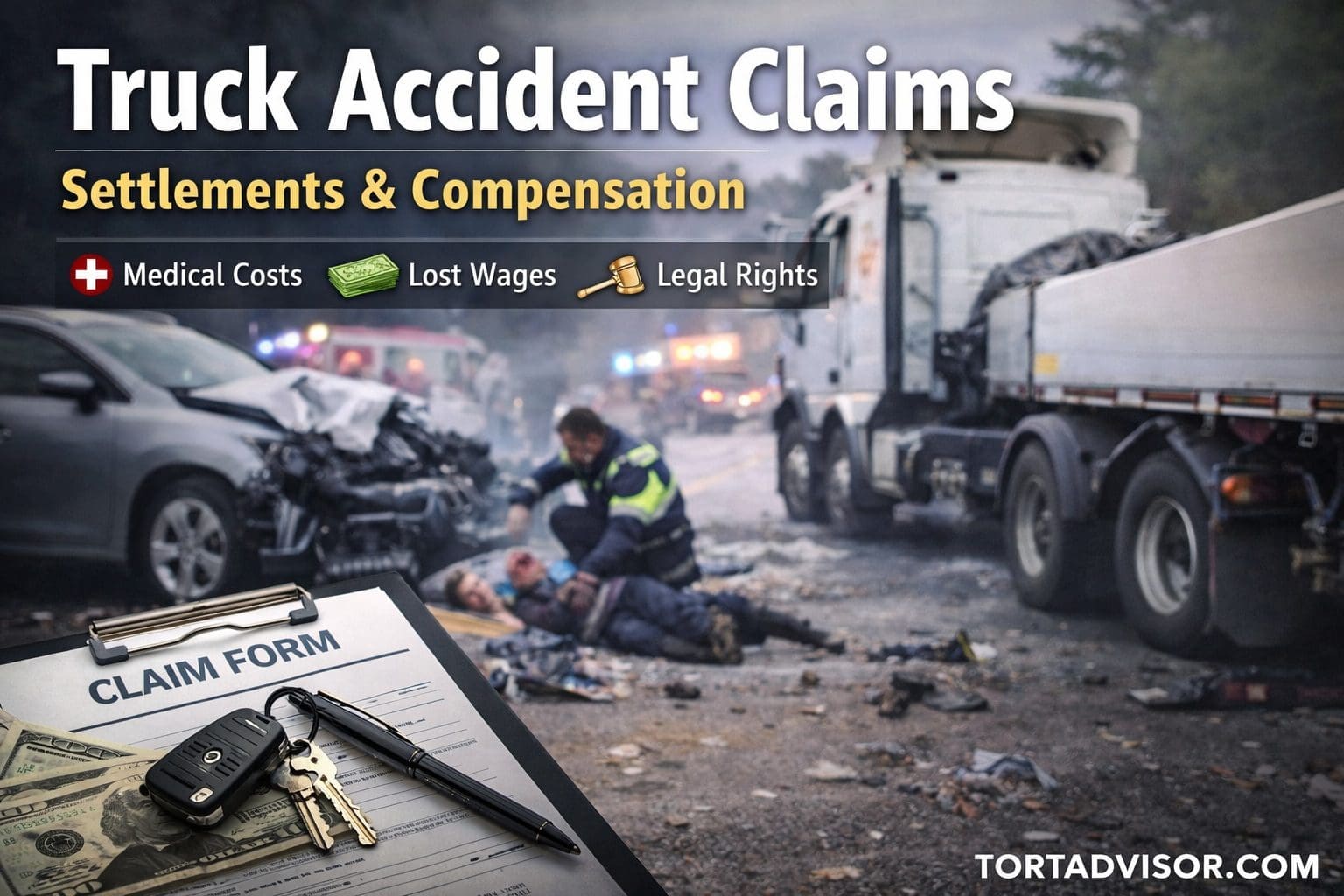
Truck Accident Lawsuit Settlements: How 18-Wheeler Claims Are Valued
When a tractor-trailer, box truck or other commercial vehicle causes a crash, the injured person can bring a claim against the driver and, very often, the motor carrier and other companies whose safety failures contributed to it.
Interstate trucking is governed by the Federal Motor Carrier Safety Administration (FMCSA). Truck crash cases are brought one person at a time, and what a claim is worth depends on the injuries, the proof of fault and the commercial insurance in place.
Check Whether Your Truck Crash Claim Could Qualify
Use the short form to send your crash details, injuries, treatment and losses for a confidential review.
How Does a Truck Accident Lawsuit Work?
A truck accident lawsuit asks a negligent commercial driver, the carrier behind them and any other responsible company to pay for medical care, lost income, pain and suffering and related losses. The Federal Motor Carrier Safety Administration (FMCSA) regulates these vehicles, and because a loaded tractor-trailer can outweigh a passenger car many times over, the injuries in these crashes tend to be far more serious.
Truck crash cases are individual injury claims, not class actions or MDLs. Each one is judged on its own facts: how the collision unfolded, who broke which rules, how badly you were hurt and how much insurance coverage the carrier carries.
Do You Have a Truck Accident Case?
Your situation is worth a closer look if several of these are true:
- You were hurt in a collision with a semi, tractor-trailer, delivery truck or another large commercial vehicle.
- The driver or carrier may have broken federal rules on driving hours, maintenance, cargo loading or licensing.
- Your medical treatment is documented and linked to the crash.
- The crash cost you income or left you with a disability or lasting impairment.
- Your state's statute of limitations has not expired.
Responsibility does not stop with the driver. The motor carrier, a shipper or loading company, an outside maintenance shop and the maker of a defective part can all share liability, and a thorough investigation looks at each of them.
Federal Trucking Rules and Who Is Liable
FMCSA rules cover driver hours of service, inspection and maintenance, cargo securement, driver qualification and drug and alcohol testing. Proof that a carrier or driver broke one of these rules is often strong evidence of negligence.
Potentially liable parties include the driver, the motor carrier, a freight broker or logistics company in some cases, the business that loaded the trailer, a maintenance contractor and the manufacturer of a failed component.
Hours-Of-Service Violations
Driving past federal hour limits leaves drivers exhausted, and fatigue shows up again and again in serious truck crashes.
Skipped Inspections and Repairs
Brakes, tires, lights and other parts that were worn out or never fixed.
Loading and Cargo Problems
Freight that was overweight, unbalanced or poorly secured and shifted or fell during the trip.
Truck Accident Settlements and Verdicts in 2026
Truck crash payouts have no fixed schedule, and any average you read is an educational estimate, not a promise. Value typically tracks the severity of the injuries, the strength of the fault evidence, the carrier's insurance limits, lost earnings, medical costs and the court where the case is filed.
| Injury Level (Educational) | Common Characteristics | What Pushes Value Up or Down |
|---|---|---|
| Severe injuries | Catastrophic harm such as spinal cord injury, brain injury or a fatal crash (see our wrongful death lawsuit requirements guide). | Federal rules require most interstate freight carriers to carry at least $750,000 in liability coverage, and up to $5 million for certain hazardous loads, so serious claims can reach high values. |
| Moderate injuries | Fractures, surgery or long treatment and recovery. | Shaped by medical bills, missed work and recovery time. |
| Minor injuries | Soft-tissue injuries that heal relatively quickly. | Shaped by documented care and any lost pay. |
Get legal advice before you respond to the trucking insurer's first offer. Carriers often send their own investigators to a crash scene within hours to start building a defense, so the earlier your side preserves evidence, the better.
What Causes Most Truck Crashes
Driver Fatigue
Exhaustion from breaking hours-of-service limits or long stretches without real rest.
Distraction and Impairment
Phones and dispatch screens, drowsiness, or alcohol and drugs behind the wheel.
Bad Loading
Overweight, unsecured or lopsided cargo that makes the truck harder to control.
Neglected Maintenance
Brake failure, tire blowouts and other mechanical breakdowns.
Jackknife and Underride Crashes
Trailers that swing out, fold or let smaller vehicles slide underneath.
Driver Inexperience
Drivers without the training or license class needed for the rig they were driving.
Proof That Matters in a Truck Crash Claim
Crash Reports and Citations
The official report, any tickets issued and the responding officers' names.
ECM Data and Driver Logs
The engine control module record, electronic logging device hours and dashcam video.
Medical and Loss Records
Bills, pay records, disability paperwork and photos of injuries and vehicle damage.
What to Do After a Truck Accident
- Call 911 so police come to the scene and write a report.
- Get medical care right away, even if you feel fine, because some injuries take time to show.
- Take photos of the scene, both vehicles, your injuries, the truck's USDOT number and its plate.
- Write down the driver's details, insurance information and the carrier's name.
- Do not give a recorded statement to the trucking company's insurer without legal advice.
- Speak with a truck accident lawyer quickly so a preservation letter goes out before ECM data and driver logs are overwritten or discarded.
How a Truck Accident Case Moves Forward
- Screening: A look at the crash, injuries, likely defendants, venue and deadlines.
- Gathering records: Crash reports, medical files, ECM data, driver logs and proof of losses.
- Legal analysis: Liability theories, shared-fault issues, damages and the law that applies.
- Demand or lawsuit: A hired attorney can negotiate with the insurers or file suit.
- Discovery and talks: Both sides exchange evidence and may work toward a settlement.
- Outcome: The claim settles, goes to trial or ends another way based on the facts.
Deadlines for Truck Accident Lawsuits
Most states allow one to three years from the crash to file, though the period can depend on the injury, who the defendants are and other facts. Crashes involving a government vehicle or road defect often require formal notice much sooner.
A missed deadline can end a claim permanently, so get a state-specific deadline review as early as you can.
Truck Accident Claim Questions
How long does a truck accident lawsuit take?
Many settle within one to two years, but cases with serious injuries, several defendants or a trial can take longer. The filing deadline itself is usually one to three years depending on your state.
Who can be held responsible for a truck crash?
The driver, the motor carrier, a loading company, a maintenance contractor and a parts manufacturer can all be liable depending on what went wrong.
Which evidence should be protected first?
The truck's ECM data, electronic driving logs, maintenance files and dashcam video. A preservation letter tells the carrier it must keep this evidence before it is deleted.
What can I recover after a truck accident?
Damages may include past and future medical bills, lost wages and earning capacity, pain and suffering, emotional distress, property damage and, in some cases, punitive damages against a reckless driver or carrier.
What is the average settlement for an 18-wheeler accident?
There is no reliable single average. Values depend on the injury, the evidence, liability, the carrier's coverage, the state and how the case is resolved.
How is a truck case different from a car accident claim?
Truck cases usually involve larger commercial policies, more defendants such as the carrier, and federal FMCSA safety rules that do not apply to ordinary passenger vehicles.
Sources and References
Each source supports the statement nearest to it. Rules and case law change, so confirm details with the official agency before relying on them.
- Federal Motor Carrier Safety Administration (FMCSA): the federal agency that regulates commercial trucking safety.
- National Highway Traffic Safety Administration (NHTSA): federal crash and traffic safety statistics.
- FMCSA Hours-of-Service Rules: federal limits on commercial driving time.
Ask for a Confidential Truck Accident Review
Use the form above or call to discuss the crash, your injuries and treatment, the evidence, your deadline and your options.