Semi Truck Accident Settlement Calculator 2026: Estimate Your Claim
This semi truck accident settlement calculator helps you sort through the factors that can shape a tractor-trailer or commercial truck injury claim — how serious the injuries are, medical costs, missed income, proof of fault, trucking-company records, available insurance and long-term losses.
- Pulls together medical costs, missed income, fault evidence and policy limits.
- Factors in trucking-specific proof like ELD/HOS logs, maintenance files and carrier details.
- Points to other parties besides the driver who may share responsibility.
- Can be revisited as treatment, wage loss and trucking evidence evolve.
Calculate Your Truck Accident Settlement Estimate
Work through the guided questions with details about the crash, your injuries and treatment, lost income, insurance and supporting evidence.
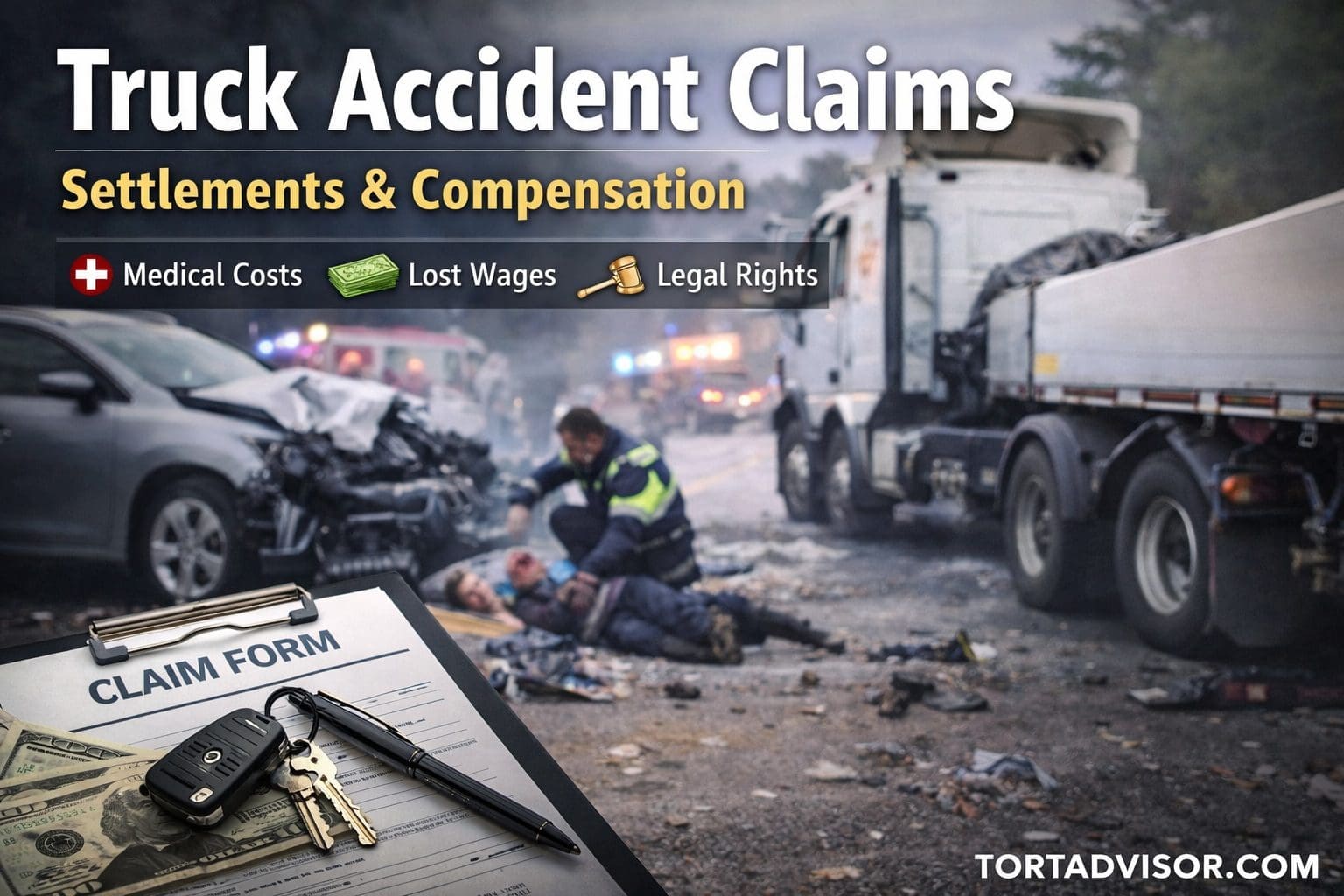
What Is a Semi-Truck Accident Settlement Worth in 2026?
The value of a truck accident settlement depends heavily on the facts. How severe the injury is, whether surgery was needed, future care, lasting impairment, lost wages, medical causation, commercial coverage, shared fault, how many parties are responsible and how strong the trucking-company evidence is can all change the result significantly.
A tractor-trailer claim can also turn on evidence that never appears in an ordinary car crash — driver qualification files, electronic logging device data, hours-of-service logs, dispatch messages, maintenance and inspection records, carrier safety history, in-cab video or vehicle computer data.
Latest Large-Truck Crash Statistics
According to FMCSA’s national Crash Statistics dashboard, large trucks were involved in 172,880 fatal and nonfatal crashes in 2024, among them 4,469 fatal crashes, resulting in 4,991 deaths and 88,611 injuries. Preliminary 2025 figures on the dashboard are lower, but FMCSA notes MCMIS data remain preliminary for 22 months.
2024 large-truck crashes
Large trucks were involved in 172,880 crashes, fatal and nonfatal.
FMCSA national crash statistics →2024 fatalities
Crashes involving large trucks led to 4,991 deaths.
FMCSA national crash statistics →2024 injuries
Crashes involving large trucks caused 88,611 reported injuries.
FMCSA Pocket Guide & statistics →Example Truck Accident Settlement Ranges by Injury Level
These broad examples were prepared by Legal Lawsuit’s editors — they are not national averages, offers, court schedules or promised results. Commercial insurance, several defendants and catastrophic injuries can push outcomes outside these ranges.
Brief Soft-Tissue Injury
$5,000–$25,000Strains, sprains or soreness with limited care and a fairly quick recovery.
Example range for illustration only.Broken Bone, Concussion or Prolonged Therapy
$25,000–$100,000Documented care, time off work, imaging, lingering symptoms or a longer recovery.
Example range for illustration only.Surgery, Spinal Injury or Serious Brain Injury
$100,000–$500,000+Hospital stays, operations, specialist care, disability or major future medical needs.
Example range for illustration only.Severe Permanent Impairment
$500,000–$5,000,000+Paralysis, amputation, serious lasting impairment, lifelong care or large earnings losses.
Example range for illustration only.Wrongful Death
$1,000,000–$10,000,000+Possible value turns largely on jurisdiction, financial dependence, family losses, fault and the coverage or assets available.
Example range for illustration only.How the Semi Truck Accident Settlement Calculator Weighs Claim Value
Injury Severity
Surgery, lasting impairment, spinal injuries, traumatic brain injuries and long-term disability can substantially raise documented damages.
Economic Losses
Past and future medical bills, lost wages, reduced earning power, rehab, travel and other documented expenses can influence value.
Fault & Carrier Evidence
Crash reports, ELD logs, hours-of-service data, dispatch records, maintenance files and witness or video evidence can shape how fault is assessed.
Commercial Coverage
Carrier insurance policies, trailer or broker arrangements, multiple defendants and other possible coverage can affect what is realistically recoverable.
Evidence That Strengthens a Truck Accident Claim
Truck cases often call for evidence beyond the usual police report and medical chart. Acting quickly to preserve it matters, because some electronic, operational and company records may not be kept forever.
- The police report and photos of the scene
- Video from dashcams, traffic cameras and nearby businesses
- Electronic logging device and hours-of-service logs
- The driver’s qualification and training file
- Dispatch communications and trip logs
- Inspection, repair and maintenance records for the truck
- Engine control module or other onboard data
- Cargo loading and securement records, if relevant
- Post-crash drug and alcohol test results where testing was required
- The carrier’s safety record and inspection history
- Medical records, scans and documentation of future care
- Pay, tax and earning-capacity records
Why FMCSA Records Matter After a Semi-Truck Crash
Federal motor-carrier regulations can generate key evidence in interstate trucking cases. Whether a given rule matters depends on the carrier, the vehicle, the route, the driver and the circumstances of the crash.
Hours-of-Service Limits
Under FMCSA’s current hours-of-service rules, property-carrying drivers generally may drive up to 11 hours after 10 straight hours off duty and may not drive past the 14th consecutive hour on duty, with certain exceptions.
FMCSA hours-of-service summary →ELD Records
Electronic logging devices track driving time and help keep duty-status records accurate, which can be important when driver fatigue or hours-of-service compliance is in question.
FMCSA ELD information →Post-Accident Testing
For covered CDL drivers, FMCSA mandates drug and alcohol testing after certain crashes. Whether a test was required turns on the type of crash and whether citations were issued.
FMCSA post-accident testing rules →Who May Be Liable for a Semi-Truck Accident?
Liability may reach well past the driver. Depending on the facts, a claim may need to examine the trucking company, the vehicle owner, an employer, the trailer owner, a maintenance shop, the shipper or loader, a freight broker, a manufacturer or another driver.
Driver Conduct
Speeding, distraction, impairment, fatigue, tailgating, unsafe lane changes and other driving behavior can influence fault.
Carrier Conduct
Hiring, qualification, supervision, dispatch practices, upkeep, recordkeeping and safety policies may matter depending on the legal theory and the evidence.
Truck Equipment or Cargo
Worn brakes or tires, poor maintenance, faulty parts, or improperly loaded or secured cargo may call for a separate investigation.
Settling With Insurance vs. Filing a Truck Accident Lawsuit
Truck claims can involve commercial policies and more than one responsible company. A fast offer may come before your medical, fault or insurance picture is fully known.
The Carrier’s Commercial Policy
The trucking company or vehicle owner may carry commercial liability insurance quite different from a typical personal auto policy.
Other Policies or Responsible Parties
Additional insurance may be available through leases, trailer owners, employers, contractors, brokers or other liable parties.
Coverage You Carry
Your own UM/UIM, medical-payments or other first-party coverage may also apply, depending on your policy and state law.
Using the Semi Truck Accident Settlement Calculator
What to Have Ready
- The crash report, photos from the scene and letters from insurers.
- Medical bills, scans and treatment records.
- Proof of lost pay and paperwork from your employer.
- Repair quotes, rental car costs and other out-of-pocket expenses.
- Anything you know about the trucking company, trailer, employer or commercial carrier.
Interpreting Your Result
- Read the result as an educational range, not a promised payment.
- Rerun the estimate as your treatment and wage details change.
- Don’t assume a single trucking company or policy is the only possible source of payment.
- Use the estimate to pinpoint open questions and missing documents.
- Don’t rely on the calculator in place of a review of state law, carrier records or coverage.
Semi Truck Accident Settlement Calculator FAQs
How accurate is this truck accident settlement calculator?
It’s an educational tool. It can organize the usual value drivers, but it can’t predict what an insurer, judge or jury will do or decide which state’s law applies.
Is there an average truck accident settlement?
No single national average reliably predicts one claim. Injuries, commercial coverage, the number of defendants, fault, venue and damages vary far too much.
How long do truck accident settlements take?
It depends on medical treatment, the investigation, preserving carrier records, fault disputes, insurance, litigation, liens and whether future damages can yet be measured.
How are truck accident claims different from car accident claims?
Truck claims may involve motor carriers, federal safety regulations, ELD and HOS logs, maintenance records, commercial insurance and several responsible companies.
Can I recover if I was partly at fault?
That depends on the state. Your share of fault may reduce your recovery or, in some states, prevent it entirely.
Which records should be saved after a truck crash?
Important records may include ELD/HOS data, dispatch messages, driver qualification files, maintenance data, in-cab video, vehicle computer data and insurance details.
Get a Free Truck Accident Case Review
Use the calculator to organize your claim, and if you’d like a closer look, request a confidential case review before you accept an offer or sign a release.
FMCSA & NHTSA Truck Safety Sources
FMCSA National Crash Statistics
FMCSA’s live national large-truck crash dashboard, with final 2024 FARS data and preliminary MCMIS data for later periods.
Open FMCSA crash statistics →FMCSA Pocket Guide
FMCSA’s yearly reference on large-truck and bus statistics.
Open FMCSA Pocket Guide →FMCSA Hours of Service
Official federal hours-of-service rules and guidance for covered commercial drivers.
Open FMCSA HOS resources →FMCSA Electronic Logging Devices
Official details on ELDs and duty-status records.
Open FMCSA ELD resources →FMCSA Drug & Alcohol Testing
Official explanation of when covered CDL drivers must be tested after a crash.
Open FMCSA testing rules →NHTSA 2025 Estimates & 2024 Final Data
Official national traffic-death figures, including 2025 estimates and final 2024 numbers.
Open NHTSA source →