
Short answer: This article explains the key facts, eligibility issues, settlement factors, deadlines, and source-backed updates related to this legal topic. Results vary by case facts, evidence, jurisdiction, and representation.
How the Top Product Liability Attorneys Can Decide the Outcome of Your Claim
What This Guide Covers
- Why Finding the Right Products Liability Lawyers Can Make or Break Your Case
- Core Legal Theories and Defect Types
- Navigating Complex Litigation and Class Actions
- Comparing Global Standards: US vs. Canadian Law
- Choosing the Right Products Liability Lawyers for Your Case
- Frequently Asked Questions about Product Liability
- Conclusion
The top product liability attorneys work to recover compensation for people hurt by unsafe or defective products, from household goods to drugs and vehicles.
Use this short breakdown to figure out which kind of lawyer fits your situation:
| Your Situation | Your Situation |
|---|---|
| You were hurt by a faulty product | A plaintiff-side product liability attorney |
| Your business is accused of selling a defective item | A defense-side product liability attorney |
| Many people were injured by the same product | An attorney who handles product class actions |
| The claim crosses state or national borders | An attorney experienced in multiple jurisdictions |
What to understand from the start:
- Defective product claims usually fall into three categories: design defects, manufacturing defects, and failure to warn
- Liability can reach the maker, the distributor, the seller, or any other business that handled the product before it reached you
- Many of these attorneys work on contingency, so you typically pay nothing up front
- Filing deadlines differ from state to state (New York, for instance, generally allows 3 years from the injury date)
- Claims can be brought by a single injured person or by a group
If a product seriously injures you, the law lets you pursue the companies responsible for it. The Supreme Court of Canada has described the bond between manufacturer and buyer as a relationship of reliance, because consumers know far less than the maker about hidden hazards. That idea sits at the center of product liability law in both the U.S. and Canada.
Recovering from an injury while medical bills stack up and paychecks stop can make the legal side feel impossible to tackle. That pressure is the main reason picking the right lawyer deserves careful thought.
I’m Mason Arnao. My work in data systems, online marketing, and lead generation has given me a practical view of how people find product liability attorneys and how those attorneys earn trust. I spend my time translating dense legal and technical material into plain language so you can choose your next step with confidence.
Related product liability attorney resources:
The Legal Theories Behind a Defective Product Claim
Product liability is the body of law that makes manufacturers, distributors, and sellers answerable for harm caused by what they sell. Put simply, a company that places a hazardous product in a consumer’s hands can be made to pay for the injuries that follow.
Attorneys handling these claims generally rely on one or more of three theories:
- Negligence: The injured person shows that the company did not exercise “ordinary care” when designing or building the product — in other words, it acted carelessly.
- Strict Liability: Frequently the strongest option for injured people. There is no need to show carelessness. The question is whether the product was defective and unreasonably dangerous when it left the defendant’s control, and whether that defect caused the harm.
- Breach of Warranty: This theory applies when a product does not perform as promised, whether the promise was spelled out (an express warranty) or created automatically by law (an implied warranty).
A broad summary of the doctrine is available on Wikipedia’s Product liability page.
Design Defects Compared With Manufacturing Defects
These two defect types call for very different proof, so it helps to know which one applies to you.
- Design Defects: Think of these as flaws in the plan itself. Every unit is built exactly to specification, yet the specification is unsafe. A vehicle engineered with a center of gravity so high that it tips easily is a classic example, and the hazard is present in every unit produced.
- Manufacturing Defects: Here the plan was sound, but production went wrong. A bicycle shipped missing a bolt or a contaminated lot of medicine are typical cases, and only that particular unit or batch carries the problem.
To learn how these injuries can affect your daily life and finances, see our product liability personal injury guide. Sorting out which defect type applies is easier with an attorney who knows the safety rules that govern your area.
Which Companies Can Be Responsible?
Pinpointing every party to name in the lawsuit is one of the hardest steps. Along the “chain of distribution,” responsibility may fall on:
- Parts Makers: For example, the business that produced a defective battery or airbag.
- Manufacturers: The main company that put the finished product together.
- Wholesalers and Distributors: The intermediaries that shipped and sold the product down the line.
- Retailers: In some strict liability cases, even the store that sold you the item can be liable.
- Advertisers: When promotional materials misstated how safe the product was.
Tracing every liable business takes experienced Attorneys for Defective Products who know where to look.
How Mass Torts and Class Actions Work in Product Cases

Few product cases stay small. Many grow into large disputes pitting thousands of injured people against global corporations, which is why you will hear the terms “class action” and “mass tort.”
In a class action, a large group (the “class”) injured in a similar way by the same product has its shared questions decided together rather than in thousands of separate trials. Defective medications, medical devices, and widespread vehicle defects are frequent subjects.
Why Expert Witnesses Matter
Saying “the heater caught fire” is not enough to win. Someone qualified has to show why it happened. That is why top product liability attorneys bring in specialists such as:
- Forensic Engineers: They examine the product and identify the precise mechanical or electrical failure.
- Doctors and Medical Experts: They connect your injuries to the defect, which is known as causation.
- Accident Reconstruction Specialists: Often used in vehicle cases to show how the defect caused the crash.
Strong technical evidence is what separates a winning strategy from a weak one. Without it, overcoming the well-funded defense teams large corporations hire is extremely difficult.
The Effect of Class Actions on Product Safety
Beyond compensating victims, class actions push companies to change how they operate. A C$1-billion claim over life-saving cardiac devices — defended by firms such as Blakes — is the kind of case that gets an entire industry’s attention, and suits like these frequently trigger recalls and tougher safety rules.
Our Defective Product Lawyer Guide walks through this process step by step. In the Northeast, a Product Liability Lawyer New York can point you toward attorneys who regularly handle high-stakes multidistrict litigation.
U.S. and Canadian Product Liability Law Side by Side
The two countries share much of the same legal foundation, but important differences appear in cross-border disputes. Manufacturers selling in both markets need a defense plan built for each system.
Blakes and Lenczner Slaght are widely regarded as leading Canadian product liability defense firms. Blakes is credited as the first Canadian firm to take a medical products class action through a 146-day trial ending in a defense verdict, and it also defended a C$80-million fire protection system case involving 20 separate claims and cross-claims.
| Feature | United States | Canada (Ontario) |
|---|---|---|
| Filing Deadline | Depends on the state (commonly 2–3 years) | Usually 2 years, subject to the discovery rule |
| Strict Liability | Adopted by most states | Overlaps with negligence and contract principles |
| Class Actions | Common, often multidistrict | More and more often certified for product claims |
| Damages | Punitive damages can be substantial | Punitive damages are less common and usually smaller |
Sector Knowledge: Drugs, Devices, and Vehicles
The best product liability attorneys understand the industries behind the products, not only the legal rules.
- Pharmaceuticals: Claims tied to Ozempic, Suboxone, or talc products call for a working knowledge of FDA and Health Canada rules and clinical trial records.
- Automotive: Airbag, brake, and self-driving software claims require an attorney who can read engineering and manufacturing plans.
- Medical Devices: Pelvic mesh, hip implants, and heart monitors are among the most frequently litigated products.
For injuries in New Jersey, a New Jersey Defective Product Injury Attorney can bring local knowledge of these industries.
How Global Manufacturers Defend These Claims
For companies, success means more than a courtroom win — it means controlling risk. Leading defense firms counsel businesses on:
- Meeting Regulations: Confirming that products satisfy every safety rule before they reach stores.
- Warnings and Instructions: Building “failure to warn” defenses by showing the labeling was clear and complete.
- Protecting Reputation: Managing public fallout after a major recall or lawsuit.
Regional resources like our Jersey City Defective Product Injury Guide show how these defenses tend to unfold in a particular court system.
How to Pick From the Top Product Liability Attorneys
Hiring a lawyer may be the biggest choice in your case. Start by deciding whether you need a plaintiff-side attorney, who represents injured people, or a defense-side attorney, who represents companies.
Credentials worth checking:
- Peer Recognition: Review listings such as the Canadian Legal Lexpert Directory, Chambers Canada, or Best Lawyers.
- Professional Ratings: Watch for Super Lawyers recognition or a Martindale-Hubbell AV-Preeminent rating.
- Courtroom Record: Ask how many product cases the attorney has actually tried before a jury. Settlements are common, but you want someone the defense knows will go to trial.
In the Southeast, an Atlanta Product Liability Attorney with a solid history of results can guide you through Georgia’s particular tort rules.
How long do I have to file a product liability lawsuit?
Deadlines are unforgiving. Miss the filing window and the claim is usually barred for good.
- New York: Typically 3 years from the injury, or from the date the injury was discovered.
- Discovery Rule: Especially important for “latent” harms, such as illnesses from years of chemical exposure, where the deadline may not begin until you learn you are ill.
Speaking with a Product Liability Lawyer New Mexico or another attorney familiar with your state’s rules is the surest way to file on time.
How is compensation calculated in a product liability case?
Attorneys usually look at several types of damages when valuing a claim:
- Economic Damages: Medical expenses, ongoing rehab, and past and future lost income.
- Non-Economic Damages: Physical pain, emotional harm, and diminished quality of life.
- Punitive Damages: Uncommon awards meant to punish a company for especially reckless or deliberate conduct.
Seasoned Defective Product Lawyers often rely on life-care planners and economists so any settlement reflects your lifelong needs.
Product Liability Questions People Ask Most
What proof do I need for a product liability claim?
Typically you will want the product itself (keep it!), a receipt or other proof of purchase, medical records of your injury, and expert analysis showing the defect. Pictures of the scene, the packaging, and any warnings are valuable as well.
How are AI and software reshaping product liability?
This area is still developing. As software increasingly counts as a “product” — in autonomous vehicles or AI diagnostic tools, for example — courts are deciding whether coding errors are “manufacturing defects” or “design flaws.” Today’s product liability attorneys need to keep pace with these shifting standards.
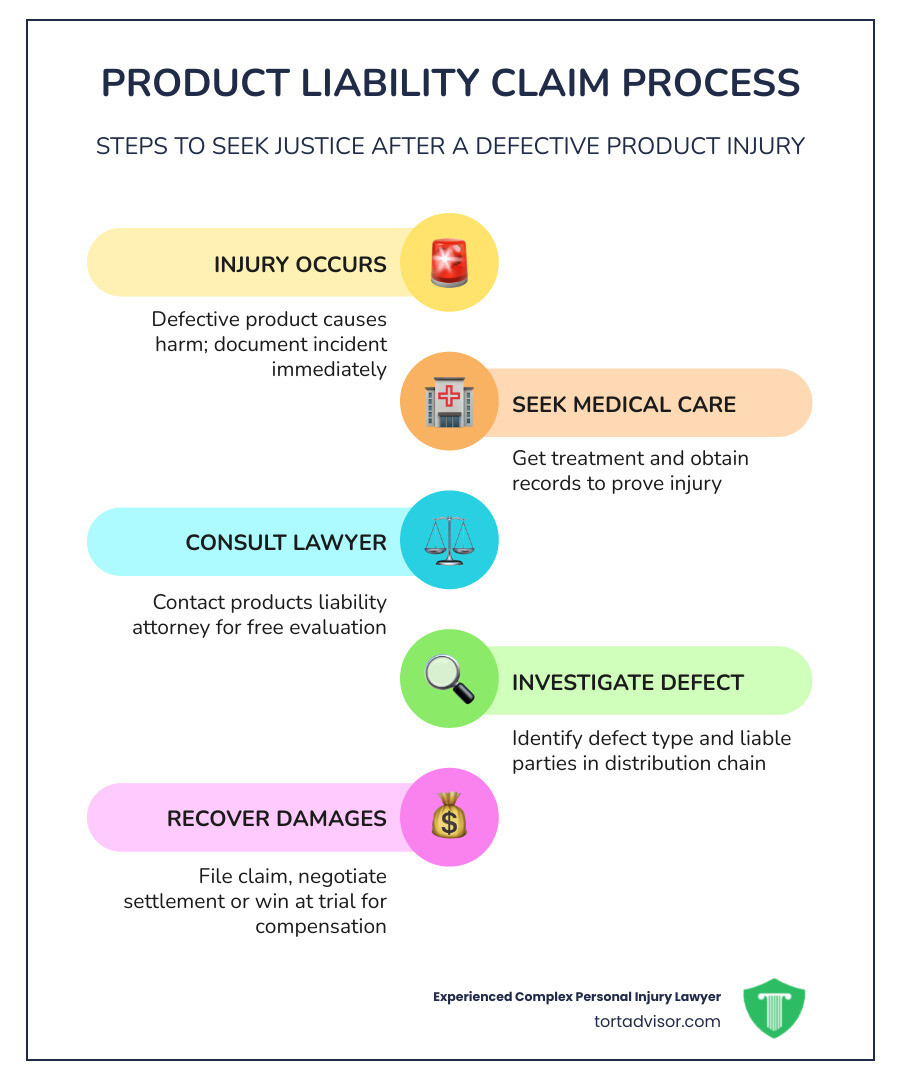
What steps should I take right after being hurt by a product?
- Get Medical Treatment: Protect your health first; your treatment records also become evidence.
- Keep the Product: Store it safely and resist any urge to repair or disassemble it.
- Hold Onto Packaging: Boxes, manuals, and warning labels can all support your claim.
- Record the Details: Photograph everything and write down what happened while your memory is clear.
- Talk to an Attorney: Avoid speaking with the manufacturer’s insurer until you have a lawyer.
Conclusion
An injury caused by a defective product can upend your life. Whether a home appliance burst into flames or a medical implant failed, getting justice depends on understanding complicated legal theories and having access to qualified technical experts.
Legal Lawsuit is a legal-information resource that helps injured people understand their options and connect with experienced product liability attorneys in our network through a free, confidential case review.
If you or someone close to you was hurt, act soon. Keep the evidence, get medical care, and contact experienced Defective Product Lawyers to protect your claim and your future.
Related Posts
Quick Answer: The Boy Scouts of America (BSA) filed for Chapter 11 bankruptcy in 2020 after facing tens of thousands [...]
Quick Answer: Survivors of sexual abuse by Catholic priests, nuns, or other Church personnel may be able to file a [...]
Quick Answer: Clergy abuse settlements vary enormously based on the severity of the abuse, the strength of evidence that the [...]