
Short answer: This article explains the key facts, eligibility issues, settlement factors, deadlines, and source-backed updates related to this legal topic. Results vary by case facts, evidence, jurisdiction, and representation.
In This Guide
When to Call Attorneys for Defective Products
Every purchase comes with an expectation of safety: that the item will do its job without hurting anyone. Sometimes that expectation is broken, and a flawed or hazardous product causes injury, pain and financial strain. That is the moment attorneys for defective products step in. If something you trusted has injured you, you are probably unsure what comes next. Here is a short overview of why legal help matters:
- Safeguard Your Rights: The law gives you a right to safe products and a right to seek redress when one harms you.
- Handle the Complexity: Product liability cases require proving that the item was defective and that the defect caused your injury.
- Find Every Responsible Party: Liability can reach from the manufacturer to the store, and attorneys know how to locate and pursue each one.
- Recover Damages: An experienced attorney can seek payment for medical costs, missed wages and pain.
- Even the Odds: Big companies have strong legal departments, and an attorney helps balance that power.
A product injury can leave you overwhelmed. If a company failed to make its product safe, the fault is not yours, and you should not have to shoulder the consequences by yourself.
Your Consumer Rights Under Product Liability Law
Expecting a product to be safe is more than wishful thinking; it is a basic consumer right protected by product liability law. These rules make manufacturers, distributors and sellers answer for defective goods that injure people. Companies must design and build safe products and supply necessary warnings, and when they fall short of that duty of care and someone is hurt, the law steps in.
Getting hurt while using a product does not automatically make you responsible. The product may have been poorly designed, badly made or marketed without proper warnings. Attorneys for defective products are trained to figure out whether a defect was the real cause of your injury.
What Counts as a Defective Product?
Legally, a product is defective when it does not meet reasonable safety standards and is therefore unreasonably dangerous. Because of some flaw, it fails to work as intended and injures someone. Defects generally fall into three groups:
- Design Defects: The blueprint itself is flawed, so every unit in the line is dangerous even if built exactly as planned.
- Manufacturing Defects: The design was safe, but a mistake during production or assembly made the item hazardous.
- Marketing Defects: The product was sold with inadequate instructions or without warnings about its risks.
These categories matter because the kind of defect shapes the legal strategy for building a strong case.
A Closer Look at the Three Defect Types
Here is how each defect type works in practice:
- Design Defects: The flaw lies in the concept, which was unsafe from the outset. These claims can be hard to prove because you usually must show that a safer design was technically and economically feasible when the product was made, which generally calls for testimony from engineers who analyze the design.
- Manufacturing Defects: A sound design is undermined during production, for example by an assembly-line error. These are often easier to prove because the item departs from the maker’s own specifications, and evidence may include production records or the faulty item itself.
- Marketing Defects (Failure to Warn): Instructions or warnings are missing, inadequate or misleading. Manufacturers must warn about known risks that cannot be designed or engineered out. If a company does not properly alert you to a hazard and you are injured, you may have a claim.
Your Rights After a Product Injury
The law recognizes several core rights when a product hurts you:
- Safety: You may expect the products you use to be safe for their intended use.
- Information: You are entitled to know about a product’s risks and how to use it safely.
- Compensation: If a defective product injures you, you may sue to hold those responsible accountable and recover damages.
- Implied Warranties: The law often reads protective terms into a sale, for instance that goods are of “merchantable quality” and “fit for a specific purpose.”
Knowing these rights is where action begins. Attorneys for defective products in our network work to make sure those rights are enforced.
How Product Liability Claims Work
It is reassuring to know product liability laws exist, but how do they operate? The underlying safety principles are broadly similar nationwide, though specific rules and procedures differ from state to state.
The United States protects consumers through a combination of federal law and state statutes. A central idea is that anyone in a product’s chain of distribution may be held liable, including distributors and retailers as well as the manufacturer, which gives injured people more routes to recovery.
Who May Be Liable?
After a product injury, figuring out who is responsible can be complicated, since liability can extend to nearly everyone who helped bring the product to you. Potential defendants include:
- The Manufacturer: The most frequent defendant, responsible for making sure the product is safe before it is sold.
- The Designer: When the flaw lies in the original design, the designer may be liable even without building the product.
- The Distributor or Wholesaler: These intermediaries can be responsible if they knew of a defect or their handling made the product more dangerous.
- The Retailer: The store that sold the product can often be liable for selling something unsafe, since it is your direct link to the item.
Attorneys for defective products trace every stage of the product’s path to find all parties who may share responsibility, improving your chances of fair compensation.
Major U.S. Product Safety Laws
Federal law provides strong protections. The Consumer Product Safety Act (CPSA) is a foundation of consumer safety and established the Consumer Product Safety Commission (CPSC), which works to protect the public from unreasonable risks of injury or death across thousands of product types. The CPSC sets standards, announces recalls and studies emerging hazards. Other agencies, including the Food and Drug Administration (FDA) and the National Highway Traffic Safety Administration (NHTSA), regulate particular categories such as food, drugs, cosmetics and vehicles.
The Legal Basis for a Claim
Federal rules set a floor, but most product liability suits are brought under state law using one or more of three legal theories:
- Strict Liability: In most states, a manufacturer or seller can be “strictly liable” when a defect causes injury, so you need not prove carelessness, only that the product was defective and caused harm.
- Negligence: Alternatively, you can show that the defendant did not use reasonable care in designing, making or selling the product and that this failure caused your injury.
- Breach of Warranty: Products come with promises. An express warranty is a specific statement by the seller, such as “shatterproof glass,” while an implied warranty is one the law adds automatically, such as fitness for ordinary use. An injury caused by a product that failed to meet one of these warranties may support a claim.
Every theory requires a clear link between the defect and your injuries, which is why experienced attorneys for defective products are so valuable.
Building a Strong Product Injury Case With Attorneys for Defective Products
You were injured by something you trusted, so what happens next? Product cases involve technical detail, scientific analysis and well-funded corporate defense teams, and they are not something to tackle alone.

Proving a defect, particularly a design defect, means questioning decisions engineers made, and showing that a company cut corners or acted carelessly is difficult. Experienced attorneys for defective products even the odds and make sure your account is heard. Legal Lawsuit also offers many more resources on product injury cases.
How Attorneys for Defective Products Gather Evidence
A strong case takes careful investigation. Attorneys in our network act as both investigators and advocates, collecting key evidence such as:
- The Product Itself: Essential. Keep the item, its packaging, manuals and receipts, since the product is often the most persuasive proof.
- Medical Records: Every record and bill from doctors, hospitals and therapy helps show how badly you were hurt and what it cost.
- Supporting Documents: Proof of purchase helps trace where the product came from, and witness statements can bolster your account.
- Expert Analysis: In complex cases, attorneys work with engineers, medical specialists and other experts who test the product and prepare reports and testimony explaining how the defect caused your injury.
Compensation You May Be Able to Recover
A successful claim can provide meaningful payment for your losses. Recoverable damages may include:
- Medical Costs: Past and future expenses such as hospitalization, surgery, prescriptions and rehabilitation.
- Lost Income and Earning Capacity: Wages already missed, plus compensation if the injury keeps you from your job or lowers what you can earn later.
- Pain and Suffering: Sometimes called general damages, covering physical pain, emotional distress and lost enjoyment of life.
- Punitive Damages: In uncommon cases of extreme recklessness, a court may award punitive damages to punish the company and discourage similar conduct.
Why Experience Matters When Choosing Attorneys for Defective Products
Because these claims are so involved, specialization counts. Here is why experienced attorneys for defective products make a difference:
- Command of Complex Litigation: They grasp the engineering, manufacturing and scientific issues and turn them into persuasive legal arguments.
- Expert Relationships: Established practices work with leading engineers, scientists and physicians who can supply crucial evidence.
- Knowledge of the Law: They keep current on the federal and state rules governing product safety and know how to use them to establish liability.
- Experience Against Large Companies: They are used to aggressive corporate defense tactics and have the resources to hold firm and pursue full compensation.
Legal Lawsuit helps people connect with attorneys in our network who focus on product liability and have meaningful experience in these cases. Attorneys in our network help clients nationwide, including in Fort Lauderdale, Miami, North Miami, Hollywood and South Beach.
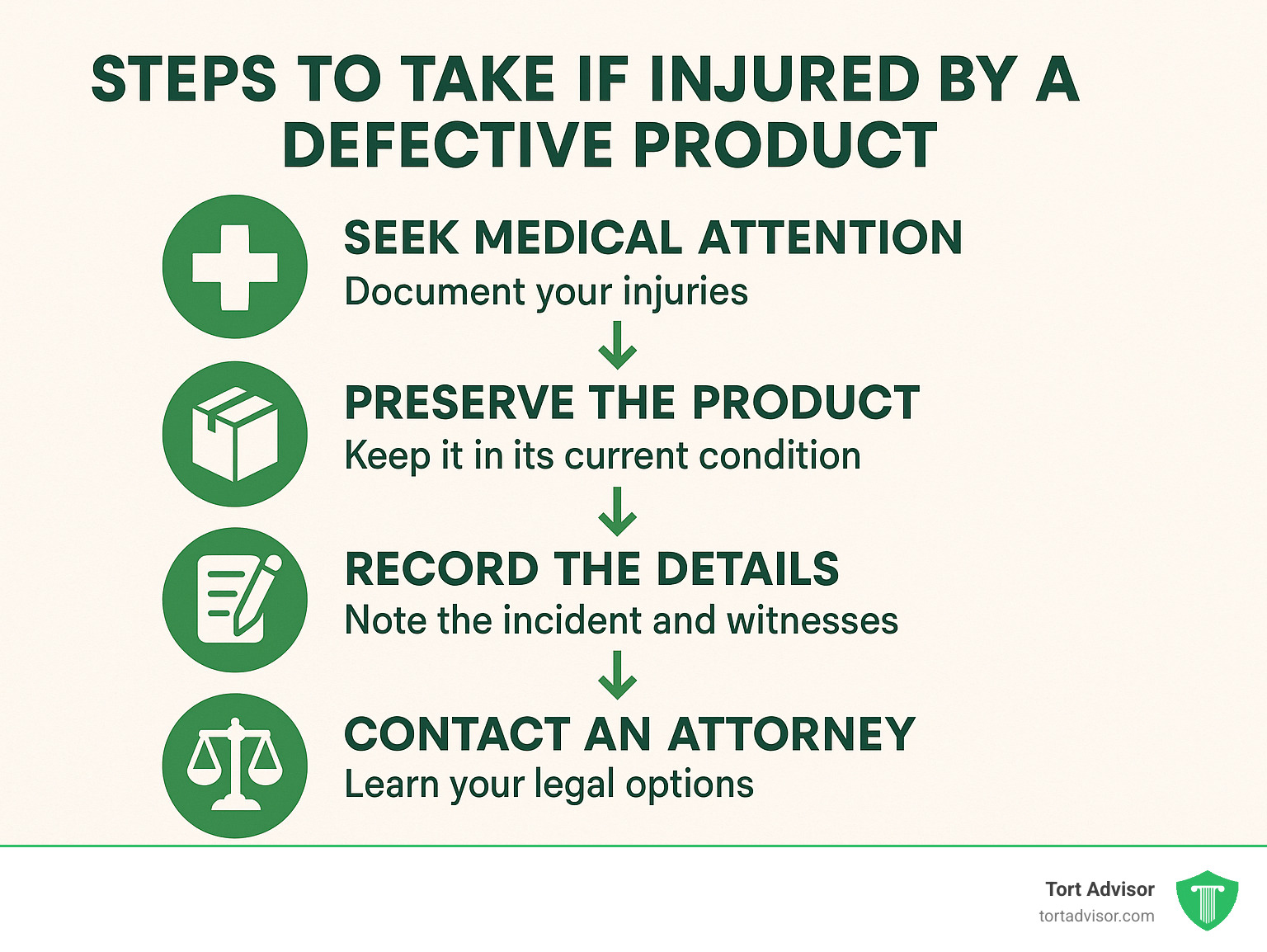
Steps to Take After a Defective Product Injury
An injury from a trusted product is upsetting and confusing. Once your immediate medical needs are handled, several steps can protect your rights and strengthen your case, and acting promptly makes a real difference.
- Get Medical Care Right Away: Your health comes first. See a doctor even for injuries that seem minor, since some problems surface later, and the visit creates an official record that is crucial to any claim.
- Keep the Product and Packaging: Do not discard, repair or modify the item. Hold on to it along with the box, manuals, receipts and warranty cards, because the product is often your strongest evidence.
- Record Everything: Photograph and film the product, the scene and your injuries. Write down exactly what happened, including date, time and place, get contact details from any witnesses and keep a log of medical visits and injury-related costs.
- Don’t Accept Blame: Watch what you say to the manufacturer or its insurer, whose aim is to limit liability. Politely decline any recorded statement until you have talked with an attorney.
- Talk to an Attorney: As soon as possible, contact an attorney who handles product liability. Reaching out to experienced attorneys for defective products early is one of the smartest steps you can take, helping you avoid common mistakes along the way.
Product Liability FAQs
Questions about a complex area like product liability are completely normal. Here are clear answers to the ones people ask most often:
What is the deadline for filing a defective product claim?
Timing is crucial. Every state sets a firm filing deadline, the “statute of limitations,” and missing it can permanently bar your claim. Limits for injury claims vary by state but are commonly two or three years from the injury, and the clock may start when you discovered, or reasonably should have discovered, the injury and its connection to the product. Because these rules can be tricky, contact attorneys for defective products promptly to protect your rights.
What if I can’t afford a lawyer?
Cost should not keep you from pursuing your claim. Most attorneys for defective products, including those in our network, work on a contingency fee basis, so there are no legal fees up front. The fee is a percentage of whatever is recovered, and if there is no recovery you generally owe no fee. This “no win, no fee” model makes quality representation available regardless of income, and Legal Lawsuit offers a free, confidential case review to get started.
Will a recall guarantee that I win?
No. A recall does not automatically win a case, though it can be powerful evidence. Recalls, which you can look up in databases like the CPSC’s, show the manufacturer has acknowledged a safety problem. You must still prove two things:
- Causation: That the specific defect directly caused your injuries.
- Damages: That you suffered real losses, such as medical bills or missed wages, because of the defect.
The manufacturer may also argue that your own carelessness played a role, which can reduce your recovery. An experienced product liability attorney can tie the evidence together, establish causation and damages and respond to whatever defenses the company raises.
Conclusion
A product that causes harm breaks a basic trust: you expected safety, not injury or lasting pain. If this has happened to you, you are not alone and do not have to carry it by yourself. Product liability law may seem daunting, but the key point is that the law protects your rights as a consumer. Companies are legally obligated to make safe products, and when they fail, they should be held responsible. These cases demand technical knowledge, expert testimony and the resources to face corporate defense teams, so you want experienced attorneys for defective products who understand the science and the law. That is the reason Legal Lawsuit exists: we help injured people connect with attorneys in our network who know how to hold large companies accountable and pursue fair compensation. You can start today. Remember the essentials: get medical care, keep the defective product and document everything. Then request a free, confidential case review for the guidance that can change the outcome. You trusted that product to be safe; now let experienced legal professionals help you seek accountability. Connect with a product injury attorney today.
Additional Resources
Related Posts
Quick Answer: The Boy Scouts of America (BSA) filed for Chapter 11 bankruptcy in 2020 after facing tens of thousands [...]
Quick Answer: Survivors of sexual abuse by Catholic priests, nuns, or other Church personnel may be able to file a [...]
Quick Answer: Clergy abuse settlements vary enormously based on the severity of the abuse, the strength of evidence that the [...]