Texas Hotel Pool Safety Rules: What Owners Must Do
By Mason ArnaoPublished

By Mason ArnaoReviewed by Mason Arnao

Under the state’s public pool and spa rules, Texas hotel pool safety rules require hotels to have a certified operator, test the water and keep logs, meet fence and gate standards, and post required safety signs, and federal law requires anti-entrapment drain covers as well. If a hotel fell short and you or someone in your family was hurt, you can report the pool to local health officials, save your records, and keep in mind that Texas generally allows two years to file a personal injury lawsuit.
Hotel pools are not held to the same rules as a backyard pool. They sit in their own category under Texas health rules, and a separate federal standard governs the drains. Knowing which rules apply can help you understand what went wrong and what to ask about.
This guide covers who must supervise the pool and test the water, and what the rules say about fences, gates, signs and safety gear. It also explains the federal drain cover requirement and when a rule violation may matter after an injury. Finally, it walks through how to file a complaint about an unsafe pool, how to protect your records, and what to expect from the hotel’s insurer.
The short answer: which rules cover a Texas hotel pool
In Texas, hotel pools and spas fall under the state’s public pool rules in 25 TAC Chapter 265, Subchapter L, the Texas standards for public swimming pools and spas. These rules sort pools into classes, and the class determines which requirements apply.
A hotel pool meant only for guests is usually a Class C pool. Under the rules, a Class C pool:
- is not a Class A or Class B pool, and
- is limited to occupants, members, or students and their guests, not the general public.
There is one important exception. If a hotel opens a pool it runs as Class C to the general public, the pool must meet Class B operational standards. This applies whether or not the hotel charges a fee. Local residents buying day passes would be one example. The class the hotel uses is not always the class the rules require, so it helps to know who was actually allowed to use the pool.
Who enforces these rules
Enforcement usually starts locally. The state says to contact your city or county health office first about a public pool concern. The Texas Department of State Health Services (DSHS) investigates complaints only in areas with no local health department.
What these rules do and do not do
The pool rules set minimum safety and operating standards. They tell a hotel what it must do to keep its pool open and safe.
They do not decide who is legally responsible when someone gets hurt. A health inspector can cite a hotel for a violation, but that is separate from any injury claim. The sections below explain the specific requirements and how they may matter after an injury.
Who has to supervise the pool and test the water
Under the Texas public pool and spa rules in 25 TAC Chapter 265, Subchapter L, every Class A, B and C pool and spa must be maintained under the supervision and direction of a properly trained and certified operator. That person does not have to stand at the pool all day. The rules allow one operator to be responsible for several pools. Even so, a certified operator must be in charge of how each pool is kept.
How often the water must be tested
For Class C pools and spas, which is the category hotel pools usually fall into, the same rules set a minimum testing schedule for disinfectant and pH. The schedule depends on whether staff are on site:
| Type of Class C pool or spa | Minimum disinfectant and pH testing |
|---|---|
| Has on-site staff, such as lifeguards | At least three times a day |
| Has no such on-site staff | At least once a day |
In both cases, the results must be recorded in the pool or spa log.
Why the pool log matters to you
The log is a written record of how the pool was maintained. It shows when someone checked the water, what the readings were, and whether testing happened as often as the rules require. If you or a family member got sick or hurt at a hotel pool, the log can help show what the water conditions were around that time. It can also show whether the required checks were done at all. Missing entries, gaps between dates, or readings that were never acted on can all be useful facts to point out to an attorney or a health inspector.
Fences, gates, signs and safety gear at hotel pools
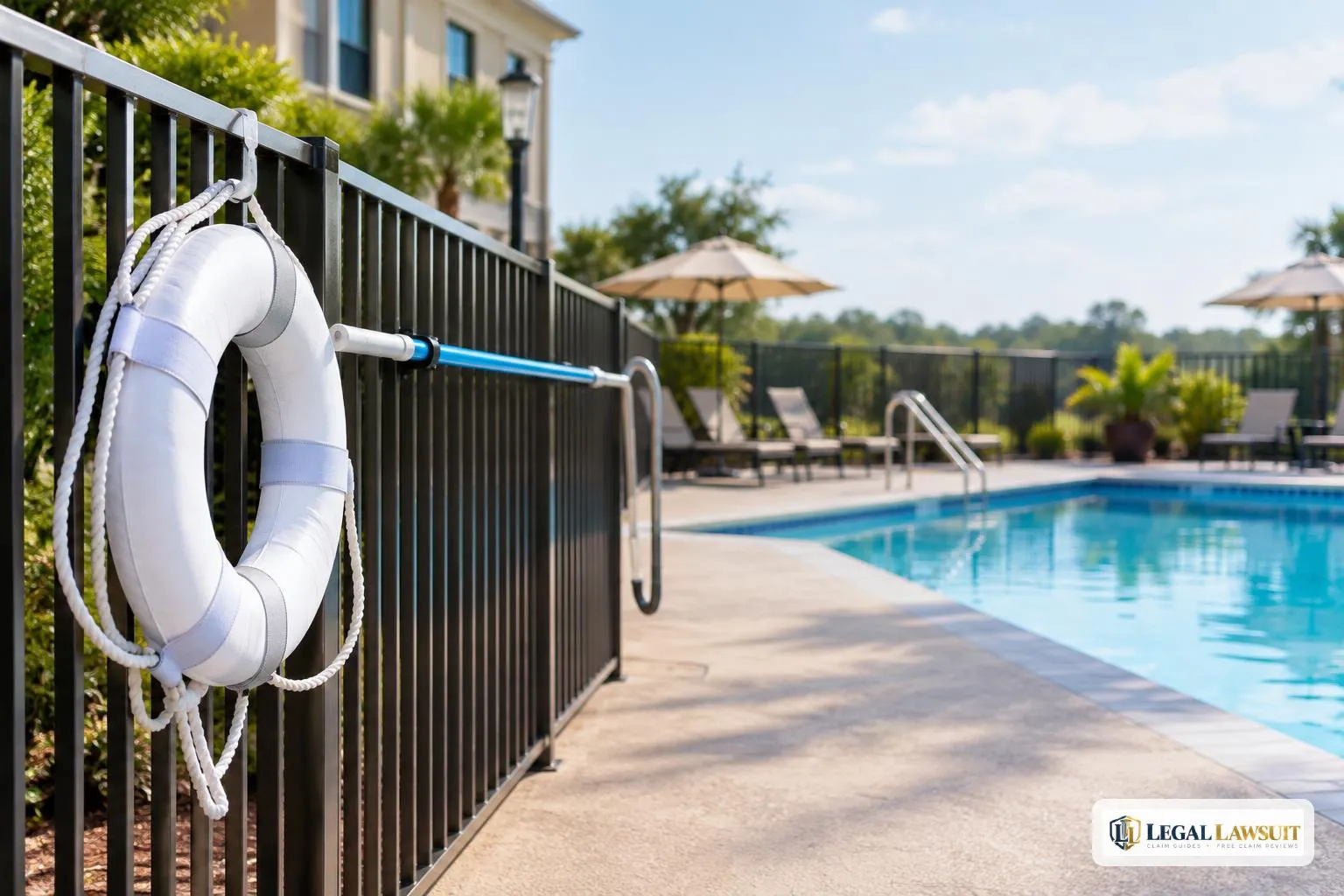
Several of the most important safety rules for a Texas hotel pool involve features you can see for yourself: the fence around the pool, the gate you walk through, and the signs posted nearby. Under the Texas public pool and spa rules in 25 TAC Chapter 265, Subchapter L, a hotel pool (a Class C pool) that is not covered by Health and Safety Code Chapter 757 must meet the following standards.
| Feature | What the rule requires | What you can check |
|---|---|---|
| Enclosure height | At least 48 inches high | Whether the fence or wall fully surrounds the pool and looks shorter than about four feet anywhere |
| Gates and doors | Self-closing, self-latching, and opening outward, away from the pool | Whether the gate swings shut and latches by itself, and which direction it opens |
| Propped gates | Propping pool gates or doors open is prohibited | Whether gates are held open with chairs, wedges, ties or other objects |
| Warning signs | Where no lifeguard is required or provided, signs such as “no lifeguard on duty” and an emergency 911 sign must be posted in the pool yard | Whether these signs are present and easy to see |
Does a hotel pool need a lifeguard?
Not automatically. A pool that serves only hotel guests is not required to have a lifeguard just because it belongs to a hotel. That is why the warning signs matter: they tell swimmers that nobody is on duty to watch the water.
The picture changes if the hotel opens its pool to the general public, for example by selling day passes to people who are not staying there. In that case, the rules apply the stricter Class B standards to the pool.
If a gate was propped open, a latch was broken, or the required signs were missing when someone was hurt, write down what you saw and take photos as soon as you safely can. Those details may matter later.
Drain covers: the federal rule every hotel pool must meet
Drain covers are governed by a federal law that applies in every state, in addition to the Texas pool rules. Under the Consumer Product Safety Commission’s guidance on the Virginia Graeme Baker Pool and Spa Safety Act (15 U.S.C. §§ 8001–8008), pool and spa drain covers must meet a federal performance standard designed to prevent entrapment.
The CPSC guidance sets out two main duties for public pools and spas, which include hotel pools:
- Compliant drain covers. Since December 19, 2008, public pools and spas must have anti-entrapment drain covers that comply with 16 C.F.R. part 1450.
- A backup protection for certain drain setups. A public pool or spa needs a secondary device or system to prevent entrapment if it has either of these:
- a single drain that can be blocked, or
- multiple drains on the same plane that are less than three feet apart.
Because the duty comes from federal law, it is separate from the Texas supervision, water-testing and fencing rules covered earlier. A hotel pool could satisfy one set of rules and still fall short on the other.
What to do if a drain cover looks wrong
A drain cover that is broken, cracked, loose or missing is a serious hazard. If you see one:
- Keep yourself and others, especially children, away from that part of the pool or spa.
- Tell hotel staff right away and ask them to close the area.
- If you can do so safely and without entering the water, take a photo of the drain and note the date and time.
The section below on reporting an unsafe hotel pool explains who to contact next and how to keep a record of what you saw.
When a rule violation may matter after an injury
If you or someone in your family was hurt at a hotel pool, a broken safety rule can be useful evidence. It shows what the hotel was expected to do and where it may have fallen short. A violation does not, by itself, prove the hotel is legally responsible, and it does not mean a claim will succeed. What still matters is how the injury happened, whether the problem actually played a part, and what the evidence shows.
Situations where the rules often come up
- Gates left open or unlatched. The Texas public pool and spa rules set enclosure, gate and door requirements for many hotel pools and ban propping gates open.
- Missing signs or safety gear. The same rules require posted signs, including a notice when no lifeguard is on duty and emergency information.
- Poor water quality. The water must be tested on a set schedule and the results recorded in logs. Those logs can show whether the testing actually happened.
- Drain hazards. Since December 19, 2008, public pools have needed federally compliant anti-entrapment drain covers.
- Wet or slippery decks. Slippery decks are one of the most common causes of falls around a pool.
A fall on a pool deck usually follows the same steps as other falls on someone else’s property. Our guide to filing a slip and fall claim walks through them.
Hotel pool injuries are not a special category of claim. Proof, damages and deadlines work the same way as in other injury cases, so it helps to understand how a personal injury claim works, from proof to deadlines before you talk with anyone about what happened.
How to report an unsafe hotel pool and protect your records
If you think a Texas hotel pool is unsafe, report it to your local city or county health office first. Then start keeping a careful record of what you saw and what happened. Both steps take little time, and both can matter later.
Where to send a complaint
According to the Texas Department of State Health Services, DSHS does not investigate public pool and spa complaints in cities or counties that have their own local health department. In those areas, the local office handles it. DSHS investigates complaints about suspected violations of the state pool rules only where there is no local health department. If you aren’t sure which office covers the hotel’s location, contact your city or county health office and ask. If there is no local office, they can tell you, and you can take the complaint to DSHS.
What to document
Write things down as soon as you can, while the details are fresh:
- When and what: the date, the time and what the pool area looked like, such as cloudy water, a gate standing open or missing signs.
- Photos: if it is safe to do so, photograph the gate, the posted signs, the drain area and the pool deck.
- Costs: keep receipts for anything you paid because of the incident, including medical bills, prescriptions and travel.
- Medical records: keep copies of visit summaries, test results and discharge papers.
Dealing with the hotel
Ask the hotel to write up an incident report, and request a copy. Keep a copy of anything you sign or receive from the hotel or its representatives, including emails and letters. Read any document carefully before you sign it. If you’re unsure what a form means, you can ask questions before you sign.
Once you’ve gathered these records, Legal Lawsuit’s guides can help you understand what to do next.

The Texas deadline and dealing with the hotel’s insurer
In Texas, a personal injury lawsuit generally must be filed within two years. Under Texas Civil Practice and Remedies Code §16.003, the clock runs from the day the cause of action accrues. If you miss the deadline, you may lose the chance to bring the claim in court, so it helps to know your date early.
What the statute says
- Injury claims: Section 16.003(a) says a personal injury suit generally must be brought no later than two years after the day the cause of action accrues.
- Claims involving a death: Section 16.003(b) also sets a two-year period when an injury results in death. That cause of action accrues on the date of death.
- Exceptions: Section 16.003(a) refers to exceptions written elsewhere in the law. Some of these can change the timing, so do not assume the basic two-year rule is the whole story for your situation.
Mark the date of the incident on a calendar now. Then work out your deadline well before it gets close, so there is time to sort out any exception that might apply.
When the hotel’s insurer calls
After a pool injury, an adjuster for the hotel may contact you quickly. They might be friendly and sound helpful. Keep in mind that the adjuster’s job is to look after the insurer’s interests, not yours.
- Recorded statements: You can politely decline to give a recorded statement until you understand how it may be used.
- Quick offers: An early offer may come before you know the full extent of your injuries or your medical costs.
- Releases: Read any document carefully before you sign it. A release may end your ability to seek more later.
Before you agree to anything, read what to know before giving an adjuster a statement or signing a release. It explains these situations in plain terms. When you’re ready for the next step, you can browse more Legal Lawsuit guides on claimant rights to understand your options.
Frequently asked questions
Is a Texas hotel required to have a lifeguard at its pool?
Usually not, but a hotel cannot simply leave swimmers to guess. Hotel pools generally fall under the Class C category in Texas’s public pool and spa rules (25 TAC Chapter 265, Subchapter L). Those rules require signs telling guests that no lifeguard is on duty and signs with emergency information. If a hotel opens its Class C pool to the general public, the stricter Class B standards apply.
How often must a Texas hotel test its pool water?
The same Subchapter L rules set a minimum water-testing schedule for Class C pools, which includes most hotel pools. The rules also require the hotel to record its test results in logs. The hotel must have a certified operator responsible for the pool. If you were hurt or became sick, ask your local health office how to request inspection records. The testing logs can show whether the water was checked when it should have been.
Who do I report an unsafe hotel pool to in Texas?
Start with the health office for the city or county where the hotel is located. The Texas Department of State Health Services complaint process sends people to their local health office first. DSHS investigates pool complaints only in areas without a local health department. Its page lists how to contact DSHS directly in those areas. Note the date, the problem you saw and the name of anyone you spoke with.
Do hotel pools have to use special drain covers?
Yes. Under the federal Virginia Graeme Baker Pool and Spa Safety Act, the Consumer Product Safety Commission’s drain cover guidance explains that public pools have needed compliant anti-entrapment drain covers since December 19, 2008, under 16 C.F.R. part 1450. Some pools need more protection. A pool with a single drain that a body could block, or with drains less than three feet apart, also needs a secondary anti-entrapment system.
How long do I have to file a lawsuit after a hotel pool injury in Texas?
In most cases, you have two years. Section 16.003 of the Texas Civil Practice and Remedies Code sets a two-year limitations period for personal injury claims. If someone died, the two years generally run from the date of death. The statute also refers to exceptions that can change the deadline. That is why it can help to have a lawyer review your dates early. Legal Lawsuit can help you find one if you want a second look at your situation.
Sources
- 25 TAC Chapter 265, Subchapter L: Public Swimming Pools and Spas · Texas Department of State Health Services · 2024-05-03
- Pool and Spa Drain Covers · U.S. Consumer Product Safety Commission
- Complaint Process – Public Swimming Pools and Spas · Texas Department of State Health Services
- Civil Practice and Remedies Code Chapter 16. Limitations · Texas Legislature
This article is general information, not legal advice. Laws and deadlines vary by state and change over time; check the linked sources or speak with a licensed attorney about your situation.
Related Posts

You have the right to say no to medical treatment, but in an injury, disability, or workers' comp claim that choice can lower or stop your benefits. Here is how each system treats a refusal, and which reasons the rules accept.
Ninguna calculadora en línea sabe cuánto recibirás de un acuerdo por filtración de datos. Esta guía explica cómo se reparte realmente el dinero y cómo calcular tus propias pérdidas documentadas antes de presentar tu reclamo.
Learn about burns, dental trauma, and other documented vaping explosion injuries, then organize product details and treatment records for reporting and a claim discussion.