
Short answer: This article explains the key facts, eligibility issues, settlement factors, deadlines, and source-backed updates related to this legal topic. Results vary by case facts, evidence, jurisdiction, and representation.
In This Guide
The PFAS Lawsuit Right Now: Key Developments Reshaping the Chemical Industry
Here is where the PFAS lawsuit right now stands: billion-dollar settlements are piling up and new cases keep arriving every month. The most important recent developments as of this PFAS lawsuit update:
Latest Headlines:
- New Jersey reached a $2 billion settlement with DuPont, Chemours and Corteva over environmental damage
- More than 12,000 active lawsuits against PFAS makers across the country
- The first personal injury bellwether trial was set for October 2025
- 3M agreed to an additional $450 million settlement with New Jersey
- The EPA finalized 4 parts per trillion drinking water limits for PFOA and PFOS, with compliance deadlines in later years
Why It Matters:
- Individual claim values that will depend on diagnosis, exposure history and evidence
- More than 158 million Americans with PFAS in their tap water
- Manufacturers facing historic liability over “forever chemicals”
Together, these developments mark a turning point in making chemical companies answer for decades of pollution, and the pressure keeps building as more people learn they were exposed.
Editorial note: Legal Lawsuit tracks PFAS court dockets, settlement announcements and regulatory actions continuously, and this litigation ranks among the most significant mass torts in recent memory. We update this page as major filings and rulings come in.
More on the PFAS lawsuit right now:
- PFAS cancer lawsuits
- pfas lawsuit settlement amounts per person
- pfas exposure risks
New Jersey’s $2 Billion Deal With DuPont, Chemours and Corteva
In one of the biggest recent developments, New Jersey secured a landmark $2 billion settlement with DuPont, Chemours and Corteva resolving environmental claims tied to PFAS. It is the largest environmental settlement in state history and a strong signal that polluters will be made to pay.
The deal sets up a full remediation plan for the contamination, including an upfront payment of $875 million, a remediation funding source of up to $1.2 billion and a $475 million reserve meant to keep cleanup going even if the companies run into financial difficulty.
New Jersey brought the case under Natural Resource Damages (NRD) laws, which let governments recover the cost of environmental harm, targeting the companies over products containing “forever chemicals” that do not naturally degrade. Key contaminated sites include Pompton Lakes and the Repauno Works and Chambers Works plants, which reflect decades of chemical manufacturing.
New Jersey Environmental Protection Commissioner Shawn LaTourette said: “Polluters who place profit above public well-being by releasing poisonous PFAS and other contamination in our State can expect to be held responsible to clean up their mess and fully compensate the State and its citizens for the precious natural resources they’ve damaged or destroyed.”
The deal fits a larger pattern: 3M separately agreed to pay New Jersey another $450 million over PFAS contamination of water supplies, underscoring how widespread the problem is.
According to DuPont, the agreement resolves all pending environmental claims, an important step toward corporate accountability. If PFAS exposure worries you, see our PFAS Cancer Water Contamination Lawsuit guide.
The National Picture: MDL 2873, Bellwether Trials and Major Settlements
PFAS litigation spans the country, with thousands of cases consolidated for efficiency in Multidistrict Litigation (MDL 2873) in South Carolina, now among the largest mass torts in American history.

By November 2024, 10,934 individual cases had been filed, including more than 10,391 pending suits focused on AFFF (Aqueous Film-Forming Foam), the firefighting foam used at airports and military bases that is a leading source of PFAS. The docket is expanding fast, with close to 1,800 new suits in one recent three-month stretch.
A pivotal bellwether trial involving kidney cancer was scheduled for October 20, 2025, and its result was expected to shape how thousands of other claims resolve; check for updates as of this writing. Ahead of it, the court planned a “Science Day” in June 2025 to walk through the scientific evidence, and the judge picked 12 contaminated sites as test cases on manufacturer liability.
Attorneys have also begun grouping claims by people with ulcerative colitis, broadening the litigation beyond cancer. Military-related AFFF claims, including those involving Navy firefighters, are another growing part of the docket.
3M’s Record Payouts at the National and State Level
3M’s settlements rank among the largest ever in environmental litigation. The company agreed to pay $10.3 billion over 13 years to help public water systems nationwide clean their supplies, part of a deal a federal judge approved with a potential value of up to $12.5 billion, plus a separate $450 million to New Jersey for contamination in that state. These agreements give communities critical money for remediation.
Other Major Company Settlements
Additional manufacturers are paying for their part in the contamination:
- Tyco Fire Products agreed to pay public water systems $750 million.
- BASF Corporation agreed to a $316.5 million settlement.
- Carrier Global, through subsidiary Kidde-Fenwal, will pay $730 million.
- Chemours, DuPont and Corteva struck a separate $1.19 billion agreement with U.S. water utilities.
These settlements across the industry show the scale of PFAS liability, which some experts say could “dwarf anything related to asbestos.”
Where do individual PFAS injury claims stand right now?
More than 12,064 personal injury suits are active and the count keeps rising. The most common conditions are ulcerative colitis (52% of cases), kidney cancer (30.2%), testicular cancer (12.7%) and liver cancer (4.8%).
No personal injury settlement amounts have been officially announced as of this update. Factors expected to drive individual claim value include:
- Diagnosis and severity: Cancers such as kidney or testicular cancer, and the extent of treatment required, generally weigh more heavily.
- Strength of evidence: Documented length and level of exposure, medical records and proof linking the exposure to the illness.
Any figures you see quoted are projections, not guarantees, and broader personal injury settlements could come before bellwether trials finish. Legal Lawsuit helps you connect with experienced attorneys in our network for these complex claims. For more on compensation, see our PFAS Lawsuit Settlement Amounts Per Person page. Acting promptly may matter for inclusion in any early settlement program.
What Forever Chemicals Are and Why They Harm
Making sense of the PFAS lawsuit right now starts with understanding the chemicals. PFAS (per- and polyfluoroalkyl substances) are a large family of man-made compounds, PFOA and PFOS being the most infamous. Their extremely strong chemical bonds keep them from breaking down in nature or in the body, earning the label “forever chemicals” and classification as persistent organic pollutants.

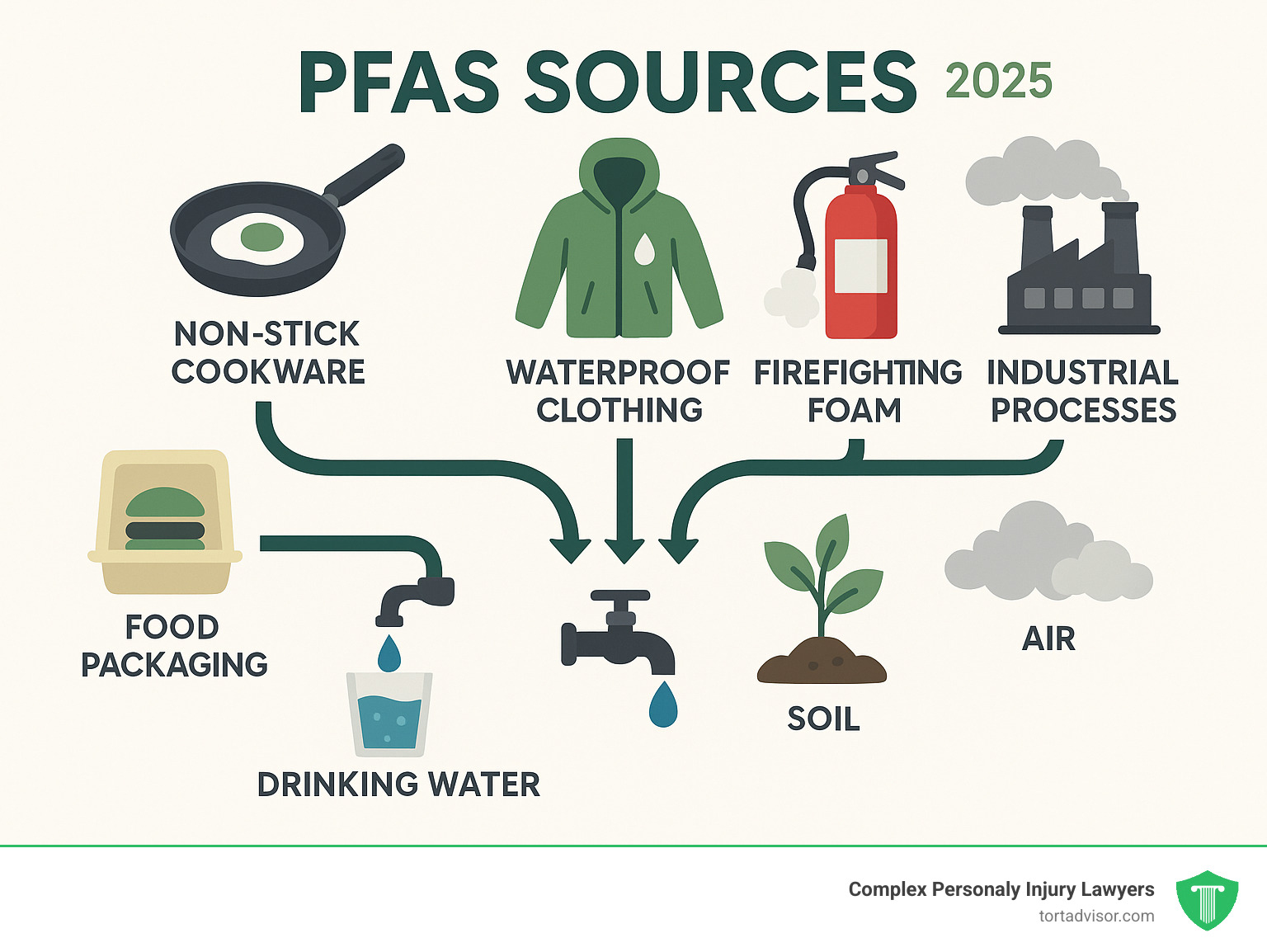
Valued for resisting grease, water and heat, PFAS spread into countless consumer and industrial goods, such as:
- Non-stick cookware
- Waterproof clothing
- AFFF firefighting foam
- Stain-repellent carpets and upholstery
- Food packaging
- Cosmetics and personal care items
The same durability that made PFAS so useful makes them dangerous: they build up over time and have created contamination worldwide.
Health Risks Tied to PFAS Exposure
Scientific findings on PFAS and disease underpin thousands of lawsuits. Roughly 95% of people have PFAS in their blood, and at high enough levels the chemicals can cause real harm.
Cancer is the leading concern. Research ties PFAS exposure to higher risks of kidney, testicular, prostate, thyroid and pancreatic cancer, and both the National Toxicology Program and the International Agency for Research on Cancer have weighed in on the link.
PFAS can also:
- Weaken the immune system, making vaccines less effective.
- Interfere with hormones, potentially leading to thyroid disease.
- Lower fertility and contribute to pregnancy complications.
- Cause developmental problems in children.
- Harm the liver and kidneys.
- Contribute to ulcerative colitis, an inflammatory bowel disease.
If you have health concerns, learning about PFAS Exposure Symptoms is an important first step. The Agency for Toxic Substances and Disease Registry (ATSDR) also publishes summaries of scientific research on PFAS health effects.
EPA Action: New Drinking Water Rules and Their Impact
The EPA has issued its first nationwide, enforceable drinking water standard for PFAS, a major factor in the PFAS lawsuit right now. The rule caps PFOA and PFOS at 4 parts per trillion (ppt), far below the old 70 ppt advisory, giving plaintiffs a strong legal benchmark (the EPA has since signaled it may revisit parts of the rule and extend deadlines, so check the current status).
According to EPA data, more than 158 million Americans drink tap water containing PFAS, and 53 million are exposed above the new limits. The agency has committed $21 billion to help communities modernize water treatment.
The EPA has also listed certain PFAS as Superfund hazardous substances, strengthening its ability to identify contaminated sites and force cleanup. This first national PFAS drinking water standard was a milestone that reinforces legal protections for public health.
PFAS Lawsuit FAQs
PFAS litigation can be confusing. Here are direct answers to common questions about the PFAS lawsuit right now.
Who can file a PFAS lawsuit?
Eligibility usually hinges on two things: meaningful exposure to contaminated water or AFFF and a qualifying medical diagnosis.
Personal injury claimants generally need a PFAS-associated diagnosis such as kidney, testicular, liver or prostate cancer or ulcerative colitis, typically diagnosed in 2000 or later, plus at least six total months of exposure to a contaminated water source. The strongest claims often involve:
- Firefighters exposed to AFFF on the job.
- People who lived or worked near military bases, airports or industrial plants.
Cities and water districts can also sue to recover the heavy costs of testing, treating and cleaning up public water to meet EPA standards. In every case, proof of exposure and diagnosis (or of contamination costs) is key.
What does a PFAS lawyer cost?
Usually nothing up front. Most reputable attorneys, including those in the Legal Lawsuit network, work on contingency, so there are no legal fees unless your case succeeds.
The fee is an agreed percentage of any settlement or verdict, and if you recover nothing, you owe nothing. This arrangement opens access to the courts so individuals can take on major corporations without financial risk.
What should I do if I suspect PFAS exposure?
If you think you were exposed, particularly if you have health problems, act promptly:
- See Your Doctor: Discuss symptoms, concerns and exposure history, which protects your health and documents your condition.
- Keep Records: Save diagnoses, treatment records and expenses, and gather proof of where you lived and worked to show exposure.
- Watch the Deadline: Every state sets a statute of limitations, and missing it can permanently end your claim.
- Talk to an Experienced Attorney: A qualified PFAS attorney can review your situation, explain options and track deadlines. These cases call for experience with environmental toxic torts.
For more on health concerns, visit our PFAS Exposure Risks page. Acting quickly is the best way to protect both your health and your rights.
Protecting Your Rights in the PFAS Litigation
The PFAS lawsuit right now points clearly toward accountability for chemical companies. Multi-billion dollar settlements are in place and thousands of individual claims are advancing, so the opportunity for compensation is real.
These cases are also highly complex, involving detailed science, decades of corporate documents and the challenge of tying your illness to chemical exposure. Timing matters because of state-specific statutes of limitations, and missing the deadline bars a claim no matter how strong it is.
Winning takes solid evidence, including medical records, exposure history and water testing data, plus experienced legal counsel with the resources to face well-funded defense teams and work alongside medical and scientific experts.
Legal Lawsuit helps you connect with attorneys in our network who handle complex environmental and personal injury cases and have mass tort experience and the resources to pursue these claims and protect your rights against large corporations.
Most PFAS attorneys work on contingency, so you pay nothing unless your case succeeds.
If you or someone you love developed a serious illness after drinking contaminated water or working with AFFF, explore your options now. Filing windows are limited, and acting early lets your attorney preserve key evidence and build the strongest case.
Visit our PFAS Cancer Lawsuit page to learn more and request a free, confidential case review with the right attorney for your situation.
Related Posts
Quick Answer: The Boy Scouts of America (BSA) filed for Chapter 11 bankruptcy in 2020 after facing tens of thousands [...]
Quick Answer: Survivors of sexual abuse by Catholic priests, nuns, or other Church personnel may be able to file a [...]
Quick Answer: Clergy abuse settlements vary enormously based on the severity of the abuse, the strength of evidence that the [...]

