
Short answer: This article explains the key facts, eligibility issues, settlement factors, deadlines, and source-backed updates related to this legal topic. Results vary by case facts, evidence, jurisdiction, and representation.
📋 Table of Contents
- Understanding the PFAS Water Contamination Crisis
- Understanding PFAS ‘Forever Chemicals’ and Their Health Risks
- The Landscape of a PFAS Cancer Water Contamination Lawsuit
- Navigating Your PFAS Claim: Steps, Settlements, and Legal Help
- Frequently Asked Questions about PFAS Lawsuits
- Conclusion: Taking the Next Step in Your PFAS Case
The PFAS Water Contamination Cancer Crisis, Explained
PFAS water contamination cancer claims sit at the center of one of the country’s biggest environmental health crises. These lawsuits are brought by people who were diagnosed with cancer after drinking water polluted with toxic PFAS, the so-called “forever chemicals.” What to Know About PFAS Cancer Water Contamination Lawsuits:
- Who may file: People diagnosed with kidney, testicular, liver or thyroid cancer following PFAS exposure
- Claim value: Depends on the illness, how long and how heavily you were exposed, and your documented losses
- Key defendants: 3M, DuPont, Chemours, Tyco Fire Products
- Settlements so far: More than $12 billion as of 2025
- How widespread: PFAS show up in at least 45% of U.S. tap water
- Cost to start: Nothing up front — attorneys take these cases on contingency
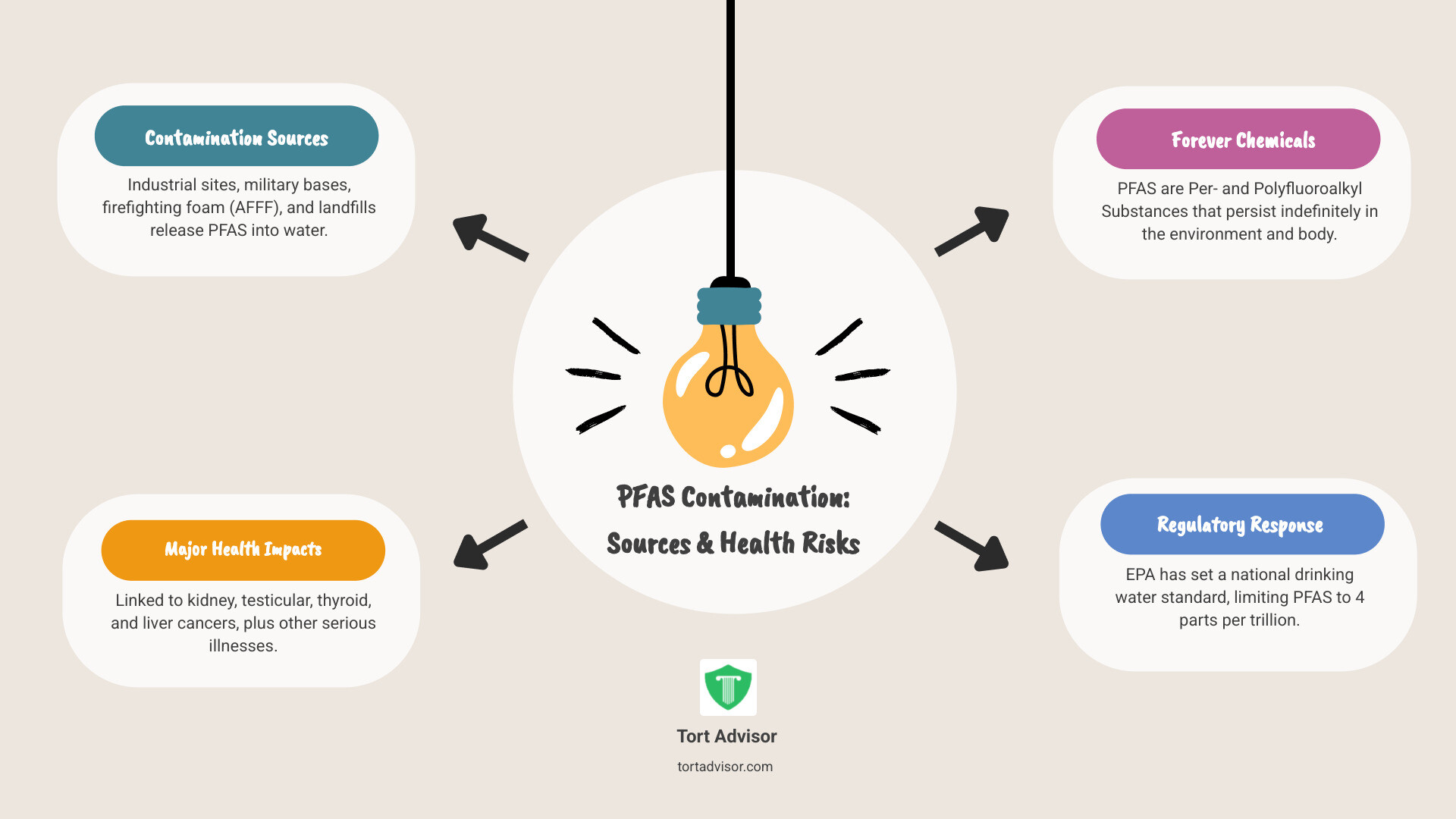
PFAS (per- and polyfluoroalkyl substances) are man-made chemicals that don’t degrade naturally, and industrial discharge and firefighting foam have carried them into drinking water in all 50 states. Studies connect them to serious illnesses including kidney cancer, testicular cancer and thyroid disease. The EPA now caps PFAS in drinking water at 4 parts per trillion. Thousands of suits are pending against manufacturers accused of continuing production despite knowing the dangers, and large settlements are flowing to affected communities and individuals. I’m Mason Arnao. My work on legal data management systems for mass tort litigation — including PFAS cancer water contamination lawsuit cases — gives me a practical view of how these complicated cases are assembled and resolved.
What PFAS “Forever Chemicals” Are — and How They Harm Health
Anyone thinking about a PFAS cancer water contamination lawsuit benefits from understanding what these chemicals are and how they’re affecting millions of Americans. It’s a story of a breakthrough turned harmful, with health consequences that touch nearly everyone.
Why PFAS Earned the Name “Forever Chemicals”
PFAS — per- and polyfluoroalkyl substances — are a family of more than 12,000 synthetic chemicals first developed in the 1940s. Because they repel heat, water and oil, they ended up in countless products, from non-stick cookware to rain jackets to food packaging. Their “forever” nickname comes from an exceptionally strong carbon-fluorine bond that keeps them from breaking down in nature or in the body, so they accumulate over time. The best known and most studied are PFOA (perfluorooctanoic acid) and PFOS (perfluorooctane sulfonic acid). The EPA’s summary of current knowledge on PFAS health risks keeps expanding as research advances.
How PFAS End Up in Drinking Water
Knowing how PFAS reach the tap is central to a PFAS water contamination lawsuit. These chemicals migrate far from their source and surface in surprising places.

Industrial facilities are leading sources, discharging PFAS into air and water. Landfills add more as PFAS-containing products break down and leach into groundwater. A major source has been Aqueous Film-Forming Foam (AFFF), a PFAS-laden firefighting foam that military bases and airports used for decades in drills and emergencies, releasing huge quantities into the ground. The military aimed to end AFFF use in 2024, but much of the harm had already occurred. Hundreds of bases now have contaminated water that often spreads to surrounding neighborhoods and private drinking wells. Once in soil or surface water, PFAS move into the groundwater that serves millions of Americans. The scale is huge — PFAS are present in at least 45% of U.S. tap water, and as of May 2024 more than 6,000 sites across all 50 states had confirmed contamination.
How PFAS Exposure Is Linked to Cancer
Since the body can’t break PFAS down, they build up over years — a process called bioaccumulation that explains why PFAS water contamination cancer cases matter so much: people were exposed through their tap water without knowing it. The research tying PFAS to cancer is now extensive. Kidney cancer has among the strongest links, with studies finding notably higher rates in people with elevated blood PFAS. Testicular cancer is another major concern, with higher risk documented in heavily exposed groups such as Air Force personnel who worked around AFFF. PFAS also disrupt the hormone system, which helps explain links to thyroid cancer and thyroid disease. Liver cancer is increasingly associated with exposure, as the chemicals can damage the liver over time. Outside of cancer, PFAS are tied to ulcerative colitis, weakened immunity, high cholesterol and fertility problems, and researchers are studying possible links to prostate, breast and pancreatic cancers. The complete list of health effects associated with PFAS is still emerging, but what’s known already is alarming.
New EPA Rules and What They Mean for PFAS Claims
Federal regulators are finally treating PFAS as a serious threat, which bolsters anyone bringing a PFAS cancer water contamination lawsuit. The EPA has shifted from voluntary guidance to binding limits. In April 2024 it issued the first nationwide drinking water standard for PFAS, setting enforceable limits of just 4 parts per trillion (ppt) for PFOA and PFOS — a dramatic change from the non-binding 70 ppt health advisory of 2016. Water systems now must test for PFAS and act when levels run too high. The Bipartisan Infrastructure Law also provides $21 billion for PFAS cleanup, funding testing, treatment technology and system upgrades. Together, these rules and dollars formally acknowledge PFAS contamination as a national emergency, lending real weight to legal claims against the companies responsible.
How PFAS Cancer Water Contamination Lawsuits Work
If you’re facing cancer or other illness after drinking contaminated water, many others share your situation. The legal terrain for a PFAS cancer water contamination lawsuit is complicated, but understanding it helps you make sound choices. Large settlements are already being reached, showing these corporations can be made to answer for the harm.
Who Qualifies for a PFAS Lawsuit?
A PFAS water contamination cancer claim generally requires two things: meaningful exposure to contaminated water and a related health condition. Drinking PFAS-contaminated water for a cumulative six months or more at any point from 1990 onward may support a strong claim, since the chemicals accumulate over time. Conditions most commonly involved in these cases include kidney, testicular, thyroid and liver cancer and ulcerative colitis, typically diagnosed in 2000 or later. Some groups face greater risk and often have strong cases. Firefighters and service members encountered huge amounts of PFAS through foam used in training and emergencies. People living near contamination sources — military bases, airports, factories or landfills where PFAS were used or dumped — also frequently qualify. Property owners are in a different position: even without a diagnosis, you may have a claim if PFAS polluted your land, lowered its value or required costly cleanup. One key point: many people were never notified by their water provider about PFAS, so don’t assume your water was safe just because no one warned you. Contamination was often discovered long after the exposure took place.
The Companies and States Involved in PFAS Litigation
In a PFAS cancer water contamination lawsuit, the defendants are usually the big chemical companies that made and distributed PFAS.

3M Company, which manufactured both PFAS and AFFF, is one of the most familiar names in this litigation. DuPont made the PFOA used in Teflon for decades. Chemours Company and Corteva, both spun off from DuPont, took on liability for past contamination. Tyco Fire Products, BASF, Carrier Global and Kidde-Fenwal have also been sued over their roles. What strengthens these cases is internal corporate records indicating many manufacturers understood PFAS health risks decades ago yet kept making and selling the chemicals. It isn’t only individuals suing, either — whole states are pushing back. New Hampshire, Florida and California, among others, have brought major suits to recoup the cost of cleaning up public water supplies. When states sue PFAS makers, it underscores how widespread the crisis is.
Major PFAS Settlements and What They Mean
PFAS contamination has produced some of the biggest environmental settlements in U.S. history, signaling how seriously courts take PFAS water contamination cases. 3M’s agreement is historic: in 2023 it committed to pay between $10.5 and $12.5 billion over 13 years to address public water system contamination, and the deal won approval in 2024. DuPont, Chemours and Corteva together agreed to $1.18 billion to help water providers add filtration and clean up supplies. Tyco settled for $750 million, BASF for $316.5 million, and Carrier Global and Kidde-Fenwal for $730 million. These multi-billion-dollar deals mainly fund public water cleanup and help municipalities cover remediation; they don’t pay individual injury claims directly, but they show the companies are being held responsible. For individual personal injury claims, value depends heavily on your diagnosis, the level and length of exposure, the strength of your records and other personal circumstances, with more serious cancers and heavier exposure generally supporting larger recoveries.
Kinds of PFAS Water Contamination Claims
Knowing the different routes for a PFAS cancer water contamination lawsuit helps you pick the right one, and your attorney can advise which fits your case. Personal injury claims are individual suits by people who developed cancer or another serious illness from PFAS, seeking payment for medical costs, lost income, pain and suffering and diminished quality of life. Class actions bundle many people harmed by the same contamination source; payouts per person tend to be smaller, but they resolve claims efficiently when thousands are affected. Multidistrict litigation (MDL) is especially significant here: many individual suits, particularly those tied to firefighting foam, have been consolidated in MDL 2873 in South Carolina, which handles similar cases together and can lead to large group settlements. Property damage claims are for owners whose land, homes or private wells were contaminated; even without a diagnosis, you may recover lost property value, testing costs or the expense of filtration systems. Environmental cleanup claims are usually brought by governments and municipalities to recover the enormous cost of restoring water supplies and natural resources — not typically filed by individuals, but important because they fund cleanup that benefits whole communities.
Pursuing a PFAS Claim: Steps, Settlements and Legal Help
If PFAS contamination may have harmed you, the legal process can look intimidating. Below are the main stages of a PFAS cancer water contamination lawsuit and what to expect along the way.
How to Get Started Filing a PFAS Claim
Acting quickly matters. A PFAS water contamination lawsuit typically moves through these steps:
- Document Exposure and Diagnosis: Start by connecting your PFAS exposure — such as a contaminated water system or on-the-job AFFF contact — to your diagnosed illness.
- Collect Evidence: Thorough proof is essential, including medical records of your diagnosis and treatment, water quality reports showing contamination, and records showing you lived or worked in the affected area.
- Talk to an Experienced Attorney: Request a free case review from an attorney who handles PFAS litigation. They can judge your eligibility and explain your state’s statute of limitations, which usually runs from when you discovered your illness or were diagnosed.
- File the Complaint: Your attorney prepares and files a formal complaint against those responsible, officially starting the case.
From there, your attorney leads you through discovery, settlement talks and, if needed, trial. Careful preparation is what drives strong results.
What a PFAS Water Contamination Settlement May Include
Compensation in a PFAS cancer water contamination lawsuit varies, and knowing what shapes it helps set realistic expectations.
- No Typical Amount: Every case is different, and there is no reliable “average” individual PFAS settlement. What a claim is worth depends on the factors below.
- What Drives Value:
- How Serious the Illness Is: The biggest factor. Severe cancers with strong PFAS links, such as kidney or testicular cancer, generally support larger recoveries.
- How Long and How Much: Longer exposure to higher PFAS concentrations tends to strengthen a claim.
- Medical Costs: Past and future care, including treatment, prescriptions and rehabilitation.
- Lost Income and Earning Power: Wages lost to illness and any reduction in your ability to earn.
- Pain and Suffering: Non-economic harm covering physical pain, emotional distress and a diminished quality of life.
- Strength of Your Legal Team: An attorney’s skill and negotiating ability can meaningfully affect the outcome.
Outcomes vary widely, and the specific result in any case depends on its own facts and evidence.
Why Experienced Legal Representation Matters
A PFAS cancer water contamination lawsuit is complicated and pits individuals against major corporations, which makes seasoned legal help essential.

Here’s why the attorney you choose matters:
- Mass Tort Experience: PFAS cases are mass torts — many plaintiffs against a few defendants — and attorneys who focus on them have the needed knowledge and resources.
- Command of the Science: These cases rest on detailed science connecting exposure to illness, so experienced attorneys partner with medical and environmental experts to build a strong case.
- Handling the Procedure: From the complaint through discovery, negotiations with defense counsel and possibly trial, the process is intricate. A skilled attorney keeps every step on track and every deadline met.
- Valuing the Full Claim: Experienced teams know how to measure damages, including future medical needs and pain and suffering, and how to negotiate for the strongest possible result.
- Contingency Fees: Most reputable PFAS attorneys work on contingency, so there are no upfront costs or hourly bills. They’re paid only if compensation is recovered, as a percentage of the settlement or award, which puts representation within reach for everyone.
- Relevant Experience: Seek attorneys with solid experience in environmental torts and complex injury cases, ideally on a national scale.
Working with attorneys who know PFAS litigation can meaningfully improve your prospects and give you peace of mind throughout the case.
Looking Ahead: Medical Monitoring and Future Costs
A PFAS cancer water contamination lawsuit should account for long-term health and financial consequences, not just immediate losses.
- Future Medical Costs: PFAS-linked cancers and illnesses may need treatment, therapy and medication for years or even a lifetime, and a settlement should ideally reflect those projected costs.
- Continued Health Monitoring: Because PFAS linger in the body and new problems can appear later, medical monitoring programs are often a key part of settlements, helping catch new conditions years after exposure. Polluters may be required to pay for this monitoring for exposed people.
- Quality-of-Life Damages: Serious illness costs more than money. These damages address emotional distress, lost enjoyment of life and the broader suffering caused by the illness and its lasting effects.
- Environmental Cleanup: Though not paid to individuals, a large share of major PFAS settlements goes to cleanup and remediation, restoring safe water supplies and indirectly supporting residents’ long-term health.
Weighing these long-term issues helps ensure victims receive compensation that covers past, present and future needs tied to PFAS exposure.
PFAS Water Contamination Lawsuit FAQs
Questions are natural when facing something as serious as PFAS contamination. A PFAS cancer water contamination lawsuit can feel overwhelming, so here are clear answers to common concerns.
How can I tell whether my water contains PFAS?
Checking your water is a smart first move, and there are several ways to do it. Start with your water utility’s reports: public suppliers often test for PFAS and publish results in annual water quality reports (also called Consumer Confidence Reports). The EWG contamination map is another tool — the Environmental Working Group’s interactive map shows known PFAS sites nationwide, at least 6,189 sites in all 50 states as of May 2024. Find it here: https://www.ewg.org/interactive-maps/pfas_contamination/. If you rely on a private well, arrange testing through your local health department or a certified lab. Where contamination turns up, activated carbon and reverse osmosis systems can help lower PFAS levels.
What does a PFAS lawyer cost?
Legal fees are a real worry, especially while you’re dealing with illness. Through Legal Lawsuit, you can connect with PFAS water contamination attorneys in our network who charge no upfront costs or hourly fees and work on a contingency fee basis. In plain terms:
- You owe nothing unless compensation is recovered for you.
- The attorney’s fee is a percentage of the final settlement or award, so they’re paid only if you are.
- You can also request a free, confidential case review to discuss your situation with no cost or commitment and find out whether you have a strong claim.
This arrangement means anyone harmed by PFAS contamination can pursue justice regardless of their finances — and getting you to the right help is what matters most.
Can I take part in a lawsuit if I was exposed but am not sick?
It depends on your circumstances and where you live. In some jurisdictions, people with significant PFAS exposure but no illness may pursue “medical monitoring” claims asking the responsible companies to pay for regular screenings that catch disease early. You may also have a property damage claim if your property or private well was contaminated, seeking compensation for lost value or filtration costs even without an injury. Eligibility rules and filing deadlines differ by state, so the surest way to find out is to speak with an attorney who handles PFAS cases and can review your exposure history and options.
Final Thoughts: Your Next Step in a PFAS Case
PFAS contamination is a complicated subject, but the bottom line is clear: these “forever chemicals” are a serious threat. They persist in our water, resist breaking down, and have been tied to devastating illnesses such as kidney, testicular, thyroid and liver cancer — a crisis touching millions of American families. The fight for accountability is just as big. For decades, some manufacturers knew the risks and carried on anyway, and a PFAS water contamination cancer lawsuit gives ordinary people a way to hold them responsible. Landmark settlements have already shown that justice is achievable for communities and individuals alike. If PFAS contamination has affected you or someone you love, you are not alone, and you do have legal options. Working through the legal system by yourself can feel overwhelming, which is where expert guidance helps. Legal Lawsuit’s mission is to help people like you connect with attorneys in our network who handle complex PFAS cases, so you can pursue the strongest possible outcome. Don’t let the scale of this crisis stop you from exploring your rights. Learning about PFAS exposure risks and recognizing PFAS exposure symptoms is an important first step; getting professional advice is the next. Request a free PFAS case review today and take that next step toward the compensation and justice you deserve.
Related Posts
Quick Answer: The Boy Scouts of America (BSA) filed for Chapter 11 bankruptcy in 2020 after facing tens of thousands [...]
Quick Answer: Survivors of sexual abuse by Catholic priests, nuns, or other Church personnel may be able to file a [...]
Quick Answer: Clergy abuse settlements vary enormously based on the severity of the abuse, the strength of evidence that the [...]

