
Short answer: This article explains the key facts, eligibility issues, settlement factors, deadlines, and source-backed updates related to this legal topic. Results vary by case facts, evidence, jurisdiction, and representation.
📋 Table of Contents
- Understanding the Growing Wave of Depo-Provera Legal Action
- What is Depo-Provera and Why is it Facing Legal Scrutiny?
- The Scientific Link: What Research Reveals About Depo-Provera and Meningioma
- The Current State of the Depo-Provera Lawsuit Litigation
- Filing a Claim: What Potential Plaintiffs Need to Know
- Potential Compensation in a Depo-Provera Lawsuit
- Frequently Asked Questions about Depo-Provera Lawsuits
- How to Get Help for Your Depo-Provera Claim
Depo-Provera Claim Tools and Resources
Depo-Provera Settlement Calculator — Get a rough estimate of potential compensation based on your meningioma diagnosis and related injuries.
Depo-Provera Settlement Amounts — See what is known so far about case values and the factors that shape them.
Why Depo-Provera Lawsuit Claims Are Growing
A Depo-Provera lawsuit claim is a case brought by a woman who developed serious health problems, most often a meningioma brain tumor, after receiving the birth control injection. Here is an overview: Depo-Provera Lawsuits at a Glance:
- Core Claim: Pfizer, the manufacturer, did not adequately warn users about a heightened risk of meningioma.
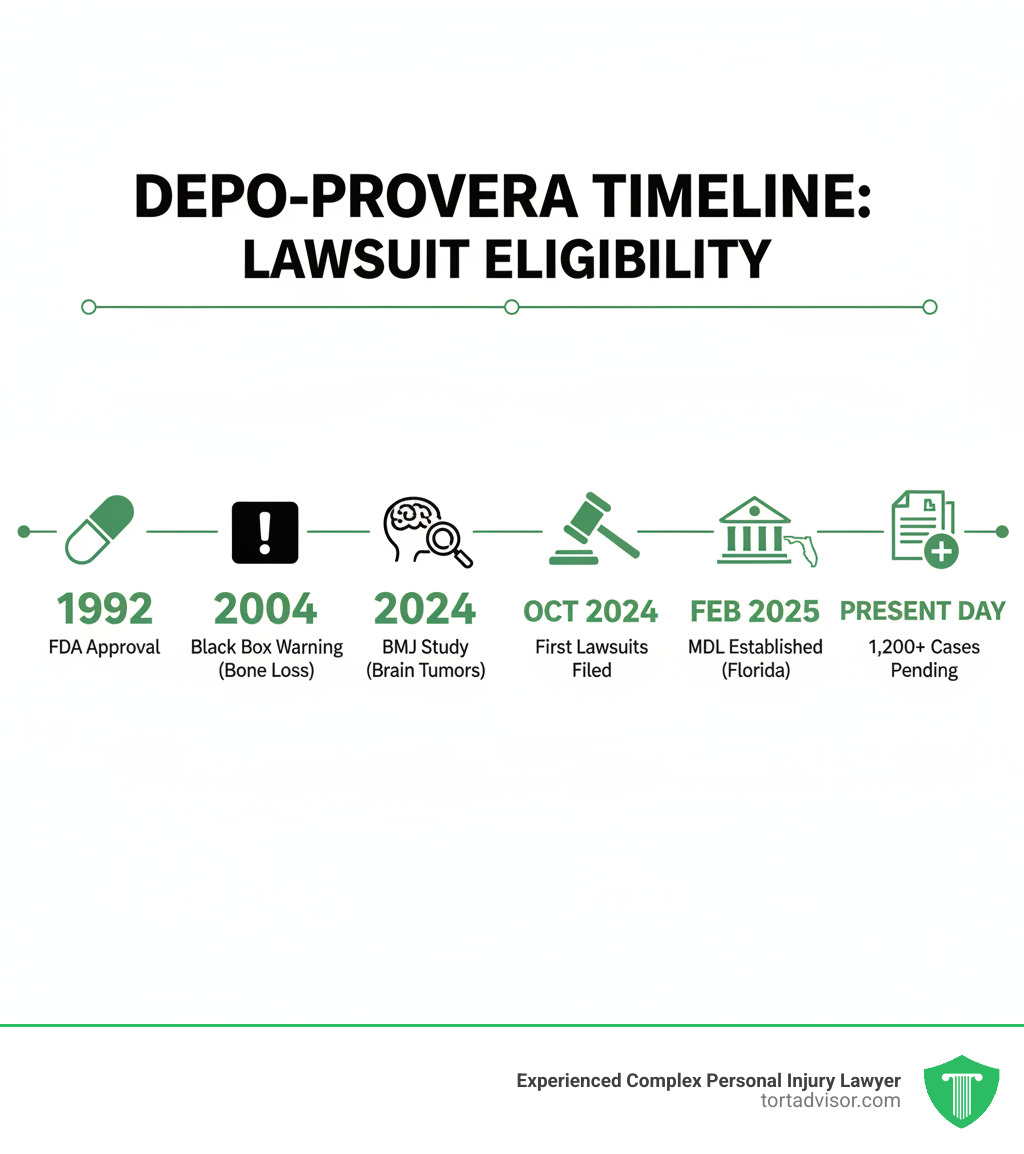
- Where Things Stand: More than 1,200 federal cases had been consolidated in Florida (MDL No. 3140) as of October 2025.
- The Science: A 2024 study found that more than a year of Depo-Provera use was tied to a 5.6-fold higher meningioma risk.
- Who May Qualify: Women who used the shot for at least a year and were later diagnosed with a meningioma.
- Legal Theories: Failure to warn, design defect and negligence against Pfizer.
- Labels Abroad: European and Canadian labeling warns of meningioma risk, while U.S. labeling long did not.
The toll on real people is serious. One plaintiff, Robin Phillip, used Depo-Provera for many years before learning she had a brain tumor; she needed two major brain operations, lost part of her vision and had to learn to walk again, and she has said she would not have taken the shot had she known the risk. The FDA approved Depo-Provera as a contraceptive in 1992, and it is given as an injection every three months. Millions of women have chosen it for its convenience, but recent research has revealed a troubling association between the drug and serious neurological injury. This guide from Legal Lawsuit explains the litigation, the science and your options if you have been affected.
What Depo-Provera Is and Why It Is in Court
Depo-Provera is a widely used contraceptive injection the FDA approved in 1992. Its active ingredient, medroxyprogesterone acetate (MPA), is a synthetic hormone that blocks ovulation, thickens cervical mucus and thins the uterine lining. Needing a shot only every three months has made it popular with millions of women, and it is also prescribed for conditions like endometriosis. The lawsuits focus on what Pfizer and its subsidiary Pharmacia & Upjohn allegedly kept from patients, claiming they failed to give adequate warning of serious dangers, especially brain tumors. That alleged failure to warn underlies every Depo-Provera lawsuit claim. Our Depo-Provera Severe Side Effects guide covers the health risks in more depth.
The Main Claim: Meningioma Brain Tumors

The most serious allegation involves meningiomas, tumors arising in the protective layers around the brain and spinal cord. They are the most common primary brain tumor and are more frequent in women, which points to a hormonal connection. Most are benign, but because they grow inside the skull they can press on the brain and cause serious problems, including:
- Intense headaches that don’t let up
- Blurred or double vision
- Seizures
- Trouble with hearing or balance
- Cognitive difficulties
Treatment often means a craniotomy, major surgery to remove the tumor. Some patients, Robin Phillip among them, have needed more than one operation and been left with lasting disabilities such as vision loss. These are life-changing injuries, and the connection between Depo-Provera and these tumors is what drives the litigation. Our Depo Shot Brain Tumor page looks at the link in more detail.
Other Side Effects Raised in Claims
Meningiomas are the focus of today’s lawsuits, but Depo-Provera has been associated with other serious health problems as well.
- Bone Loss: The risk of major bone density loss is so well established that the FDA added a black box warning, its strongest, in 2004, advising against use beyond two years. Bone loss was also the subject of a Canadian class action that Pfizer settled. See our Depo-Provera Bone Loss Lawsuit page.
- Pseudotumor Cerebri: Also called intracranial hypertension, this is a buildup of pressure around the brain that mimics a tumor and can cause permanent vision loss.
- Blood Clots: Some claims have also raised concerns about a higher risk of clotting.
What ties these claims together is the allegation that women never received proper warnings and so could not make an informed decision about their health.
What the Research Shows About Depo-Provera and Meningioma
Strong scientific evidence underpins Depo-Provera lawsuit claims. There is a plausible biological explanation: many meningiomas carry progesterone receptors, and MPA, the synthetic hormone in Depo-Provera, may attach to those receptors and fuel tumor growth. Researchers have explored this hormonal connection for decades, and several recent large studies have reinforced it:
- 2024 BMJ Study: A major French study published in The British Medical Journal found a 5.6-fold higher meningioma risk among women who used Depo-Provera for over a year. See the findings at The BMJ study.
- JAMA Neurology Study: Analyzing records from more than ten million women, researchers found Depo-Provera users had about double the meningioma risk, with higher risk after more than four years of use. Read more at JAMA Neurology study.
- University of British Columbia Study: Another analysis reported a 3.55-fold higher risk for women using the shot longer than a year.
The agreement among these separate, large studies is notable. Meningioma remains uncommon overall, but the added risk is meaningful; one analysis estimates one extra tumor for every 1,111 women who use Depo-Provera for three years. These are observational studies that show strong associations rather than proving direct cause, yet together they give the legal claims a solid scientific footing and turn individual stories into a documented pattern. Our Depo-Provera Lawsuit Side Effects Guide explains how this research supports claims.
Where the Depo-Provera Litigation Stands

Depo-Provera lawsuit claims have multiplied quickly. By October 2025, more than 1,200 federal suits had been filed against Pfizer and related companies, all centered on the alleged failure to warn patients and doctors about meningioma risk. To handle them efficiently, the cases were combined into a multidistrict litigation (MDL). For the newest developments, see our Depo-Provera Lawsuit Updates 2025 page.
How the Depo-Provera MDL Works
MDL No. 3140 is centralized in the U.S. District Court for the Northern District of Florida before Judge M. Casey Rodgers, who has extensive experience with complex drug litigation. Official filings are posted here: Depo-Provera (Depot Medroxyprogesterone Acetate) Products Liability Litigation | Northern District of Florida. An MDL differs from a class action in important ways:
- Your Own Case: Each MDL plaintiff keeps a separate lawsuit, while a class action is one suit on behalf of everyone.
- Individual Compensation: MDL outcomes reflect each person’s own damages, such as medical costs and lost income, while class members typically split one lump sum.
- Greater Control: MDL plaintiffs have more say in their case and can turn down a settlement offer.
Because injuries differ so much from person to person, this structure suits Depo-Provera cases well. The MDL coordinates pretrial work like discovery, and a handful of bellwether trials are expected to go first to help set settlement values for the rest. Dozens of additional cases are pending in New York state courts. For more on the difference, see our Depo-Provera Class Action Lawsuit 2024 page.
How to File a Depo-Provera Lawsuit Claim
If you received Depo-Provera and were later diagnosed with a meningioma, you may be able to bring a Depo-Provera lawsuit claim. Each case is unique, but there are general criteria and steps.

Do You Qualify? You may have a claim if all three of these apply:
- Meaningful Use: You used Depo-Provera for a year or more (roughly four shots).
- Diagnosis: You were diagnosed with a meningioma of the brain or spine.
- Timing: The diagnosis came after you started the injections, supporting a plausible link.
Learn more on our page Who May Qualify to File a Depo Provera Lawsuit?. What Evidence Will You Need? A strong claim depends on records, including:
- Proof You Used It: Medical or pharmacy records documenting your Depo-Provera shots.
- Proof of Injury: Every record tied to your meningioma diagnosis and care, including MRIs, CT scans, pathology reports and operative notes.
The Legal Grounds for a Depo-Provera Claim
These are product liability cases, and failure to warn is the heart of them. Plaintiffs say Pfizer knew or should have known about the meningioma risk yet didn’t tell U.S. patients and physicians. That argument is bolstered by warnings added to Depo-Provera labels elsewhere, including Canada and Europe, after a recommendation from the European Medicines Agency; plaintiffs contend the absence of a matching U.S. warning left American patients unprotected. Additional claims include design defect (the drug is unreasonably dangerous) and negligence (the manufacturer failed to use reasonable care).
Filing Deadlines and the Discovery Rule
Every claim must be filed within the statute of limitations, which varies by state and is often one to three years. The clock doesn’t necessarily start when the injury happens: under the “discovery rule,” it may begin when you learned, or reasonably should have learned, that your meningioma could be tied to Depo-Provera, which for many women was only recently. Because these deadlines are strict and tricky, talk to an attorney promptly. Our Depo-Provera Lawsuit Criteria Guide covers filing requirements.
What a Depo-Provera Lawsuit Claim Can Recover
A successful Depo-Provera lawsuit claim can compensate for the heavy financial, physical and emotional toll of a meningioma. Pfizer signed a Master Settlement Agreement for eligible claims in July 2026, and claimants may recover several types of damages.
- Economic Damages: Past and future medical costs, from brain surgery and hospitalization to rehab and medication, plus lost wages and reduced future earning ability.
- Non-Economic Damages: Compensation for intangible harm like pain and suffering, emotional distress, anxiety and diminished quality of life, such as no longer being able to enjoy hobbies or daily routines.
- Punitive Damages: Sometimes awarded to punish a manufacturer for reckless conduct, such as concealing known risks, and to discourage similar behavior.
For more detail, read our Depo-Provera Lawsuit Compensation Guide 2025.
What Shapes Settlement Value
Compensation is tailored to the facts of each case. The main factors include:
- How Severe the Injury Is: A large or aggressive tumor needing several surgeries is valued higher than a small one removed easily.
- Long-Term Outlook: Lasting disabilities such as vision loss, seizures or cognitive problems raise a claim’s value considerably.
- How Long You Used the Shot: Longer use strengthens the connection, since the research shows risk rising with dose.
- Quality of Evidence: Complete, clear medical records are essential.
- Your Age: Younger plaintiffs with more years of lost earning capacity may receive more.
It is too early for reliable figures in the Depo-Provera MDL, and Legal Lawsuit does not publish projected payout ranges; values are likely to be shaped by bellwether trial results and the factors above. Our Calculator: Depo Provera Settlement Calculator can offer a preliminary estimate, but only an experienced attorney can assess your claim accurately.
Depo-Provera Lawsuit Claim FAQs
Thinking about a Depo-Provera lawsuit claim raises plenty of questions. Here are answers to the most frequent ones.
How does the FDA figure into the Depo-Provera cases?
The FDA is central to Pfizer’s defense. Pfizer asked the FDA to add a meningioma warning to the U.S. label, and the FDA declined, citing insufficient evidence from observational studies. Pfizer now argues “federal preemption”: that state-law claims can’t fault it for omitting a warning the FDA rejected. Plaintiffs respond that Pfizer had other options, including the “Changes Being Effected” (CBE) process that lets a manufacturer update its label on its own. Their strongest point is the international double standard, as regulators in Europe, Canada and South Africa all moved to add meningioma warnings; both the European Medicines Agency and South Africa’s drug regulatory agency issued related updates. Plaintiffs argue this shows Pfizer could and should have done more to warn American women. See similar litigation on our Birth Control Shot Lawsuit page.
What should I do if I think Depo-Provera harmed me?
If you believe your meningioma may be connected to Depo-Provera, act right away:
- Get Medical Care: Your health comes first, so talk with your doctor about your symptoms and Depo-Provera history.
- Collect Records: Gather every medical and pharmacy record about your injections and your tumor diagnosis and treatment.
- Keep a Journal: Write down your symptoms, pain levels and how the condition affects everyday life.
- Talk to an Attorney: Contact a lawyer who handles pharmaceutical cases quickly so your claim is filed before the deadline.
- Stay Off Social Media: Avoid posting about your health or your case, since posts can be used against you.
Why hire a lawyer for a Depo-Provera claim?
Taking on a drug company the size of Pfizer by yourself is extremely difficult. An experienced attorney brings key advantages:
- Know-How: Familiarity with the science and procedures of mass tort litigation.
- Resources: Access to the medical experts needed to prove your claim.
- A Buffer: They deal with the defense, so you aren’t pressured.
- Full Value: The negotiating skill to pursue everything your claim is worth.
- No Upfront Cost: These attorneys typically work on contingency, so there is no fee unless your case recovers money.
A skilled attorney evens the odds so you can concentrate on healing. Our Depo-Provera Injury Lawyer page has more on finding the right help.
Getting Help With Your Depo-Provera Lawsuit Claim
Suing a pharmaceutical giant like Pfizer calls for experienced legal help. If you were diagnosed with a meningioma after using Depo-Provera, you deserve an advocate with the resources and experience to pursue the compensation you are owed. These cases involve detailed medical evidence and powerful corporate defense teams, so having the right attorney matters. Legal Lawsuit can help by connecting you with attorneys in our network who handle Depo-Provera lawsuit claims and other pharmaceutical injury cases. When you reach out, we will listen to what happened, help you understand your options and connect you with an experienced attorney for a free, confidential case review. You trusted a medication and paid a heavy price, and you deserve to be treated as a person, not a file number. Filing deadlines are limited, so don’t wait to take the first step toward accountability.
Related Posts
Quick Answer: The Boy Scouts of America (BSA) filed for Chapter 11 bankruptcy in 2020 after facing tens of thousands [...]
Quick Answer: Survivors of sexual abuse by Catholic priests, nuns, or other Church personnel may be able to file a [...]
Quick Answer: Clergy abuse settlements vary enormously based on the severity of the abuse, the strength of evidence that the [...]