

Short answer: This article explains the key facts, eligibility issues, settlement factors, deadlines, and source-backed updates related to this legal topic. Results vary by case facts, evidence, jurisdiction, and representation.
In This Guide
Why Birth Control Shot Lawsuits Are Growing
The number of birth control shot lawsuit filings has climbed quickly nationwide as women come forward alleging that Depo-Provera caused serious brain tumors. The suits claim that Pfizer, the maker, did not alert patients and doctors to the elevated risk of meningiomas after using the widely prescribed contraceptive injection. Birth Control Shot Lawsuit at a Glance:
- Core Claim: Long-term Depo-Provera use is linked to a 5.6-fold higher meningioma risk
- Main Evidence: A 2024 British Medical Journal study tying extended use to meningiomas
- Where It Stands: Hundreds of cases consolidated in federal MDL 3140 (more than 348 by early 2025, and growing)
- Who May File: Women who used Depo-Provera for a year or more and were later diagnosed with a brain tumor
- Possible Compensation: Depends on tumor severity, treatment needed, lasting effects, and lost income
- Deadline: Commonly 2–3 years from diagnosis, depending on the state
At the center of the dispute is a failure to warn claim. Pfizer’s European labels included meningioma warnings, while U.S. patients went without them for years despite research going back decades. Women like T.C., who used Depo-Provera for years before being diagnosed with a meningioma, now live with the anxiety that follows brain surgery and ongoing neurological problems. What makes these cases so striking is the gap between how Pfizer warned patients abroad and at home: European and Canadian labels addressed brain tumor risk, while U.S. labels, at the time these suits were filed, did not. I’m Mason Arnao. Through my work with Legal Lawsuit, I have helped many people connect with experienced attorneys on complex cases, including birth control shot lawsuit claims, and my background in technology and lead generation gives me a practical view of how mass torts like this one develop.
What Is Depo-Provera, and What Health Risks Are Alleged?
Millions of women have used Depo-Provera, an injectable contraceptive made with medroxyprogesterone acetate (MPA), for decades because it is effective and easy. New research, however, has placed this familiar contraceptive at the center of a growing wave of birth control shot lawsuit claims.

The litigation focuses on two serious conditions affecting the brain: meningiomas (brain tumors) and intracranial hypertension (harmful pressure inside the skull). Both can lead to brain surgery and long-term medical care. For a broader look at possible health effects, see our guide on Depo-Provera Severe Side Effects.
How the Birth Control Shot Prevents Pregnancy
Depo-Provera releases a synthetic hormone, a progestin, that prevents pregnancy in two ways. It stops ovulation, so no egg is released, and it thickens cervical mucus, making it hard for sperm to get through. Given once every three months, this long-acting contraceptive spares women a daily pill, which is why so many choose it.
The Meningioma Connection
This is where the concern lies. Current birth control shot lawsuit claims center on research linking Depo-Provera to meningiomas, tumors that form in the protective membranes around the brain and spinal cord. A key 2024 British Medical Journal study found that women who used Depo-Provera for more than a year had a 5.6 times greater risk of meningiomas requiring surgery — a substantial increase patients were not told about. Researchers believe many meningiomas carry progesterone receptors, so the synthetic progestin in Depo-Provera may fuel their growth over time. As the Mayo Clinic’s meningioma information explains, these are usually slow-growing tumors, but because the skull leaves no room to expand, even benign growth can cause serious harm. Most worrying, the risk appears greatest with long-term use — exactly how Depo-Provera is usually prescribed.
Warning Signs Not to Ignore
Anyone who has used Depo-Provera, particularly for over a year, should know the warning signs, which often start mild and worsen over time. Meningioma symptoms include persistent, severe headaches, vision problems such as blurring or double vision, and sudden seizures. Many women also report memory problems or feeling mentally foggy, along with hearing loss or tinnitus and unexplained weakness in the arms or legs. Intracranial hypertension looks different but is just as serious, often involving headaches behind the eyes unlike ordinary headaches, constant ringing in the ears, frequent dizziness, and nausea with no obvious cause. Don’t dismiss these symptoms; treating a meningioma can be very expensive and can disrupt your life and career. If you notice them after using Depo-Provera, get medical care promptly. Sadly, many women relied on their doctors and on Pfizer to tell them about these risks and learned of them only after developing life-changing conditions.
The Case Against Pfizer: Failure to Warn
Every birth control shot lawsuit comes down to one question: did Pfizer adequately warn women about serious risks? These claims rest on a “failure to warn” theory, and plaintiffs argue the evidence shows Pfizer knew about tumor risks but did not tell U.S. patients.

The difference in how Pfizer warned patients in different countries is troubling. Depo-Provera labels in Europe clearly warned of brain tumor risk, while U.S. labels did not at the time, raising serious concerns about patient safety and informed consent.
What a Failure-to-Warn Claim Means
A failure to warn claim asserts that Pfizer had a legal obligation to tell patients and doctors about known risks. That obligation includes the manufacturer’s duty to test and monitor its product, to list known risks on the label, and to give enough information for informed consent. Without proper warnings, doctors and patients cannot weigh benefits against risks, choose another contraceptive, or watch more closely for symptoms. When a company hides or minimizes serious dangers, it takes that choice away.
How Pfizer Allegedly Kept Patients and Doctors Uninformed
Research pointing to a link between progestins and brain tumor growth dates back to the 1980s and 1990s. Plaintiffs allege that Pfizer nonetheless did not update U.S. labels for decades. The key point: Depo-Provera labels in Europe and Canada already carried meningioma warnings. Canadian labels have included them since at least 2016, and European labels also flag brain tumor risk, yet U.S. patients were not told for years. Plaintiffs argue this was a deliberate decision that favored profits over safety, leaving women to take risks they did not know about. Pfizer has argued that the FDA would not allow it to add a meningioma warning to the U.S. label, but plaintiffs counter that if the risk justified warning European patients, the company should have pressed harder to protect American women. The U.S. label has since been revised; see the FDA prescribing information linked below for the current version.
Depo-Provera’s History of Safety Questions
This is not the first time Depo-Provera has faced safety concerns, and that history makes the brain tumor allegations more troubling. In 1978, the FDA declined to approve Depo-Provera as a contraceptive because of cancer concerns, and it was not approved for that use until 1992. In 2004, the FDA added a “black box” warning, its most serious label warning, for significant bone density loss in long-term users, who faced a risk of osteoporosis and possibly permanent bone damage. That, too, was a serious risk that took years to communicate clearly. Pfizer has faced consequences before, reportedly paying more than $2 million in Canadian settlements over inadequate bone density warnings. Plaintiffs say the same pattern — weak warnings followed by litigation — is repeating with brain tumors, and they argue that this history shows Pfizer knows how to warn patients when it chooses to.
How the Depo-Provera Birth Control Shot Lawsuit Works
If you used Depo-Provera and later developed a brain tumor, you may be wondering about your legal options. Current birth control shot lawsuit claims give women who believe they were harmed a meaningful chance to seek justice and compensation.

The goal of these suits is to hold Pfizer responsible for allegedly failing to warn U.S. women about known tumor risks. Legal Lawsuit understands how overwhelming legal questions can be while you are dealing with a serious diagnosis, and as a legal-information site we help people connect with experienced pharmaceutical injury attorneys in our network. For more on the litigation, see our Depo-Provera Lawsuits page.
Where the Depo-Provera MDL Stands
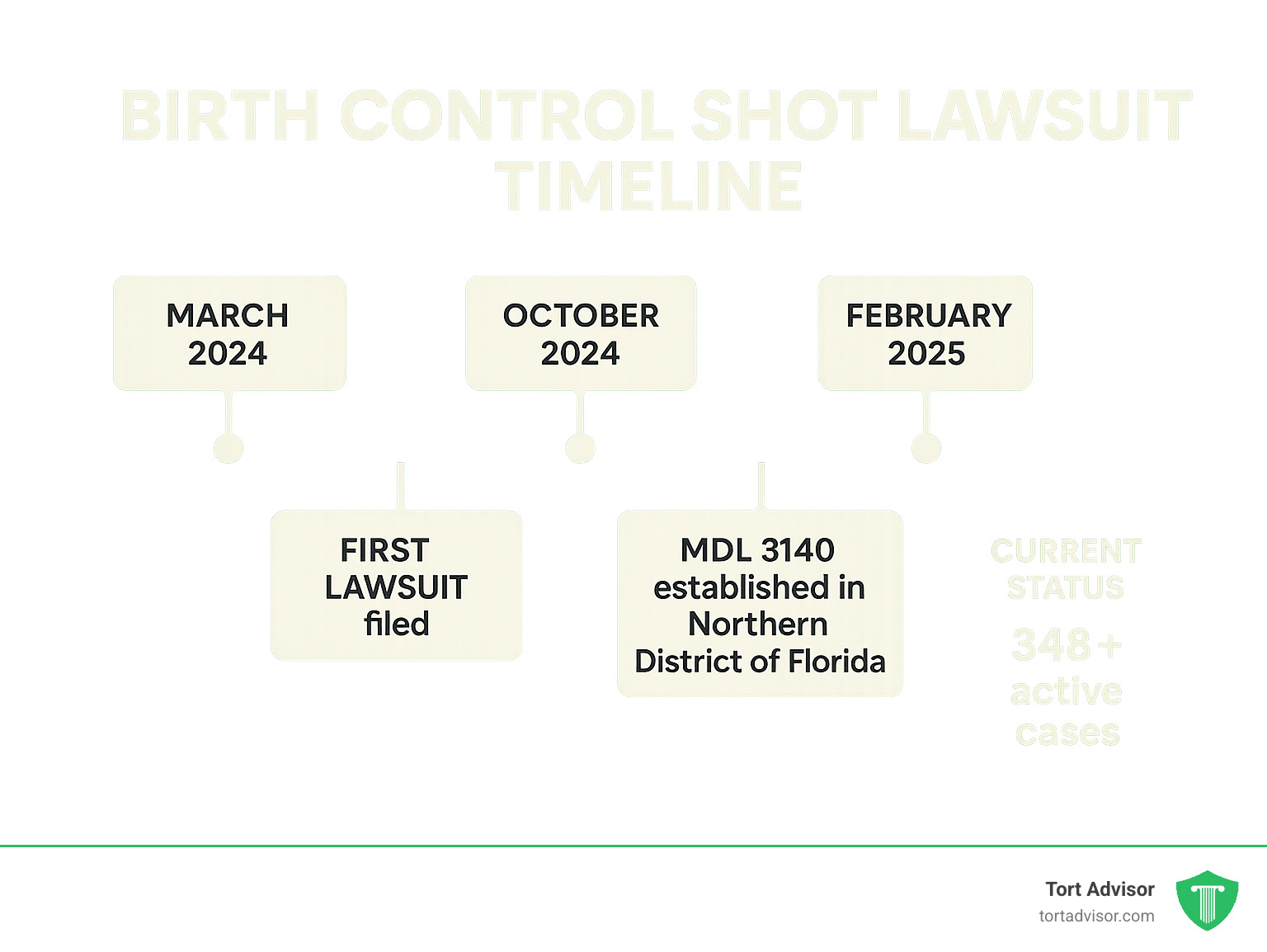
Birth control shot lawsuit claims reached an important stage when Multidistrict Litigation (MDL 3140) was created in the U.S. District Court for the Northern District of Florida. An MDL gathers many similar federal cases before one judge rather than leaving them scattered across courts nationwide. Judge M. Casey Rodgers, who has extensive experience with large pharmaceutical litigation, presides. The first Depo-Provera meningioma suit was filed in October 2024, and by early 2025 more than 348 claims had been filed and consolidated, with the count continuing to grow as of this update. The MDL signals that courts see common questions across these cases and should make evidence gathering more efficient, which may speed resolution.
Who May Qualify for a Birth Control Shot Lawsuit?
Not every Depo-Provera user will have a claim, but you may if you meet certain criteria. How long you used it matters: most attorneys are looking for women who used Depo-Provera for a year or more, consistent with research showing risk rises with longer use. You need a confirmed meningioma diagnosis in your medical records, usually based on MRI imaging and sometimes a biopsy. How serious your condition is also matters; attorneys tend to focus on cases that required substantial treatment such as brain surgery, radiation, or ongoing neurological care, while small incidental tumors that need no treatment may be worth less. Timing is critical: most states set a statute of limitations of about 2–3 years from when you discovered, or should have discovered, the connection between Depo-Provera and your tumor, and under the “discovery rule” that may be recent for many women.
What Drives Compensation in a Birth Control Shot Lawsuit
Compensation in a birth control shot lawsuit is meant to address the full financial and emotional toll of a brain tumor. Medical costs are often the biggest component, covering past and future expenses for imaging, surgery, radiation, and follow-up care. Lost income and earning capacity also matter, since symptoms can derail careers and limit future earnings. Pain and suffering damages recognize the fear, anxiety, and disruption to daily life. A settlement program for eligible claims was created in 2026, but its payout figures have not been released, so no reliable per-claim amounts exist. Rather than relying on predicted dollar ranges, it helps to understand what typically drives value: the tumor’s grade and location, whether surgery or radiation was required, any permanent neurological effects, your age and work history, and the strength of the evidence connecting your use of the shot to your diagnosis. Punitive damages may also be possible if a court finds Pfizer’s conduct especially reckless.
Depo-Provera Lawsuit Questions, Answered
If you are thinking about a birth control shot lawsuit, you probably have questions, especially while coping with a serious health problem. Here are answers to several common ones.
How long do I have to file a Depo-Provera lawsuit?
A statute of limitations is the deadline to file suit, and missing it can bar your claim no matter how strong it is. Deadlines differ considerably by state; many states allow roughly 2–3 years from a meningioma diagnosis to file a birth control shot lawsuit, while some allow more time and others less. The “discovery rule” may help: because tumors can appear years after use, the clock may not start until you learned, or reasonably should have learned, about the link between the shot and your meningioma. Don’t delay — contact an experienced attorney as soon as you suspect a connection so you know your state’s deadline.
How does an MDL differ from a class action?
People often confuse Multidistrict Litigation (MDL) with class actions, but the Depo-Provera cases are proceeding as an MDL, which works differently. An MDL brings similar individual cases from around the country before one judge for shared pretrial steps such as discovery, making the process more efficient. That is what MDL 3140 in Florida is doing.
| Aspect | MDL (How Depo Cases Proceed) | Class Action |
|---|---|---|
| Your Case | Your lawsuit stays individual and reflects your circumstances | You join one large group case |
| Settlements | Compensation reflects your own injuries and losses | A single recovery is divided among the group |
| Control | You choose whether to settle or go to trial | Class representatives decide for everyone |
| Trial | Your case can be sent back to your home court for trial | The whole group is tried together |
The biggest advantage of an MDL is that your case stays your own, and any compensation is based on your specific damages, such as medical bills and lost wages, rather than split among a crowd.
Can I bring a claim if I received a generic version of the shot?
Many women received generic medroxyprogesterone acetate. You may still have a claim against Pfizer. Under a theory called “innovator liability,” the brand-name maker can sometimes be held responsible for inadequate warnings even when a patient used a generic, because generic makers must copy the brand label. States differ on this: some accept innovator liability and others reject it. Evidence of Pfizer’s role in producing or labeling generic versions could also open other paths. Because the issue is complicated, a pharmaceutical injury attorney should review your state’s law and recommend the best approach for your birth control shot lawsuit.
Your Next Steps
If you used Depo-Provera and later developed a meningioma or symptoms of intracranial hypertension, you may feel overwhelmed, even betrayed. That is understandable: you trusted a medication to be safe and now face health problems you never expected. Legal Lawsuit understands. As a legal-information site, our purpose is to help people in your situation connect with experienced attorneys in our network who handle birth control shot lawsuit cases, because something this serious deserves skilled help. Put your health first. Work closely with a neurologist or other specialist experienced with meningiomas; your medical care comes before everything else. Begin collecting records now. It is tedious but important: gather documentation of your diagnosis, your treatment, and especially your prescription history showing when and for how long you received Depo-Provera. Strong documentation makes for a stronger claim. Be mindful of deadlines. Filing deadlines vary by state and are strictly enforced; many states allow about 2–3 years from diagnosis to file a birth control shot lawsuit, some less. The discovery rule may give you extra time, but it is better not to count on it. Case reviews are free and confidential, with no obligation or pressure — just a straightforward look at whether you may have a claim. Attorneys in our network serve clients across the country, from California to Florida and Texas to New York, in big cities like Chicago and Miami and in smaller communities alike. Drug companies have large legal teams protecting their interests, and you deserve skilled representation protecting yours, because these cases involve detailed medical records, expert witnesses, and complex strategy. Request a free case review to see if you have a claim today. It costs nothing, and the information could be extremely valuable. Don’t let filing deadlines pass while you try to sort this out alone. You trusted Depo-Provera to be safe; if that trust was broken because Pfizer failed to warn you, you deserve justice and compensation. Let us help you take the first step.
Additional Resources
Related Posts
Quick Answer: The Boy Scouts of America (BSA) filed for Chapter 11 bankruptcy in 2020 after facing tens of thousands [...]
Quick Answer: Survivors of sexual abuse by Catholic priests, nuns, or other Church personnel may be able to file a [...]
Quick Answer: Clergy abuse settlements vary enormously based on the severity of the abuse, the strength of evidence that the [...]

