Short answer: This article explains the key facts, eligibility issues, settlement factors, deadlines, and source-backed updates related to this legal topic. Results vary by case facts, evidence, jurisdiction, and representation.
📋 Table of Contents
- Understanding the Hidden Dangers of Birth Control Injections
- How Depo-Provera Works & Common Reactions
- Depo Provera Severe Side Effects
- Long-Term Health Concerns Backed by Research
- Who Faces Greater Danger & Red-Flag Symptoms
- Reducing Risk & Exploring Safer Alternatives
- Legal Options: Current Depo-Provera Lawsuits & Compensation
- Frequently Asked Questions about Depo-Provera Severe Side Effects
The Hidden Risks of the Birth Control Shot
Depo Provera severe side effects can change a woman’s life in lasting ways. If you are looking into the risks of this widely used contraceptive injection, here is the essential information:
| Serious Side Effect | Description | Warning Signs |
|---|---|---|
| Loss of Bone Density | Carries an FDA boxed warning; may not fully reverse | Broken bones, loss of height |
| Meningioma Brain Tumors | About 5.6 times the risk with long-term use | Persistent headaches, vision problems, seizures |
| Blood Clots | Close to 4 times the risk of deep vein thrombosis | Leg pain or swelling, chest pain, trouble breathing |
| Stroke/Heart Attack | Higher risk, particularly for smokers | Sudden weakness, slurred speech, chest pain |
| Liver Damage | Uncommon but serious liver damage | Yellowing skin, belly pain, dark urine |
Depo-Provera is convenient and very effective, with each shot lasting three months, but many women are never told the full extent of its serious risks. The FDA advises against using it for more than two years because of bone health concerns, yet plenty of patients stay on it far longer without knowing what that could mean. Newer research has also tied extended use to serious health problems. Most notably, a study published in the British Medical Journal in March 2024 found that using Depo-Provera for more than a year raised the risk of meningioma more than fivefold compared with other contraceptives.
How the Depo Shot Works and Its Common Side Effects
Depo-Provera does several jobs at once. This progestin-only contraceptive contains medroxyprogesterone acetate, a synthetic version of the hormone progesterone, and once injected it stops ovulation, thickens cervical mucus so sperm can’t get through and thins the uterine lining so implantation is less likely. With typical use it is about 96% effective, and getting each shot on time every 12 weeks makes it even more reliable. Before turning to the more serious Depo Provera severe side effects, it helps to know the common ones. Periods usually change a lot: as many as 68% of users eventually stop menstruating, while others have irregular bleeding or spotting. Weight gain is common too, averaging about 5.5 pounds at one year, 8.1 pounds at two years and as much as 16.5 pounds after six years. Many users also report mood changes such as depression, anxiety and irritability. What surprises many women most is what happens after they stop. Fertility usually returns quickly with other methods, but after Depo-Provera the typical wait to conceive is around 10 months and can reach 18 months or longer. As scientific research on the contraceptive injection notes, these everyday effects lead many women to quit before any serious complication appears.
Depo-Provera Compared With Depo-SubQ Provera 104
The drug comes in two forms. Standard Depo-Provera is a 150 mg intramuscular injection, usually in the buttock or upper arm, given by a healthcare provider. Depo-SubQ Provera 104 is a lower 104 mg dose injected just under the skin with a smaller needle, tends to hurt less and may be self-administered at home. Both last roughly three months, and some research suggests the lower-dose SubQ form may bring fewer Depo Provera severe side effects, especially where bone density is concerned.
Depo Provera Severe Side Effects Explained
Common side effects can be a nuisance, but Depo Provera severe side effects can upend lives. These serious reactions have led to FDA warnings and prompted many women to sue the manufacturer, Pfizer.

Bone Loss and Osteoporosis
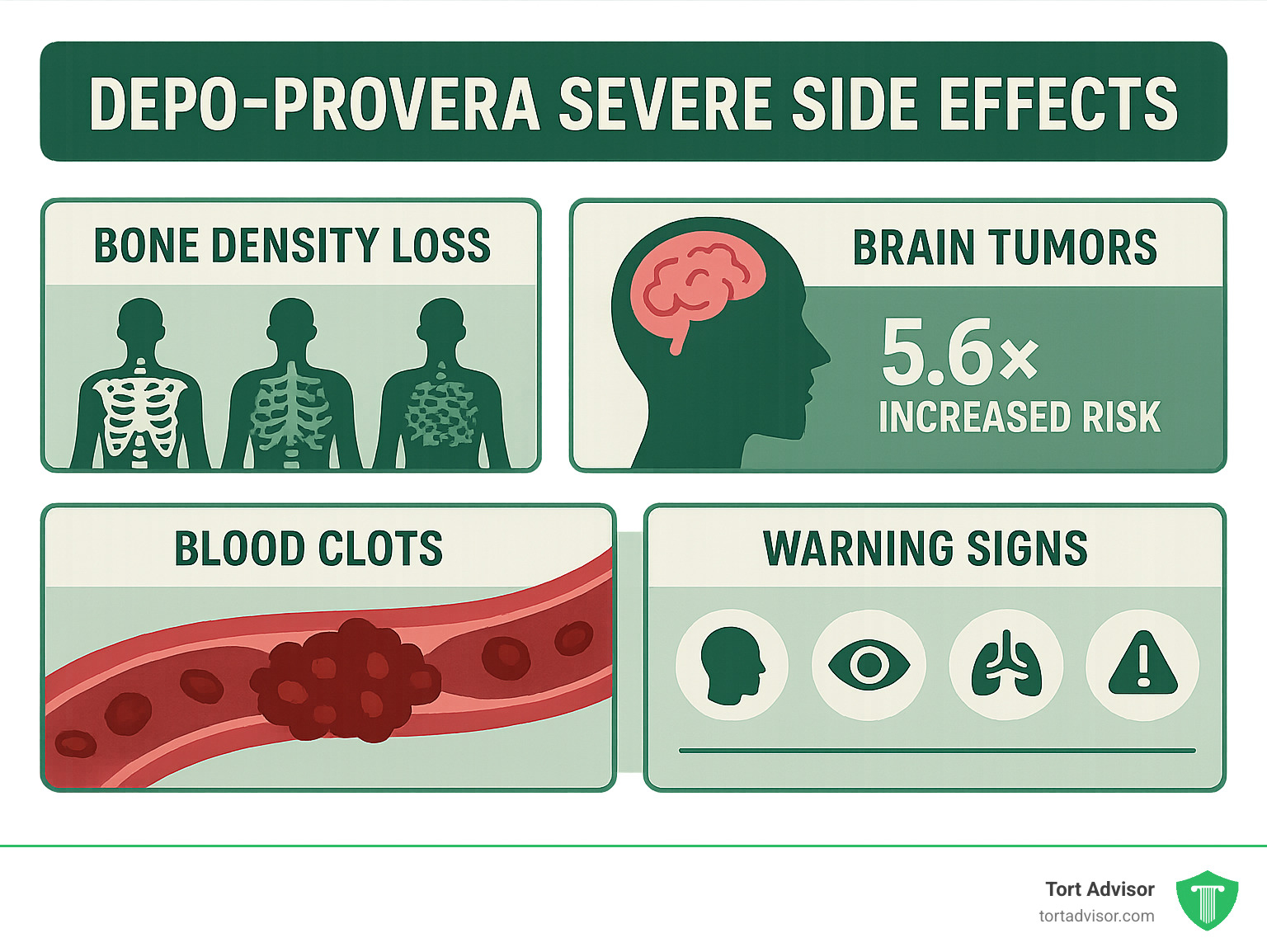
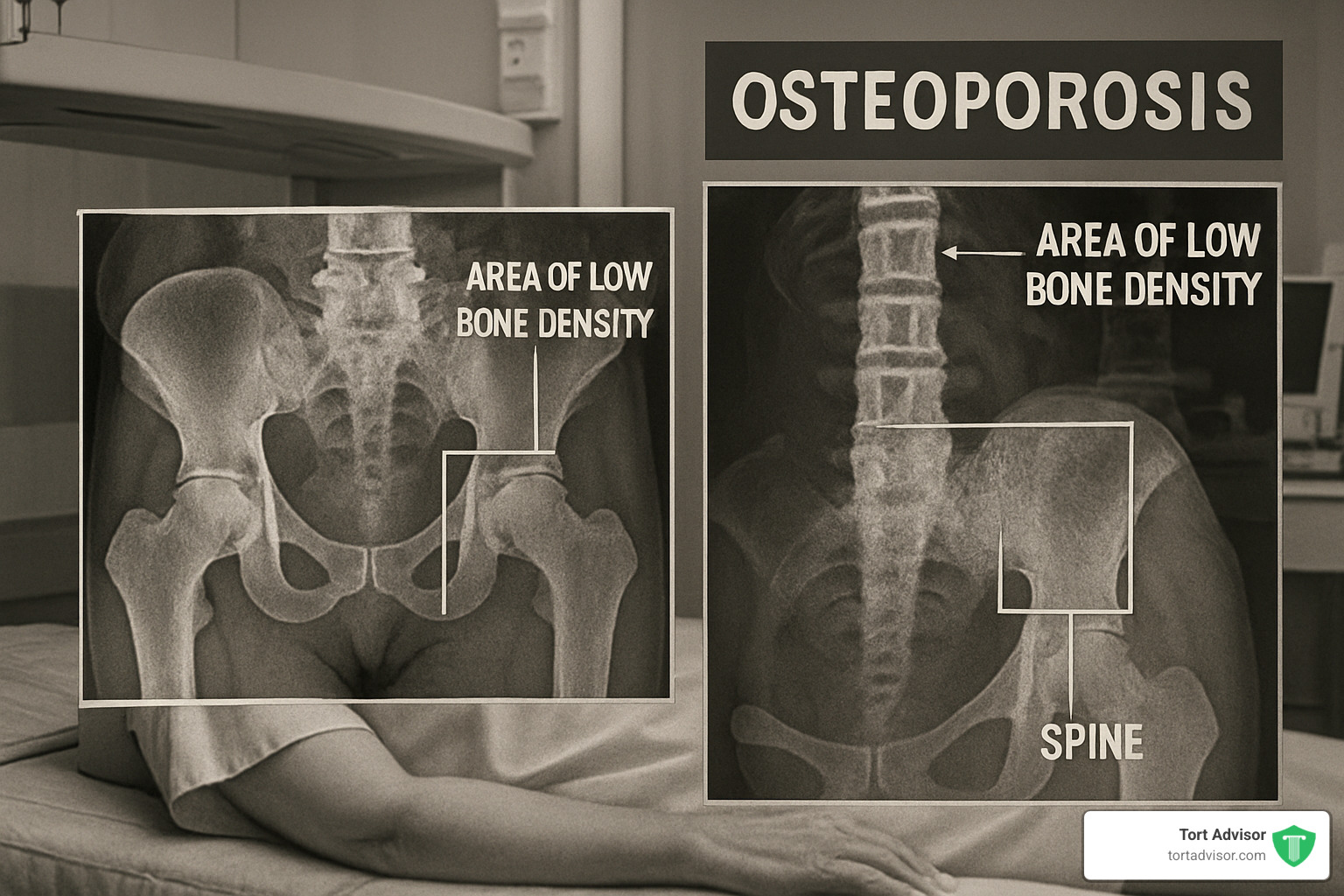
The best-documented Depo Provera severe side effect is significant loss of bone mineral density, serious enough that the FDA requires its strongest alert, a boxed (“black box”) warning. The drug lowers estrogen, and lower estrogen speeds up bone loss. The loss is fastest in the first two to three years, and teens, whose bones are still forming, are most at risk. Studies show some women never fully regain bone density even years after stopping. The FDA’s label states that Depo-Provera CI should not be used as a long-term birth control method (longer than two years) unless other methods are inadequate, and research found that teens who used it for over two years still had not fully recovered bone density five years after their last shot.
Meningioma Brain Tumors
One of the most worrying recent discoveries concerns meningiomas, tumors that grow on the membranes surrounding the brain and spinal cord. A landmark March 2024 study in the British Medical Journal found that women who used Depo-Provera for more than a year had a 5.6-fold higher risk of these tumors, with risk rising as injections added up. Meningiomas can cause constant headaches, blurred or lost vision, seizures, hearing loss, limb weakness and memory problems. European regulators added meningioma warnings to Depo-Provera labeling well before U.S. labeling addressed the issue, a gap at the center of the litigation (check the current U.S. label, as labeling may have changed as of this update). The scientific research on the meningioma link shows the risk is substantial and dose-dependent.
Blood Clots, Stroke and Heart Problems
Blood clots are another group of potentially deadly Depo Provera severe side effects. Studies found users were nearly four times as likely to develop deep vein thrombosis (DVT) as non-users, and clots can lead to DVT, pulmonary embolism, heart attack and stroke. Smokers, women with obesity and those with a history of clotting disorders face greater risk. As scientific research on deep vein thrombosis risk shows, these problems can strike even young, healthy women.
Long-Term Health Effects Supported by Research
Some Depo Provera severe side effects can linger well after the final injection.
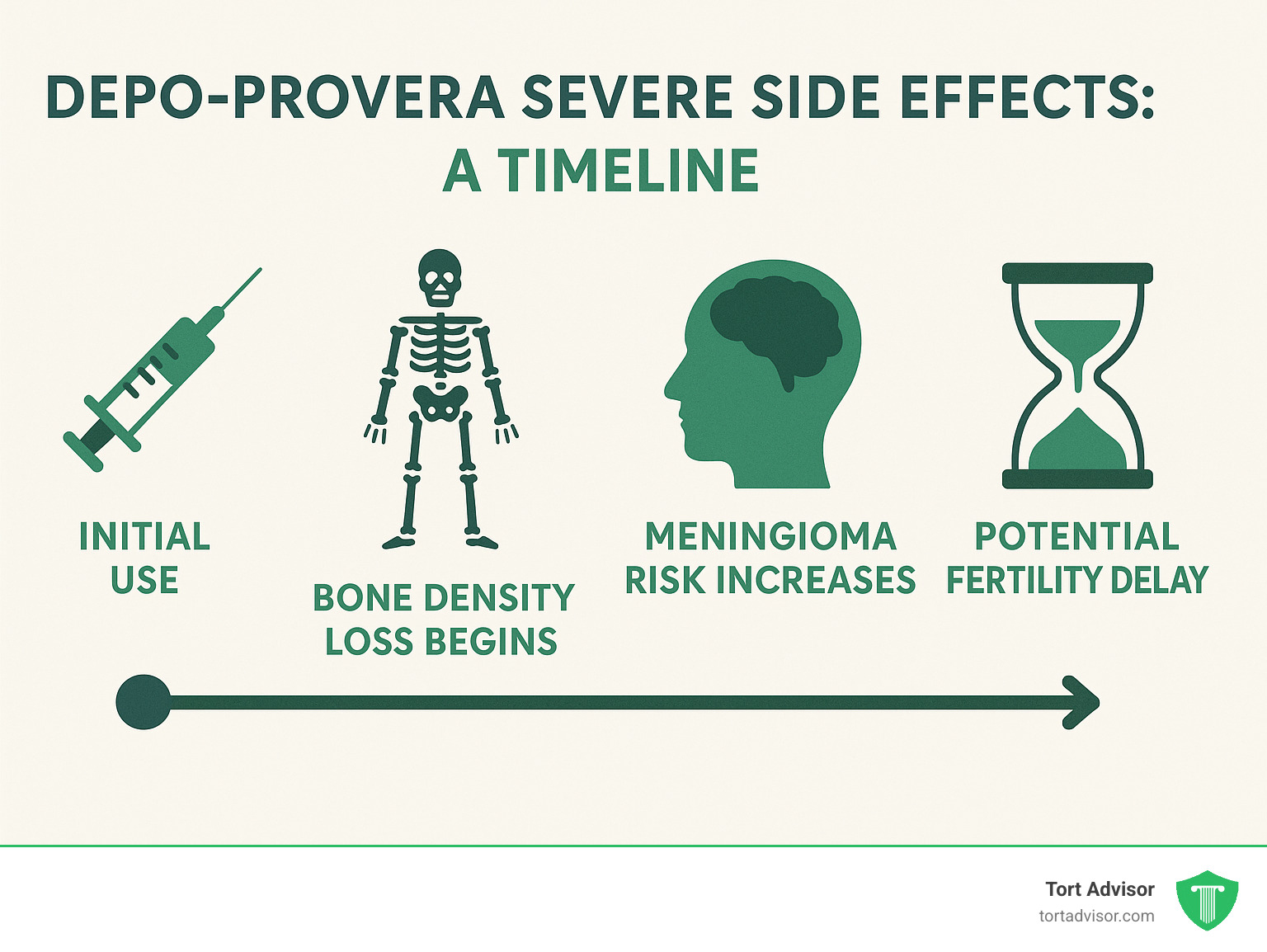
Delayed fertility is a major one. Fertility tends to return fast after the pill or an IUD, but Depo-Provera’s effects can last. The median time to pregnancy is roughly 10 months after the last shot, and experiences vary: 68% conceive within 12 months and 83% within 15 months, yet some wait as long as 31 months, more than two and a half years. Weight gain also tends to build over time and may not go away, averaging 5.5 pounds at one year, 8.1 at two years, 13.8 at four years and 16.5 at six years. Findings from the Women’s Health Initiative raised concerns about a possible higher dementia risk in postmenopausal women who used estrogen plus medroxyprogesterone acetate; more research is needed to know whether that applies to Depo-Provera, but it is another long-term question. The long-term effects of amenorrhea (no periods) are also not fully understood, since the consequences of suppressing hormones for many years remain unclear.
These long-term effects are especially troubling because many women say no one adequately warned them before they started the shot.
Who Is Most at Risk, and Warning Signs to Watch For
Risk is not the same for every user. Any woman can experience Depo Provera severe side effects, but some are more vulnerable. Teens and young adults still building bone may suffer greater bone thinning. Smokers should be especially careful, since smoking combined with Depo-Provera sharply raises the odds of clots, stroke and heart attack. Low calcium intake or corticosteroid use adds to bone risk. Family history matters as well: if clots run in your family or you have had one, Depo-Provera may not be the safest choice, and women with higher body weight face more vascular risk. Long-term users are the biggest concern. Despite the FDA’s two-year guidance, many women stay on the shot much longer, and each extra year raises the chance of serious problems, especially meningioma and lasting bone loss. Know the warning signs: while on Depo-Provera, never brush off a severe headache that won’t quit, sudden vision changes, chest pain, trouble breathing, or leg pain and swelling, which can signal a clot, stroke or brain tumor. Also watch for yellow skin or eyes, seizures, very dark urine or bones that break too easily. Mood shifts are common with hormonal birth control, but severe depression or suicidal thoughts need immediate professional help.
When to Call 911 or Head to the ER
Some Depo Provera severe side effects are true emergencies. Get help right away for any of the following: a sudden, explosive headache, especially “the worst headache of your life,” which can mean bleeding in the brain; sharp chest pain that gets worse with deep breaths, a possible pulmonary embolism; coughing up blood, even small streaks; sudden weakness or numbness on one side, trouble speaking or confusion, classic stroke signs; severe leg pain and swelling, particularly if one leg is visibly bigger, a possible DVT; and sudden vision loss or severe belly pain with yellowing skin.
Lowering Your Risk and Considering Alternatives
Whether you are on Depo-Provera now or thinking about it, you can take steps to protect yourself, and there are many alternatives if it isn’t the right fit. If you are a current user: limit use to two years or less, as the FDA advises; take daily calcium (1,000-1,200 mg) and vitamin D (600-800 IU) to support your bones; do regular weight-bearing exercise; and if you stay on it longer than two years, ask about yearly DXA scans to track bone density. If you smoke, quitting matters even more, because smoking plus hormonal contraception greatly increases clot and vascular risk. And learn the warning signs, since your body often signals when something is wrong. If you are weighing other options, several may carry better safety profiles: the copper IUD is 99.2% effective, contains no hormones, lasts up to 10 years and has no effect on bone health or meningioma risk; the hormonal IUD is 99.8% effective and releases progestin locally rather than throughout the body, limiting bone concerns and likely carrying less meningioma risk than Depo-Provera; and the contraceptive implant is 99.9% effective for up to 5 years and, while it contains progestin, appears to have little effect on bone density compared with Depo-Provera. If a daily method works for you, the combined pill and the progestin-only pill are each about 91% effective with typical use.
| Method | Effectiveness | Hormone-Free | Duration | Effect on Bones | Meningioma Risk |
|---|---|---|---|---|---|
| Copper IUD | 99.2% | Yes | As long as 10 years | None | None |
| Hormonal IUD | 99.8% | No (progestin acts locally) | 3-7 years | Minimal | Likely lower |
| Contraceptive Implant | 99.9% | No (progestin) | As long as 5 years | Minimal | Likely lower |
| Combined Pill | 91% typical use | No | Daily | Possibly protective | Lower |
| Barrier Methods | 79-88% typical use | Yes | Per use | None | None |
If Depo-Provera has already harmed you, legal options may be available. See our page on Personal Injury Lawsuits to learn about your rights.
Depo-Provera Lawsuits: Your Legal Options and Compensation
If you have experienced Depo Provera severe side effects, you are not alone, and you may have legal options. Mounting evidence linking the shot to serious harm, meningiomas above all, has led to lawsuits against Pfizer. Many claims focus on one troubling point: Pfizer added meningioma warnings to Depo-Provera labels in several other countries without giving American women a comparable warning. That “failure to warn” theory drives most of the litigation. To manage the volume, federal Depo-Provera cases were consolidated in 2025 into a Multidistrict Litigation (MDL), which handles similar cases together while still letting each person seek compensation for their own injuries. You may be eligible to join if you:
- Had at least two Depo-Provera injections
- Were later diagnosed with a meningioma
- Can still file within your state’s statute of limitations
Pfizer signed a Master Settlement Agreement for eligible MDL 3140 claims in July 2026, but the payout tiers and individual amounts have not been made public, and Legal Lawsuit does not publish estimated payout ranges. A claim’s value will depend on factors like the size and location of the tumor, whether surgery or radiation was needed, lasting effects such as vision loss or seizures, how long and how often you received the shot, lost income and your state’s law. Filing deadlines differ by state, commonly somewhere between one and six years, and many states apply a “discovery rule” that starts the clock only when you reasonably could have connected your condition to Depo-Provera. Legal Lawsuit can connect you with attorneys in our network who handle pharmaceutical injury cases through a free, confidential case review. For more on the litigation, visit our Depo Provera Lawsuit page.
Evidence That Strengthens a Depo-Provera Claim
If you are thinking about a claim, solid evidence is essential, and your attorney will likely ask for several kinds of records. Medical records are the foundation, especially documentation of every injection with dates, doses and who gave it. Imaging reports, such as MRIs or CT scans showing the meningioma or other conditions, provide hard proof of injury. Pharmacy prescription logs can confirm your Depo-Provera history. Expert medical opinions help link your condition to the drug. Treatment records covering surgery, therapy or ongoing care show how much harm you suffered, and employment records showing missed work or reduced earning ability support a lost-wages claim.
Depo-Provera Severe Side Effects: Common Questions
How often do serious side effects happen with Depo-Provera?
Most serious Depo Provera severe side effects occur in fewer than 1 in 1,000 users, which counts as “rare,” but that figure hides important differences. Women in higher-risk groups face much greater danger. Recent meningioma research shows that a little over a year of use multiplies tumor risk about 5.6 times, clot risk rises nearly fourfold compared with non-users, and nearly all long-term users lose some bone density, with teens most at risk. Tens of thousands of reports involving Depo-Provera, including reported deaths, have been submitted to the FDA’s adverse event reporting system; such reports do not prove the drug caused the events, but they suggest serious problems may be more frequent than clinical trials indicated.
Does bone density come back after stopping the shot?
In adult women, studies show partial recovery during the first two years after stopping, but many never get back to their original bone density. The picture is worse for teens: those who used the shot for more than two years still hadn’t fully recovered five years after their final injection. Recovery depends on several factors:
- How old you were while using it
- How many years you used it
- How much calcium and vitamin D you get
- How much you exercise
- Your inherited risk of bone problems
If you have used Depo-Provera and worry about your bones, ask your doctor about a DXA scan to check your bone density.
Will changing birth control bring fertility back faster?
No. Switching methods won’t speed things up, because the drug’s effects on your reproductive system can last long after the last shot no matter what you use next. Fertility typically returns on this timeline:
- Roughly 68% conceive within 12 months of the final shot
- 83% conceive within 15 months
- 93% conceive within 18 months
- The average is about 10 months, with a range of 4 to 31 months
If you hope to get pregnant down the road, consider stopping Depo-Provera well ahead of time, ideally at least a year before you want to conceive.
Conclusion
Every birth control choice involves trade-offs. Depo-Provera means thinking about contraception only four times a year, but that convenience can come with serious risks worth weighing carefully. From steadily worsening bone loss to the newly discovered meningioma link, Depo Provera severe side effects can stay with you long after the final shot.

Many women say they were never fully informed about these risks, and it is especially troubling that European labels addressed meningioma risk before U.S. labeling did; women everywhere deserve the same safety information. If you have experienced Depo Provera severe side effects, take these steps:
- Take warning signs seriously and get prompt medical care for worrying symptoms
- Keep thorough records of your treatment and its connection to Depo-Provera
- Find out about your legal rights and possible compensation
- Act promptly, because statutes of limitations can cut off your claim
Legal Lawsuit is committed to connecting you with attorneys who understand pharmaceutical injury litigation. Attorneys in our network across the country can handle both the medical and legal complexities of Depo-Provera cases. For guidance on your options after Depo Provera severe side effects, see our Depo-Provera lawsuit services page or request a free, confidential case review.
Related Posts
Quick Answer: The Boy Scouts of America (BSA) filed for Chapter 11 bankruptcy in 2020 after facing tens of thousands [...]
Quick Answer: Survivors of sexual abuse by Catholic priests, nuns, or other Church personnel may be able to file a [...]
Quick Answer: Clergy abuse settlements vary enormously based on the severity of the abuse, the strength of evidence that the [...]