
Short answer: This article explains the key facts, eligibility issues, settlement factors, deadlines, and source-backed updates related to this legal topic. Results vary by case facts, evidence, jurisdiction, and representation.
In This Guide
Depo-Provera Bone Loss Lawsuit: An Overview
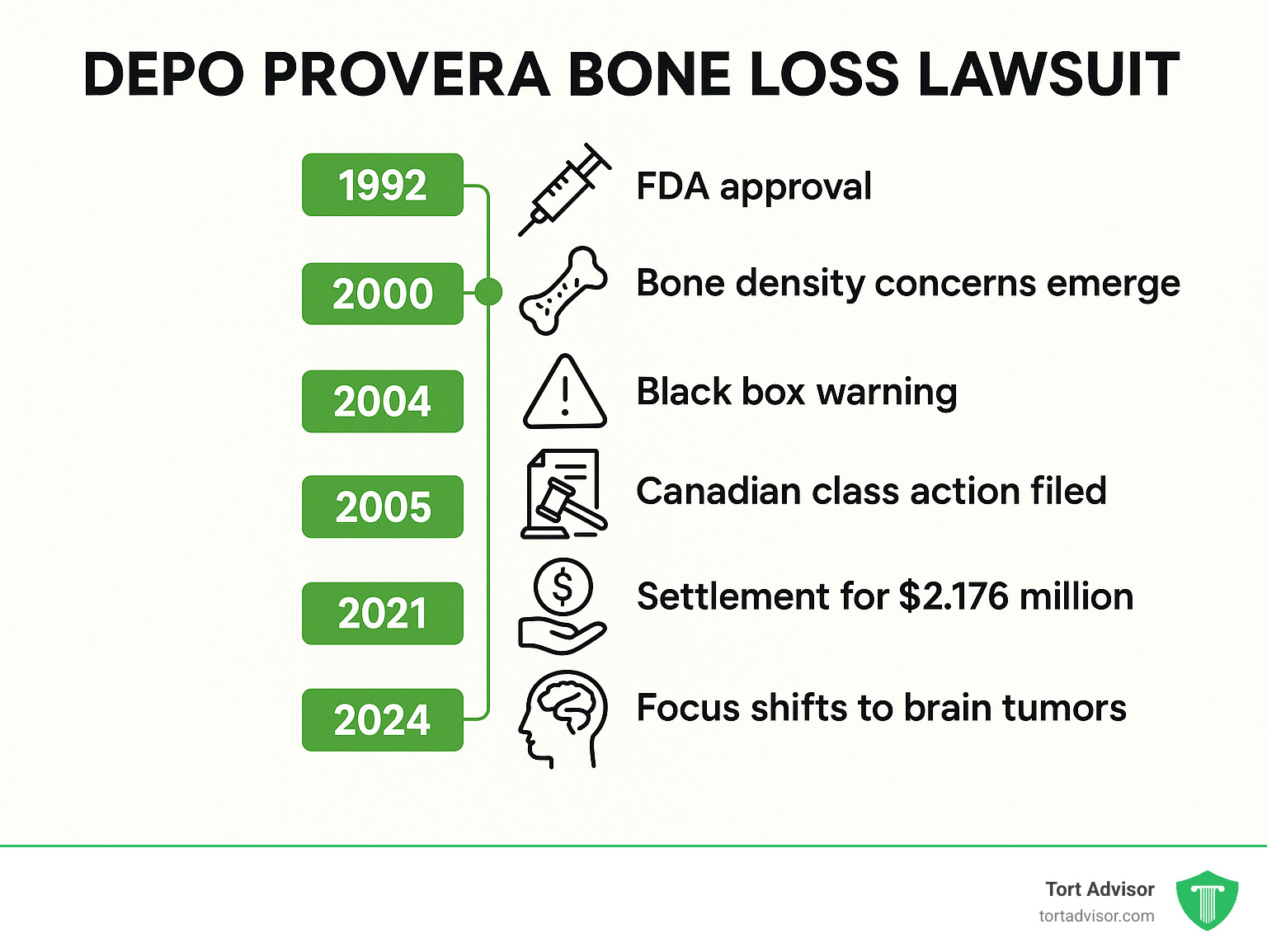
The Depo-Provera bone loss lawsuit focused on allegations that Pfizer did not properly warn patients that its injectable birth control could cause serious loss of bone density. The essentials:
- Settlement: Pfizer resolved the Canadian class action in May 2021 for $2,176,250.
- Claims Closed: The filing deadline was March 1, 2022, and the case has ended.
- Core Allegation: Pfizer misstated the risks and did not warn that the shot could cause significant, possibly permanent bone mineral density loss.
- Where Things Stand: Bone loss claims are essentially finished, and newer cases center on meningioma brain tumors.
- FDA Warning: A boxed (black box) warning about bone density loss was added in 2004.
Depo-Provera is a birth control injection that prevents pregnancy for three months at a time. Studies show users lose bone mineral density, particularly in the first several years, and younger women seem especially prone to this thinning. The legal picture has changed: the bone density class action settled in Canada, while today’s litigation focuses on meningiomas, with U.S. cases consolidated in federal court as MDL 3140. I’m Mason Arnao of Legal Lawsuit. I have helped people hurt by prescription drugs connect with qualified attorneys, and I know how much clear, accurate information matters in cases like these.
Related Depo-Provera bone loss lawsuit searches:
- Depo Provera severe side effects
- birth control shot lawsuit
- depo shot brain tumor
What Is Depo-Provera?
Depo-Provera is the brand name of medroxyprogesterone acetate (MPA), a hormonal birth control given by injection. The FDA approved it in 1992, and its convenience made it a common long-term option. It works by halting ovulation, thickening cervical mucus to block sperm and thinning the uterine lining. For some women, though, unexpected side effects created serious health problems that led to the Depo-Provera bone loss lawsuit. For a wider view of possible harms, see the Legal Lawsuit overview of Depo-Provera’s severe side effects.
How Bone Loss Concerns Came to Light
Medical experts started flagging Depo-Provera’s effect on bone mineral density (BMD), and research showed users could lose a meaningful amount of bone, possibly for good. In 2004 the FDA responded with a boxed warning, its most serious label alert, cautioning that bone loss could lead to osteopenia and osteoporosis and advising that the shot generally not be used longer than two years unless other birth control methods were unsuitable. The message was clear: convenience came with a real risk to bone health.
How Depo-Provera Affects Bone Density

The science explains why the Depo-Provera bone loss lawsuit arose. Bone is constantly being rebuilt through bone remodeling: cells called osteoclasts break down old tissue while osteoblasts lay down new tissue, and that balance keeps the skeleton strong. Depo-Provera’s active ingredient, medroxyprogesterone acetate, lowers the body’s estrogen, a hormone that helps regulate remodeling. With less estrogen, breakdown can outpace formation, so Bone Mineral Density (BMD) falls and bones grow more fragile. Studies have repeatedly found BMD declines among users, especially early on, and that evidence was at the heart of the legal claims. A central question is whether the loss can be reversed. Some women rebuild bone after stopping the shot, but recovery is often partial, which can leave them at higher risk of osteoporosis and fractures years later.
Warning Signs of Bone Loss and Osteoporosis
Osteoporosis is known as a “silent disease” because it often causes no symptoms until a bone breaks. For current or former Depo-Provera users, possible signs include:
- Back pain caused by small fractures in the spine.
- Gradual loss of height from compression fractures in the vertebrae.
- A stooped posture or rounded upper back.
- Fractures from minor falls or bumps that normally would not break a bone.
Who Faces the Greatest Risk?
Some groups are more likely to lose bone density on Depo-Provera.
- Teens and young women are still building peak bone mass, so disrupting that process can have long-lasting effects, and they appear especially susceptible to bone thinning.
- Long-term users (more than two years) face growing risk, since bone loss rises with length of use.
- Women who already have osteoporosis risk factors are most at risk, including those with low body weight, poor nutrition (too little calcium and vitamin D), a family history of osteoporosis, smoking or heavy drinking. For them, the shot may speed up bone loss.
These risk groups were central to legal arguments that Pfizer should have warned more clearly about who was most vulnerable.
The Canadian Depo-Provera Bone Loss Class Action

Many women who developed serious bone density problems after using the shot believed they had not been adequately warned, which led to a major legal fight against Pfizer Inc. and Pfizer Canada ULC. The Depo-Provera bone loss lawsuit proceeded as a class action on behalf of many women with similar experiences, built around two core claims: misrepresentation and failure to warn. Plaintiffs said Pfizer did not give a full picture of the shot’s effects on bone health.
What the Bone Loss Lawsuit Alleged
Class members claimed that Pfizer:
- Did not disclose the risks: The central complaint was that Pfizer knew about the danger of serious, permanent bone loss but did not adequately tell patients and doctors.
- Overstated the drug’s safety: The suit also alleged Pfizer presented Depo-Provera as safer than it was, possibly through marketing or information given to providers.
According to the lawsuit, this failure to warn left women with significant, irreversible bone loss and conditions such as osteopenia and osteoporosis, which bring higher fracture risk, chronic pain and lasting health problems.
How the Bone Loss Lawsuit Ended
After more than 15 years of litigation, the Canadian class action against Pfizer was resolved. In May 2021, the Superior Court of Quebec approved a settlement of $2,176,250, with $1,913,750 going to affected women and $262,500 to health insurers. The case is now closed: the claims deadline was March 1, 2022, approved claims were paid in 2023 and it is no longer possible to join. Concerns about Depo-Provera have not gone away, however; attention has moved to a possible link between the shot and meningioma brain tumors. For women harmed by bone loss, the settlement offered a measure of accountability and reinforced that drugmakers must be open about serious risks.
Depo-Provera Lawsuit Update: The Shift to Brain Tumor Claims
The Depo-Provera bone loss lawsuit is over, but Depo-Provera litigation is far from finished. New cases now target other serious alleged side effects, especially brain tumors.

Drug litigation often follows the latest research, and for Depo-Provera that research now points to meningiomas. The result is a new set of U.S. lawsuits claiming Pfizer failed to warn about this risk. Learn more on the main Depo-Provera lawsuit page, which tracks its current status.
Depo-Provera and Meningioma Brain Tumors
Meningiomas grow in the membranes that surround the brain and spinal cord. They are usually benign, but by pressing on the brain they can cause headaches, vision loss and seizures. Recent research suggests Depo-Provera users face a higher risk. A study published in the British Medical Journal (BMJ) found that using the shot for a year or longer was associated with roughly 5.6 times the risk of a meningioma needing surgery. One proposed explanation is that meningioma cells often carry progesterone receptors, and as a synthetic progestin, Depo-Provera may fuel tumor growth. This research underpins current claims that Pfizer failed to warn users.
Are Other Depo-Provera Lawsuits Underway?
Yes, though the U.S. meningioma litigation is not a class action. Individual cases have been consolidated in a Multidistrict Litigation (MDL No. 3140, Depo-Provera Products Liability Litigation), which brings similar lawsuits before one court for coordinated pretrial steps such as discovery while each plaintiff keeps an individual case. Since late 2024 and into 2025, new filings have focused almost entirely on meningioma. The bone loss link is well documented, but the legal routes for those claims have mostly closed. To learn more, see the Depo Provera Class Action Lawsuit 2024 page, which explains the move to an MDL.
Steps to Take If Depo-Provera Affected You
If you used Depo-Provera and now have health concerns, there are ways to protect both your health and your legal rights. Start with a doctor’s visit and share your full Depo-Provera history and symptoms. For bone concerns, your doctor may order a bone density (DEXA) scan, which measures BMD and can identify osteopenia or osteoporosis. Next, organize your medical records, including prescriptions, appointments, test results and treatments; a thorough prescription history is especially useful, and a complete timeline strengthens any claim. Finally, consider talking with an attorney who handles drug injury cases. The Depo-Provera bone loss lawsuit has ended, but an attorney can explain your options, particularly in the newer brain tumor litigation.
Ways to Protect Your Bone Health
Looking after your bones now protects your future. Helpful steps include:
- See your doctor: Talk about your concerns, bone density results and long-term plan, and if you still use Depo-Provera, ask about other birth control options.
- Adjust your habits: Get enough calcium and vitamin D from food such as dairy and leafy greens, or from supplements.
- Do weight-bearing exercise: Walking, dancing and climbing stairs prompt the body to build bone; regular activity matters most.
Getting Legal Advice
If you are thinking about a claim, timing matters. The statute of limitations differs by state and can be short, so act quickly to protect your rights.
- Gather proof: Pull together medical records and bills to show your health timeline and the financial toll.
- Track symptoms and their impact: Keep a journal of how symptoms affect daily life, work and quality of life.
The main Depo-Provera bone loss lawsuit has closed, but an experienced attorney can review your situation, especially if a brain tumor is involved, and recommend next steps.
Depo-Provera Bone Loss FAQs
Answers to common questions about Depo-Provera, bone loss and legal options.
Is Depo-Provera bone loss permanent?
This question was central to the Depo-Provera bone loss lawsuit, and the answer is nuanced. Bone density usually improves after stopping the shot, but it may not return all the way to where it was. Studies show many women do not fully recover, particularly after more than two years of use, and the FDA boxed warning describes the loss as “possibly irreversible.” That can mean a higher fracture risk both during and after use. How much bone returns differs from person to person, depending on age, length of use, genetics and lifestyle.
Can I still join a Depo-Provera bone loss lawsuit?
No. The main Canadian bone loss class action is over. It settled in May 2021, claims were due by March 2022, and the case is closed to new members. Legal attention has moved to meningioma brain tumors, and while bone loss remains a serious issue, the main path for those claims has ended. If you have a meningioma after using Depo-Provera, you may still have legal options.
What does the FDA warning on Depo-Provera say today?
In 2004, the FDA placed a boxed (“black box”) warning, its strongest alert, on Depo-Provera’s label. It cautions that long-term use can cause significant and possibly irreversible loss of bone density and advises against use beyond two years unless other methods are inadequate. In other words, after two years the bone risk is serious enough that continued use should be reserved for women without good alternatives. The warning is still in place, which helps explain why the Depo-Provera bone loss lawsuit was filed: the risks were real and, plaintiffs argued, poorly communicated.
Getting Help With a Depo-Provera Claim
If you developed osteoporosis, a meningioma or another serious condition after using Depo-Provera, it is important to understand your legal options. The Depo-Provera bone loss lawsuit has closed, but you may still have rights, particularly for other Depo-Provera injuries. Handling legal questions while managing your health is exhausting, and the right help makes a difference. Legal Lawsuit connects people with experienced attorneys in our network who handle drug injury cases against pharmaceutical companies, through a free, confidential case review. Deadlines matter. Statutes of limitations vary by state, and waiting too long can cost you the right to compensation, especially for newer meningioma claims. An attorney can review your situation, including your medical history, Depo-Provera use and the severity of your injuries, to determine whether you have a viable claim and pursue the compensation you deserve. Most drug injury cases are taken on contingency, so there is no attorney fee unless money is recovered. To learn more and take the first step, visit the Legal Lawsuit Depo-Provera lawsuit information page.
Additional Resources
Related Posts
Quick Answer: The Boy Scouts of America (BSA) filed for Chapter 11 bankruptcy in 2020 after facing tens of thousands [...]
Quick Answer: Survivors of sexual abuse by Catholic priests, nuns, or other Church personnel may be able to file a [...]
Quick Answer: Clergy abuse settlements vary enormously based on the severity of the abuse, the strength of evidence that the [...]