
Short answer: This article explains the key facts, eligibility issues, settlement factors, deadlines, and source-backed updates related to this legal topic. Results vary by case facts, evidence, jurisdiction, and representation.
In This Guide
Do You Meet the Depo-Provera Lawsuit Criteria?
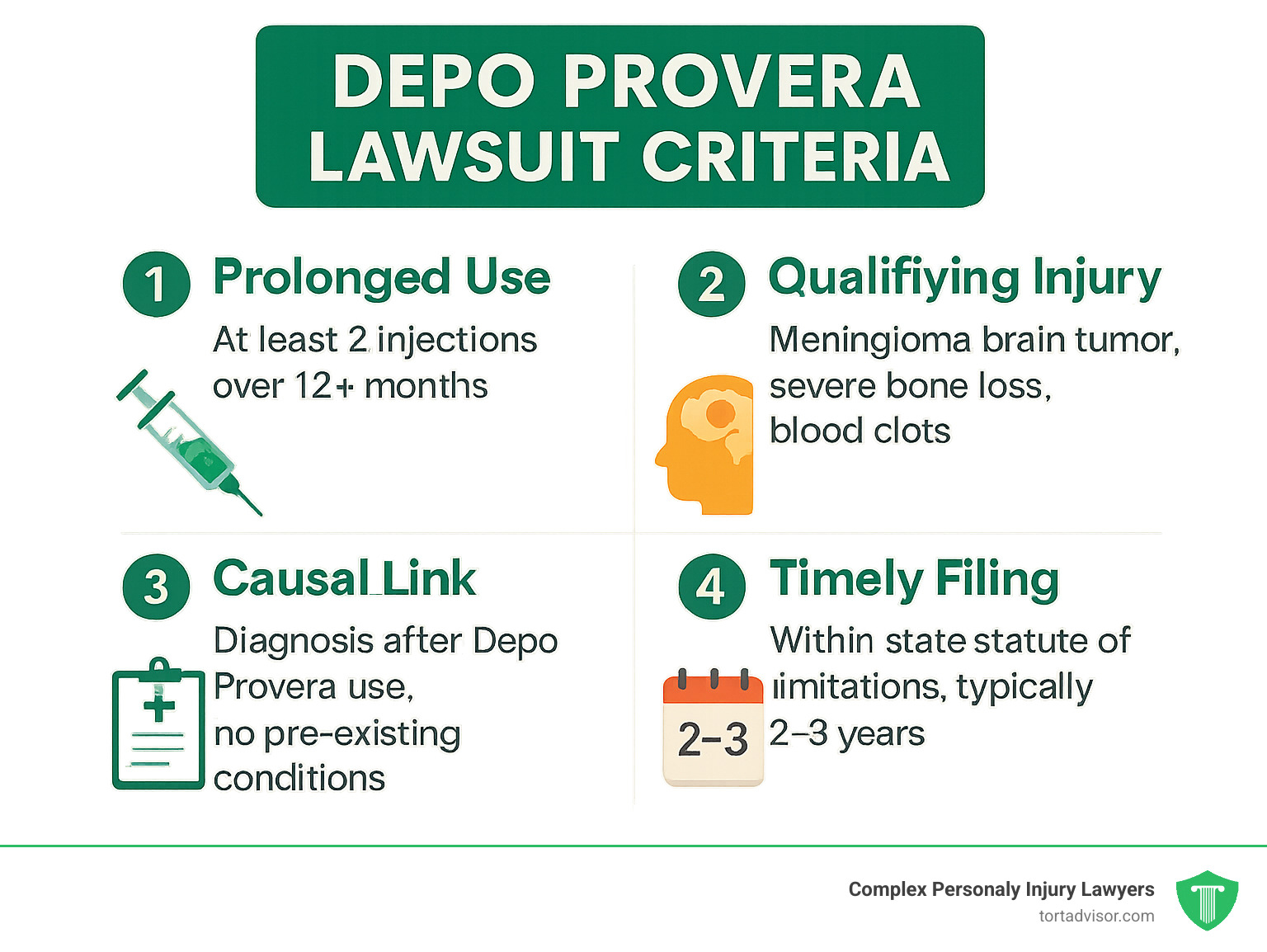
The Depo Provera lawsuit criteria matter to anyone who developed a serious condition after receiving the birth control shot. Thousands of cases were coordinated in federal multidistrict litigation over research tying long-term use to meningioma brain tumors, and a global settlement framework was reached in 2026. Core eligibility factors:
- Extended use – generally a year or more of repeated injections
- A qualifying diagnosis – primarily meningioma confirmed by imaging or pathology
- Timing – diagnosis after starting the shot, without an earlier tumor
- Deadlines – both state filing deadlines and settlement program deadlines apply
A 2024 study in The BMJ reported about a 5.6-fold higher risk of intracranial meningioma among women who used medroxyprogesterone acetate injections for a year or longer. Plaintiffs note that meningioma warnings appeared on labels in Europe and Canada before the U.S. label was updated, which is the basis of the failure-to-warn claims. Federal cases were consolidated in MDL 3140 before Judge M. Casey Rodgers in the Northern District of Florida, and in 2026 Pfizer reached a global agreement in principle in June followed by a Master Settlement Agreement in July, administered by BrownGreer. Individual award amounts have not been made public. I’m Mason Arnao, and my work in legal data and intake systems has shown me how much documentation shapes these claims.
Related Depo-Provera guides:
The Four Depo-Provera Lawsuit Criteria
Qualifying for a Depo-Provera claim comes down to a handful of requirements, and they are more manageable than they may seem. The litigation centers on allegations that Pfizer did not adequately warn U.S. patients about the meningioma risk. Federal cases were combined in an MDL in Florida, which handles similar lawsuits together, and most claimants now pursue compensation through the settlement program created in 2026.

Here are the four criteria attorneys look at first.
Criterion 1: Your Depo-Provera Use
Every claim starts with use of the drug, and eligibility usually depends on extended use rather than a single injection. Because the shot is given about every three months, a year of use means at least four injections, and longer use generally strengthens a claim since meningiomas develop over time. Use of a generic medroxyprogesterone acetate injection may also matter. Under a theory called innovator liability, some states allow claims against the brand manufacturer because generic makers must copy the brand label. Whether that applies, and how the settlement program treats generic use, depends on the specifics, so ask an attorney.
Criterion 2: A Qualifying Diagnosis
Not every health issue qualifies. The main injury in this litigation is meningioma, a tumor of the membranes covering the brain and spinal cord. Most are not cancerous, but they can cause serious symptoms and require surgery or radiation. The BMJ research reported a roughly 5.6-fold increased risk with use of a year or more. Other conditions sometimes raised, such as severe bone density loss, idiopathic intracranial hypertension (pseudotumor cerebri) or blood clots, are not the focus of the meningioma settlement and are evaluated case by case. Our guide to the Depo shot brain tumor link explains the research in more detail.
Criterion 3: Linking Use to the Diagnosis
Use followed by a diagnosis is not enough on its own; the claim must show the drug caused or substantially contributed to the condition. Your diagnosis should come after you began the shot; a meningioma found before your first injection generally rules out a claim. Specialists such as neurologists and neurosurgeons review your history, the sequence of events and the research. Excluding other explanations also helps, for example a lack of family history of meningioma, which reduces the chance a genetic cause will be blamed.
Criterion 4: Meeting the Deadlines
Deadlines are strict. Each state sets a statute of limitations, often between one and six years, and many apply a discovery rule that starts the clock when you knew or reasonably should have known of the possible connection. If you were diagnosed in 2023 but did not learn of the Depo-Provera link until 2024, for example, the clock may have started in 2024 in some states. The 2026 settlement program also has its own registration deadline, reported as November 30, 2026. Talk with an attorney promptly to confirm which deadlines apply to you.
Evidence to Gather for a Depo-Provera Claim
If you think you meet the Depo Provera lawsuit criteria, the next step is collecting records. Each document helps show how the drug affected your health and your life.

Drug makers scrutinize every detail, so solid documentation is essential. Your records need to show two things: that you used Depo-Provera and developed a qualifying injury, and that the injury caused measurable harm.
Medical and Pharmacy Records
These records are the core of your claim. Prescription and pharmacy records show when and how often you received injections, which addresses the first criterion, and most pharmacies keep digital histories for years. Provider notes trace your symptoms, diagnoses and treatment. For meningioma, specialist reports from neurologists, neurosurgeons or oncologists describe the tumor’s size, location, grade and effects. MRI or CT imaging documents the tumor, and pathology reports confirm the diagnosis when tissue was removed. Include treatment records for surgery, radiation or other care. If you do not have these documents, HIPAA gives you the right to request them, and HHS explains how; an attorney can also request them for you.
Documenting Your Losses
Showing the injury is half the case; showing its impact is the other half. Keep track of medical bills for visits, hospital stays, surgery and medication. Future care can be significant, since meningioma patients may need years of monitoring, and attorneys work with experts to estimate those costs. Record lost wages and reduced earning ability, both past and expected. Pain and suffering covers physical pain and emotional distress, and a journal describing symptoms and how they affect daily life can be persuasive. Also save receipts for other expenses such as travel to appointments, home modifications or assistive devices. Our Depo-Provera settlement amounts guide explains which factors affect value.
What Can Disqualify a Depo-Provera Claim
Not everyone who used the shot and later became ill will qualify. Knowing the common obstacles helps set realistic expectations.

An honest look at these issues early can save time and frustration.
Earlier Conditions and Other Possible Causes
Causation is usually the hardest issue. A diagnosis that predates your first injection is the clearest disqualifier. A strong family history of tumors does not automatically end a claim but can give the defense an alternative explanation. Using other hormonal treatments at the same time can make it harder to attribute the injury to Depo-Provera. And conditions not linked to the drug by research will not qualify.
Missed Deadlines
Timing ends many otherwise valid claims. Once a filing deadline passes, courts generally dismiss the case regardless of merit, and settlement programs enforce their own cutoffs. People often miss deadlines because they did not connect their illness to the shot right away, and while the discovery rule can help, relying on it is risky. Get advice as soon as you suspect a link.
Missing Proof of Use or Diagnosis
Without evidence, a claim cannot proceed. Missing medical records are common for people who used the shot long ago, and no proof of injections is a serious obstacle. A vague diagnosis, such as headaches without imaging and a specialist’s findings, will not meet the requirements. And if experts cannot connect the drug to the injury, or another cause is more likely, the claim may fail.
Depo-Provera Eligibility FAQs
Here are answers to questions people often ask about the Depo Provera lawsuit criteria.
Can I file if I received a generic version of the shot?
Possibly. Under innovator liability, some states allow claims against the brand manufacturer when a patient used a generic, because generic makers must use the same warning label as the brand. Courts in states such as California have recognized versions of this theory, but many states have not, so whether it helps you depends on where you live and on the settlement program’s terms. An attorney can evaluate your situation.
What does it cost to hire a Depo-Provera lawyer?
Typically nothing upfront. Lawyers handling these claims generally work on contingency, with no consultation fee, retainer or hourly charge, and are paid a percentage of any recovery. If nothing is recovered, you generally owe no attorney fee, so cost should not keep you from getting advice.
Where does the Depo-Provera litigation stand now?
Federal cases are coordinated in the Depo-Provera Products Liability Litigation, MDL 3140, before Judge M. Casey Rodgers in the Northern District of Florida. The docket grew rapidly through 2025, and in 2026 Pfizer reached a global agreement in principle in June and a Master Settlement Agreement in July. BrownGreer was appointed to administer claims, and a registration deadline of November 30, 2026 has been reported, with first payments projected for 2027. Award amounts remain confidential, and people who are not eligible for the settlement may continue to litigate. Confirm the latest details with an attorney or the official settlement notice.
How to Move Forward With a Depo-Provera Claim
If your situation fits the Depo Provera lawsuit criteria, you are not alone, and you do not have to work through this by yourself. The most important step is a legal consultation. It is not a commitment; an attorney simply reviews your records and timeline and tells you honestly where you stand, walking through your use of the shot, your diagnosis, the causal link and your deadlines, and identifying any missing evidence. Timing matters. Court deadlines and settlement registration deadlines are firm, and waiting can cost you your claim. Legal Lawsuit can connect you with independent attorneys who handle pharmaceutical injury cases and understand the MDL and the settlement program. Getting answers carries little risk: most attorneys work on contingency, so there is nothing to pay upfront. Holding manufacturers accountable for missing warnings matters for you and for others who use the drug. Even if it turns out you do not have a claim, you will have clear answers. See whether you may qualify for a Depo-Provera claim
Related Posts
Quick Answer: The Boy Scouts of America (BSA) filed for Chapter 11 bankruptcy in 2020 after facing tens of thousands [...]
Quick Answer: Survivors of sexual abuse by Catholic priests, nuns, or other Church personnel may be able to file a [...]
Quick Answer: Clergy abuse settlements vary enormously based on the severity of the abuse, the strength of evidence that the [...]