
Short answer: This article explains the key facts, eligibility issues, settlement factors, deadlines, and source-backed updates related to this legal topic. Results vary by case facts, evidence, jurisdiction, and representation.
📋 Table of Contents
Why Getting SSDI in Arkansas Right Matters for Your Future
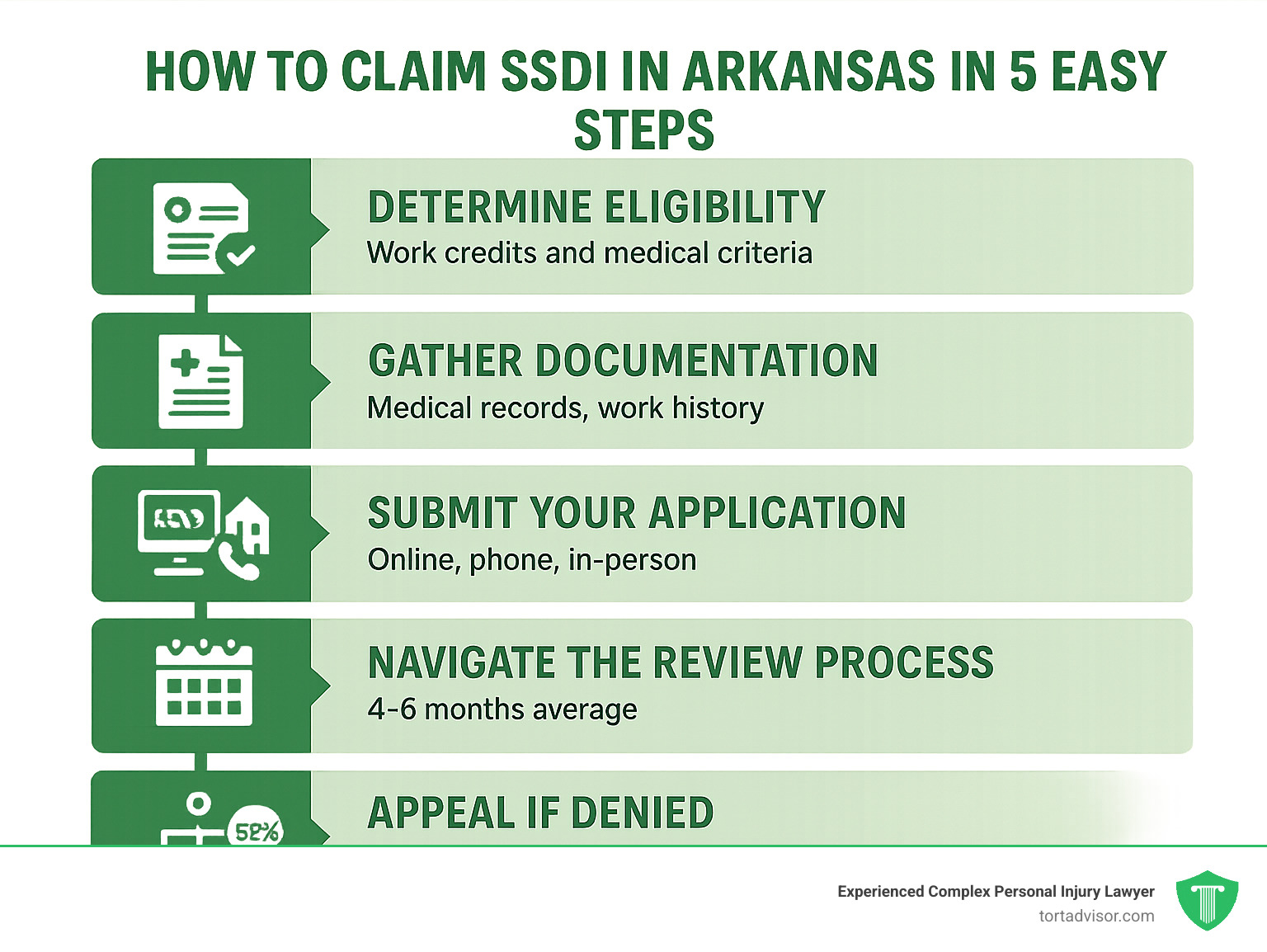
Claiming SSDI in Arkansas comes down to five stages, starting with eligibility and ending, if necessary, with an appeal. In brief:
- Check eligibility: satisfy the medical rule (a disability lasting 12+ months) and the work credit rule
- Collect your paperwork: medical records, job history, and personal details
- File the application: online, by phone (1-800-772-1213), or at a local SSA office
- Get through the review: the Arkansas DDSSA evaluates your claim, usually in 4-6 months
- Appeal a denial: four appeal levels are available, and ALJ hearings approve 52% of claims
SSDI in Arkansas comes with its own hurdles. Arkansas has the 4th-highest share of residents on disability benefits in the country, close to 200,000 people. Even so, the Arkansas DDSSA approved just 38% of initial claims in 2023. The process can feel crushing, and roughly 70% of first applications are turned down. Taking a case to an Administrative Law Judge (ALJ) changes the picture, since Arkansas ALJs grant benefits in 52% of cases. With Arkansas SSDI checks averaging $1,499 a month, approval can make the difference in staying financially afloat. I’m Mason Arnao. My work in technology and data management focuses on making complicated application processes work better, and I’ve helped many people understand the steps to file for SSDI in Arkansas correctly on the first try.
Step 1: Confirm You Meet the Eligibility Rules
Before you put time into an application, make sure you clear the Social Security Administration’s basic requirements. The SSA enforces firm medical and non-medical criteria that every applicant must meet.
SSDI vs. SSI for Arkansas Applicants
The SSA runs two separate disability programs, and choosing the right one shapes your claim. Social Security Disability Insurance (SSDI) is insurance you earn through work: the FICA taxes withheld from your pay build work credits, and your benefit reflects your lifetime earnings. Supplemental Security Income (SSI) is need-based help for disabled people who haven’t worked enough for SSDI or who have very limited income and assets, so it looks at your finances today rather than your job history. The medical standard is the same for both programs, but the financial tests are entirely different.
| Feature | SSDI | SSI |
|---|---|---|
| Eligibility | Insurance earned through work | Assistance based on financial need |
| Work Credits Needed | Yes – usually 40 credits, 20 of them in the past 10 years | None |
| Funding Source | Social Security trust funds | U.S. Treasury general funds |
| Typical Monthly Benefit in Arkansas | $1,499 | $571 |
| Health Coverage | Medicare after 24 months | Medicaid immediately |
Key Eligibility Factors for SSDI in Arkansas
The SSA defines disability more narrowly than most people expect. Your condition has to keep you from doing any substantial work for at least 12 months, or be expected to end in death.
- Medical rules: You need a medically determinable impairment backed by objective proof such as clinical findings or lab results. Earning more than $1,620 a month (2024 figure) counts as “substantial gainful activity,” and the SSA will probably deny the claim for non-medical reasons.
- Work record (for SSDI): Your job history decides SSDI eligibility. Paying Social Security taxes earns work credits, and most people need 40 credits in total, 20 of them from the 10 years before the disability began. Credits can lapse, so applying soon after you stop working helps protect your “insured status.”
The SSA’s official website spells out its exact definition of disability. Clearing these medical and work requirements is the first and most important hurdle.
Step 2: Collect Every Document You Will Need
A complete, well-organized application helps avoid delays and boosts your odds of approval. Giving the SSA full details from the start lets it process your claim faster.
Personal and Employment Details
Have these items ready before starting your application:

- Personal details: your Social Security Number, birth certificate, and proof of U.S. citizenship or lawful alien status.
- Banking details: your account number and your bank’s routing number for direct deposit.
- Family details: names, birth dates, and Social Security Numbers for your spouse and any minor children.
- Military records: discharge papers (DD Form 214) if you served.
- Other benefits: details about any workers’ compensation or other disability payments you get.
- Employment history: W-2s or self-employment tax returns for the past two years, plus a detailed list of the jobs you held over the last 15 years with titles, dates, and a summary of your duties.
Building Your Medical Evidence
Objective medical proof is the core of any claim. The SSA relies on it to confirm your condition fits its disability definition.
- Providers: list every doctor, therapist, clinic, and hospital you have seen, with names, addresses, and phone numbers.
- Treatment timeline: record your medical appointments, hospital stays, and surgeries in order.
- Prescriptions: list each medication, the dose, and the doctor who prescribed it.
- Test results: get copies of diagnostic reports such as MRIs, X-rays, blood tests, and psychological evaluations.
- Doctor notes on your limits: often the strongest evidence is a doctor’s description of how your condition restricts work tasks like lifting, sitting, or concentrating. If your records don’t say this, ask your doctor to fill out a Medical Source Statement or a Residual Functional Capacity (RFC) form.
Thorough medical records give the SSA the proof of disability it needs. The SSA’s publication on disability benefits offers additional guidance.
Step 3: How to File Your Claim for SSDI in Arkansas
Once your paperwork is together, you can file. Arkansans have three simple ways to send their application to the SSA.
Filing Online: Usually the Quickest Route
The online application tends to be the most convenient choice. It is open around the clock, and you can save your work and finish later.

The SSA website walks you through each section. The Adult Disability Checklist helps confirm you have everything, and you’ll sign the Medical Release Form (SSA-827) so the SSA can request your medical records. SSI applicants can begin online, after which an SSA representative calls to finish the process. Get started through the SSA’s Apply for disability benefits online page.
Filing by Phone or at an Office
If you would rather talk to someone, apply by phone or visit a local SSA office.
- Phone: Reach the SSA at 1-800-772-1213 (TTY 1-800-325-0778 for deaf or hard of hearing callers), 8:00 AM to 7:00 PM, Monday through Friday. Staff can take your application, answer questions, and set up an in-person visit.
- In person: Arkansas has 17 Social Security field offices, where a claims representative can go over your application with you. Calling ahead for an appointment is strongly advised to cut down on waiting.
The SSA’s office locator (Find your local Social Security field office) shows the closest location. Whichever way you file, aim for a complete, accurate application that makes clear how your disability affects your ability to work.
Step 4: Getting Through the Arkansas Disability Review
Once you file, the SSA checks your non-medical eligibility first (work credits or income limits). Then your file moves to the Arkansas Disability Determination for Social Security Administration (DDSSA) in Little Rock for the medical evaluation.
What Happens After You File
The DDSSA is a state office that works with the SSA to decide whether your medical condition meets the standard for benefits.
Your case goes to a claims examiner, who studies your medical evidence and may ask your providers for more records to decide whether you can work. In Arkansas, an initial decision usually takes four to six months. If more information is needed, the DDSSA may send you to a Consultative Examination (CE) that it pays for. You must attend; skipping it can result in an automatic denial. More about the agency is available on the Arkansas DDSSA website.
Conditions Commonly Approved in Arkansas
No two cases are alike, but some conditions are approved often in Arkansas. The outcome turns on how severe the condition is and how much it limits your ability to work.
- Musculoskeletal disorders (33.7% of recipients): problems with bones, joints, and muscles, such as serious back conditions or severe arthritis.
- Mental health disorders (30.6% of recipients): including depressive and bipolar disorders (15,651 recipients), intellectual disorders (13,065 recipients), and schizophrenia (5,116 recipients).
- Nervous system disorders (9.2% of recipients): such as multiple sclerosis, epilepsy, and Parkinson’s disease.
- Circulatory disorders (7.8% of recipients): heart disease, severe high blood pressure, and other vascular problems.
A diagnosis on this list doesn’t guarantee approval. The SSA looks at how your particular symptoms restrict what you can do.
Step 5: Appealing a Denial and Getting Professional Help
A first denial doesn’t end your claim. Because about 70% of applications are rejected at first, appeals are where many people ultimately win benefits, and sticking with the process often pays off.
Appealing a Denial of SSDI in Arkansas
The SSA offers four levels of appeal, and each one must be filed within 60 days of the denial notice.
- Reconsideration: a new examiner at the Arkansas DDSSA reviews your file along with any new evidence. Approvals here are uncommon (about 14%), and this stage adds three to five months.
- Administrative Law Judge (ALJ) hearing: your strongest opportunity. An independent judge looks at your case, and Arkansas ALJs granted benefits in 52% of hearings in 2023. You can submit new evidence and call witnesses, though the average wait for a hearing in 2023 was 16 months. The SSA publishes ALJ hearing data.
- Appeals Council review: if the judge denies you, the Appeals Council can review that decision and either approve the claim, send it back to the ALJ, or let the denial stand. This step can last more than a year.
- Federal court: the last option is a civil suit in federal district court, which requires a lawyer.
How an Arkansas Disability Attorney Improves Your Odds
You don’t have to hire a lawyer, but doing so makes a big difference. Applicants with attorneys are approved about 60% of the time, versus only 20% for those who go it alone. A seasoned disability attorney helps by:
- Bringing legal know-how: they understand complicated SSA rules and can shape a case around the exact medical criteria.
- Building the evidence: they work with your doctors to obtain detailed statements about your limitations and make sure every form is accurate and on time.
- Advocating at hearings: they prepare you for the ALJ hearing, question witnesses, and make a persuasive case for you.
Most disability lawyers work on contingency, so there is no upfront cost. Fees are capped by law at 25% of back pay, with a ceiling of $7,200 (as of 2023), which puts experienced help within reach. A GAO report on attorney representation supports the benefit of having a lawyer. The rules are complicated, but you don’t have to face them by yourself. See how representation can help with SSDI Lawsuits.
SSDI in Arkansas: Frequently Asked Questions
Answers to common questions about filing for SSDI in Arkansas.
What does SSDI pay in Arkansas?
SSDI benefits depend on your average lifetime earnings, not on how severe your disability is, and the SSA uses your full work record to calculate them. Arkansas SSDI recipients averaged $1,499 a month in 2023. The highest possible benefit in 2025 is $4,018 a month, available only to people with a long history of very high earnings. Your own amount will reflect your earnings record. For a rough estimate, try an SSDI Settlement Calculator.
How long does SSDI take from start to finish in Arkansas?
It depends largely on whether you have to appeal.
- First decision: roughly four to six months.
- Reconsideration: another three to five months.
- ALJ hearing: about 16 months on average to get a hearing date.
When a claim goes through several appeal stages, the whole process can run well past two years. Apply as early as you can, since you may be owed back pay reaching back to when your disability started.
How does Arkansas Rehabilitation Services fit in?
Arkansas Rehabilitation Services (ARS) is a state agency that helps people with disabilities get ready for and find jobs. The SSA supports working when possible through “work incentives” that let you try a job without losing benefits right away. ARS provides career counseling, job training, and placement help, which can be useful if your health improves or you adjust to your disability. Learn more on the ARS website. Filing for SSDI gives you support today without closing off future work.
Conclusion
Pursuing SSDI in Arkansas is hard, with low first-round approval rates and long waits for appeals. This guide maps out the process for SSDI in Arkansas, but preparation and persistence make the real difference. The numbers tell the story: 38% of first applications are approved, rising to 52% at an ALJ hearing, and applicants with a lawyer see roughly 60% approval compared with 20% for those on their own. An experienced attorney knows what evidence the SSA wants and can lead you through appeals, and most charge only if you win. Legal Lawsuit connects Arkansans with experienced disability attorneys in our network who know the local system well. For help with your claim, explore SSDI Lawsuits and request a free, confidential case review. Your financial future deserves careful attention.
Related Posts
Quick Answer: The Boy Scouts of America (BSA) filed for Chapter 11 bankruptcy in 2020 after facing tens of thousands [...]
Quick Answer: Survivors of sexual abuse by Catholic priests, nuns, or other Church personnel may be able to file a [...]
Quick Answer: Clergy abuse settlements vary enormously based on the severity of the abuse, the strength of evidence that the [...]